
Comparison PXN V99 vs PXN V9
Add to comparison |  | 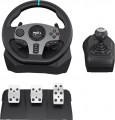 |
|---|---|---|
| PXN V99 | PXN V9 | |
from $209.99 | from $159.99 | |
| TOP sellers | ||
| Device type (configuration) | steering wheel, pedals, and gearbox | steering wheel and pedals |
| Steering wheel size | 30 cm | 28 cm |
| Detachable steering wheel |  |  |
| Compatibility | PC (Windows) Switch Xbox PlayStation 3 PlayStation 4 | PC (Windows) Switch Xbox PlayStation 3 PlayStation 4 |
| Connection | wired | wired |
| Cable | USB-A | USB-A |
Technical specifications | ||
| Total number of buttons | 14 | 14 |
| Feedback | power | vibration |
| Drive type | belt | |
| Max. torque | 3.2 Nm | |
| D-pad controller | | |
| Steering wheel turn | 270° – 900° | 270° – 900° |
| Paddle shifters | 4 pcs | 2 pcs |
| Pedals | accelerator brake clutch | accelerator brake clutch |
General information | ||
| Mounting | clamps | clamps |
| Steering wheel cover | rubber | |
| Power source | network | USB port |
| Weight | 3280 g | |
| Added to E-Catalog | december 2024 | march 2023 |


Compare PXN V99 and V9
You may be interested in
PXN V99 often compared


PXN V9 often compared


Glossary
Device type (configuration)
— Steering Wheel. Ready-to-use gaming steering wheels that can be plugged in and played right out of the box. Such a set usually includes the wheel with a base, mount, and cables, but without pedals or a separate gearbox, so acceleration and braking may be assigned to buttons or paddles. This option is suitable for arcade races, simple racing simulators, and cases where a basic kit without extra accessories is needed.
— Steering Wheel with Pedals. A more complete racing kit that, in addition to the steering block, includes a separate pedal platform for the accelerator, brake, and sometimes the clutch. This set is noticeably closer to real car control than just a wheel without pedals, as speed and braking are controlled with your feet. It's a convenient starting option for Forza, Gran Turismo, F1, Assetto Corsa, and other racing games.
— Steering Wheel, Pedals, and Gearbox. Contains the three main elements at once: a steering block, pedals, and a separate gear shifter. Here, the gear shifter refers to a standalone shifter that mimics manual shifting, not paddle shifters on the wheel. This set is better suited for simulators, drifting, truck games, and fans of manual gear shifting, where more realistic seating and control are important.
— Steering Wheel with Gearbox. Kits where the gear lever is provid...ed along with the wheel. Unlike kits with a separate gearbox, here the lever is often located directly on the same base with the wheel, making the set more compact and not requiring separate space for the shifter. This option is convenient for arcade races, simple simulators, and users who want manual shifting without complex modular assembly.
— Steering Wheel. A separate interchangeable part of a gaming steering wheel, designed to be mounted on a compatible steering base. This option is considered a more professional solution because the user assembles the simulator modularly: separately choosing the base, wheel, pedals, gearbox, and other accessories. This allows you to customize the shape, diameter, grip, buttons, and style of the wheel for specific races — for example, formula, rally, drift, or GT races.
— Steering Base. The main power block to which the steering wheel is connected and which is responsible for rotation, resistance, and Force Feedback feedback. The base itself is not a ready-to-play wheel, as it usually requires a separate steering wheel, pedals, and other accessories. This option is more often chosen for modular simulators where power, precision, and the ability to assemble the kit yourself are important.
— Pedals. An independent accessory for a gaming steering wheel that is responsible for the accelerator, brake, and in some kits, the clutch. They are purchased to replace the basic pedal block, upgrade a simulator, or assemble a kit from separate components. For example, more advanced pedals can more accurately transmit braking force and better suit serious racing simulators.
— Gearbox. A gear shifter for gaming steering wheels and racing simulators. It mimics the operation of a manual or sequential gearbox, depending on the model's design. This accessory is especially useful for car simulators, drifting, rally, truck simulators, and games where players want to control gears with a separate lever instead of paddles.
— Handbrake. An accessory for a racing simulator that mimics a lever for a parking or hydraulic brake. It is especially useful in drifting, rally, and some arcade races, where you need to quickly break the rear axle into a slide or take a corner sideways.
— Steering Wheel with Pedals. A more complete racing kit that, in addition to the steering block, includes a separate pedal platform for the accelerator, brake, and sometimes the clutch. This set is noticeably closer to real car control than just a wheel without pedals, as speed and braking are controlled with your feet. It's a convenient starting option for Forza, Gran Turismo, F1, Assetto Corsa, and other racing games.
— Steering Wheel, Pedals, and Gearbox. Contains the three main elements at once: a steering block, pedals, and a separate gear shifter. Here, the gear shifter refers to a standalone shifter that mimics manual shifting, not paddle shifters on the wheel. This set is better suited for simulators, drifting, truck games, and fans of manual gear shifting, where more realistic seating and control are important.
— Steering Wheel with Gearbox. Kits where the gear lever is provid...ed along with the wheel. Unlike kits with a separate gearbox, here the lever is often located directly on the same base with the wheel, making the set more compact and not requiring separate space for the shifter. This option is convenient for arcade races, simple simulators, and users who want manual shifting without complex modular assembly.
— Steering Wheel. A separate interchangeable part of a gaming steering wheel, designed to be mounted on a compatible steering base. This option is considered a more professional solution because the user assembles the simulator modularly: separately choosing the base, wheel, pedals, gearbox, and other accessories. This allows you to customize the shape, diameter, grip, buttons, and style of the wheel for specific races — for example, formula, rally, drift, or GT races.
— Steering Base. The main power block to which the steering wheel is connected and which is responsible for rotation, resistance, and Force Feedback feedback. The base itself is not a ready-to-play wheel, as it usually requires a separate steering wheel, pedals, and other accessories. This option is more often chosen for modular simulators where power, precision, and the ability to assemble the kit yourself are important.
— Pedals. An independent accessory for a gaming steering wheel that is responsible for the accelerator, brake, and in some kits, the clutch. They are purchased to replace the basic pedal block, upgrade a simulator, or assemble a kit from separate components. For example, more advanced pedals can more accurately transmit braking force and better suit serious racing simulators.
— Gearbox. A gear shifter for gaming steering wheels and racing simulators. It mimics the operation of a manual or sequential gearbox, depending on the model's design. This accessory is especially useful for car simulators, drifting, rally, truck simulators, and games where players want to control gears with a separate lever instead of paddles.
— Handbrake. An accessory for a racing simulator that mimics a lever for a parking or hydraulic brake. It is especially useful in drifting, rally, and some arcade races, where you need to quickly break the rear axle into a slide or take a corner sideways.
Steering wheel size
The size of a gaming steering wheel usually refers to the diameter of the wheel in round and D-shaped forms and affects the realism of control, rotation speed, and grip comfort. Compact wheels, around 20 – 24 cm, are more common in simple models and are suitable for arcade racing but feel less realistic. A size of 27 – 30 cm is considered more versatile and closer to an actual car steering wheel, making it convenient for simulators, GT, rally, and everyday play. Larger wheels, 31 – 35 cm, are more often used in advanced setups, especially for trucking simulators, drifts, or the most realistic seating.
For formula wheels or steering wheels with a cut-off shape, the size is more often indicated by the maximum width between the outermost grip points.
For formula wheels or steering wheels with a cut-off shape, the size is more often indicated by the maximum width between the outermost grip points.
Detachable steering wheel
The ability to detach the steering wheel from the base. This is convenient for storage, transportation, and changing the wheel for different types of racing: for example, installing a round wheel for drifting or a yoke for formula simulators.
Feedback
Type of feedback provided in the design of the controller (if it is available at all).
Feedback is the controller's response to certain events occurring in the game. Such a response enhances the "immersion effect," creating the impression for the player that they are holding a real airplane joystick, car steering wheel, etc. It can be as follows:
— Vibration. Feedback in the form of vibration allows imitation of, for example, the shaking from driving off-road, the shudder of an airplane when firing onboard weapons, or entering a turbulence zone, etc.
— Force. Controllers with force feedback are capable of creating certain resistance to the player's efforts—for example, to imitate the difficulty of turning the steering wheel with wheels stuck in the mud.
— Vibration/force. Controllers supporting both of the feedback types described above. This option is the most advanced and at the same time the most expensive.
Feedback is the controller's response to certain events occurring in the game. Such a response enhances the "immersion effect," creating the impression for the player that they are holding a real airplane joystick, car steering wheel, etc. It can be as follows:
— Vibration. Feedback in the form of vibration allows imitation of, for example, the shaking from driving off-road, the shudder of an airplane when firing onboard weapons, or entering a turbulence zone, etc.
— Force. Controllers with force feedback are capable of creating certain resistance to the player's efforts—for example, to imitate the difficulty of turning the steering wheel with wheels stuck in the mud.
— Vibration/force. Controllers supporting both of the feedback types described above. This option is the most advanced and at the same time the most expensive.
Drive type
The drive type indicates how the motor's force is transmitted to the wheel and how realistic the feedback feels in the game.
— Gear-driven. A gear mechanism transmits the motor's force to the wheel through a gear transmission, making these models generally simpler and more affordable. It provides basic feedback and is suitable for getting acquainted with racing, but may feel noisier, more stepped, and less smooth than belt or direct drive. Therefore, a gear-driven wheel is suitable for Forza, Need for Speed, or initial runs in simulators without serious precision demands.
— Belt-driven. The transfer of force through a belt makes the wheel rotation smoother and quieter compared to a gear mechanism. This type of drive usually smooths out jerks better, provides pleasant feedback, and is suitable for those looking for a noticeable step up from basic models. A belt-driven wheel is well-suited for circuit racing, where smooth trajectory handling and precise car correction are important.
— Hybrid. A combined drive uses several types of force transmission, most often belts and gears, to combine affordable pricing with smoother feedback. It generally operates more softly than a purely gear-driven mechanism but does not offer the precision and speed of direct drive. A hybrid wheel is suitable for a player who has outgrown the basic model but is not yet ready to invest in an expensive Direct Drive base.
— Direct. A direct drive system transmit...s motor force directly to the steering shaft, without belts and gears, allowing the wheel to react as quickly and accurately as possible. This option is valued for its powerful feedback, detailed transmission of small effects, and absence of play, though it is usually more expensive and requires secure mounting. For example, direct drive is well-suited for serious sim racing, where feeling tire slip, car weight, and the moment of drifting is important.
— Gear-driven. A gear mechanism transmits the motor's force to the wheel through a gear transmission, making these models generally simpler and more affordable. It provides basic feedback and is suitable for getting acquainted with racing, but may feel noisier, more stepped, and less smooth than belt or direct drive. Therefore, a gear-driven wheel is suitable for Forza, Need for Speed, or initial runs in simulators without serious precision demands.
— Belt-driven. The transfer of force through a belt makes the wheel rotation smoother and quieter compared to a gear mechanism. This type of drive usually smooths out jerks better, provides pleasant feedback, and is suitable for those looking for a noticeable step up from basic models. A belt-driven wheel is well-suited for circuit racing, where smooth trajectory handling and precise car correction are important.
— Hybrid. A combined drive uses several types of force transmission, most often belts and gears, to combine affordable pricing with smoother feedback. It generally operates more softly than a purely gear-driven mechanism but does not offer the precision and speed of direct drive. A hybrid wheel is suitable for a player who has outgrown the basic model but is not yet ready to invest in an expensive Direct Drive base.
— Direct. A direct drive system transmit...s motor force directly to the steering shaft, without belts and gears, allowing the wheel to react as quickly and accurately as possible. This option is valued for its powerful feedback, detailed transmission of small effects, and absence of play, though it is usually more expensive and requires secure mounting. For example, direct drive is well-suited for serious sim racing, where feeling tire slip, car weight, and the moment of drifting is important.
Max. torque
The max torque indicates the force with which the steering base can resist the steering wheel's turn. The higher the torque, the more strongly tire grip, impacts, skids, curbs, and load in turns are felt, making the control closer to that of a real car. Simple steering wheels usually provide up to 3 Nm, more advanced models — 4-8 Nm, and powerful Direct Drive bases can deliver 10-20 Nm and above.
Meanwhile, in simulators, the force is often adjusted for the game, car, and user's comfort. For example, for arcade racing, a small effort is enough, whereas for iRacing, Assetto Corsa, or serious drifting, a powerful base with a torque reserve provides more accurate and rich feedback.
Meanwhile, in simulators, the force is often adjusted for the game, car, and user's comfort. For example, for arcade racing, a small effort is enough, whereas for iRacing, Assetto Corsa, or serious drifting, a powerful base with a torque reserve provides more accurate and rich feedback.
Paddle shifters
Paddle shifters behind the steering wheel, which can be pressed with fingers without removing hands from the wheel, are most often used for gear shifting. Basic models usually have two paddles: the right one is for shifting up, and the left one is for shifting down. More advanced wheels may have 4 or 6 paddles, with additional pairs used for clutch, manual start, DRS, car adjustments, or other commands in simulators. The more paddle shifters there are, the more convenient it is to control important functions directly from the wheel, especially in F1, GT, and other racing simulators.
Steering wheel cover
The steering wheel covering affects grip, tactile sensations, wear resistance, and comfort during long gameplay. The material determines whether the wheel is pleasant to the touch, won't slip in your hands, and how quickly the surface will lose its appearance with active use.
— Rubber. Practical, affordable, and well-suited for basic gaming wheels. This covering withstands frequent use, is easy to clean, and requires less maintenance, but usually feels simpler compared to leather or Alcantara.
— Alcantara. A pleasant-to-touch material that provides a firm grip, often found in more expensive and sporty steering wheels. It is great for simulators and active driving but gets dirty faster and requires gentle care, especially if playing without gloves.
— Leather. Usually represented by faux leather, making the wheel more akin to a car's and pleasant for everyday gaming. This covering is ideal for general use, GT, rally, and road simulators but may wear out over time in areas of active grip.
— Rubber. Practical, affordable, and well-suited for basic gaming wheels. This covering withstands frequent use, is easy to clean, and requires less maintenance, but usually feels simpler compared to leather or Alcantara.
— Alcantara. A pleasant-to-touch material that provides a firm grip, often found in more expensive and sporty steering wheels. It is great for simulators and active driving but gets dirty faster and requires gentle care, especially if playing without gloves.
— Leather. Usually represented by faux leather, making the wheel more akin to a car's and pleasant for everyday gaming. This covering is ideal for general use, GT, rally, and road simulators but may wear out over time in areas of active grip.
Power source
Power source used by a gaming controller.
This parameter directly depends on the type of connection (see "Connection"). For example, power from a USB port or network (power adapter) is mainly found in wired models, while devices with wireless connectivity (both purely wireless and combined) are almost guaranteed to use a battery or batteries. Here is a more detailed description of each of these options:
— USB port. Power from a USB port is usually the same one through which the controller directly interacts with the console, PC, or other gaming device. This type of connection allows avoiding extra wires. On the other hand, the power from USB is relatively low, making this option less suitable for controllers with powerful feedback systems (specifically, advanced wheels)—with such accessories, a separate power adapter (see below) is required. It is also worth noting that this power method is found in some wireless models—usually controllers for mobile devices that interact with a gadget via Bluetooth and receive power from this same gadget's USB port. This working format allows avoiding batteries in the controller itself; however, it additionally consumes the main device's charge.
— Network. Power from a standard electrical outlet using a separate power adapter (PA). This is mainly used in high-end wir...ed wheels (see "Device Type") that require high power for efficient operation of feedback systems. Theoretically, this option is not very convenient as it requires finding an additional socket; however, in practice, this usually poses no particular difficulties (in extreme cases, an extension cord can be used).
— Battery. Power from a built-in battery not related to standard sizes (unlike batteries), and often non-removable. This is the most popular power method for wireless controllers nowadays. Its main advantage over batteries is that it requires no extra expense or effort: the battery is included in the package, it doesn't need to be bought separately, and when the charge runs out, it's enough to recharge the controller. True, this procedure takes some time; however, the full charging time rarely exceeds a couple of hours, while the operating time can be measured in days (although there are more modest indicators). Moreover, many controllers can be used without disconnecting the charging device; this somewhat limits mobility, but this moment is usually not critical.
— Batteries (AA, AAA). Power from replaceable standard-sized elements—usually "finger" AA or "pinkie" AAA. The number of elements used may vary; however, the general features of such power are the same in all controllers. On the one hand, batteries allow for quick replacement, which enables playing with minimal interruptions: when the charge is depleted, it is enough to simply install fresh power elements instead of the dead ones. Meanwhile, the user has a choice: either regularly buy disposable batteries or invest in rechargeable batteries with an external charging device. If two sets of such batteries are purchased, one set can be kept on charge while the other is in use. On the other hand, using batteries inevitably involves additional costs: power elements are usually not included in the package and must be purchased separately before first use. As a result, this type of power is used noticeably less often than batteries, although it can be found in quite advanced and well-known devices—in particular, standard gamepads for Xbox 360, Xbox One, and even Xbox Series X|S.
This parameter directly depends on the type of connection (see "Connection"). For example, power from a USB port or network (power adapter) is mainly found in wired models, while devices with wireless connectivity (both purely wireless and combined) are almost guaranteed to use a battery or batteries. Here is a more detailed description of each of these options:
— USB port. Power from a USB port is usually the same one through which the controller directly interacts with the console, PC, or other gaming device. This type of connection allows avoiding extra wires. On the other hand, the power from USB is relatively low, making this option less suitable for controllers with powerful feedback systems (specifically, advanced wheels)—with such accessories, a separate power adapter (see below) is required. It is also worth noting that this power method is found in some wireless models—usually controllers for mobile devices that interact with a gadget via Bluetooth and receive power from this same gadget's USB port. This working format allows avoiding batteries in the controller itself; however, it additionally consumes the main device's charge.
— Network. Power from a standard electrical outlet using a separate power adapter (PA). This is mainly used in high-end wir...ed wheels (see "Device Type") that require high power for efficient operation of feedback systems. Theoretically, this option is not very convenient as it requires finding an additional socket; however, in practice, this usually poses no particular difficulties (in extreme cases, an extension cord can be used).
— Battery. Power from a built-in battery not related to standard sizes (unlike batteries), and often non-removable. This is the most popular power method for wireless controllers nowadays. Its main advantage over batteries is that it requires no extra expense or effort: the battery is included in the package, it doesn't need to be bought separately, and when the charge runs out, it's enough to recharge the controller. True, this procedure takes some time; however, the full charging time rarely exceeds a couple of hours, while the operating time can be measured in days (although there are more modest indicators). Moreover, many controllers can be used without disconnecting the charging device; this somewhat limits mobility, but this moment is usually not critical.
— Batteries (AA, AAA). Power from replaceable standard-sized elements—usually "finger" AA or "pinkie" AAA. The number of elements used may vary; however, the general features of such power are the same in all controllers. On the one hand, batteries allow for quick replacement, which enables playing with minimal interruptions: when the charge is depleted, it is enough to simply install fresh power elements instead of the dead ones. Meanwhile, the user has a choice: either regularly buy disposable batteries or invest in rechargeable batteries with an external charging device. If two sets of such batteries are purchased, one set can be kept on charge while the other is in use. On the other hand, using batteries inevitably involves additional costs: power elements are usually not included in the package and must be purchased separately before first use. As a result, this type of power is used noticeably less often than batteries, although it can be found in quite advanced and well-known devices—in particular, standard gamepads for Xbox 360, Xbox One, and even Xbox Series X|S.