
Comparison PXN V9 vs ThrustMaster T300 RS
Add to comparison | 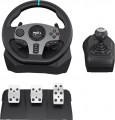 | 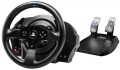 |
|---|---|---|
| PXN V9 | ThrustMaster T300 RS | |
from $159.99 | Compare prices 1 | |
| TOP sellers | ||
| Device type (configuration) | steering wheel and pedals | steering wheel and pedals |
| Steering wheel size | 28 cm | |
| Detachable steering wheel |  |  |
| Compatibility | PC (Windows) Switch Xbox PlayStation 3 PlayStation 4 | PC (Windows) PlayStation 3 PlayStation 4 |
| Connection | wired | wired |
| Cable | USB-A | USB-A |
Technical specifications | ||
| Total number of buttons | 14 | 15 |
| Feedback | vibration | power |
| Drive type | belt | |
| Max. torque | 3.9 Nm | |
| D-pad controller | | |
| Steering wheel turn | 270° – 900° | 270° – 1080° |
| Paddle shifters | 2 pcs | 2 pcs |
| Pedals | accelerator brake clutch | accelerator brake |
General information | ||
| Mounting | clamps | clamps |
| Power source | USB port | network |
| Weight | 3280 g | |
| Color | ||
| Added to E-Catalog | march 2023 | december 2016 |



Compare PXN V9 and ThrustMaster T300 RS
Price comparison
You may be interested in
My comparisons
PXN V9 often compared


ThrustMaster T300 RS often compared


Glossary
Steering wheel size
The size of a gaming steering wheel usually refers to the diameter of the wheel in round and D-shaped forms and affects the realism of control, rotation speed, and grip comfort. Compact wheels, around 20 – 24 cm, are more common in simple models and are suitable for arcade racing but feel less realistic. A size of 27 – 30 cm is considered more versatile and closer to an actual car steering wheel, making it convenient for simulators, GT, rally, and everyday play. Larger wheels, 31 – 35 cm, are more often used in advanced setups, especially for trucking simulators, drifts, or the most realistic seating.
For formula wheels or steering wheels with a cut-off shape, the size is more often indicated by the maximum width between the outermost grip points.
For formula wheels or steering wheels with a cut-off shape, the size is more often indicated by the maximum width between the outermost grip points.
Detachable steering wheel
The ability to detach the steering wheel from the base. This is convenient for storage, transportation, and changing the wheel for different types of racing: for example, installing a round wheel for drifting or a yoke for formula simulators.
Compatibility
Compatibility shows which devices a gaming wheel can work with: PC, PlayStation, Xbox, Nintendo Switch or specific console generations. It is important to check this parameter before purchasing because a PC wheel does not always fit a console, and models for PlayStation and Xbox often have different versions (PS3, PS4, PS5) due to the proprietary license and electronics inside the base.
Special attention should be given to steering wheels that have specific compatibility with bases. In most cases, all bases from the brand are suitable, but it is better to confirm this additionally.
Special attention should be given to steering wheels that have specific compatibility with bases. In most cases, all bases from the brand are suitable, but it is better to confirm this additionally.
Total number of buttons
The total number of buttons provided in the manipulator's design.
The more buttons, the more additional functions can be "assigned" to the manipulator, reducing the likelihood of having to use other control devices (e.g., a PC keyboard) during gameplay. However, many gaming consoles (see "Platform Compatibility") require a certain minimum number of buttons for a compatible gamepad — having fewer buttons would simply not allow full use of all the console functions. For instance, the standard controller for the PlayStation 4 has 11 buttons.
Note that the D-Pad manipulator (see below) is not counted in this calculation: it is considered a specific control device, although it is based on buttons.
The more buttons, the more additional functions can be "assigned" to the manipulator, reducing the likelihood of having to use other control devices (e.g., a PC keyboard) during gameplay. However, many gaming consoles (see "Platform Compatibility") require a certain minimum number of buttons for a compatible gamepad — having fewer buttons would simply not allow full use of all the console functions. For instance, the standard controller for the PlayStation 4 has 11 buttons.
Note that the D-Pad manipulator (see below) is not counted in this calculation: it is considered a specific control device, although it is based on buttons.
Feedback
Type of feedback provided in the design of the controller (if it is available at all).
Feedback is the controller's response to certain events occurring in the game. Such a response enhances the "immersion effect," creating the impression for the player that they are holding a real airplane joystick, car steering wheel, etc. It can be as follows:
— Vibration. Feedback in the form of vibration allows imitation of, for example, the shaking from driving off-road, the shudder of an airplane when firing onboard weapons, or entering a turbulence zone, etc.
— Force. Controllers with force feedback are capable of creating certain resistance to the player's efforts—for example, to imitate the difficulty of turning the steering wheel with wheels stuck in the mud.
— Vibration/force. Controllers supporting both of the feedback types described above. This option is the most advanced and at the same time the most expensive.
Feedback is the controller's response to certain events occurring in the game. Such a response enhances the "immersion effect," creating the impression for the player that they are holding a real airplane joystick, car steering wheel, etc. It can be as follows:
— Vibration. Feedback in the form of vibration allows imitation of, for example, the shaking from driving off-road, the shudder of an airplane when firing onboard weapons, or entering a turbulence zone, etc.
— Force. Controllers with force feedback are capable of creating certain resistance to the player's efforts—for example, to imitate the difficulty of turning the steering wheel with wheels stuck in the mud.
— Vibration/force. Controllers supporting both of the feedback types described above. This option is the most advanced and at the same time the most expensive.
Drive type
The drive type indicates how the motor's force is transmitted to the wheel and how realistic the feedback feels in the game.
— Gear-driven. A gear mechanism transmits the motor's force to the wheel through a gear transmission, making these models generally simpler and more affordable. It provides basic feedback and is suitable for getting acquainted with racing, but may feel noisier, more stepped, and less smooth than belt or direct drive. Therefore, a gear-driven wheel is suitable for Forza, Need for Speed, or initial runs in simulators without serious precision demands.
— Belt-driven. The transfer of force through a belt makes the wheel rotation smoother and quieter compared to a gear mechanism. This type of drive usually smooths out jerks better, provides pleasant feedback, and is suitable for those looking for a noticeable step up from basic models. A belt-driven wheel is well-suited for circuit racing, where smooth trajectory handling and precise car correction are important.
— Hybrid. A combined drive uses several types of force transmission, most often belts and gears, to combine affordable pricing with smoother feedback. It generally operates more softly than a purely gear-driven mechanism but does not offer the precision and speed of direct drive. A hybrid wheel is suitable for a player who has outgrown the basic model but is not yet ready to invest in an expensive Direct Drive base.
— Direct. A direct drive system transmit...s motor force directly to the steering shaft, without belts and gears, allowing the wheel to react as quickly and accurately as possible. This option is valued for its powerful feedback, detailed transmission of small effects, and absence of play, though it is usually more expensive and requires secure mounting. For example, direct drive is well-suited for serious sim racing, where feeling tire slip, car weight, and the moment of drifting is important.
— Gear-driven. A gear mechanism transmits the motor's force to the wheel through a gear transmission, making these models generally simpler and more affordable. It provides basic feedback and is suitable for getting acquainted with racing, but may feel noisier, more stepped, and less smooth than belt or direct drive. Therefore, a gear-driven wheel is suitable for Forza, Need for Speed, or initial runs in simulators without serious precision demands.
— Belt-driven. The transfer of force through a belt makes the wheel rotation smoother and quieter compared to a gear mechanism. This type of drive usually smooths out jerks better, provides pleasant feedback, and is suitable for those looking for a noticeable step up from basic models. A belt-driven wheel is well-suited for circuit racing, where smooth trajectory handling and precise car correction are important.
— Hybrid. A combined drive uses several types of force transmission, most often belts and gears, to combine affordable pricing with smoother feedback. It generally operates more softly than a purely gear-driven mechanism but does not offer the precision and speed of direct drive. A hybrid wheel is suitable for a player who has outgrown the basic model but is not yet ready to invest in an expensive Direct Drive base.
— Direct. A direct drive system transmit...s motor force directly to the steering shaft, without belts and gears, allowing the wheel to react as quickly and accurately as possible. This option is valued for its powerful feedback, detailed transmission of small effects, and absence of play, though it is usually more expensive and requires secure mounting. For example, direct drive is well-suited for serious sim racing, where feeling tire slip, car weight, and the moment of drifting is important.
Max. torque
The max torque indicates the force with which the steering base can resist the steering wheel's turn. The higher the torque, the more strongly tire grip, impacts, skids, curbs, and load in turns are felt, making the control closer to that of a real car. Simple steering wheels usually provide up to 3 Nm, more advanced models — 4-8 Nm, and powerful Direct Drive bases can deliver 10-20 Nm and above.
Meanwhile, in simulators, the force is often adjusted for the game, car, and user's comfort. For example, for arcade racing, a small effort is enough, whereas for iRacing, Assetto Corsa, or serious drifting, a powerful base with a torque reserve provides more accurate and rich feedback.
Meanwhile, in simulators, the force is often adjusted for the game, car, and user's comfort. For example, for arcade racing, a small effort is enough, whereas for iRacing, Assetto Corsa, or serious drifting, a powerful base with a torque reserve provides more accurate and rich feedback.
Steering wheel turn
The steering wheel rotation angle in the control wheel (see "Device Type"). This parameter is measured by the total range — from one extreme point to the other; accordingly, the rotation angle from the mid position will be half of the total. For instance, an indicator of 180° means the wheel can turn both right and left by 90°.
This parameter directly affects both the overall level and the purpose of the wheel. Models with a rotation angle up to 270° are predominantly entry-level and are mainly intended for arcade racing enthusiasts without a significant emphasis on realism, as well as for children and beginner gamers. More advanced wheels have a rotation angle of 900°, or even 1080°. These figures are not arbitrary — they correspond to the steering wheel rotation ranges in most production cars (900°) and some racing supercars (1080°). Thus, such features make using the wheel as realistic as possible — on the other hand, they significantly impact the cost.
The range of steering wheel rotation can be adjusted by the steering angle adjustment function (if this feature is implemented in the game controller). The option is set either directly in the game or through the software that manages the wheel's operation.
This parameter directly affects both the overall level and the purpose of the wheel. Models with a rotation angle up to 270° are predominantly entry-level and are mainly intended for arcade racing enthusiasts without a significant emphasis on realism, as well as for children and beginner gamers. More advanced wheels have a rotation angle of 900°, or even 1080°. These figures are not arbitrary — they correspond to the steering wheel rotation ranges in most production cars (900°) and some racing supercars (1080°). Thus, such features make using the wheel as realistic as possible — on the other hand, they significantly impact the cost.
The range of steering wheel rotation can be adjusted by the steering angle adjustment function (if this feature is implemented in the game controller). The option is set either directly in the game or through the software that manages the wheel's operation.
Pedals
Types of pedals included in the manipulator package.
This parameter is specified only in controllers designed for auto racing (in flight simulators, pedals have only one specialization — rudder control — and specifying it further is unnecessary). Most of these "racing" controllers are wheels (see "Device Type"), however, pedals can also be released completely separately. In any case, the minimum necessary for more or less effective car control is two pedals, gas and brake. Meanwhile, for enthusiasts of maximum realism, more expensive three-pedal controllers are produced, which also include a clutch; this complicates control but provides many additional possibilities unavailable with two pedals.
This parameter is specified only in controllers designed for auto racing (in flight simulators, pedals have only one specialization — rudder control — and specifying it further is unnecessary). Most of these "racing" controllers are wheels (see "Device Type"), however, pedals can also be released completely separately. In any case, the minimum necessary for more or less effective car control is two pedals, gas and brake. Meanwhile, for enthusiasts of maximum realism, more expensive three-pedal controllers are produced, which also include a clutch; this complicates control but provides many additional possibilities unavailable with two pedals.