Best Value 500GB SSDs

We independently test the products and technologies that we recommend.
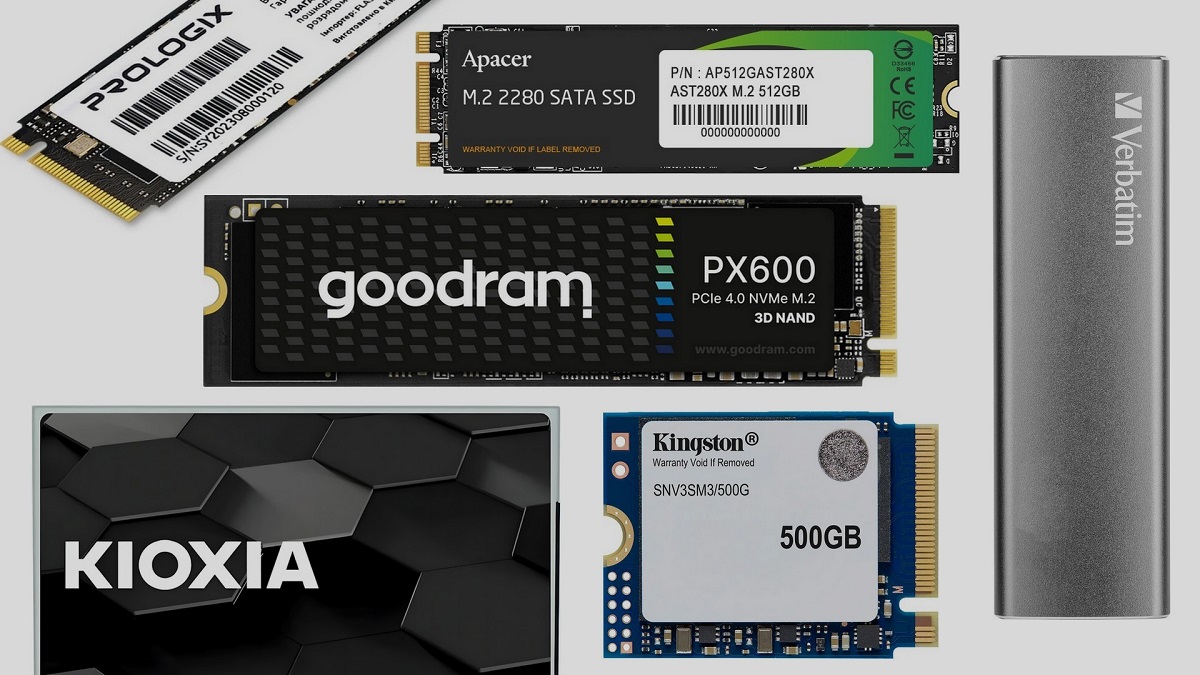

Kioxia Exceria SATA — a representative of the oldest 2.5" SATA form factor, from when SSDs replaced HDDs. Unlike hard drives, it's not afraid of vibration, temperature fluctuations, and magnetic fields. Unlike plastic peers, it's encased in metal. Ideal as a second drive when the motherboard has only one M.2 slot but four SATA slots.
The brand Kioxia is the new name for Japanese company Toshiba, which spun off its semiconductor business. It owns flash memory chip manufacturing plants in Yokkaichi and Kitakami. Besides its own products, Kioxia BiCS TLC chips are used in other SSD brands, like Goodram. Polish companies represent Japanese interests in European countries.
Read speed of 555 MB/s, write of 540 MB/s, random processing 88k IOPS (input/output operations per second). Naturally, after filling the virtual SLC array, the write speed will decrease. After this, the disk needs time to rest to restore its original performance. The proprietary application Kioxia SSD Utility helps update the controller firmware.

Apacer AST280X — an undeservedly underestimated SSD combining the modern M.2 size with the classic SATA bus. The first eliminates annoying cables, while the second makes it an optimal choice to breathe new life into old laptops and nettops. Typically, these lack a 2.5-inch drive bay but still don't support the NVMe bus.
Based on the RayMX RM1135 controller, a subsidiary sub-brand of Realtek, better known for its Ethernet and sound card chips. Sequential reading and writing of large files are 520 and 500 MB/s, with the theoretical throughput capacity of the SATA3 protocol up to 560 MB/s. Small files (4K blocks) are processed at a speed of 74 thousand IOPS.
The intelligent controller monitors the SSD's health status with S.M.A.R.T., cleans up software garbage with TRIM, corrects recording errors with ECC, and redistributes worn flash memory cells with Intelligent Block Management. The warranty period is 3 years, provided you don't overwrite more than 280 TB of data beforehand (TBW limit akin to a car's mileage).

Prologix S380 — a Ukrainian NVMe solid-state drive that interacts with the motherboard via PCI-Express 3.0. Of course, SSDs with more advanced PCIe 4.0 and 5.0 interfaces have been around for quite a while. But they are not only noticeably more expensive but also considerably hotter, making them not the best choice for laptops or desktops without a graphene heatsink.
Our "hero" is based on the Hongxinyu HG2283 controller, which is just a renamed Phison E13T with a single core on 28 nanometers. At peak PCIe 3.0 speeds of 3400 MB/s and 300K IOPS (writing slower at 1900 MB/s), it's noticeably cooler than the Realtek RTS5766DL, which many other SSDs have migrated to for cost reduction.
Mean time between failures is 1.5 million hours MTBF, but of course, the 250 TBW rewrite resource should be considered. After exceeding it, the drive won't turn into a "pumpkin," but will gradually lose volume by blocking worn-out cells. This principle applies to all SSDs without exception. Prologix also has good old 2.5" SATA drives at 480/512 GB.
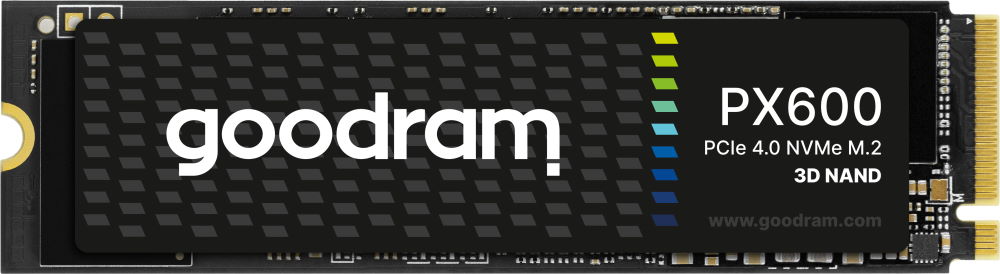
Goodram PX600 — currently the most affordable half-terabyte PCI-Express 4.0 drive on the market. Cheaper than it is only its younger brother PX600 Lite, which is juridically also PCIe 4.0, but with actual performance like PCIe 3.0. It is made not in Southeast Asia, but by the European company Wilk Elektronik, with a factory located in the Polish town of Laziska.
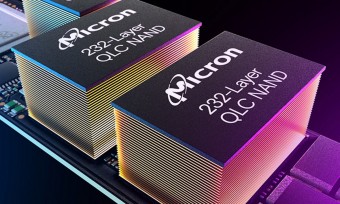
The reading and writing speeds of 4700/1700 MB/s suggest that the drive is mostly suitable for gamers rather than content creators. Load your Steam game library and then play them for 100+ hours. Those who regularly copy giant 4K@60FPS video files from a professional camera might experience disk subsystem performance shortages.
Considering the 3-year warranty and 160 TBW life (typical for budget QLC memory), on average, you are allowed to overwrite 30% of the full SSD volume per day, which is not too little. It will last long for PlayStation 5 Slim and Pro, with which it is also compatible. Due to the lack of ventilation in the PS5 M.2 slot, it's advisable to buy a ribbed heatsink, which is quite cheap.

| BestBuy.com | $152.07 | To Store |
| BestBuy.com | $156.99 | To Store |
| BestBuy.com | $186.57 | To Store |
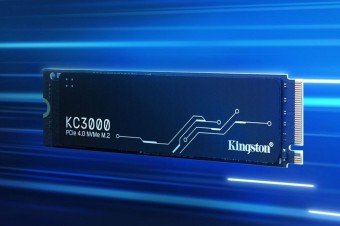
Kingston NV3 2230 — differs from the majority of other M.2 SSDs with a length of just 3 cm versus the traditional 8 cm. It's the smallest existing disk, except for the single-chip UFS, which is soldered directly onto the motherboard. It is primarily intended for ultrabooks and all-in-one PCs in the monitor case, as well as for portable gaming consoles.
It is compatible with global bestsellers like Steam Deck, ASUS ROG Alloy, MSI Claw, and other lesser-known models. It consists of just two elements: the Silicon Motion SM2268XT2 controller and a single 3D NAND with 218 semiconductor layers. The dual-core ARM Cortex R8 architecture processor caches through the HMB (Host Memory Buffer) algorithm directly in the PC's RAM.
Thanks to its ultra-dense assembly, the volume of this "baby" varies from 500 GB to 4 TB, which is accumulated by two chips on both sides of the PCB. The speed also varies depending on the volume: reading 5000-6000 MB/s and writing 3000-5000 MB/s, which corresponds to PCIe 4.0. Acronis True Image software for OS cloning is offered as a bonus.

| Officedepot.com | $185.99 | To Store |
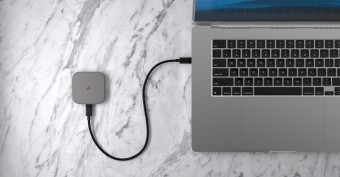
Verbatim Vx500 — a renowned American brand of information carriers with a 57-year history, well known since the days of floppy disks and laser CD/DVDs. Evolving with the times, it reprofiled to USB flash drives, memory cards, and portable SSDs. The Vx500 model in an aluminum Space Gray body is 9 cm long and weighs about 30 grams (excluding the cable).
As a result, it easily fits in a lady's handbag or the breast pocket of a shirt. The set includes two removable USB cables: a Type-C and a Type-A. This makes the drive truly "omnivorous": Windows / Linux / MacOS / ChromeOS computers, Android / iOS / iPadOS smartphones and tablets, and GoogleTV / WebOS / Tizen TVs and media players.
Linear reading and writing are 500 and 440 MB/s when connected to a USB 3.2 Gen 2 port, whereas USB 3.0 will give 10% less. Backward compatibility with USB 2.0 is maintained in case you decide to connect the drive directly to a Wi-Fi router to make it a local server. Nero BackItUp is suggested as a backup application.

Articles, reviews, useful tips
All materials