How to choose a good replacement for the factory car radio

We independently test the products and technologies that we recommend.
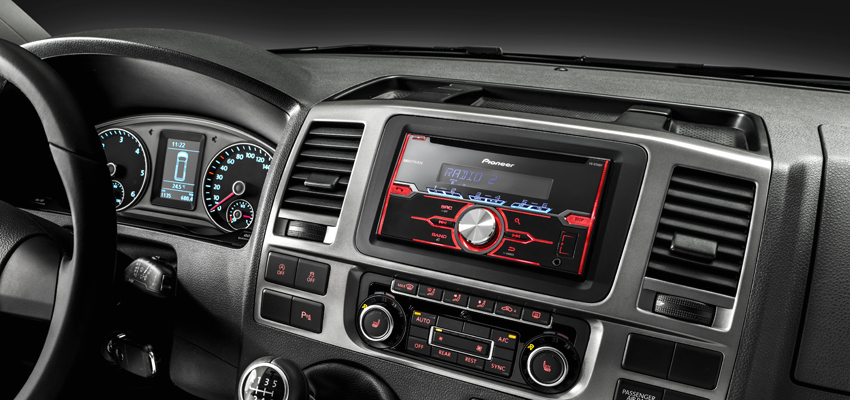
Buying a car radio is an important element in building a good acoustic system in a car. But first of all, let's deal with the terms. Car radios were called cassette models with a sound-absorbing magnetic head and they have not been on the market for a long time. It is not quite correct to call modern devices this way, although this name is fixed for them. Devices that combine a radio receiver, an amplifier and a CD or DVD drive in one case are correctly called CD or DVD receivers. Every year there are more and more diskless models that are correctly called media receivers (models without a screen) or multimedia receivers (models with a touch screen).
The head unit (GU) is a generic name for all such devices. This name emphasizes that the device is the control centre of the entire multimedia system in the car. This system can consist of only four or two speakers connected directly to the radio. The system can also have a complex composition, where the head unit controls external power amplifiers, a sound processor, front and rear cameras, monitors for passengers, etc. It turns out that the tape recorders differ not only in sound and video quality, but also in the ability to connect devices and manage them. Other criteria are also important — usability (including click response) and build quality, number of inputs and outputs, size and appearance.
Standard and non-standard dimensions of the GU
When choosing a head unit, first of all, it is necessary to determine what is the size of the regular place for its installation in your car. In European and Asian cars, two standards are adhered to (dimensions for GU): 1 DIN and 2 DIN (double 1 DIN). There is also an American standard 1/2 DIN, for which we have nothing suitable on the market. But if you need to replace the regular "half-platinum" radio, you can switch to the 1 DIN standard using a custom-made transition frame. If in cars of previous years it was possible to meet the standard size of the regular seat for the GU 1 DIN and 2 DIN, then in modern cars the front panel of the GU has non-standard shapes. Therefore, there are two ways to replace the GU today.
A simple way is to replace the base model with a so—called "regular" GU with better functionality (with a large touch screen, navigation, TV tuner, USB, DVD, etc.) Now there are many such models on the market, produced under the brands Phantom, nTray, PMS, Cyclon, Gazer, RoadRover, MyDead, Globex, AudioSources. In fact, these are not regular GUS, as many believe, but Chinese receivers of the 2 DIN format. Such models are initially combined with a special transitional non-removable frame.
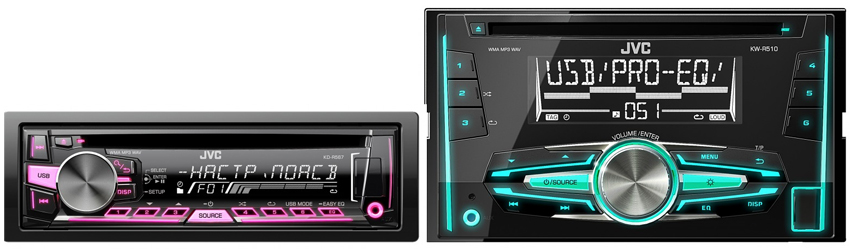 |
| JVC KD-R567 and KW-R510EE are CD receivers with USB and AUX inputs on the front panel of size 1 and 2 DIN |
GU, designed for a specific car, also exist in well-known companies (Kenwood DNX-521VBT, Alpine X800D-ML), but their units. Their main difference from the products of the above Chinese brands is in sound quality, ease of use and reliability of assembly. Regardless of the choice of brand, the advantage of this method is that you get only one device, already equipped with all the necessary adapters.
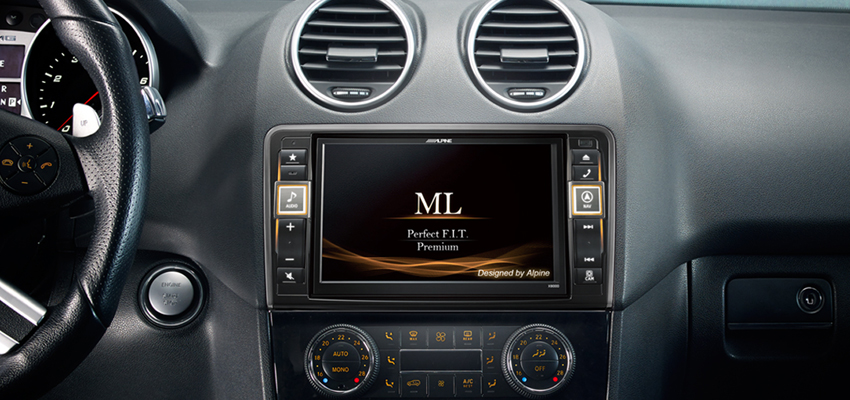 |
| X800D-ML — standard head unit from Alpine for Mercedes-Benz ML and GL |
A complicated way is to install a conventional "two—din" device in a non-standard regular place using a special transition frame, which are produced for different car brands. The difficulty is that you need to pick up at least two things — a frame and a 2 DIN radio, and sometimes more: an adapter for steering, adapters for powering the GU and for a standard radio antenna, etc. But in this case, you can use high-quality products from Japanese brands Sony, JVC, Kenwood, Pioneer, Alpine. Moreover, the cost of such a kit may be cheaper than the first option of replacing the existing head unit with a Chinese brand model.
Consider one nuance about installing Chinese multimedia systems through a transitional frame. Japanese manufacturers adhere to a single standard of the front panel (170x96 mm) for 2 DIN devices. All transitional frames of serial production from ACV, Metra, Carav, Intro, etc. are also adjusted to this size. The front panels of Chinese GU are not infrequently 1-5 mm wider or higher than standard ones. Therefore, the installation of such models in a transitional frame from the listed brands sometimes requires "file refinement" of the transitional frame. If you want to avoid such a situation, choose compatible devices of well-known Japanese brands.
This nuance with non-standard dimensions of the front panel can be used as one of the means to determine the authenticity of products. In general, there are several ways to identify whether you have an original 2 DIN GU in front of you or a fake, for example Pioneer or another brand:
— visually by the quality of manufacture and functional menu (requires the experience of the seller);
— try to find this model on the official website of the manufacturer (if it is not there, it is likely that it is a fake);
— measure the front panel with a tape measure or attach to the panel of the tested 2 DIN Pioneer a complete frame from another, 100% original Pioneer, Sony, JVC, Kenwood, Alpine (if the frame is not put on, it means a fake).
All 1 DIN tape recorders have standard dimensions, so the option with measuring tape will not help to determine their authenticity.
Finishing the section of standard and non—standard sizes of tape recorders, let's consider another recently appeared standard — with an 8-inch screen and a 2-DIN case from Alpine. So far there are only two such models: INE-W928R and X800D-U. Their internal (installation) part of the radio has a standard size of 2 DIN, and the front panel is one inch larger. The problem with the lack of transitional frames and under 8" in Alpine was solved easily — by offering their own transitional frames. However, not for all car brands. When choosing such an 8-inch device, make sure that the Alpine range has a suitable adapter frame for your car.
Key choice
Knowing the size of the regular space for the GU and the presence of transitional frames for your car, at the next stage of choosing a radio, you need to decide what features of the radio you will use. All models can be divided into two types — with video support and with audio only. Consider the pros and cons of each type.
Car radios with video playback (multimedia and DVD receivers)
Usually, multimedia and DVD receivers are models in 2 DIN format with a screen. Every year there are fewer models with 1 DIN dimensions, because this standard is not relevant for new cars. Among the 1 DIN headsets that play video files, there is still plenty to choose from among Chinese brands, and there are few models left from Japanese brands from Pioneer and JVC. In models of the 1 DIN format with a non-touch 3-3.5 inch screen, you will literally have to look closely to see something on such a screen. And a 1 DIN device with an off-site 7-inch touchscreen monitor will be very similar to the 2 DIN model. Although, solutions with an exit display do not please with a large price tag and a breakdown of their exit mechanism is not excluded.
Choosing a head unit with a screen, you will get the opportunity:
— connect a rear-facing camera (standard function for models with a screen);
— use multiple monitors in the cabin, for example, to entertain passengers in the rear (requires the presence of video outputs, which is available in almost all models with a screen);
— use the navigation system, which can be either built-in or in a separately purchased unit (not all GUS have touch control support for connecting external navigation);
— output an image from a smartphone to the radio screen (this relatively new option is still "raw", but promising).
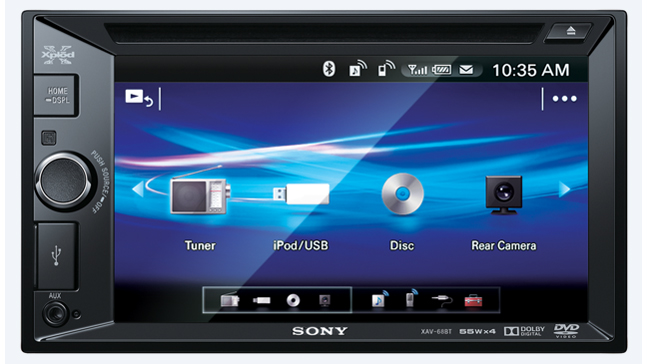 |
| Sony XAV-68BT — multimedia system with a 6.2-inch touch screen |
Audio recorders (CD receivers and media receivers)
Audio receivers are cheaper compared to video receivers. Therefore, you can abandon the multimedia capabilities described above in order to save on the purchase or in order to achieve better sound from the audio system. In the second case, money is invested not in monitors, cameras and navigation, but in more expensive sound components: sound processor, amplifiers, acoustics, wiring. Of course, it is possible to build a Hi-Fi system with a GU equipped with a screen. But practice shows that sometimes a device without a screen is used to achieve the best sound quality (where the audio system can exceed the cost of the multimedia system several times).
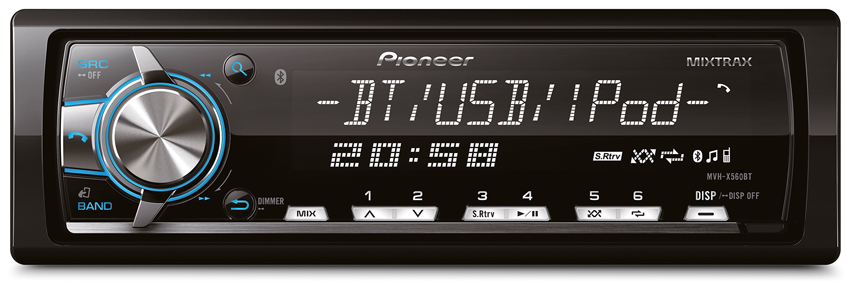 |
| Pioneer MVH-X560BT — media receiver with Bluetooth module for connecting smartphones |
Common features and differences
Before we find differences among audio recorders, we first determine what they have in common, except for such an indispensable attribute as a radio receiver. 99% of 1-DIN tape recorders have a removable front panel (to protect against theft), and 2-DIN models usually have a non-removable panel. The rated power of all radio recorders (1 DIN and 2 DIN, with or without a screen) is approximately the same — 15-20 watts, and the peak power is 4 to 50 watts.
All modern models have a USB port and an AUX (line input) for a mini-jack (3.5 mm cut). In low-cost models, they are located on the front panel, for quick and convenient connection of a USB flash drive or phone through the headphone output. When installing expensive equipment in the cabin, it is considered unsightly to connect cables and drives to the front panel. Therefore, the USB port and AUX ports are usually located on the back of the radio. With the help of extension cords, the desired cut is displayed in a convenient and secretive place, usually in the glove compartment.
Now let's look at the differences, starting with the simplest GU. Today, the most low-cost niche is occupied by diskless media receivers. When choosing them, we advise you to look towards the Pioneer, Sony, JVC, Kenwood models that are currently being assembled in Indonesia, Malaysia or Thailand. They are one and a half to two times more expensive than Chinese media receivers of the same type, but they are more reliable and have a better sound. And in terms of functions, the differences in models of this class are insignificant. For example, it is good if the device has one pair of line outputs to connect an active subwoofer. And the latest fashion for tape recorders is reading FLAC files (lossless format "compressing" files while maintaining sound quality like an audio CD).
Mid-range models with higher prices are distinguished by the addition and/or improvement of some components. These include the presence of a CD-drive, variable illumination of the front panel, wireless (Bluetooth) communication with the phone for hands-free communication and music playback, a higher-quality display, 2 pairs of line outputs (to enhance the front and rear acoustics).
The most expensive models have a built—in DSP (digital signal processor — digital sound processor) for sound correction, taking into account the placement of acoustics in the car interior, and three pairs of line outputs (for connecting front, rear acoustics and a subwoofer via an external power amplifier). The exception is the Pioneer DEX-P99RS, which has 4 pairs of outputs for a three-band channel—by—channel front, where the first pair of outputs is connected to tweeters, the second pair to midrange speakers, the third pair to midbases and the fourth to a subwoofer. This Pioneer model does not have a built-in amplifier, it is necessary to use an external power amplifier with it, which is necessary to obtain high-quality sound.
It is convenient to communicate with a Bluetooth headset not only while driving a car, but also in the office and on a walk.
It is also not easy to connect and configure the amplifier correctly, as well as to choose a model for purchase.
We find out what a battery is, what functions it performs and how to choose it for your car.
We understand the main points of operation and selection of motorcycle tyres.
We compare compact models for cleaning in the car and at home.