
Comparison A-Jazz GP100 vs GamePro GPX13
Add to comparison |  | 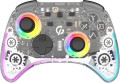 |
|---|---|---|
| A-Jazz GP100 | GamePro GPX13 | |
from $79.91 | Outdated Product | |
| User reviews | ||
| TOP sellers | ||
| Product type | gamepad | gamepad |
Connection | ||
| Platform | PC (Windows) Android iOS Switch | PC (Windows) Android iOS Switch |
| Interface | Bluetooth / radio / wired | Bluetooth / radio / wired |
| Wired interface | USB-A | USB-A |
| Bluetooth version | 5.3 | |
| Max. polling rate | 1000 Hz (1 ms) | |
| Range | 10 m | 10 m |
| Receiver (Dongle) | USB A | USB A |
Control | ||
| Number of buttons | 14 pcs | 15 pcs |
| Switch type | mechanical | membrane |
| Feedback | vibration | vibration |
| D-pad | 4 position | 4 position |
| Sticks | 2 on Hall sensors asymmetrical | 2 on Hall sensors |
| Bumpers (shifts) | 2 pcs | |
| Triggers | 2 pcs on Hall sensors with stroke adjustment | 2 pcs on Hall sensors with stroke adjustment |
| Rear buttons | 2 pcs | 2 pcs |
Features | ||
| Turbo Function |  | |
| Backlight | RGB | RGB |
| Headphone output |  | |
| Gyroscope | | |
| Detachable cable | | |
Power supply | ||
| Power source | battery | battery |
| Battery capacity | 800 mAh | |
| Port on the device | USB-C | USB-C |
General | ||
| Material | plastic | plastic |
| Weight | 256 g | 250 g |
| Added to E-Catalog | january 2026 | november 2024 |


Compare A-Jazz GP100 and GamePro GPX13
You may be interested in
A-Jazz GP100 often compared


GamePro GPX13 often compared


Glossary
Bluetooth version
The version of Bluetooth indicates which generation of the wireless standard a gamepad or other controller uses to connect to a smartphone, tablet, laptop, or Smart TV. This directly affects the stability of the connection, response delay, range, and battery efficiency. The newer the version (such as Bluetooth 5.x compared to older 2.x–4.x), the more likely you are to have a more reliable connection in a "noisy" apartment with Wi-Fi and a lower risk of disconnections, as well as faster reconnections after the device wakes up. However, it's important to remember that the connection always operates at the "lowest common denominator" — if the phone only supports an older Bluetooth version, the controller will also operate in that mode.
Max. polling rate
The polling rate indicates how often the controller sends data about presses and movements to the system, usually measured in Hz, and it directly affects the sense of responsiveness. The higher the polling rate, the smaller the "time window" between your action and when it appears in the game, making control feel more precise, especially in shooters, fighting games, and rhythm games. However, the actual effect also depends on the type of connection: wired high frequency often provides more stable performance, while Bluetooth can be limited by protocol or power saving, so two identical game controllers may feel different in wired and wireless modes. Thus, if you play a competitive shooter, a higher polling rate helps "catch" micro-movements of the stick more accurately; for calm games, the difference might be barely noticeable.
Number of buttons
The total number of buttons provided in the design of the manipulator.
The more buttons — the more additional features you can "tie" to the manipulator, the lower the likelihood that during the game you will have to turn to other controls (for example, a PC keyboard). However, many game consoles (see "Platform Compatibility") provide a certain minimum number of buttons for a compatible gamepad — a smaller number simply would not allow full use of all the functions of the console. For example, the original PlayStation 4 controller has 11 buttons.
Note that the D-Pad (see below) is not included in this calculation: it is considered a specific control, although it is based on buttons.
The more buttons — the more additional features you can "tie" to the manipulator, the lower the likelihood that during the game you will have to turn to other controls (for example, a PC keyboard). However, many game consoles (see "Platform Compatibility") provide a certain minimum number of buttons for a compatible gamepad — a smaller number simply would not allow full use of all the functions of the console. For example, the original PlayStation 4 controller has 11 buttons.
Note that the D-Pad (see below) is not included in this calculation: it is considered a specific control, although it is based on buttons.
Switch type
The type of switches indicates the mechanism under the buttons of a gamepad or controller and how exactly the device registers pressing. This affects the click feel, response speed, noise, durability, and accuracy of repeated presses.
— Membrane. Under the button is a flexible rubber or silicone membrane that gets pressed to close the contact. These switches are usually quieter, softer, and cheaper but can lose elasticity over time and do not match mechanical solutions in terms of response precision.
— Mechanical. In mechanical switches, each press is handled by an individual mechanism with a spring and more pronounced tactile feedback. These buttons feel better to the fingers, return to the starting position faster, and are well-suited for fighting games, arcade games, and frequent commands.
— Optical. An optical switch registers the button's movement by interrupting or changing a light beam, rather than through regular contact. Compared to mechanical solutions, it can respond faster and wear less in the contact zone, making them a good choice for active gaming and esports.
— Membrane. Under the button is a flexible rubber or silicone membrane that gets pressed to close the contact. These switches are usually quieter, softer, and cheaper but can lose elasticity over time and do not match mechanical solutions in terms of response precision.
— Mechanical. In mechanical switches, each press is handled by an individual mechanism with a spring and more pronounced tactile feedback. These buttons feel better to the fingers, return to the starting position faster, and are well-suited for fighting games, arcade games, and frequent commands.
— Optical. An optical switch registers the button's movement by interrupting or changing a light beam, rather than through regular contact. Compared to mechanical solutions, it can respond faster and wear less in the contact zone, making them a good choice for active gaming and esports.
Sticks
The number and location of analogue sticks provided in the design of the manipulator.
The analogue lever can be described as a "miniature joystick" — it is a protruding lever that can be deflected in any direction. Its purpose is generally similar to the D-Pad (see above), but the stick does not have fixed positions; this provides more "fine" control, which is very important in modern games. In addition, tilting it is often more convenient than pressing the D-Pad.
Separately, it is worth mentioning sticks on Hall sensors. The design of such levers is more reliable due to the absence of rubbing and contacting parts, and the position of the stick is determined by changes in the fluctuations of the magnetic field, which are monitored by appropriate sensors. Sticks on Hall sensors do not have “dead zones”, are devoid of the drift effect (misalignment), and wear out an order of magnitude slower. However, such solutions are not cheap.
This feature is most widely used in gamepads (see "Device type") — most of these controllers have at least one lever, models without sticks are already considered rare. In addition, such equipment, by definition, is installed in all arcade controllers; and analogue levers are also found in virtual reality weapons and motion controllers — it is very convenient to control the movement of the character through them.
...As for the location, it is indicated mainly for traditional design gamepads with a full set of controls, including 2 sticks. The most common options here are the left lever on top, the right one on the bottom ( like Xbox) or both levers on the bottom (like PlayStation). Much less common are devices where both analogue sticks are installed on top — this is, in particular, a regular gamepad for Wii U, as well as many models for mobile gadgets. And in some manipulators, a customizable (adjustable) arrangement of levers is provided: usually, the right stick in such models is fixed, and the left one can be installed from above or below, changing the format of the gamepad to suit your preferences.
The analogue lever can be described as a "miniature joystick" — it is a protruding lever that can be deflected in any direction. Its purpose is generally similar to the D-Pad (see above), but the stick does not have fixed positions; this provides more "fine" control, which is very important in modern games. In addition, tilting it is often more convenient than pressing the D-Pad.
Separately, it is worth mentioning sticks on Hall sensors. The design of such levers is more reliable due to the absence of rubbing and contacting parts, and the position of the stick is determined by changes in the fluctuations of the magnetic field, which are monitored by appropriate sensors. Sticks on Hall sensors do not have “dead zones”, are devoid of the drift effect (misalignment), and wear out an order of magnitude slower. However, such solutions are not cheap.
This feature is most widely used in gamepads (see "Device type") — most of these controllers have at least one lever, models without sticks are already considered rare. In addition, such equipment, by definition, is installed in all arcade controllers; and analogue levers are also found in virtual reality weapons and motion controllers — it is very convenient to control the movement of the character through them.
...As for the location, it is indicated mainly for traditional design gamepads with a full set of controls, including 2 sticks. The most common options here are the left lever on top, the right one on the bottom ( like Xbox) or both levers on the bottom (like PlayStation). Much less common are devices where both analogue sticks are installed on top — this is, in particular, a regular gamepad for Wii U, as well as many models for mobile gadgets. And in some manipulators, a customizable (adjustable) arrangement of levers is provided: usually, the right stick in such models is fixed, and the left one can be installed from above or below, changing the format of the gamepad to suit your preferences.
Bumpers (shifts)
Bumpers or Shifts are buttons located on the top of gaming controllers. They are intended for assigning various actions in games, and are also used for user interaction with menu interfaces and applications on gaming consoles or computers.
Such control elements are characteristic of gamepads (see "Type") and are rarely found in other types of gaming controllers. Shifts are usually pressed with the index fingers while holding the gamepad. Often, bumper buttons can perform different functions depending on the game (for example, switching weapons, running mode, etc.), and they are also used for navigating between sections of the user interface. In any case, bumpers provide additional control options for the player.
Such control elements are characteristic of gamepads (see "Type") and are rarely found in other types of gaming controllers. Shifts are usually pressed with the index fingers while holding the gamepad. Often, bumper buttons can perform different functions depending on the game (for example, switching weapons, running mode, etc.), and they are also used for navigating between sections of the user interface. In any case, bumpers provide additional control options for the player.
Headphone output
The presence of a headphone output in the design of the manipulator.
The purpose of this connector is obvious from the name: it allows you to connect wired headphones or a headset directly to the controller. This is especially convenient in light of the fact that the controller is in the hands of the user, while the gaming device itself (PC, console) can be located at a very significant distance. Also note that this function is very popular in wireless models (see “Connection”), which makes it even more convenient when working with headphones / headsets.
The purpose of this connector is obvious from the name: it allows you to connect wired headphones or a headset directly to the controller. This is especially convenient in light of the fact that the controller is in the hands of the user, while the gaming device itself (PC, console) can be located at a very significant distance. Also note that this function is very popular in wireless models (see “Connection”), which makes it even more convenient when working with headphones / headsets.
Gyroscope
The presence of a gyroscope in the design of the controller.
A gyroscope is a device designed to track the rotation of the manipulator along one axis or another. Such a device is most often combined with an accelerometer — this device determines the position in space (in a stationary state), as well as accelerations, shocks and shocks acting on the controller. Such equipment allows you to very accurately track the movement of the manipulator in space.
The gyroscope significantly expands the possibilities of control: it allows you to give commands not only with the help of buttons, levers, etc., but also due to tilts and turns of the controller itself in space. Specific features of the implementation of such control depend on platforms and specific games. Note, however, that motion controllers (see "Device Type") are almost by definition equipped with gyroscopes; therefore, the presence of this function is specifically specified only for other types of gaming accessories, primarily gamepads.
A gyroscope is a device designed to track the rotation of the manipulator along one axis or another. Such a device is most often combined with an accelerometer — this device determines the position in space (in a stationary state), as well as accelerations, shocks and shocks acting on the controller. Such equipment allows you to very accurately track the movement of the manipulator in space.
The gyroscope significantly expands the possibilities of control: it allows you to give commands not only with the help of buttons, levers, etc., but also due to tilts and turns of the controller itself in space. Specific features of the implementation of such control depend on platforms and specific games. Note, however, that motion controllers (see "Device Type") are almost by definition equipped with gyroscopes; therefore, the presence of this function is specifically specified only for other types of gaming accessories, primarily gamepads.
Battery capacity
The battery capacity in a controller impacts its operation duration without recharging and determines how often the device needs to be charged. Although manufacturers usually specify the operating time, the capacity helps assess the battery's lifespan under intensive use or when additional features are activated.