
Comparison Casio CT-S300 vs Casio CTK-3500
Add to comparison | 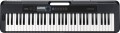 | 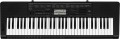 |
|---|---|---|
| Casio CT-S300 | Casio CTK-3500 | |
| Compare prices 3 | Outdated Product | |
| TOP sellers | ||
| Type | synthesizer (rompler) | synthesizer (rompler) |
Keys | ||
| Number of keys | 61 | 61 |
| Size | full size | full size |
| Mechanics | active | active |
| Sensitivity adjustment |  |  |
| Rigidity | semi-weighted | unweighted |
Specs | ||
| Polyphony | 48 voices | 48 voices |
| Built-in timbres | 400 шт | 400 шт |
| Auto accompaniment | | |
| Accompaniment styles | 77 шт | 100 шт |
| Learning mode | | |
| Tempo change | 20 – 255 | |
| Metronome | | |
| Sequencer (recording) | | |
| Built-in compositions | | |
Effects and control | ||
| Timbres layering | | |
| Keyboard split | | |
| Reverberation | | |
| Transposition | | |
| Pitch controller | | |
| Fine tuning | | |
Connectors | ||
| Inputs | mini-Jack (3.5 mm) | mini-Jack (3.5 mm) |
| Connectable pedals | 1 шт | 1 шт |
| Outputs | USB to host (type B) headphones | USB to host (type B) headphones |
| Linear outputs | 1 | |
In box | ||
| In box | music stand PSU | music stand PSU |
General | ||
| Built-in acoustics | 5 W | 4 W |
| Number of bands | 1 | 1 |
| Display | monochrome | monochrome |
| Power consumption | 9.5 W | |
| Autonomous power supply | aA batteries | aA batteries |
| Operating hours | 16 h | 12 h |
| Dimensions (WxHxD) | 930x73x256 mm | 946x92x307 mm |
| Weight | 3.3 kg | 3.4 kg |
| Color | ||
| Added to E-Catalog | april 2020 | august 2017 |





Compare Casio CT-S300 and CTK-3500
Price comparison
You may be interested in
My comparisons
Casio CT-S300 often compared


Casio CTK-3500 often compared


Glossary
Sensitivity adjustment
Ability to change the sensitivity of active mechanics (see above) in the synthesizer.
This function allows you to adjust the intensity of the key's response to pressing. Simply put, the higher the sensitivity, the louder and sharper the sound will be, with the same pressing force. This allows you to change the characteristics of the instrument's sound.
Also in synthesizers with this function, it is often possible to completely turn off the active mechanics and play on a “passive” keyboard. This can be useful for making certain voices, such as harpsichord or organ, sound realistic.
This function allows you to adjust the intensity of the key's response to pressing. Simply put, the higher the sensitivity, the louder and sharper the sound will be, with the same pressing force. This allows you to change the characteristics of the instrument's sound.
Also in synthesizers with this function, it is often possible to completely turn off the active mechanics and play on a “passive” keyboard. This can be useful for making certain voices, such as harpsichord or organ, sound realistic.
Rigidity
— Unweighted. Keys with a very low pressing force, literally "failing" under the fingers. This option is well suited for inexpensive synthesizers with passive mechanics (see above), but is rarely used in active models — a small resistance force makes it difficult to choose the optimal pressing force.
— Semi- weighted. Medium-strength keys, not up to the hardness of a full-fledged piano, but showing noticeably more resistance than unweighted ones. This variant is most popular among instruments with active mechanics (see above) — the force on the keys provides adequate feedback and at the same time playing such an instrument does not cause any special difficulties even for those who previously dealt only with unweighted keyboards.
— Weighted. Keys with high actuation force, comparable to that of a classical piano. Used only in professional hammer action instruments (see above) — high rigidity is a must for such mechanics (more precisely, for the response that it must provide).
— Semi- weighted. Medium-strength keys, not up to the hardness of a full-fledged piano, but showing noticeably more resistance than unweighted ones. This variant is most popular among instruments with active mechanics (see above) — the force on the keys provides adequate feedback and at the same time playing such an instrument does not cause any special difficulties even for those who previously dealt only with unweighted keyboards.
— Weighted. Keys with high actuation force, comparable to that of a classical piano. Used only in professional hammer action instruments (see above) — high rigidity is a must for such mechanics (more precisely, for the response that it must provide).
Accompaniment styles
The number of auto accompaniment styles (see above) originally provided in the synthesizer, in other words, the number of accompaniment options available to the user.
The more extensive this set, the higher the probability of finding among these melodies suitable options for a particular case. At the same time, the abundance of styles in itself is not yet a 100% guarantee that among them there will be a suitable one, especially since different synthesizer models can differ markedly in a specific set of melodies. So the list does not hurt to clarify before buying. Also note that the situation can be corrected by user styles (see below) — many synthesizers with auto accompaniment support them.
The more extensive this set, the higher the probability of finding among these melodies suitable options for a particular case. At the same time, the abundance of styles in itself is not yet a 100% guarantee that among them there will be a suitable one, especially since different synthesizer models can differ markedly in a specific set of melodies. So the list does not hurt to clarify before buying. Also note that the situation can be corrected by user styles (see below) — many synthesizers with auto accompaniment support them.
Tempo change
The range in which you can change the tempo of the programme played by the synthesizer — auto accompaniment, lesson tune (see above), metronome (see below), recorded sample, etc.
Pace is measured in beats per minute. Changing it allows you to adjust the speed of the synthesizer to the specifics of the situation — for example, slightly slow down the tutorial if it is too hard to master at the initial pace. The wider the range of tempo adjustment, the more options the musician has to choose from, especially in the area of very slow and very fast tempos.
Note that the traditional range of musical tempos covers values from 40 beats / min (“grave”, “very slowly”) to 208 beats / min (“prestissimo”, “very fast”), however, in synthesizers it can be more extensive — for example, 30 – 255 bpm.
Pace is measured in beats per minute. Changing it allows you to adjust the speed of the synthesizer to the specifics of the situation — for example, slightly slow down the tutorial if it is too hard to master at the initial pace. The wider the range of tempo adjustment, the more options the musician has to choose from, especially in the area of very slow and very fast tempos.
Note that the traditional range of musical tempos covers values from 40 beats / min (“grave”, “very slowly”) to 208 beats / min (“prestissimo”, “very fast”), however, in synthesizers it can be more extensive — for example, 30 – 255 bpm.
Sequencer (recording)
The sequencer is a device that allows you to record music played on the instrument in real time. Recording is usually done in MIDI format. At the same time, the capabilities of the sequencer can include not only the recording and playback of the music being played, but also advanced options for editing it: sequential overlay of several parts, mixing of recorded tracks, changing the volume, tempo, timbre, key of the recorded compositions, quantization to eliminate tempo irregularities, etc. .P. The specific capabilities of the sequencer, usually, directly depend on the type (see above) and the price category of the synthesizer. However, anyway, this function can be an important help for both a novice musician and a professional.
Timbres layering
The ability to overlay different timbres of the synthesizer sound on top of each other. This creates the effect of the sound of two (or even more) instruments at once — for example, piano and violin. At the same time, in advanced models, it may be possible to set different settings for different timbres so that the sameness of the extracted notes is not so noticeable — for example, the same "violin" can be set to smooth transitions between notes, while on the "piano" they will sound jerky.
Keyboard split
Possibility of dividing the keyboard of the synthesizer into two parts, each of which is responsible for its own timbre of sound. Thus, on one keyboard, you can play two "instruments" at once in real time — for example, accompany the solo part of the violin with chords of a string orchestra. At the same time, unlike auto accompaniment (see above), all notes are taken by the musician himself, without relying on the automatic settings prescribed in the programme.
Usually, several “split keyboard” combinations are pre-written in the synthesizer’s memory, however, some models allow you to separately select a timbre for each half, at the discretion of the musician.
Usually, several “split keyboard” combinations are pre-written in the synthesizer’s memory, however, some models allow you to separately select a timbre for each half, at the discretion of the musician.
Pitch controller
The presence of a pitch controller(Pitch Bend) in the design of the synthesizer.
This function allows you to smoothly change the pitch by a small amount. In this way, specific playing techniques on some instruments are imitated — for example, tightening the strings on a guitar, which gives a characteristic, “floating” sound in frequency. The pitch control usually has the form of a wheel or lever.
This function allows you to smoothly change the pitch by a small amount. In this way, specific playing techniques on some instruments are imitated — for example, tightening the strings on a guitar, which gives a characteristic, “floating” sound in frequency. The pitch control usually has the form of a wheel or lever.
Fine tuning
The ability to fine-tune the synthesizer by sound frequencies. Often, such models also indicate the range in which such adjustment can be carried out.
The standard tuning, which is used by default in all synthesizers, is designated as “440 Hz” — this is the frequency of the “la” note of the first octave, as well as the standard frequency of the tuning fork, all other notes are tuned to it. With fine tuning, the musician can set a different base frequency, raising or lowering the overall tone of the synthesizer. At the same time, unlike the transposition described above, in this case the frequency does not change in steps (by tones-semitones), but smoothly, with an accuracy of a hertz or even a tenth of a hertz. Such an opportunity can be useful in some non-standard situations — for example, if you have to accompany a guitarist whose instrument is tuned slightly higher or lower than the standard, and for one reason or another it is impossible to change the guitar's tuning.
The standard tuning, which is used by default in all synthesizers, is designated as “440 Hz” — this is the frequency of the “la” note of the first octave, as well as the standard frequency of the tuning fork, all other notes are tuned to it. With fine tuning, the musician can set a different base frequency, raising or lowering the overall tone of the synthesizer. At the same time, unlike the transposition described above, in this case the frequency does not change in steps (by tones-semitones), but smoothly, with an accuracy of a hertz or even a tenth of a hertz. Such an opportunity can be useful in some non-standard situations — for example, if you have to accompany a guitarist whose instrument is tuned slightly higher or lower than the standard, and for one reason or another it is impossible to change the guitar's tuning.