School PC with Upgrade Potential

We independently test the products and technologies that we recommend.

1. Processor
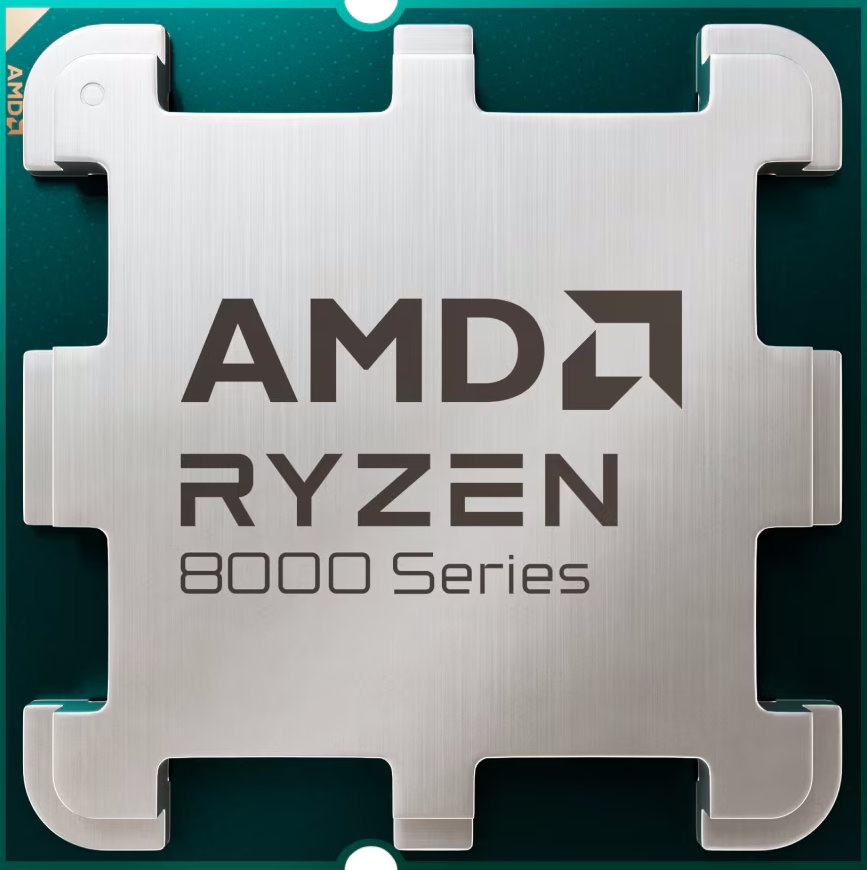
The AMD Ryzen 5 8600G is the most affordable APU with a neural module to accelerate artificial intelligence. The integrated Radeon 760M doesn't hit memory limits, unlike discrete graphics which have this problem. You can pack four non-binary sticks of 192 GB of RAM to locally run large language models in the LM Studio application (Gemma, Mistral, Qwen, Deep Seek).
The six-core Zen 4 architecture is split into twelve SMT threads and automatically overclocks up to 5 GHz. However, if you simultaneously load the iGPU and NPU, the frequency will be lower. Unlike the Ryzen 7000 and 9000 series, TDP of 88 watts cannot be expanded through Precision Boost Overdrive. The fact is that the 8600G operates on the principle of laptop CPUs with a strict power limit.
However, it is still better not to take the Box version with the Wraith Stealth cooler, with which the processor will heat up to 95 degrees Celsius due to thermal paste instead of solder under the heat spreader. Among the non-critical downsides, there is only 16 MB of cache and a narrow PCIe 4.0 x8 bus. However, modern mid-level graphics cards also have eight PCI-Express lines: GeForce RTX 5050, 5060, 5060 Ti.
2. RAM

Patriot Viper Elite 5 Ultra (model code VEU532G6432K) - if Ryzen 7000 processors only supported DDR5 up to 6000 MT/s, then Ryzen 8000 and 9000 series already support 6400 MT/s. Moreover, in the synchronous mode of the RAM controller "one-to-one," which is why AMD even expanded the overclocking tolerances of EXPO. As a result, four profiles are offered at once: XMP and EXPO, 6200 and 6400 MT/s.
And the latency between read-write cycles, known as timings, is on the contrary better than that of regular JEDEC memory at 4800 MT/s - CL32 versus CL40. True, it is achieved by increasing the voltage from 1.1 to 1.4 volts, which is compensated by thick-walled aluminum heatsinks. They can be simply painted black or additionally decorated with synchronized RGB backlighting.
Under the heatsinks are manually selected DRAM chips, a PMIC power distributor between the left and right channels, an ECC error corrector, and an SDP profile storage. In addition to factory settings, you can save your personal frequency formula here. Viper Elite 5 Ultra is supposed to overclock well, as there are paired kits up to 8000 MT/s (only for Intel).
3. Power Supply

The DeepCool GamerStorm PF700X is an upgraded version of one of the most popular PSUs in the price segment of around $50. The X index signifies an increased efficiency ratio up to 88 percent. Previously, it was awarded only the basic 80+ White certificate, but now it has received as many as three bronze medals for energy efficiency: 80 PLUS, Cybenetics ETA, and PPLP.
The fourth Cybenetics Lamba A- badge indicates a low noise level, achieved by a 12-centimeter HYB bearing fan with a service life of 40 thousand hours. The electronic components on the printed circuit board are arranged in such a way as to actively blow on the hottest parts. A mix of Taiwanese and Japanese capacitors ensures 16 ms hold time.
ATX 2.52 standard schematic - the latest among those only with classic video card connectors 6+2-pin. The polyurethane sleeve of the cables mimics a nylon weave, which is both beautiful and flexible for installation. It withstands even extreme environmental conditions: a room temperature of 40°C and an altitude of 5000 meters.
4. Monitor

The 2E A2222B is a worthy candidate for the role of a child's first monitor. Or if you previously used only a 14-15 inch laptop to avoid a sharp jump in diagonal, which can tire the eyes if not used to it. Moreover, the 21.5-inch screen with FullHD resolution has the same high pixel density of 103 PPI as the three times more expensive 27" QuadHD.
The small diagonal also positively affects power consumption: even at maximum brightness of 220 cd/m2, it consumes only 26 watts. This is extremely low for VA matrices, which are usually more power-hungry than IPS, but surpass in contrast with 3000:1 (deep black color). The refresh rate is the standard 75 Hz, as budget PCs won't offer more FPS in games anyway.
If the volume of the built-in 2x2W speakers is insufficient, connect external speakers via Mini-Jack. The video interfaces VGA and HDMI (the second cable included) correspond to those that are soldered on motherboards for iGPU. The native stand only adjusts the tilt angle, if you need more freedom, switch to the VESA bracket (also available in the 2E range).
5. Motherboard
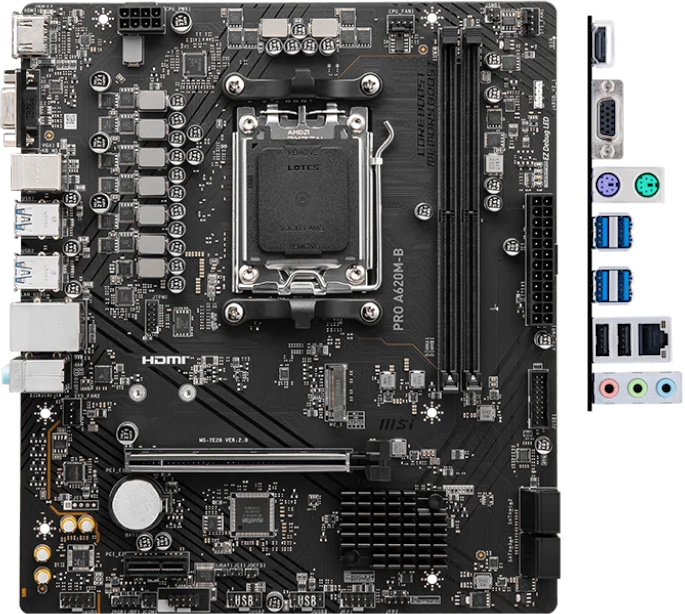
The MSI PRO A620M-B is the cheapest motherboard with an AM5 socket and two DIMM DDR5 slots up to 6800 MT/s (already only in asynchronous mode). The model with the B index differs from the two-year-old E with an accelerated 2.5 Gbps Ethernet adapter. The junior A620 chipset cannot overclock processor cores and integrated graphics, but it supports high-frequency XMP and EXPO memory.
The VRM power subsystem is built according to the 6+2+1 scheme for the CPU, iGPU, and DRAM, respectively. There is no heatsink on the MOSFETs, but the smart AMD PBO technology will slightly reduce the frequency to prevent overheating. The connector for the M.2 solid-state drive is fast, Gen4 up to 7400 MB/s, and the PCI-Express x16 is reinforced with metal so that it is not bent and does not break by a heavy graphics card.
In case of using integration, there are two video outputs: digital HDMI and analog VGA. The trendy Type-C port is implemented with an internal connector, which is brought to the front panel of the case. There is no Agesa BIOS reflashing button via USB for supporting next-generation Ryzen 9000F and 9000G. However, there are EZ Debug LED indicators for diagnosing key PC components.
6. Cooling

Sama Digi62 - a CPU cooler whose technical specifications are encoded in its name. The number 6 indicates the number of heat pipes, the number 2 the number of towers and fans, and the word Digi about the presence of a digital LED screen. By default, the processor temperature is displayed, but you can set it to display other PC parameters (CPU frequency, fan RPM).
The top cover of the cooler not only hides the soldered ends of the pipes from view but is also decorated with ARGB backlighting around the perimeter. The blades of the 12-centimeter fans also shine, and the soft rubber corners, combined with resilient clips, dampen vibrations. The front fan is slightly raised to not interfere with the installation of RAM modules with tall heatsinks.
The inner fan between the towers, on the contrary, is lowered slightly to blow on the VRM area of the motherboard. The speed adjusts between 800-1800 revolutions per minute, and connection is via a Y-shaped splitter. The cooler is intended for all current sockets: AMD AM4, AM5, Intel LGA 1700, 1851, and ahead of the curve 1954 for upcoming Nova Lake processors for 2026.
7. SSD Drive

The Transcend MTE255S is a one-terabyte M.2 NVMe with a sequential read speed of large files at 7400 MB/s and write speed at 5200 MB/s (the 2TB version is faster at 6500 MB/s). And random small file processing happens at 700 thousand IOPS, that is, input-output operations per second. It operates on a PCIe Gen4 bus and is backward compatible with the old Gen3 (limit of 3700 MB/s).
Unlike the previous MTE250H model with a ribbed heatsink, it is cooled with a thin plate made of an aluminum-carbon alloy. It is called graphene and is distinguished by enhanced thermal conductivity, making it suitable for desktops and laptops, including ultrabooks, as well as PlayStation. The LDPC technology is an improved version of the ECC error autocorrection.
It claims a lifetime of up to two million hours and a warranty resource of 600 TBW. Over five years, you can even daily rewrite a third of the total disk volume, which is almost unachievable in home conditions. The proprietary Transcend SSD Scope application monitors the disk's health, updates firmware, and clones the operating system.
8. PC Case

The 1stPlayer H2-BK-4F7 is a compact and lightweight Micro-ATX case weighing 3.3 kg made from SPCC 0.5 mm sheet steel and tempered glass on two-thirds of the side panel. The 1stPlayer case labeling clearly indicates how many fans are factory-installed. The 4F7 index indicates a quartet of 1stPlayer F7 propellers: three in front for intake, one in the rear for exhaust.
The letter R at the end would mean that the fans are reversible, with the airflow directed in the opposite direction. There are no such on the 1stPlayer H2, but one can still be placed above the power supply casing to blow onto the graphics card. There are a total of seven seats for fans available. A separate, not paired with the Reset button, is responsible for switching ARGB colors.
The front panel is decorated with a gamery-brutal grill. The video card fits a length of 31 cm, the air tower height of 16.5 cm. A 240 mm water cooling system is mounted under the roof, but it has a too small gap, which may rest against high-radiator memory (more than 4 cm). However, it is unlikely anyone would think of implementing liquid cooling in such an inexpensive case.
Articles, reviews, useful tips
All materials