
Comparison Hyundai L5100S vs Hyundai L5500S
Add to comparison | 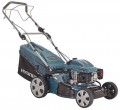 | 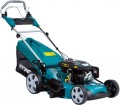 |
|---|---|---|
| Hyundai L5100S | Hyundai L5500S | |
from $409.03 up to $449.84 | from $468.28 up to $515.00 | |
| User reviews | ||
| TOP sellers | ||
Mulching function. Side ejection. Spacious combination bag. The fitting for flushing the deck. | ||
| Type | lawn mower | lawn mower |
| Motor type | petrol | petrol |
Mowing | ||
| Cutting width | 51 cm | 55 cm |
| Cutting system | rotary | rotary |
| Min. cutting height | 25 mm | 25 mm |
| Max. cutting height | 75 mm | 75 mm |
| Cutting height adjustment | synchronous | synchronous |
Cleaning | ||
| Mulching |  | |
| Grass ejection | side ejection rear ejection in a bag | side ejection rear ejection in a bag |
| Bag type | combined | combined |
| Bag volume | 70 L | 70 L |
| Full bag indicator | | |
Design | ||
| Features | self-propelled handle height adjustment cleaning nozzle | self-propelled handle height adjustment cleaning nozzle cup holder |
| Wheel drive | rear | rear |
In box | ||
| Nozzles | 2-tooth blade | 2-tooth blade |
Motor | ||
| ICE type | 4-stroke | 4-stroke |
| Motor model | HYUNDAI ICV180 | Hyundai ICV180 |
| Engine size | 173 cm³ | 173 cm³ |
| Motor power | 5.17 hp | 5.17 hp |
| Motor power | 3800 W | 4400 W |
| Fuel tank volume | 1 L | 1 L |
General | ||
| Deck material | steel | steel |
| Front wheel diameter | 20.3 cm | 20 cm |
| Rear wheel diameter | 25.4 cm | 25 cm |
| Weight | 39.1 kg | 42.6 kg |
| Added to E-Catalog | april 2016 | june 2012 |


Compare Hyundai L5100S and L5500S
Hyundai lawn mowers L5100S and L5500S have similar characteristics, but there are key differences. The L5500S has a larger cutting width of 55 cm compared to the 51 cm of the L5100S, allowing for faster processing of large areas. The engine power of the L5500S is 4400 W, which is also higher than that of L5100S (3800 W). Both models feature mulching functions and a 70-liter combination bag, however, the L5500S additionally offers a cup holder and improved design with anti-vibration coating on the handle. Users note that the L5500S can be more difficult to handle, especially for women, due to its weight (42.6 kg compared to 39.1 kg for the L5100S).
You may be interested in
My comparisons
Hyundai L5100S often compared


Glossary
Cutting width
The capture width provided by the unit, in other words, the width of the strip of land cultivated in one pass. In fact, this size corresponds to the width of the working nozzle.
The large working width is useful when processing large open spaces, as it allows you to finish the job in a small number of passes. On the other hand, for hard-to-reach places, relatively narrow tools are better suited, able to go where a wider unit will not fit. In addition, the width of the tool directly affects the weight and price.
In general, it makes sense to compare in terms of working width only units of the same type (see above). However, it is worth noting here that trimmers do not differ so much from each other — most models capture from 25 to 45 cm (and a wide processing band is provided by moving the nozzle from side to side). As for the other types, in the most modest models the capture width does not exceed 40 cm, in the heaviest and most powerful it can be 56 – 60 cm or even more(in mini tractors — up to 1.5 m).
The large working width is useful when processing large open spaces, as it allows you to finish the job in a small number of passes. On the other hand, for hard-to-reach places, relatively narrow tools are better suited, able to go where a wider unit will not fit. In addition, the width of the tool directly affects the weight and price.
In general, it makes sense to compare in terms of working width only units of the same type (see above). However, it is worth noting here that trimmers do not differ so much from each other — most models capture from 25 to 45 cm (and a wide processing band is provided by moving the nozzle from side to side). As for the other types, in the most modest models the capture width does not exceed 40 cm, in the heaviest and most powerful it can be 56 – 60 cm or even more(in mini tractors — up to 1.5 m).
Features
- Self-propelled. In self-propelled lawn mowers, the engine rotates not only the cutting tool, but also the wheels of the lawn mower; thus, the user does not need to push it in front of him - it is enough just to set and control the direction of movement. This is convenient, but such models are more expensive than non-self-propelled ones. This is due not only to the complexity of the design, but also to the fact that such devices require more powerful engines - after all, power must be divided between the cutting nozzle and the chassis. For the same reason, a self-propelled unit will be less productive and efficient than a non-self-propelled analogue of the same power. However, some types of lawn mowers are by definition self-propelled - in particular, these are heavy professional models that would be difficult to push with your hands, as well as mini tractor riders(see "Type").
- Height adjustable handle. Possibility of height adjustment of the lawn mower handle, which allows to optimally adjust the device to the height of the user. This feature is especially useful for short or, conversely, tall people - by default, lawn mower handles are made for medium height, and it would be inconvenient to work with the unit without height adjustment.
- Piano wheels. The lawn mower has special, so-called. caster wheels (similar to th...ose used, for example, in supermarket carts). These wheels automatically turn in the direction of movement of the device, which significantly reduces the turning radius of the lawn mower and increases its maneuverability. At the same time, it is worth noting that this design is usually used only for the front wheels, while the rear ones remain rigidly fixed to the axle. So moving such a structure sideways still does not work.
- Flushing fitting. The presence of a fitting in the lawn mower for connecting a garden hose; usually such a fitting is located on the deck and is designed for a standard connector used in hoses. In accordance with the name, this function allows you to rinse the deck and blade of the unit, removing grass residues and other contaminants from them: just connect the hose, turn on the working nozzle and give water. This is much more convenient than removing the deck and washer blade by hand - especially when it comes to a heavy professional mower or rider (see "Type").
- Cup holder. The presence of a cup holder in the design of the lawn mower - a specialized stand for glasses and relatively small bottles. Such a stand usually has a characteristic recess where a container with a drink for the operator is installed. Often, cupholders are made in pairs, they are placed on a separate panel between the tubes of the handle of the unit. There are coasters in traditional lawn mowers and riders (mini tractors).
- Height adjustable handle. Possibility of height adjustment of the lawn mower handle, which allows to optimally adjust the device to the height of the user. This feature is especially useful for short or, conversely, tall people - by default, lawn mower handles are made for medium height, and it would be inconvenient to work with the unit without height adjustment.
- Piano wheels. The lawn mower has special, so-called. caster wheels (similar to th...ose used, for example, in supermarket carts). These wheels automatically turn in the direction of movement of the device, which significantly reduces the turning radius of the lawn mower and increases its maneuverability. At the same time, it is worth noting that this design is usually used only for the front wheels, while the rear ones remain rigidly fixed to the axle. So moving such a structure sideways still does not work.
- Flushing fitting. The presence of a fitting in the lawn mower for connecting a garden hose; usually such a fitting is located on the deck and is designed for a standard connector used in hoses. In accordance with the name, this function allows you to rinse the deck and blade of the unit, removing grass residues and other contaminants from them: just connect the hose, turn on the working nozzle and give water. This is much more convenient than removing the deck and washer blade by hand - especially when it comes to a heavy professional mower or rider (see "Type").
- Cup holder. The presence of a cup holder in the design of the lawn mower - a specialized stand for glasses and relatively small bottles. Such a stand usually has a characteristic recess where a container with a drink for the operator is installed. Often, cupholders are made in pairs, they are placed on a separate panel between the tubes of the handle of the unit. There are coasters in traditional lawn mowers and riders (mini tractors).
Motor model
Model of the engine installed in the lawn mower. The main performance data of the engine is usually indicated in the general data for the unit. However, knowing the exact name of the motor, you can find more detailed information on it — from specific data to reviews and reviews. Also, data on the engine model can be useful when searching for spare parts or consumables.
Motor power
Lawnmower engine power expressed in watts. This designation is used absolutely for all electric models (see "Engine type"), and it is also often found in gasoline and diesel units along with horsepower (these units are clearly related, 1 hp is about 735 watts).
In general, the more powerful the engine, the more performant the mower and the better it will cope with heavy work such as cutting thick grass, bushes, etc. On the other hand, high power has a corresponding effect on fuel / electricity consumption, as well as the weight and price of the engine. In addition, note that the power requirements depend on the type of mower itself and its engine (see above for both). For example, for most robots, the power does not exceed 500 W — more, taking into account specialization, is not required, besides, otherwise the devices would turn out to be too bulky and heavy. Trimmers and lawn mowers of similar power are only electric, and the power limit for power tools is 2500 – 3000 W when powered from the mains and 1500 – 2000 W for battery models. But in gasoline tools, the minimum power is about 500 – 1000 W for trimmers and 1000 – 1500 W for mowers; the maximum value can exceed 4 kW.
Detailed recommendations for choosing a lawn mower d...epending on its type and features of the planned work can be found in special sources.
In general, the more powerful the engine, the more performant the mower and the better it will cope with heavy work such as cutting thick grass, bushes, etc. On the other hand, high power has a corresponding effect on fuel / electricity consumption, as well as the weight and price of the engine. In addition, note that the power requirements depend on the type of mower itself and its engine (see above for both). For example, for most robots, the power does not exceed 500 W — more, taking into account specialization, is not required, besides, otherwise the devices would turn out to be too bulky and heavy. Trimmers and lawn mowers of similar power are only electric, and the power limit for power tools is 2500 – 3000 W when powered from the mains and 1500 – 2000 W for battery models. But in gasoline tools, the minimum power is about 500 – 1000 W for trimmers and 1000 – 1500 W for mowers; the maximum value can exceed 4 kW.
Detailed recommendations for choosing a lawn mower d...epending on its type and features of the planned work can be found in special sources.
Front wheel diameter
The diameter of the front wheels of the unit. For more information about this parameter, see "Rear wheel diameter" — everything written there is true in this case. We only note that the front wheels relatively rarely have their own drive, so the diameter for them is not as important as for the rear ones.
Rear wheel diameter
The diameter of the rear wheels of the unit.
Larger wheels, on the one hand, increase cross-country ability and allow you to effectively overcome pits, bumps and other obstacles on rough terrain. On the other hand, they cost more, are more expensive, and in self-propelled models, they also require more traction from the engine.
This indicator is often determined by the type of lawn mower (see above). So, mowers and riders, by definition, have large wheels, because they are designed for difficult terrain, and in a minitractor, the wheels must also withstand a fairly significant weight. But robotic lawn mowers, on the contrary, are used mainly on flat surfaces with low grass, and they do not need large wheels.
If you have to choose among classic lawn mowers, where this parameter can be different, you should proceed from the planned working conditions. So, if we are talking about a flat lawn — you can not pay much attention to this indicator; but for rough terrain with pits, tubercles, ditches, etc., you should choose larger wheels — from 25 cm or more.
Larger wheels, on the one hand, increase cross-country ability and allow you to effectively overcome pits, bumps and other obstacles on rough terrain. On the other hand, they cost more, are more expensive, and in self-propelled models, they also require more traction from the engine.
This indicator is often determined by the type of lawn mower (see above). So, mowers and riders, by definition, have large wheels, because they are designed for difficult terrain, and in a minitractor, the wheels must also withstand a fairly significant weight. But robotic lawn mowers, on the contrary, are used mainly on flat surfaces with low grass, and they do not need large wheels.
If you have to choose among classic lawn mowers, where this parameter can be different, you should proceed from the planned working conditions. So, if we are talking about a flat lawn — you can not pay much attention to this indicator; but for rough terrain with pits, tubercles, ditches, etc., you should choose larger wheels — from 25 cm or more.