
Comparison stockpots
Save List
Add to comparison | 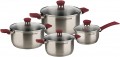 |
|---|---|
| Rondell Strike RDS-818 | |
from $91.54 up to $127.96 | |
| TOP sellers | |
| Type | set of dishes |
| Main items | 4 |
| In box | ladle |
Specs | |
| Size | 16 cm 18 cm 20 cm 24 cm |
| Volume | 1.3 L 2 L 2.8 L 4.8 L |
| Non-stick coating | in absent |
More features | |
| Features | induction compatible dishwasher compatible layered bottom measuring scale |
| Material | steel |
| Lid material | glass |
| Handles | bakelite |
| Country of origin | Germany |
| Color | |
| Added to E-Catalog | october 2016 |


You may be interested in
Glossary
Type
— Pot. This category includes the classic type of pots: deep vessels with a pair of small looped handles on the sides. Except for rare cases, they are round in shape, and their volume (see below) can vary widely. Classic pots are mainly designed for boiling and stewing in the traditional way, either on an open fire or in an oven (the latter largely depends on the handle material and non-stick coating, see relevant sections).
— Saucepan. A variety of pots distinguished by a long handle (instead of the classic pair of looped handles). In some cases, it is easier to manage these pots, and long handles do not heat up as quickly as shorter ones. On the other hand, saucepan handles don't handle heavy weight well, so these pots usually have a relatively small volume and can be challenging to use in the oven.
— Pressure Cooker. A type of pot equipped with a special lid that can close hermetically, ensuring increased steam pressure and temperature inside. This significantly speeds up cooking (hence the name). Additionally, due to its sealed nature, food does not oxidize from exposure to air, making pressure cookers optimal for vegetables. They are also very useful for cooking other foods, especially long-cooking dishes like aspic. Another advantage of the sealed design is ease of use: pressure cookers do not create splashes or stains and do not make the kitchen stuffy as all the steam stays inside....However, using such pots requires caution: the lid cannot be opened until the internal pressure is reduced to a safe level. Usually, there is a specific valve for releasing steam, and many models also have emergency valves to prevent critical pressure buildup. If necessary, a pressure cooker can be used as a regular pot by not closing the lid's latch or using another lid that fits but is not airtight.
— Steamer. As the name suggests, these pots are designed for steaming dishes. A traditional steamer consists of a main container where water is heated to create steam, and one or more "tiers" where the food is placed during cooking. The bottoms of these tiers are made from a special mesh or have small holes to allow steam to pass through. Technically, with some tricks, you can steam food in an ordinary pot as well (see above), but it is much more convenient and easier to use a specialized steamer. Additionally, in many models, the primary container is quite deep and can be used as a regular pot when necessary.
— Pasta Pot. A pot designed for cooking pasta. It resembles a steamer and consists of two parts: the main pot and a container with holes at the bottom and sides, or simply a mesh basket. A pasta pot allows the pasta to remain submerged in water, and after cooking, you can simply lift the upper element. The water will drain automatically, eliminating the need for a colander.
— Cocotte. Structurally similar to saucepans (see above), these have a very small capacity—usually around 100-150 ml. They are intended for making julienne and other similar dishes, typically using a baking method. They are less suitable for other purposes but can be invaluable as individual portion dishes.
— Milk Pan. As the name suggests, these are designed for heating and boiling milk. Milk pan designs are typically chosen to prevent "boiling over." Some models have double walls and can be used for bain-marie cooking. The volume of such a dish varies: the smallest milk pans hold about 0.25 – 0.5 liters and are intended for heating 1 – 2 portions of milk (or milk to add to coffee), while the largest can hold over 2 liters. However, all milk pans feature "elongated" proportions—their height is noticeably greater than the diameter.
— Juicer Pot. Specially designed pots for extracting juice from vegetables and fruits. A juicer pot typically consists of three "levels": water is poured into the bottom container, the middle is for collecting the juice, and the top serves as a colander for placing fruits and vegetables. Heating occurs via steam from the bottom container, and the juice container has a spout for draining. Juicer pots are similar in use to juicers but offer several advantages. First, you can not only make juices but also jams, marmalades, jellies, etc., with a juicer pot. Second, the product can be canned immediately without the need for sterilization. Third, juice from a juicer pot can be stored for a long time in a regular refrigerator, whereas juice from a juicer is best consumed immediately. One downside to this method is the long preparation time.
— Cookware Set. A set of pots and/or saucepans of different sizes selected for everyday cooking. Usually, it includes models for various tasks: a small pot/saucepan for porridge, eggs, or sauces, a medium one for side dishes and soups, and a large one for broths, compotes, or family meals. This set is more convenient than buying items individually because it covers multiple cooking scenarios at once.
— Saucepan. A variety of pots distinguished by a long handle (instead of the classic pair of looped handles). In some cases, it is easier to manage these pots, and long handles do not heat up as quickly as shorter ones. On the other hand, saucepan handles don't handle heavy weight well, so these pots usually have a relatively small volume and can be challenging to use in the oven.
— Pressure Cooker. A type of pot equipped with a special lid that can close hermetically, ensuring increased steam pressure and temperature inside. This significantly speeds up cooking (hence the name). Additionally, due to its sealed nature, food does not oxidize from exposure to air, making pressure cookers optimal for vegetables. They are also very useful for cooking other foods, especially long-cooking dishes like aspic. Another advantage of the sealed design is ease of use: pressure cookers do not create splashes or stains and do not make the kitchen stuffy as all the steam stays inside....However, using such pots requires caution: the lid cannot be opened until the internal pressure is reduced to a safe level. Usually, there is a specific valve for releasing steam, and many models also have emergency valves to prevent critical pressure buildup. If necessary, a pressure cooker can be used as a regular pot by not closing the lid's latch or using another lid that fits but is not airtight.
— Steamer. As the name suggests, these pots are designed for steaming dishes. A traditional steamer consists of a main container where water is heated to create steam, and one or more "tiers" where the food is placed during cooking. The bottoms of these tiers are made from a special mesh or have small holes to allow steam to pass through. Technically, with some tricks, you can steam food in an ordinary pot as well (see above), but it is much more convenient and easier to use a specialized steamer. Additionally, in many models, the primary container is quite deep and can be used as a regular pot when necessary.
— Pasta Pot. A pot designed for cooking pasta. It resembles a steamer and consists of two parts: the main pot and a container with holes at the bottom and sides, or simply a mesh basket. A pasta pot allows the pasta to remain submerged in water, and after cooking, you can simply lift the upper element. The water will drain automatically, eliminating the need for a colander.
— Cocotte. Structurally similar to saucepans (see above), these have a very small capacity—usually around 100-150 ml. They are intended for making julienne and other similar dishes, typically using a baking method. They are less suitable for other purposes but can be invaluable as individual portion dishes.
— Milk Pan. As the name suggests, these are designed for heating and boiling milk. Milk pan designs are typically chosen to prevent "boiling over." Some models have double walls and can be used for bain-marie cooking. The volume of such a dish varies: the smallest milk pans hold about 0.25 – 0.5 liters and are intended for heating 1 – 2 portions of milk (or milk to add to coffee), while the largest can hold over 2 liters. However, all milk pans feature "elongated" proportions—their height is noticeably greater than the diameter.
— Juicer Pot. Specially designed pots for extracting juice from vegetables and fruits. A juicer pot typically consists of three "levels": water is poured into the bottom container, the middle is for collecting the juice, and the top serves as a colander for placing fruits and vegetables. Heating occurs via steam from the bottom container, and the juice container has a spout for draining. Juicer pots are similar in use to juicers but offer several advantages. First, you can not only make juices but also jams, marmalades, jellies, etc., with a juicer pot. Second, the product can be canned immediately without the need for sterilization. Third, juice from a juicer pot can be stored for a long time in a regular refrigerator, whereas juice from a juicer is best consumed immediately. One downside to this method is the long preparation time.
— Cookware Set. A set of pots and/or saucepans of different sizes selected for everyday cooking. Usually, it includes models for various tasks: a small pot/saucepan for porridge, eggs, or sauces, a medium one for side dishes and soups, and a large one for broths, compotes, or family meals. This set is more convenient than buying items individually because it covers multiple cooking scenarios at once.
Main items
The number of main items included in the package. This parameter can be specified for both cookware sets and for steamers / juicers (see "Type" for both). In the first case, the main items are cooking vessels — pots, pans; lids and additional accessories like stands are not counted. For steamers, the number of items indicates the number of tiers provided in the design — including the lowest one, in which water is poured.
In box
Cookware included in the set (see "Type") besides the pots themselves. Such cookware usually uses the same materials and coatings as the pot itself; therefore, these parameters are specified as common to the entire set. The specific types of items can be as follows:
— Frying Pan. A classic frying pan primarily meant for frying foods.
— Saute Pan. Cookware that combines features of a frying pan and a pot; essentially a type of frying pan with high vertical walls and a flat bottom. It is mainly intended for braising, sautéing, making sauces and gravies, as well as other types of cooking that involve a lot of liquid and require tall walls. However, sauté pans can also be used for frying.
— Casserole. A dish resembling a low pot with a tightly fitting lid; some of these pots closely resemble the aforementioned sauté pans, differing mainly in greater height and having paired handles. A casserole usually heats up faster and more intensely than a regular pot, allowing not only boiling but also frying various foods; the tight lid helps retain steam inside, resulting in a flavorful finished dish. These features can be indispensable for certain dishes, such as pilaf. However, casseroles are not well-suited for "slow" cooking.
— Steamer. A device for cooking various dishes using steam. For more details on this c...ooking method, see "Type"; here we note that in sets, a steamer usually appears not as a separate vessel, but as a removable basket that fits into one of the included pots.
— Ladle. A classic ladle with a long handle; for more details, see "Type." Here, we only mention that sometimes it might be more convenient to purchase such a vessel in a set rather than separately.
— Kettle. Typically, an ordinary kitchen kettle meant for boiling water on the stove. It is styled similarly to the pots, making it blend better into the cookware set than a kettle purchased separately.
— Plastic Lid. A fitting lid used not for cooking on the stove but for convenient storage and transport of ready dishes directly in the same cookware. It tightly seals the pot after cooling, helps avoid absorbing odors in the fridge, and protects the contents from accidental spills when moving the pot to a shelf or taking it with you, for example, to the country house. Unlike a glass or metal lid, plastic is usually lighter and quieter, but it cannot be subjected to heat — it's precisely a "cold" lid for household use.
— Handle Covers. Having such covers in the set makes it safe to handle pot handles without fear of burning. They can be removed if necessary, allowing the use of the cookware in the oven.
— Frying Basket. A device in the form of a basket made of metal mesh, allowing the pot to be used as a deep fryer. The basket with the frying products is immersed in liquid oil, heated in the pot, and extracted when ready.
— Trivet. A trivet made from special heat-insulating material, most commonly bakelite. Such a device can be used to place a hot pot or other cookware on without fear of damaging the surface underneath. Note that in sets (see "Type"), there may be several trivets, although often fewer than the main items. However, during cooking, usually only 1-2 pieces of cookware are used at a time, so even such a number is generally sufficient.
— Kitchen Utensils. Various utensils used during cooking: ladles, spatulas, cooking spoons, meat forks, skimmers, etc. Among other things, included utensils are convenient in that they match the style of the cookware—appreciated by those aiming for neatness in kitchen décor.
— Frying Pan. A classic frying pan primarily meant for frying foods.
— Saute Pan. Cookware that combines features of a frying pan and a pot; essentially a type of frying pan with high vertical walls and a flat bottom. It is mainly intended for braising, sautéing, making sauces and gravies, as well as other types of cooking that involve a lot of liquid and require tall walls. However, sauté pans can also be used for frying.
— Casserole. A dish resembling a low pot with a tightly fitting lid; some of these pots closely resemble the aforementioned sauté pans, differing mainly in greater height and having paired handles. A casserole usually heats up faster and more intensely than a regular pot, allowing not only boiling but also frying various foods; the tight lid helps retain steam inside, resulting in a flavorful finished dish. These features can be indispensable for certain dishes, such as pilaf. However, casseroles are not well-suited for "slow" cooking.
— Steamer. A device for cooking various dishes using steam. For more details on this c...ooking method, see "Type"; here we note that in sets, a steamer usually appears not as a separate vessel, but as a removable basket that fits into one of the included pots.
— Ladle. A classic ladle with a long handle; for more details, see "Type." Here, we only mention that sometimes it might be more convenient to purchase such a vessel in a set rather than separately.
— Kettle. Typically, an ordinary kitchen kettle meant for boiling water on the stove. It is styled similarly to the pots, making it blend better into the cookware set than a kettle purchased separately.
— Plastic Lid. A fitting lid used not for cooking on the stove but for convenient storage and transport of ready dishes directly in the same cookware. It tightly seals the pot after cooling, helps avoid absorbing odors in the fridge, and protects the contents from accidental spills when moving the pot to a shelf or taking it with you, for example, to the country house. Unlike a glass or metal lid, plastic is usually lighter and quieter, but it cannot be subjected to heat — it's precisely a "cold" lid for household use.
— Handle Covers. Having such covers in the set makes it safe to handle pot handles without fear of burning. They can be removed if necessary, allowing the use of the cookware in the oven.
— Frying Basket. A device in the form of a basket made of metal mesh, allowing the pot to be used as a deep fryer. The basket with the frying products is immersed in liquid oil, heated in the pot, and extracted when ready.
— Trivet. A trivet made from special heat-insulating material, most commonly bakelite. Such a device can be used to place a hot pot or other cookware on without fear of damaging the surface underneath. Note that in sets (see "Type"), there may be several trivets, although often fewer than the main items. However, during cooking, usually only 1-2 pieces of cookware are used at a time, so even such a number is generally sufficient.
— Kitchen Utensils. Various utensils used during cooking: ladles, spatulas, cooking spoons, meat forks, skimmers, etc. Among other things, included utensils are convenient in that they match the style of the cookware—appreciated by those aiming for neatness in kitchen décor.
Size
The size of a pan is indicated by its diameter ( for round pans) or width ( for square pans). For sets containing objects of different sizes, values for all objects are given in this paragraph.
The volume of the pan directly depends on the size (see below). At the same time, it is also determined by depth; In fact, this means that dishes with the same capacity can vary in size. In such cases, when choosing, it is worth considering that a wider pan heats up faster and more evenly, but requires a larger burner. Actually, the size of the pan should not be less than the size of the burner; this is especially important if you plan to use the dishes on an electric stove.
The smallest pans, sold individually, are 16 cm or less in size, in the largest this figure can exceed 25 cm. As for sets, their sizes can be quite varied: in the smallest sets, the diameter of the largest pan is less than 20 cm(although other types of dishes can be larger), in the largest sets, the size is the same 20 cm(or even more) has the smallest pan.
The volume of the pan directly depends on the size (see below). At the same time, it is also determined by depth; In fact, this means that dishes with the same capacity can vary in size. In such cases, when choosing, it is worth considering that a wider pan heats up faster and more evenly, but requires a larger burner. Actually, the size of the pan should not be less than the size of the burner; this is especially important if you plan to use the dishes on an electric stove.
The smallest pans, sold individually, are 16 cm or less in size, in the largest this figure can exceed 25 cm. As for sets, their sizes can be quite varied: in the smallest sets, the diameter of the largest pan is less than 20 cm(although other types of dishes can be larger), in the largest sets, the size is the same 20 cm(or even more) has the smallest pan.
Volume
Working volume (capacity) of the pan. For sets (see "Type"), which include dishes of different sizes, values are given in this paragraph for all items.
A large volume allows you to cook a large amount of product at a time, but it affects the dimensions and weight of the pan. Therefore, the optimal capacity for different cases will also be different — depending on the amount of cooking and the type of dish. So, for classic pots, 3 – 4 L is considered a universal option: in such dishes it is convenient to cook soups and compotes for an average family. Models with a capacity of 2 – 3 liters are also popular — they are convenient for cooking side dishes, as well as small amounts of cooking (for 1 – 2 people). The smallest pans have a volume of less than 1 liter, they are suitable, in particular, for boiling eggs and heating milk. And the largest ones contain more than 10 liters, such dishes are designed mainly for catering and public events.
There are also more detailed recommendations on the choice of volume, including for other types of dishes — ladles, milk jugs, etc. (see "Type"); these recommendations can be found in special sources.
A large volume allows you to cook a large amount of product at a time, but it affects the dimensions and weight of the pan. Therefore, the optimal capacity for different cases will also be different — depending on the amount of cooking and the type of dish. So, for classic pots, 3 – 4 L is considered a universal option: in such dishes it is convenient to cook soups and compotes for an average family. Models with a capacity of 2 – 3 liters are also popular — they are convenient for cooking side dishes, as well as small amounts of cooking (for 1 – 2 people). The smallest pans have a volume of less than 1 liter, they are suitable, in particular, for boiling eggs and heating milk. And the largest ones contain more than 10 liters, such dishes are designed mainly for catering and public events.
There are also more detailed recommendations on the choice of volume, including for other types of dishes — ladles, milk jugs, etc. (see "Type"); these recommendations can be found in special sources.
Non-stick coating
- Teflon. Classic so-called non-stick coatings, used primarily to ensure that the prepared product does not stick to the walls of the vessel during overheating and burning. On the other hand, this material is very delicate: it is recommended to protect it from scratches, wash it without abrasives, use plastic or wooden spoons/scoops, etc. And even with full compliance with the rules of use, Teflon wears out and becomes unusable in 3–4 years. We also note that this type of coating is highly recommended to be combined with a thick, preferably multi-layer bottom - in order to avoid deformations and the appearance of cracks on the surface.
— Ceramic. A fairly advanced version of non-stick coating : unlike Teflon, it has high strength, but does not lose its properties and does not emit harmful substances even when scratches and cracks appear. A disadvantage of ceramics is sensitivity to temperature changes - for example, if you fill a heated dish with cold water, cracks and chips may appear. And such a coating is somewhat more sensitive to impacts than Teflon.
— Stone (marble). This name combines several varieties of non-stick coatings that have one common feature - stone inclusions, mainly marble, granite, etc. is also found. The properties of such materials...and the features of their operation are often different. But in general, this addition gives the coating not only additional strength and wear resistance, but also an unusual “speckled” appearance - stone particles are usually lighter than the base. The specific features of the operation of such coatings in each case should be clarified separately, but they are most often more durable and resistant to various “troubles” than pure Teflon.
— Enameled. The special enamel coating does not have any special non-stick properties - it is used mainly to prevent contact of the metal surface of the vessel with food. Even stainless steel is prone to oxidize to some extent, which, if stored for long periods of time, can ruin the taste of food or even make it hazardous to health; Enameled dishes are free from such shortcomings. On the other hand, enamel is quite sensitive to scratches and chips; it cannot be washed with abrasive agents (which makes cleaning difficult), and the lifespan of such a coating is relatively short. We also note that modern manufacturers use enamels of different grades and, accordingly, quality; In this case, it makes sense to focus on the price category of the pan.
— Ceramic. A fairly advanced version of non-stick coating : unlike Teflon, it has high strength, but does not lose its properties and does not emit harmful substances even when scratches and cracks appear. A disadvantage of ceramics is sensitivity to temperature changes - for example, if you fill a heated dish with cold water, cracks and chips may appear. And such a coating is somewhat more sensitive to impacts than Teflon.
— Stone (marble). This name combines several varieties of non-stick coatings that have one common feature - stone inclusions, mainly marble, granite, etc. is also found. The properties of such materials...and the features of their operation are often different. But in general, this addition gives the coating not only additional strength and wear resistance, but also an unusual “speckled” appearance - stone particles are usually lighter than the base. The specific features of the operation of such coatings in each case should be clarified separately, but they are most often more durable and resistant to various “troubles” than pure Teflon.
— Enameled. The special enamel coating does not have any special non-stick properties - it is used mainly to prevent contact of the metal surface of the vessel with food. Even stainless steel is prone to oxidize to some extent, which, if stored for long periods of time, can ruin the taste of food or even make it hazardous to health; Enameled dishes are free from such shortcomings. On the other hand, enamel is quite sensitive to scratches and chips; it cannot be washed with abrasive agents (which makes cleaning difficult), and the lifespan of such a coating is relatively short. We also note that modern manufacturers use enamels of different grades and, accordingly, quality; In this case, it makes sense to focus on the price category of the pan.
Features
— Compatibility with Induction. Compatibility of a pot with induction-type electric heaters. Such heaters have specific requirements for cookware — in particular, the bottom must be flat and made of certain metals; therefore, it is best to use pots initially designed for induction.
— Dishwasher Safe. The ability to wash the pot in a dishwasher. Not all cookware is compatible with such machines due to size, material characteristics, etc.; therefore, if you plan to wash the pot in a dishwasher, it's worth ensuring compatibility separately.
— Oven Safe. The possibility of using the pot for cooking dishes in the oven — baking, simmering, etc. The main requirement in this case is resistance to high temperatures. Accordingly, pots with this feature should have metal handles (or removable handles if the handles are made of less heat-resistant materials). Non-stick coating is not a barrier to oven use, although some types require caution; see "Coating" for more details.
— Lid with Thermometer. The availability of a lid with an integrated sensor displaying the temperature inside the pot. Such a sensor facilitates monitoring the degree of product heating inside and, accordingly, helps adjust the cooking mode accurately. Drawbacks include incompatibility of such lids with ovens and, frequ...ently, dishwashers (see above). The price of pots with a thermometer increases accordingly. Note that if this function is not standardly provided, a corresponding size lid can be purchased separately.
— Rain Effect Lid. A special lid design that promotes uniform moisture distribution during cooking. It is equipped with indentations or grooves that collect condensed steam and cause it to drip back into the pot, creating a "rain" effect. This process helps keep dishes juicy, preventing them from drying out, and improves stewing by evenly distributing heat and moisture. This effect is particularly useful when cooking large pieces of meat, such as goose, as it contributes to tenderness and rich flavor.
— Spice Funnel. The presence of a spice funnel in the standard pot lid. This funnel is usually located in the center of the lid and combined with the handle. Its purpose is the even delivery of liquid seasonings (vinegar, wine, oil, etc.) into the dish being cooked: the liquid is poured into the funnel, from which it gradually drips into the pot through a small opening. Additionally, many such handle-funnels have a dual-purpose — their shape allows the lid to be placed handle down and used as a stand for hot dishes.
— Steam Vent. The presence of a steam vent in the pot lid. High steam pressure is good in pressure cookers (see "Type"), but under normal conditions, it is not always desirable, as it can lead to foam formation and product "overflow," with all the corresponding inconveniences — like stove contamination, or even extinguished gas. To avoid this, it's necessary to slightly open the lid, shifting it from the center of the pot. However, this creates another danger — the lid lies unsecured and may slip due to a misplaced position. A steam vent eliminates both inconveniences: the lid can securely remain in its designated place, yet excess pressure will still be released.
— Pouring Spout. The presence of a specific feature in the pot's design that facilitates the pouring of liquid from it. The term "spout" is quite conditional — typically, it refers to a spout or groove on the upper edge of the pot. Such a groove directs and narrows the flow of liquid, which is very useful when pouring into another container, especially if the container has a narrow neck (for example, when pouring freshly brewed compote into a bottle). In more advanced versions, there is a unique lid design: in the part of the lid opposite the spout, there are holes or a grid installed. This allows the lid to act as a strainer, letting liquid out of the pot while retaining other contents inside.
— Multi-layered Bottom. The presence of a multi-layered bottom in the pot's design. This feature is most often used in stainless steel models, occasionally in aluminium ones (see "Material"). Such a bottom usually consists of three layers: the outer and inner layers from the pot's primary material, with an intermediate layer made of another substance with higher thermal conductivity and capacity (e.g., copper). As a result, significantly faster and more even heating is ensured, and such cookware also cools down more slowly than single-layered ones.
— Capacity Scale. A special scale applied inside the pot, allowing a certain degree of accuracy in determining the volume of the contents. This feature is especially useful for those who like to cook in exact accordance with recipes.
— Removable Handles. The ability to detach the handle(s) from the pot. This feature has two main purposes. Firstly, it makes the cookware more compact, which is useful for storage and transportation. Secondly, this option is often crucial for using the cookware in an oven (see above): a long handle might simply not fit, and some materials (see "Handles") are not designed for oven use.
— Dishwasher Safe. The ability to wash the pot in a dishwasher. Not all cookware is compatible with such machines due to size, material characteristics, etc.; therefore, if you plan to wash the pot in a dishwasher, it's worth ensuring compatibility separately.
— Oven Safe. The possibility of using the pot for cooking dishes in the oven — baking, simmering, etc. The main requirement in this case is resistance to high temperatures. Accordingly, pots with this feature should have metal handles (or removable handles if the handles are made of less heat-resistant materials). Non-stick coating is not a barrier to oven use, although some types require caution; see "Coating" for more details.
— Lid with Thermometer. The availability of a lid with an integrated sensor displaying the temperature inside the pot. Such a sensor facilitates monitoring the degree of product heating inside and, accordingly, helps adjust the cooking mode accurately. Drawbacks include incompatibility of such lids with ovens and, frequ...ently, dishwashers (see above). The price of pots with a thermometer increases accordingly. Note that if this function is not standardly provided, a corresponding size lid can be purchased separately.
— Rain Effect Lid. A special lid design that promotes uniform moisture distribution during cooking. It is equipped with indentations or grooves that collect condensed steam and cause it to drip back into the pot, creating a "rain" effect. This process helps keep dishes juicy, preventing them from drying out, and improves stewing by evenly distributing heat and moisture. This effect is particularly useful when cooking large pieces of meat, such as goose, as it contributes to tenderness and rich flavor.
— Spice Funnel. The presence of a spice funnel in the standard pot lid. This funnel is usually located in the center of the lid and combined with the handle. Its purpose is the even delivery of liquid seasonings (vinegar, wine, oil, etc.) into the dish being cooked: the liquid is poured into the funnel, from which it gradually drips into the pot through a small opening. Additionally, many such handle-funnels have a dual-purpose — their shape allows the lid to be placed handle down and used as a stand for hot dishes.
— Steam Vent. The presence of a steam vent in the pot lid. High steam pressure is good in pressure cookers (see "Type"), but under normal conditions, it is not always desirable, as it can lead to foam formation and product "overflow," with all the corresponding inconveniences — like stove contamination, or even extinguished gas. To avoid this, it's necessary to slightly open the lid, shifting it from the center of the pot. However, this creates another danger — the lid lies unsecured and may slip due to a misplaced position. A steam vent eliminates both inconveniences: the lid can securely remain in its designated place, yet excess pressure will still be released.
— Pouring Spout. The presence of a specific feature in the pot's design that facilitates the pouring of liquid from it. The term "spout" is quite conditional — typically, it refers to a spout or groove on the upper edge of the pot. Such a groove directs and narrows the flow of liquid, which is very useful when pouring into another container, especially if the container has a narrow neck (for example, when pouring freshly brewed compote into a bottle). In more advanced versions, there is a unique lid design: in the part of the lid opposite the spout, there are holes or a grid installed. This allows the lid to act as a strainer, letting liquid out of the pot while retaining other contents inside.
— Multi-layered Bottom. The presence of a multi-layered bottom in the pot's design. This feature is most often used in stainless steel models, occasionally in aluminium ones (see "Material"). Such a bottom usually consists of three layers: the outer and inner layers from the pot's primary material, with an intermediate layer made of another substance with higher thermal conductivity and capacity (e.g., copper). As a result, significantly faster and more even heating is ensured, and such cookware also cools down more slowly than single-layered ones.
— Capacity Scale. A special scale applied inside the pot, allowing a certain degree of accuracy in determining the volume of the contents. This feature is especially useful for those who like to cook in exact accordance with recipes.
— Removable Handles. The ability to detach the handle(s) from the pot. This feature has two main purposes. Firstly, it makes the cookware more compact, which is useful for storage and transportation. Secondly, this option is often crucial for using the cookware in an oven (see above): a long handle might simply not fit, and some materials (see "Handles") are not designed for oven use.
Material
The following material options can be used in modern pans: aluminum, steel, cast iron, ceramics and copper. Learn more about each of them.
- Aluminum. A material familiar to many from Soviet-style pots; however, it does not lose popularity in our time. The advantages of aluminum are low weight, durability and good thermal conductivity, which ensures fast heating. Aluminum pans are well suited for vegetables and cereals; in addition, many consider this material the best choice for boiling milk: it practically does not burn during the process. At the same time, it is not recommended to cook products containing acids and alkalis (cabbage soup, jelly, compotes, etc.) in such dishes: with prolonged contact, aluminum reacts, which spoils the taste and leads to the formation of harmful substances. This material is also prone to scratches, and therefore you should not use hard brushes or abrasives when washing. If the wall thickness is small, you should also be careful with the temperature - deformation may occur if overheated.
- Steel. In the case of pans, stainless steel can be classified as a premium material: it is quite expensive, but strong, durable, heats evenly, cools fairly slowly, and most importantly, it is chemically inert and does not emit any harmful substances upon contact with foo...d. As a result, steel is very widely used in mid- and top-class models. Among the disadvantages, besides the price, it is worth noting the tendency to burn, which requires care when cooking.
- Cast iron. A kind of “kitchen classic”; It is relatively rare in pans, but continues to be used to this day. The advantages of cast iron are uniform heating, high heat capacity (such cookware retains heat for a long time) and resistance to overheating. Many consider this material ideal for “slow” cooking - stewing, simmering, etc. The large weight of cast iron can be considered both a disadvantage and an advantage - it provides stability on the stove. Obvious disadvantages are the tendency to rust (which requires careful care) and unsuitability for storing food - prolonged contact leads to oxidation and spoils the taste of the product. Additionally, cast iron pans are relatively fragile; however, this is partly compensated by the low cost of this material, and cast iron can only be split with a fairly strong blow.
- Ceramics. Ceramics based on fired clay or other similar materials. Such dishes conduct heat less well than metal ones, but they heat up very evenly and cool down slowly, making these pans ideal for “slow cooking” such as stewing and simmering. Ceramic pans are quite easy to clean; they allow the use of “harsh” detergents. Another advantage is that ceramics is chemically inert and does not affect the taste of food, even if it is stored in a pan for a long time. The main disadvantage of this material is its fragility: the pan can crack from a strong blow. Also, with ceramics, it is undesirable to allow sudden temperature changes - for example, placing heated dishes under cold water
- Copper. One of the key advantages of copper is its unusual appearance; thanks to the reddish-golden color, such dishes really look beautiful and stylish. On the practical side, this material is notable for its high thermal conductivity, thanks to which the pan heats up quickly and evenly - and this contributes to high-quality and quick cooking. Copper is not suitable for regular contact with food - this leads to oxidation and the appearance of harmful substances; however, this disadvantage is compensated for by the use of additional coatings (for example, tin or steel). But the clear disadvantage of this material is its high cost. In addition, the copper surface loses its shine literally after the first cooking, and to restore its appearance it must be washed manually with special products.
- Aluminum. A material familiar to many from Soviet-style pots; however, it does not lose popularity in our time. The advantages of aluminum are low weight, durability and good thermal conductivity, which ensures fast heating. Aluminum pans are well suited for vegetables and cereals; in addition, many consider this material the best choice for boiling milk: it practically does not burn during the process. At the same time, it is not recommended to cook products containing acids and alkalis (cabbage soup, jelly, compotes, etc.) in such dishes: with prolonged contact, aluminum reacts, which spoils the taste and leads to the formation of harmful substances. This material is also prone to scratches, and therefore you should not use hard brushes or abrasives when washing. If the wall thickness is small, you should also be careful with the temperature - deformation may occur if overheated.
- Steel. In the case of pans, stainless steel can be classified as a premium material: it is quite expensive, but strong, durable, heats evenly, cools fairly slowly, and most importantly, it is chemically inert and does not emit any harmful substances upon contact with foo...d. As a result, steel is very widely used in mid- and top-class models. Among the disadvantages, besides the price, it is worth noting the tendency to burn, which requires care when cooking.
- Cast iron. A kind of “kitchen classic”; It is relatively rare in pans, but continues to be used to this day. The advantages of cast iron are uniform heating, high heat capacity (such cookware retains heat for a long time) and resistance to overheating. Many consider this material ideal for “slow” cooking - stewing, simmering, etc. The large weight of cast iron can be considered both a disadvantage and an advantage - it provides stability on the stove. Obvious disadvantages are the tendency to rust (which requires careful care) and unsuitability for storing food - prolonged contact leads to oxidation and spoils the taste of the product. Additionally, cast iron pans are relatively fragile; however, this is partly compensated by the low cost of this material, and cast iron can only be split with a fairly strong blow.
- Ceramics. Ceramics based on fired clay or other similar materials. Such dishes conduct heat less well than metal ones, but they heat up very evenly and cool down slowly, making these pans ideal for “slow cooking” such as stewing and simmering. Ceramic pans are quite easy to clean; they allow the use of “harsh” detergents. Another advantage is that ceramics is chemically inert and does not affect the taste of food, even if it is stored in a pan for a long time. The main disadvantage of this material is its fragility: the pan can crack from a strong blow. Also, with ceramics, it is undesirable to allow sudden temperature changes - for example, placing heated dishes under cold water
- Copper. One of the key advantages of copper is its unusual appearance; thanks to the reddish-golden color, such dishes really look beautiful and stylish. On the practical side, this material is notable for its high thermal conductivity, thanks to which the pan heats up quickly and evenly - and this contributes to high-quality and quick cooking. Copper is not suitable for regular contact with food - this leads to oxidation and the appearance of harmful substances; however, this disadvantage is compensated for by the use of additional coatings (for example, tin or steel). But the clear disadvantage of this material is its high cost. In addition, the copper surface loses its shine literally after the first cooking, and to restore its appearance it must be washed manually with special products.
Lid material
The material of the lid supplied as standard with the pan.
— Metal. Metal covers are characterized primarily by strength and reliability. In addition, metal is practically the only option for pressure cookers (see "Type"), as the lids of such pans are subjected to considerable stress. Most often, metal lids are made from the same material as the pan itself (see "Material"). The main disadvantage of this option is opacity: you can check the condition of the product in the pan only by opening the lid. Yes, and to a “hard” washing (abrasive powders, metal brushes), such covers are quite sensitive — scratches may appear.
— Cast iron. Lids made of cast iron are mainly used in pans made of the same material (see "Material"). They have all the characteristic features of metal lids (see above), except that they are heavier and somewhat more brittle; however, it is still quite difficult to damage cast iron.
— Glass. The main advantage of glass lids over metal and cast iron lids is transparency — due to this, you can observe the state of the product in the pan without removing the lid. Of course, such a cover is prone to fogging and getting dirty, which interferes with the view, but anyway it is better than with a completely opaque material. In addition, dishes with glass lids have a rather stylish appearance, and the lids themselves are often equipped...with handles made of Bakelite or other heat-insulating material, which allows you to remove them with your bare hands and not be afraid of burns. Yes, and "hard" cleaning glass transfers without problems. Its main disadvantage is increased fragility — such a cover can crack from a relatively mild impact. However, this disadvantage is partly compensated by the large thickness of the glass.
— Ceramics. Such lids are used exclusively with pans of the same material; for more information about the properties of ceramics, see "Material".
Some pans may come with additional lids made of different materials. For example, a pressure cooker may come with a glass lid — it is not suitable for regular use with high pressure inside, but will be convenient when used as a classic pot.
Also note that pot lids are sold separately and usually have standard diameters. So if for one reason or another you are not satisfied with the complete cover or it is not in the set, there is almost always an opportunity to buy another one.
— Metal. Metal covers are characterized primarily by strength and reliability. In addition, metal is practically the only option for pressure cookers (see "Type"), as the lids of such pans are subjected to considerable stress. Most often, metal lids are made from the same material as the pan itself (see "Material"). The main disadvantage of this option is opacity: you can check the condition of the product in the pan only by opening the lid. Yes, and to a “hard” washing (abrasive powders, metal brushes), such covers are quite sensitive — scratches may appear.
— Cast iron. Lids made of cast iron are mainly used in pans made of the same material (see "Material"). They have all the characteristic features of metal lids (see above), except that they are heavier and somewhat more brittle; however, it is still quite difficult to damage cast iron.
— Glass. The main advantage of glass lids over metal and cast iron lids is transparency — due to this, you can observe the state of the product in the pan without removing the lid. Of course, such a cover is prone to fogging and getting dirty, which interferes with the view, but anyway it is better than with a completely opaque material. In addition, dishes with glass lids have a rather stylish appearance, and the lids themselves are often equipped...with handles made of Bakelite or other heat-insulating material, which allows you to remove them with your bare hands and not be afraid of burns. Yes, and "hard" cleaning glass transfers without problems. Its main disadvantage is increased fragility — such a cover can crack from a relatively mild impact. However, this disadvantage is partly compensated by the large thickness of the glass.
— Ceramics. Such lids are used exclusively with pans of the same material; for more information about the properties of ceramics, see "Material".
Some pans may come with additional lids made of different materials. For example, a pressure cooker may come with a glass lid — it is not suitable for regular use with high pressure inside, but will be convenient when used as a classic pot.
Also note that pot lids are sold separately and usually have standard diameters. So if for one reason or another you are not satisfied with the complete cover or it is not in the set, there is almost always an opportunity to buy another one.