
Comparison Ugreen PB552 vs Ugreen PB205
Add to comparison |  | 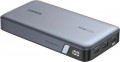 |
|---|---|---|
| Ugreen PB552 | Ugreen PB205 | |
| Compare prices 1 | Compare prices 1 | |
| TOP sellers | ||
Device charging power of 165W cannot be achieved through a single port. Only when using two USB-C cables. | ||
| Battery capacity | 25000 mAh 93 W*h | 25000 mAh 90 W*h |
| Real capacity | 15700 mAh | 15700 mAh |
| Battery type | Li-Pol | Li-Pol |
Charging gadgets / outputs | ||
| USB-C | 3 pcs | 2 pcs |
| USB-A | 1 pcs | 1 pcs |
| USB-C1 | 140 W | 140 W |
| USB-C2 | 65 W | 65 W |
| USB-C3 | 65 W | |
| USB-A1 | 22.5 W | 22.5 W |
| Power output (all ports) | 120 W | |
| Built-in charging cable | USB-C | |
Power bank charging | ||
| Power bank charging inputs | USB-C | USB-C |
| Power bank charge power | 90 W | 65 W |
| Full charge time | 2 h | 2 h |
Features | ||
| Low current charging |  |  |
| Pass-through charging | | |
| Fast charge | Quick Charge 4.0 Power Delivery 3.1 | Quick Charge 3.0 Power Delivery 3.1 |
| Bundled cables (adapters) | USB-C | |
| Features | info display | info display |
General | ||
| Body material | plastic | plastic |
| Dimensions | 169x81x27 mm | 160x80x20 mm |
| Weight | 550 g | 513 g |
| Color | ||
| Added to E-Catalog | march 2026 | november 2023 |


Compare Ugreen PB552 and PB205
Price comparison
You may be interested in
My comparisons
Ugreen PB205 often compared


Glossary
Battery capacity
The capacity of a powerbank indicates the amount of energy it can store and is usually specified in two formats in the specifications — mAh and Wh. The mAh value is more familiar to most buyers and helps quickly understand the class of the model, while Wh more accurately reflects the total energy reserve and is more convenient for a more accurate comparison of devices.
For example, a powerbank with 10000 mAh usually has about 37 Wh, a model with 20000 mAh — approximately 74 Wh, and a version with 30000 mAh — about 111 Wh. The higher these values, the more charges for a smartphone, headphones, watch, or other devices can be expected, but the larger, heavier, and usually more expensive the device becomes.
At the same time, it is important to remember that the actual output is always lower than the nominal figures due to energy conversion losses. Therefore, capacity is one of the main parameters that immediately shows whether the powerbank is suitable for a day's backup or for more serious autonomous use.
USB-C
The number of modern ports USB-C and built-in USB-C cables that can be used to charge smartphones, tablets, headphones, consoles, and other current devices. This format is particularly convenient today because USB-C has become the main connector for most new devices and usually supports higher charging power than USB-A. One USB-C output is usually enough for everyday use, while two and three are convenient if you need to connect several gadgets at the same time.
USB-C3
The power on the USB-C3 port indicates the maximum power with which the power bank can operate through the third USB-C port, which is more often used as an additional output for less demanding devices or for simultaneous charging of multiple gadgets. It is worth noting that simultaneous charging on multiple ports reduces the maximum power output.
Power output (all ports)
The total charge power provided by the power bank on all connectors overnight - when devices are connected simultaneously to all charging ports.
This parameter is given due to the fact that the total charge power does not always correspond to the sum of the maximum powers of all available ports. The built-in battery of a power bank often has its own limitation on the output power. Therefore, for example, in a model with two 18 W USB ports, each total charge power can be the same 18 W. Note that the distribution of power among the connectors may be different: in some models it is divided equally, in others it is divided in proportion to the maximum current strength (if it differs on different ports). These nuances should be clarified using the detailed characteristics of the charging connectors.
If you plan to regularly use all power bank connectors at once, you should pay attention to this indicator.
This parameter is given due to the fact that the total charge power does not always correspond to the sum of the maximum powers of all available ports. The built-in battery of a power bank often has its own limitation on the output power. Therefore, for example, in a model with two 18 W USB ports, each total charge power can be the same 18 W. Note that the distribution of power among the connectors may be different: in some models it is divided equally, in others it is divided in proportion to the maximum current strength (if it differs on different ports). These nuances should be clarified using the detailed characteristics of the charging connectors.
If you plan to regularly use all power bank connectors at once, you should pay attention to this indicator.
Built-in charging cable
Type of built-in cable(or cables) for charging external devices, provided in the design of the power bank.
The main advantage of such equipment over a removable one (see "Bundled wires (adapters)") is that the built-in cable is always in place — you can lose it only together with the power bank itself (or as a result of an "accident" with physical damage to the structure) . On the other hand, such a cable cannot be quickly replaced with another one (longer, with a different plug, etc.); and if it is damaged, you will have to carry the power bank for repair or change it entirely. As for the type of built-in wires, this is indicated by the type of plugs for charging external gadgets that such wires are equipped with. Most often these are microUSB, USB type C and/or Lightning connectors, here is a more detailed description of them:
— microUSB. Relatively old, but still popular connector for portable equipment (mobile phones, tablets, players, etc.); used by almost all manufacturers of such equipment, except for Apple with their proprietary Lightning interface (see below).
— USB type C. A miniature connector, released relatively recently, but gaining more and more popularity (to the point that even Apple, which usually prefers proprietary interfaces, uses USB type C to charge its laptops). It is small (slightly large...r than microUSB) and has conveniently reversible design, well optimized for various advanced features, including some fast charging technologies (although the presence of USB type C does not mean support for such charging).
— Lightning. Apple proprietary connector used in portable devices of this brand (iPhone, iPad, iPod); does not apply to other manufacturers. Note that for a power bank with such a cable, MFi certification is desirable (see above).
If there are several types of plugs, they can be provided both on individual wires and on one combined cable. But if a removable adapter is included in the kit, its type is indicated in the “Bundled wires (adapters)” paragraph.
The main advantage of such equipment over a removable one (see "Bundled wires (adapters)") is that the built-in cable is always in place — you can lose it only together with the power bank itself (or as a result of an "accident" with physical damage to the structure) . On the other hand, such a cable cannot be quickly replaced with another one (longer, with a different plug, etc.); and if it is damaged, you will have to carry the power bank for repair or change it entirely. As for the type of built-in wires, this is indicated by the type of plugs for charging external gadgets that such wires are equipped with. Most often these are microUSB, USB type C and/or Lightning connectors, here is a more detailed description of them:
— microUSB. Relatively old, but still popular connector for portable equipment (mobile phones, tablets, players, etc.); used by almost all manufacturers of such equipment, except for Apple with their proprietary Lightning interface (see below).
— USB type C. A miniature connector, released relatively recently, but gaining more and more popularity (to the point that even Apple, which usually prefers proprietary interfaces, uses USB type C to charge its laptops). It is small (slightly large...r than microUSB) and has conveniently reversible design, well optimized for various advanced features, including some fast charging technologies (although the presence of USB type C does not mean support for such charging).
— Lightning. Apple proprietary connector used in portable devices of this brand (iPhone, iPad, iPod); does not apply to other manufacturers. Note that for a power bank with such a cable, MFi certification is desirable (see above).
If there are several types of plugs, they can be provided both on individual wires and on one combined cable. But if a removable adapter is included in the kit, its type is indicated in the “Bundled wires (adapters)” paragraph.
Power bank charge power
The power in watts at which the power bank is charged under normal conditions.
The higher the charging power, the less time it takes to charge (given the same battery capacity). For example, fast charging of a power bank typically means a charging power of 30W or more. However, this parameter does not directly affect compatibility with charging devices: modern portable batteries can work with chargers of both higher and lower power. In the first case, the battery controller will automatically limit the charging current, while in the second case, charging will simply take more time.
The higher the charging power, the less time it takes to charge (given the same battery capacity). For example, fast charging of a power bank typically means a charging power of 30W or more. However, this parameter does not directly affect compatibility with charging devices: modern portable batteries can work with chargers of both higher and lower power. In the first case, the battery controller will automatically limit the charging current, while in the second case, charging will simply take more time.
Low current charging
Low current charging allows you to seamlessly charge devices that do not require high current. This allows you to extend the life cycle of the devices and protect them as much as possible during charging. Such devices include smartwatches, headphones, headsets, etc.
Pass-through charging
A function that allows a power bank connected to the mains to transfer power to other external devices for charging. Note that pass-through charging can be implemented in different ways. In some cases, a portable battery can supply all incoming power from an energy source through a USB port, in others, the power bank coordinates the power consumption with the gadget being charged and accumulates the remaining energy in the cells of its own battery. In the latter version, both devices are charged at the same time. However, the presence of such a function is not often specified by the manufacturer. Sometimes even the manuals do not provide information on end-to-end charging. Therefore, it is better to focus on the reviews and, before buying, further clarify the availability of pass-through charging.
Fast charge
Fast charging technologies supported by the power bank. This is primarily about charging external gadgets, but the same technology can also be used when replenishing the power bank itself.
The fast charging feature, hence the name, can significantly reduce the time spent on the procedure. This is achieved through increased current and/or voltage, as well as smart process control (at each stage, the current and voltage correspond to the optimal parameters).
Fast charging is especially important for devices with high-capacity batteries that take a long time to charge normally. However, to fully use this feature, the power source and the gadget being charged must support the same charging technology; at the same time, different technologies are not compatible with each other, although occasionally there are exceptions. The most popular fast charging formats these days are QuickCharge (versions 3.0, 4.0 and 4.0+), Power Delivery (Power Delivery 3.0 and Power Delivery 3.1), Pump Express, Samsung Adaptive Fast Charging, Huawei Fast Charge Protocol, Huawei SuperCharge Protocol..., OPPO VOOC, OnePlus Dash Charge ; Here are the specific features of these, as well as some other options:
— Quick Charge (1.0, 2.0, 3.0, 4.0, 5.0). Technology created by Qualcomm and used in gadgets with Qualcomm CPUs. The later the version, the more advanced the technology: for example, Quick Charge 2.0 has 3 fixed voltage options, and version 3.0 has a smooth adjustment in the range from 3.6 to 20 V. Most often, gadgets with a newer version of Quick Charge are also compatible with older devices for charging, but for full use, an exact match in versions is desirable.
Also note that certain versions of Quick Charge have become the basis for some other technologies. However, again, the mutual compatibility of chargers/power banks and gadgets supporting these technologies needs to be clarified separately.
— Pump Express. Own development of MediaTek, used in portable devices with CPUs of this brand. Also available in several versions, with improvements and additions as it develops.
— Power delivery. Native fast charging technology for the USB type C connector. Used by many brands, found mainly in chargers (including power banks) and gadgets using this type of connector. Presented in several versions.
— Samsung Adaptive Fast Charging. Samsung's proprietary fast charging technology. It has been used without any changes since 2015, in light of which it looks quite modest compared to newer standards. Nevertheless, it is able to provide good speed, especially in the first 50% of the charge.
— Huawei FastCharge Protocol. One of Huawei's proprietary technologies. Formally similar to Quick Charge 2.0, but used with both Qualcomm and other brands of mobile processors, so compatibility is not guaranteed. In general, it is considered obsolete, gradually being replaced by more advanced standards like the SuperCharge Protocol.
— Huawei SuperCharge Protocol. Another proprietary technology from Huawei introduced in 2016; for 2021 is available in several versions. In some devices, the power of such charging exceeds 60 V — not a record, but quite an indicator.
— Oppo VOOC. OPPO technology, used both in branded smartphones and in equipment from other brands. Available in several versions; The latest (for 2021) version of SuperVOOC is for 2-cell batteries and is sometimes listed as a separate technology called Oppo SuperVOOC Flash Charge.
— OnePlus Dash Charge. A relatively old proprietary standard from OnePlus. An interesting feature is that in some gadgets, the effectiveness of Dash Charge is practically independent of the use of the screen: when the display is on, the battery charges at almost the same rate as when it is off. Technically a licensed version of OPPO's VOOC, however, these technologies are not compatible. Since 2018, Dash Charge has been phased out by Warp Charge, but this newer technology is still rare in separately sold chargers and power banks.
— PowerIQ. Technology developed by the Anker brand. The key feature of PowerIQ is that it is not a standalone standard, but a combined format of operation that combines a wide range of popular fast charging formats. In particular, version 3.0 claims the ability to work with Quick Charge, Power Delivery, Apple Fast Charging, Samsung Adaptive Fast Charging and others.
The fast charging feature, hence the name, can significantly reduce the time spent on the procedure. This is achieved through increased current and/or voltage, as well as smart process control (at each stage, the current and voltage correspond to the optimal parameters).
Fast charging is especially important for devices with high-capacity batteries that take a long time to charge normally. However, to fully use this feature, the power source and the gadget being charged must support the same charging technology; at the same time, different technologies are not compatible with each other, although occasionally there are exceptions. The most popular fast charging formats these days are QuickCharge (versions 3.0, 4.0 and 4.0+), Power Delivery (Power Delivery 3.0 and Power Delivery 3.1), Pump Express, Samsung Adaptive Fast Charging, Huawei Fast Charge Protocol, Huawei SuperCharge Protocol..., OPPO VOOC, OnePlus Dash Charge ; Here are the specific features of these, as well as some other options:
— Quick Charge (1.0, 2.0, 3.0, 4.0, 5.0). Technology created by Qualcomm and used in gadgets with Qualcomm CPUs. The later the version, the more advanced the technology: for example, Quick Charge 2.0 has 3 fixed voltage options, and version 3.0 has a smooth adjustment in the range from 3.6 to 20 V. Most often, gadgets with a newer version of Quick Charge are also compatible with older devices for charging, but for full use, an exact match in versions is desirable.
Also note that certain versions of Quick Charge have become the basis for some other technologies. However, again, the mutual compatibility of chargers/power banks and gadgets supporting these technologies needs to be clarified separately.
— Pump Express. Own development of MediaTek, used in portable devices with CPUs of this brand. Also available in several versions, with improvements and additions as it develops.
— Power delivery. Native fast charging technology for the USB type C connector. Used by many brands, found mainly in chargers (including power banks) and gadgets using this type of connector. Presented in several versions.
— Samsung Adaptive Fast Charging. Samsung's proprietary fast charging technology. It has been used without any changes since 2015, in light of which it looks quite modest compared to newer standards. Nevertheless, it is able to provide good speed, especially in the first 50% of the charge.
— Huawei FastCharge Protocol. One of Huawei's proprietary technologies. Formally similar to Quick Charge 2.0, but used with both Qualcomm and other brands of mobile processors, so compatibility is not guaranteed. In general, it is considered obsolete, gradually being replaced by more advanced standards like the SuperCharge Protocol.
— Huawei SuperCharge Protocol. Another proprietary technology from Huawei introduced in 2016; for 2021 is available in several versions. In some devices, the power of such charging exceeds 60 V — not a record, but quite an indicator.
— Oppo VOOC. OPPO technology, used both in branded smartphones and in equipment from other brands. Available in several versions; The latest (for 2021) version of SuperVOOC is for 2-cell batteries and is sometimes listed as a separate technology called Oppo SuperVOOC Flash Charge.
— OnePlus Dash Charge. A relatively old proprietary standard from OnePlus. An interesting feature is that in some gadgets, the effectiveness of Dash Charge is practically independent of the use of the screen: when the display is on, the battery charges at almost the same rate as when it is off. Technically a licensed version of OPPO's VOOC, however, these technologies are not compatible. Since 2018, Dash Charge has been phased out by Warp Charge, but this newer technology is still rare in separately sold chargers and power banks.
— PowerIQ. Technology developed by the Anker brand. The key feature of PowerIQ is that it is not a standalone standard, but a combined format of operation that combines a wide range of popular fast charging formats. In particular, version 3.0 claims the ability to work with Quick Charge, Power Delivery, Apple Fast Charging, Samsung Adaptive Fast Charging and others.