
Comparison Nokia 3 16 GB vs Nokia 5 16 GB
Add to comparison | 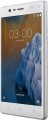 | 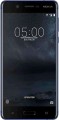 |
|---|---|---|
| Nokia 3 16 GB | Nokia 5 16 GB | |
from $50.00 | Compare prices 1 | |
| User reviews | ||
| TOP sellers | ||
Stock Android OS. Front camera with autofocus. Separate slots for 2 SIM and microSD card. | ||
| Operating system | Android 7.1 | Android 7.1 |
| Stock Android |  | |
Display | ||
| Main display | 5 " 1280х720 (16:9) 294 ppi IPS Gorilla Glass | 5.2 " 1280х720 (16:9) 282 ppi IPS Gorilla Glass |
| Display-to-body ratio | 67 % | 69 % |
Hardware | ||
| CPU frequency | 1.4 GHz | 1.4 GHz |
| CPU cores | 4 | 8 |
| RAM | 2 GB | 2 GB |
| Memory storage | 16 GB | 16 GB |
| Memory card slot | microSD | microSD |
| Max. memory card storage | 256 GB | 256 GB |
Test results | ||
| AnTuTu Benchmark Test | 24 000 points | 42 000 points |
Main camera | ||
| Main lens | 8 MP | 13 MP |
| Full HD (1080p) | + | + |
| Flash | | |
Front camera | ||
| Main selfie lens | 8 MP | 8 MP |
Connections and communication | ||
| Cellular technology | 4G (LTE) | 4G (LTE) CDMA |
| SIM card type | nano-SIM | nano-SIM |
| SIM slots | 2 SIM | 2 SIM |
| Connectivity technology | Wi-Fi 4 (802.11n) Bluetooth v4.2 NFC | Wi-Fi 5 (802.11ac) Bluetooth NFC |
| Inputs & outputs | microUSB mini-Jack (3.5 mm) top | microUSB mini-jack (3.5 mm) |
Features and navigation | ||
| Features | no fingerprint scanner FM receiver noise cancellation gyroscope | front fingerprint scanner FM receiver noise cancellation gyroscope |
| Navigation | aGPS GPS module digital compass | aGPS GPS module GLONASS digital compass |
Power supply | ||
| Battery capacity | 2630 mAh | 3000 mAh |
| Battery type | Li-ion (graphite) | Li-ion (graphite) |
General | ||
| Bezel/back cover material | metal/plastic | metal/metal |
| Dimensions (HxWxD) | 143.4x71.4x8.5 mm | 149.7x72.5x8 mm |
| Weight | 169 g | |
| Color | ||
| Added to E-Catalog | february 2017 | february 2017 |



Compare Nokia 3 and 5
Comparing the Nokia 3 and Nokia 5, it can be noted that both models run on Android 7.1 and have similar display characteristics, but the Nokia 5 offers a more powerful Snapdragon 430 processor with 8 cores, while the Nokia 3 uses a MediaTek MT6737 with 4 cores. Users note that the Nokia 5 has better performance and a 13 MP camera, unlike the 8 MP on the Nokia 3. Additionally, the Nokia 5 is equipped with a fingerprint scanner and supports faster Wi-Fi 5, making it a more modern choice. However, both models have battery issues: users complain about rapid discharge and insufficient capacity. Overall, the Nokia 5 seems to be a more attractive option due to its better performance and functionality, despite some shortcomings.
Price comparison
You may be interested in
My comparisons
Nokia 3 often compared


Nokia 5 often compared


Glossary
Main display
Characteristics of the main (and most often the only) display installed in the device.
In addition to the basic properties - such as size, resolution (according to it, screens are conventionally divided into HD, Full HD, 2K and more), sensor type (most often IPS, OLED, AMOLED, Super AMOLED, Dynamic AMOLED,), this list can more specific features. Among them are the shape of the surface ( flat or curved), the presence and version of the Gorilla Glass coating (including the top v6 and Victus), HDR support and the refresh rate (a frequency on top 60 Hz is considered high, namely 90 Hz, 120 Hz and 144 Hz) . Here is a more detailed description of the characteristics relevant to modern displays:
- Size. Traditionally, the screen size is indicated in inches. A larger display is more convenient to use: more information is placed on i...t, and the image itself is better readable. The downside of increasing the size is an increase in the dimensions of the device. Today, smartphones with screens of 5" or less are considered small. 5.6 - 6" and up to 6.5" is already a medium format. Also, many modern models have a size of 6.5". Classic phones without touch screens do not need a large size - in them it usually does not exceed 3".
- Permission. Screen resolution is specified based on its vertical and horizontal dimensions in dots (pixels). The larger these dimensions (with the same size) - the more detailed and smoothed the picture looks and the less individual pixels are visible on it. On the other hand, increasing the resolution increases both the cost of the display itself and the requirements for the phone's hardware. It is also worth noting that the same resolution on screens of different sizes looks different; so when evaluating detail, it is worth considering not only this parameter, but also the PPI number (see below).
— PPI. The density of dots (pixels) on the screen of the device. It is indicated by the number of dots per " (points per ") - the number of pixels for each horizontal or vertical segment of 1 ". This indicator depends both on the size and resolution, but in the end it is the PPI number that determines how smooth and detailed the image on the display is. For comparison, we note that at a distance of about 25 - 30 cm from the eyes, a density of 300 PPI or more makes individual pixels almost invisible to a person with normal vision, the picture is perceived as a complete one; at greater distances, a similar effect is noticeable at a lower point density.
— Matrix type. The technology by which the screen sensor is made. This parameter is indicated only for relatively advanced displays that are superior in performance to the simplest LCD screens of push-button phones. The most widespread in our time are the following types of matrices:
HDR. A technology that allows you to expand the dynamic range of the screen. In this case, the range of brightness is implied - simply put, the presence of HDR allows the screen to display brighter whites and darker blacks than on displays without support for this technology. In practice, this gives a noticeable improvement in image quality: the saturation and reliability of the transmission of various colors improves, and the details in very light or very dark areas of the frame do not “sink” in white or black. However, all these advantages become noticeable only on the condition that the content being played is originally recorded in HDR. Nowadays, several varieties of this technology are used, here are their features:
- DC Dimming support. Literally from English, Direct Current Dimming is translated as direct current dimming. This technology is designed to minimize flicker in OLED and AMOLED screens, which, in turn, reduces the load on the user's visual apparatus and protects eyesight. The “flicker-free” effect is achieved by directly controlling the brightness of the backlight LEDs by changing the voltage applied to them. Due to this, a decrease in the intensity of the glow of the screen is ensured.
- Curved screen. A screen that has curved edges to which the displayed image extends. In other words, in this case, not only glass is curved, but also part of the active sensor. Displays where both edges are curved are sometimes referred to as "2.5D glass" as well; also there are devices where the screen is bent only on one side. In any case, this feature gives the smartphone an interesting appearance and improves the visibility of the image from some angles, but it significantly affects the cost and can create inconvenience when holding (especially without a case). So before buying a model with such equipment, ideally, you should hold the device in your hand and make sure that it is comfortable enough.
- Gorilla Glass. Special high-strength glass used as a display cover. It is characterized by endurance and resistance to scratches, many times superior to ordinary glass in these indicators. It is widely used in smartphones, where large screen sizes put forward increased requirements for coverage reliability. Modern phones may have different versions of this glass, here are the features of different options:
In addition to the basic properties - such as size, resolution (according to it, screens are conventionally divided into HD, Full HD, 2K and more), sensor type (most often IPS, OLED, AMOLED, Super AMOLED, Dynamic AMOLED,), this list can more specific features. Among them are the shape of the surface ( flat or curved), the presence and version of the Gorilla Glass coating (including the top v6 and Victus), HDR support and the refresh rate (a frequency on top 60 Hz is considered high, namely 90 Hz, 120 Hz and 144 Hz) . Here is a more detailed description of the characteristics relevant to modern displays:
- Size. Traditionally, the screen size is indicated in inches. A larger display is more convenient to use: more information is placed on i...t, and the image itself is better readable. The downside of increasing the size is an increase in the dimensions of the device. Today, smartphones with screens of 5" or less are considered small. 5.6 - 6" and up to 6.5" is already a medium format. Also, many modern models have a size of 6.5". Classic phones without touch screens do not need a large size - in them it usually does not exceed 3".
- Permission. Screen resolution is specified based on its vertical and horizontal dimensions in dots (pixels). The larger these dimensions (with the same size) - the more detailed and smoothed the picture looks and the less individual pixels are visible on it. On the other hand, increasing the resolution increases both the cost of the display itself and the requirements for the phone's hardware. It is also worth noting that the same resolution on screens of different sizes looks different; so when evaluating detail, it is worth considering not only this parameter, but also the PPI number (see below).
— PPI. The density of dots (pixels) on the screen of the device. It is indicated by the number of dots per " (points per ") - the number of pixels for each horizontal or vertical segment of 1 ". This indicator depends both on the size and resolution, but in the end it is the PPI number that determines how smooth and detailed the image on the display is. For comparison, we note that at a distance of about 25 - 30 cm from the eyes, a density of 300 PPI or more makes individual pixels almost invisible to a person with normal vision, the picture is perceived as a complete one; at greater distances, a similar effect is noticeable at a lower point density.
— Matrix type. The technology by which the screen sensor is made. This parameter is indicated only for relatively advanced displays that are superior in performance to the simplest LCD screens of push-button phones. The most widespread in our time are the following types of matrices:
- IPS. The most popular technology for the screens of modern smartphones. It provides a very decent image quality, viewing angles and response speed, although it is somewhat inferior in these parameters to many more advanced options (see below). On the other hand, IPS also has important advantages: durability, uniform wear, and also a rather low cost. Thanks to this, such screens can be found in all categories of smartphones - from low-cost to top-end.
- AMOLED. Organic light-emitting diode (OLED) sensor technology developed by Samsung. One of the key differences between such matrices and more traditional displays is that they do not require external illumination: each pixel is its own light source. Because of this, the power consumption of such a screen depends on the characteristics of the displayed image, but in general it turns out to be quite low. In addition, AMOLED matrices are distinguished by wide viewing angles, excellent brightness and contrast ratios, high color reproduction quality and fast response time. Due to this, such screens continue to be used in modern smartphones, despite the emergence of more advanced technologies; they can be found even in top-end models. The main disadvantage of this technology is the relatively high cost and uneven wear of the pixels: dots that work longer and more often at high brightness burn out faster. However, usually this effect becomes noticeable only after several years of intensive use - a period comparable to the operational resource of the smartphone itself.
- AMOLED (LTPO). An advanced version of AMOLED panels with the ability to dynamically adjust the refresh rate depending on the tasks performed. The abbreviation LTPO stands for Low Temperature Polycrystalline Oxide. Behind this term is a combination of traditional LTPS technology and a thin layer of TFT oxide film with the addition of hybrid-oxide polycrystalline silicon to drive the sweep switching circuits. AMOLED panels (LTPO) reduce the energy consumption of the gadget by an order of magnitude. So, when performing active actions, the device screen uses the maximum or high refresh rate, and while viewing pictures or reading text, the display reduces the rate to a minimum.
- Super AMOLED. An improved version of the AMOLED technology described on top One of the key improvements is that in Super AMOLED screens there is no air gap between the touch layer and the display located under it. This made it possible to further increase the brightness and image quality, increase the speed and reliability of the sensor response and at the same time reduce power consumption. The disadvantages of such matrices are the same as the original AMOLED. In general, they are quite widespread; most smartphones with similar screens belong to the middle and top categories, but there are also low-cost models.
- OLED. Various types of matrices based on the use of organic light emitting diodes; in fact - analogues of AMOLED and Super AMOLED, produced not by Samsung, but by other companies. The specific features of such screens may be different, but for the most part they are, on the one hand, more expensive than popular IPS, on the other hand, they provide higher image quality (including brightness, contrast, viewing angles and color fidelity), and also consume less energy and have small thickness. The main disadvantages of OLED screens are the high price (which, however, is constantly decreasing as the technology develops and improves), as well as the susceptibility of organic pixels to burn-in when broadcasting static images for a long time or images with static elements (notification panel, on-screen buttons, etc.). ).
- OLED (polymer). Organic Light-Emitting Diode (OLED) screens, which do not use glass as a base, but a transparent polymer material. We emphasize that we are talking about the basis of the sensor; from on top it is covered with the same glass as in other types of screens. However, this design offers a number of advantages over traditional "glass" matrices: it provides additional impact resistance and is great for creating curved displays. On the other hand, in terms of optical properties, plastic still falls short of glass; so screens of this type are often inferior in image quality to their “peers” made using traditional OLED technology, and with a similar picture quality, they are noticeably more expensive.
- OLED (LTPO). OLED-matrices with adaptive refresh rate, which can be changed in a wide range based on the tasks performed. In games, screens with LTPO technology automatically raise the refresh rate to the maximum values, while viewing static images, they reduce it to a minimum (from 1 Hz). At the heart of the technology is a traditional LTPS substrate with a thin TFT oxide film on top of the TFT base. The ability to control the flow of electrons provides dynamic control over the refresh rate. The competitive advantage of OLED (LTPO) is reduced power consumption.
- pls. A variation of IPS technology created by Samsung. In some respects - in particular, brightness, contrast and viewing angles - it surpasses the original, while it is cheaper to manufacture and allows you to create flexible displays. However, for a number of reasons, it is not particularly popular.
- Super AMOLED Plus. A further development of the Super AMOLED technology described on top. Allows you to create even brighter, more contrasting and at the same time thin and energy-efficient screens. However, most often such screens in our time are simply referred to as "Super AMOLED", without the "Plus" prefix.
- Dynamic AMOLED. Another AMOLED improvement introduced in 2019. The main features of such matrices are increased brightness without a significant increase in power consumption, as well as 100% coverage of the DCI-P3 color space and compatibility with HDR10 +; the last two points, in particular, make it possible to reproduce modern high-low-cost cinema on such screens with the highest quality. The main disadvantage of Dynamic AMOLED is traditional - the high price; so such matrices are found mainly in top models.
- Super Clear TFT. A joint development by Samsung and Sony, which appeared as a forced alternative to Super AMOLED matrices (the demand for them at one time significantly exceeded production capabilities). True, the image quality of Super Clear TFT is somewhat lower - but in production such matrices are noticeably simpler and cheaper, but in terms of performance they still surpass most IPS screens. However, in our time, this technology is rare, giving way to AMOLED in different versions.
- super LCD. Another alternative to various kinds of AMOLED technology; used mainly in HTC smartphones. Similar to Super AMOLED, such screens do not have an extra air gap, which has a positive effect on both image quality and the clarity of sensor responses. A notable advantage of the Super LCD is its good power efficiency, especially when displaying bright whites; but in terms of overall color saturation (including black), this technology is noticeably inferior to AMOLED.
- LTPS. An advanced type of TFT matrices, created on the basis of the so-called. low temperature polycrystalline silicon. It allows you to easily create screens with a very high pixel density (more than 500 PPI - see on top), achieving high resolutions even with a small size. In addition, part of the control electronics can be built directly into the sensor, reducing the overall thickness of the display. The main disadvantage of LTPS is the relatively high cost, but nowadays such screens can be found even in low-cost smartphones.
- S-PureLED. A technology developed by Sharp and used primarily in its smartphones. Actually, the technology of the matrices themselves in this case is called S-CG Silicon TFT, and S-PureLED is the name of a special layer used to increase transparency. S-CG Silicon TFT is positioned by the creators as a modification of the LTPS technology described on top, which allows to further increase the resolution of the display and at the same time build more control electronics into it (up to a whole “processor on glass”) without increasing the thickness. Of course, these screens are not cheap.
- e-ink. Matrices based on the so-called "electronic ink" - a technology common primarily in electronic books. The main feature of such a screen is that during its operation, energy is spent only on changing the image; a still picture does not require power and can remain on the display even in the absence of power. In addition, by default, E-Ink matrices do not glow on their own, but reflect outside light - so their own backlight is not necessary for them (although it can be provided for work at dusk and darkness). All this provides a solid energy savings; and for some users, such screens are purely subjectively more comfortable and less tiring than traditional matrices. On the other hand, E-Ink technology also has serious drawbacks - first of all, a long response time, as well as the complexity and high cost of color displays, combined with poor color reproduction quality on them. In light of this, in smartphones, such matrices are a very rare and exotic option.
HDR. A technology that allows you to expand the dynamic range of the screen. In this case, the range of brightness is implied - simply put, the presence of HDR allows the screen to display brighter whites and darker blacks than on displays without support for this technology. In practice, this gives a noticeable improvement in image quality: the saturation and reliability of the transmission of various colors improves, and the details in very light or very dark areas of the frame do not “sink” in white or black. However, all these advantages become noticeable only on the condition that the content being played is originally recorded in HDR. Nowadays, several varieties of this technology are used, here are their features:
- HDR10. Historically the first of the consumer HDR formats, it is extremely popular today: in particular, it is supported by almost all streaming services with HDR content and is standardly used for such content on Blu-ray discs. Provides a color depth of 10 bits (more than a billion shades). At the same time, HDR10+ format content (see below) can also be played on devices with this technology, except that its quality will be limited by the capabilities of the original HDR10.
- HDR10+. An improved version of HDR10. With the same color depth (10 bits), it uses the so-called dynamic metadata, which allows transmitting information about the color depth not only for groups of several frames, but also for individual frames. This results in an additional improvement in color reproduction.
- Dolby vision. An advanced standard used particularly in professional cinematography. It allows you to achieve a color depth of 12 bits (almost 69 billion shades), uses the dynamic metadata mentioned on top, and also makes it possible to transmit two image options at once in one video stream - HDR and normal (SDR). At the same time, Dolby Vision is based on the same technology as HDR10, so in modern electronics this format is often combined with HDR10 or HDR10 +.
- DC Dimming support. Literally from English, Direct Current Dimming is translated as direct current dimming. This technology is designed to minimize flicker in OLED and AMOLED screens, which, in turn, reduces the load on the user's visual apparatus and protects eyesight. The “flicker-free” effect is achieved by directly controlling the brightness of the backlight LEDs by changing the voltage applied to them. Due to this, a decrease in the intensity of the glow of the screen is ensured.
- Curved screen. A screen that has curved edges to which the displayed image extends. In other words, in this case, not only glass is curved, but also part of the active sensor. Displays where both edges are curved are sometimes referred to as "2.5D glass" as well; also there are devices where the screen is bent only on one side. In any case, this feature gives the smartphone an interesting appearance and improves the visibility of the image from some angles, but it significantly affects the cost and can create inconvenience when holding (especially without a case). So before buying a model with such equipment, ideally, you should hold the device in your hand and make sure that it is comfortable enough.
- Gorilla Glass. Special high-strength glass used as a display cover. It is characterized by endurance and resistance to scratches, many times superior to ordinary glass in these indicators. It is widely used in smartphones, where large screen sizes put forward increased requirements for coverage reliability. Modern phones may have different versions of this glass, here are the features of different options:
- Gorilla Glass v3. The oldest of the current versions is released in 2013; now found mainly among inexpensive or obsolete devices. However, this coating also has undoubted advantages: this is the first generation of Gorilla Glass, where the creators have made a noticeable emphasis on resistance to scratches from keys, coins and other objects that the phone can “collide” in a pocket or bag. In this respect, the v3 version remained unsurpassed until the release of Gorilla Glass Victus in 2020.
- Gorilla Glass v4. Version released in 2014. A key feature was that the development of this coating focused on impact resistance (whereas previous generations focused mainly on scratch resistance). As a result, the glass is twice as strong as in version 3, despite the fact that its thickness is only 0.4 mm. But here's the scratch resistance, compared with its predecessor, has decreased slightly.
- Gorilla Glass v5. A gorilla improvement released in 2016 to further improve impact resistance. According to the developers, the glass of the v5 version is 1.8 times stronger than its predecessor, remaining intact in 80% of drops from a height of 1.6 m "face down" on a rough surface (and guaranteed impact resistance is 1.2 m). Scratch resistance has also improved somewhat, but this material still falls short of v3 performance.
- Gorilla Glass v6. Version introduced in 2018. For this coating, a 2-fold increase in strength compared to its predecessors is claimed, as well as the ability to endure multiple drops on a hard surface (in tests, v6 glass successfully endured 15 drops from a height of 1 m). The maximum drop height (single) with guaranteed integrity is declared at 1.6 m. Scratch resistance has received practically no improvement.
- Gorilla Glass 7. Original name for Gorilla Glass Victus - see below.
- Gorilla Glass Victus. The "heir" of Gorilla Glass 6, released in the summer of 2020. In this coating, the creators paid attention not only to increasing the overall strength, but also to improving scratch resistance. According to the latter indicator, Victus surpasses even the v3 version, not to mention more sensitive materials (and compared to v6, scratch resistance is claimed to be twice as high). As for durability, it allows you to guarantee to endure single drops from a height of up to 2 m, as well as up to 20 consecutive drops from a height of 1 m.
Display-to-body ratio
The ratio of the screen area to the total front panel area of the phone. Simply put, this spec describes how much of the front panel is occupied by the screen; the rest is the bezels.
This indicator is given exclusively for smartphones with touch screens — it is for them that it is most relevant. The larger the percentage of the body is occupied by the screen, the thinner are the bezels, the neater the smartphone looks and the more convenient it is to work with it with one hand. As for specific numbers, the average values are 80 – 85 %, the higher values allow us to talk about a thin bezel, and more than 90 % — about a “bezel less” design.
Separately, we note that this parameter has nothing to do with the aspect ratio of the screen. The aspect ratio describes only the display itself — its proportions, the ratio between the larger and smaller side of the rectangle.
This indicator is given exclusively for smartphones with touch screens — it is for them that it is most relevant. The larger the percentage of the body is occupied by the screen, the thinner are the bezels, the neater the smartphone looks and the more convenient it is to work with it with one hand. As for specific numbers, the average values are 80 – 85 %, the higher values allow us to talk about a thin bezel, and more than 90 % — about a “bezel less” design.
Separately, we note that this parameter has nothing to do with the aspect ratio of the screen. The aspect ratio describes only the display itself — its proportions, the ratio between the larger and smaller side of the rectangle.
CPU cores
The number of cores in the processor of a mobile phone.
The core in this specific case refers to the part of the processor that executes one thread of commands. Accordingly, the presence of multiple cores allows you to work with multiple threads simultaneously, which has a positive effect on performance. At the same time multi-core CPUs are now found even in the most inexpensive modern smartphones — even chips with 8 cores are not uncommon among them, not to mention simpler quad -core and six-core solutions. And some modern processors can have up to 10 cores.
Theoretically, more cores can improve processor efficiency. However, in fact, the performance of the CPU (and the smartphone itself, eventually) depends on many additional factors. Thus the number of cores is purely a reference parameter. For example, a high-end quad-core processor may be much more performant than an inexpensive eight-core one. So you really should focus on overall level of performance and the results shown in various tests (see below)
It is also worth mentioning that individual cores of mobile CPUs may vary in clock speed, performance and power consumption. The classic version is 8 cores working according to the “4 + 4” scheme: 4 relatively “weak” and power efficient cores are responsible for simple tasks like Internet surfing, and ano...ther 4 – more powerful ones - turn on when high performance is required (for example, in games with advanced graphics). This scheme of work allows you to achieve the optimal balance between performance and energy efficiency of CPU.
The core in this specific case refers to the part of the processor that executes one thread of commands. Accordingly, the presence of multiple cores allows you to work with multiple threads simultaneously, which has a positive effect on performance. At the same time multi-core CPUs are now found even in the most inexpensive modern smartphones — even chips with 8 cores are not uncommon among them, not to mention simpler quad -core and six-core solutions. And some modern processors can have up to 10 cores.
Theoretically, more cores can improve processor efficiency. However, in fact, the performance of the CPU (and the smartphone itself, eventually) depends on many additional factors. Thus the number of cores is purely a reference parameter. For example, a high-end quad-core processor may be much more performant than an inexpensive eight-core one. So you really should focus on overall level of performance and the results shown in various tests (see below)
It is also worth mentioning that individual cores of mobile CPUs may vary in clock speed, performance and power consumption. The classic version is 8 cores working according to the “4 + 4” scheme: 4 relatively “weak” and power efficient cores are responsible for simple tasks like Internet surfing, and ano...ther 4 – more powerful ones - turn on when high performance is required (for example, in games with advanced graphics). This scheme of work allows you to achieve the optimal balance between performance and energy efficiency of CPU.
Test results
The test results are specified either by a younger model in a line or a particular model, made for a better understanding performance of phone models if you compare phones against these parameters. For example, the 128 GB model has test results, and the 256 GB model has no information on the network, and in both models you will see the same value that will give an understanding of the overall performance of the device. But if the editorial office has information for each model individually, then each model will have its test results filled out, and the model with bigger RAM will have bigger values.
AnTuTu Benchmark Test
The result shown by a device when undergoing a performance test (benchmark) in AnTuTu Benchmark.
AnTuTu Benchmark is a comprehensive test designed specifically for mobile devices, primarily smartphones and tablets. It evaluates the efficiency of the processor, memory, graphics, and input/output systems, providing a clear impression of the system's capabilities. The higher the performance, the more points are awarded. Smartphones that score over 1.5M points are considered high-performance according to the AnTuTu ranking.
Like any benchmark, this test does not provide absolute precision: the same device can show different results, usually with deviations within 5-7%. These deviations depend on various factors unrelated to the system itself, such as the device's load from third-party programs and the ambient temperature during testing. Therefore, significant differences between two models can only be noted when the gap in their scores exceeds this margin of error.
AnTuTu Benchmark is a comprehensive test designed specifically for mobile devices, primarily smartphones and tablets. It evaluates the efficiency of the processor, memory, graphics, and input/output systems, providing a clear impression of the system's capabilities. The higher the performance, the more points are awarded. Smartphones that score over 1.5M points are considered high-performance according to the AnTuTu ranking.
Like any benchmark, this test does not provide absolute precision: the same device can show different results, usually with deviations within 5-7%. These deviations depend on various factors unrelated to the system itself, such as the device's load from third-party programs and the ambient temperature during testing. Therefore, significant differences between two models can only be noted when the gap in their scores exceeds this margin of error.
Main lens
Specifications of the main lens of the rear camera installed in the phone. In models with several lenses (see “Number of lenses”), the main one is responsible for basic shooting capabilities and does not have a pronounced specialization (wide-angle, telephoto, etc.). Four main parameters can be indicated here: resolution, aperture ( high aperture optics are quite common), focal length, additional sensor data.
Resolution(in megapixels, MP)
Resolution of the sensor used for the main lens. Budget options are equipped with a module 8 MP and below, many models have 12 MP camera / 13 MP, also recently a trend towards increasing megapixels has been popular. Often in smartphones you can find the main photomodule at 48 MP, 50 MP< /a>, 64 MP and even 108 MP, 200 MP.
The maximum resolution of the resulting image directly depends on the resolution of the sensor; and the high resolution of the "picture", in turn, allows you to better display fine details. On the other hand, an increase in the number of megapixels in itself can lead to a deterioration in the overall image quality - due to the smaller size of each individual pixel..., the noise level increases. As a result, the direct resolution of the camera has little effect on the quality of the shooting - more depends on the physical size of the matrix, the features of the optics and various design tricks used by the manufacturer.
Aperture
Aperture describes the ability of a lens to transmit light. It is written as a fractional number, for example f/1.9. Moreover, the larger the number in the denominator, the lower the aperture ratio, the less light passes through the optics, all other things being equal. For example, an f/2.6 lens will be “darker” than f/1.9.
High aperture gives the camera a number of advantages. First, it improves the quality of shooting in low light. Secondly, it's possible to shoot at low shutter speeds, minimizing the effect of "stirring" and blurring of moving objects in the frame. Thirdly, with fast optics it is easier to achieve a beautiful background blur ("bokeh") — for example, when shooting portraits.
Focal length(in millimetres)
The focal length is a distance between the sensor and the centre of the lens (focused to infinity), at which the most clear image is obtained on the matrix. However, for smartphones, the specifications indicate not the actual, but the so-called equivalent focal length — a conditional indicator recalculated using special formulas. This indicator can be used to evaluate and compare cameras with different sensor sizes (the actual focal length cannot be used for this, since with a different sensor size the same real focal length will correspond to different viewing angles). (It is also worth saying that the equivalent focal length can be noticeably larger than the thickness of the case — there is nothing unusual in this, since this is a conditional, and not a real indicator).
Anyway, the field of view and the degree of magnification directly depend on the equivalent focal length: a larger focal length gives a smaller field of view and a larger size of individual objects that fall into the frame, and a decrease in this distance, in turn, allows you to cover more space. In most modern smartphones, the focal length of the main camera ranges from 13 to 35 mm; if compared with the optics of traditional cameras, then lenses with equivalent focal length up to 25 mm can be attributed to wide-angle lenses, more than 25 mm — to universal models “with a bias towards wide-angle shooting”. Such values are chosen due the fact that smartphones are often used for shooting in cramped conditions, when a fairly large space needs to fit into the frame at a small distance. Enlargement of the picture, if necessary, is most often carried out digitally — due to the reserve of megapixels on the sensor; but there are also models with optical zoom (see below) — for them, not one value is given, but the entire working range of the equivalent focal length (recall, optical zoom is carried out by changing the focal length).
Field of view(in degrees). It characterizes the size of the area covered by the lens, as well as the size of individual objects "seen" by the camera. The larger this field, the more of the scene gets into the frame, but the smaller the individual objects in the image are. The field of view is directly related to the focal length (see above): increasing this distance narrows the field of view of the lens, and vice versa.
Note that this parameter is generally considered important for professional use of the camera rather than for amateur photography. Therefore, viewing angle data is given mainly for smartphones equipped with advanced cameras — including in order to emphasize the high class of cameras. As for specific values, for the main lens they usually are in the range from 70° to 82° — this corresponds to the general specifics of such optics (universal shooting with an emphasis on general scenes and extensive coverage at short distances).
Additional Sensor Data
Additional information regarding the sensor installed in the main lens. This item can specify both the size (in inches) and the sensor model, and sometimes both parameters at once. Anyway, such data is provided only if the device is equipped with a high-end sensor. With the model, everything is quite simple: knowing the name of the sensor, you can find detailed data on it. The size is worth considering a little more.
The size of the sensor is traditionally indicated in fractional parts of an inch — accordingly, for example, a 1/2.3" sensor will be larger than 1/2.6". Larger sensors are considered more advanced, as they provide better image quality at the same resolution. The logic here is simple - due to the large sensor area, each individual pixel is also larger and gets more light, which improves sensitivity and reduces noise. Of course, the actual image quality will also depend on a number of other parameters, but in general, a larger sensor size usually means a more advanced camera. In advanced photo flagships, you can find matrices with a physical size of 1”, which is comparable to image sensors used in top compact cameras with fixed lenses.
Resolution(in megapixels, MP)
Resolution of the sensor used for the main lens. Budget options are equipped with a module 8 MP and below, many models have 12 MP camera / 13 MP, also recently a trend towards increasing megapixels has been popular. Often in smartphones you can find the main photomodule at 48 MP, 50 MP< /a>, 64 MP and even 108 MP, 200 MP.
The maximum resolution of the resulting image directly depends on the resolution of the sensor; and the high resolution of the "picture", in turn, allows you to better display fine details. On the other hand, an increase in the number of megapixels in itself can lead to a deterioration in the overall image quality - due to the smaller size of each individual pixel..., the noise level increases. As a result, the direct resolution of the camera has little effect on the quality of the shooting - more depends on the physical size of the matrix, the features of the optics and various design tricks used by the manufacturer.
Aperture
Aperture describes the ability of a lens to transmit light. It is written as a fractional number, for example f/1.9. Moreover, the larger the number in the denominator, the lower the aperture ratio, the less light passes through the optics, all other things being equal. For example, an f/2.6 lens will be “darker” than f/1.9.
High aperture gives the camera a number of advantages. First, it improves the quality of shooting in low light. Secondly, it's possible to shoot at low shutter speeds, minimizing the effect of "stirring" and blurring of moving objects in the frame. Thirdly, with fast optics it is easier to achieve a beautiful background blur ("bokeh") — for example, when shooting portraits.
Focal length(in millimetres)
The focal length is a distance between the sensor and the centre of the lens (focused to infinity), at which the most clear image is obtained on the matrix. However, for smartphones, the specifications indicate not the actual, but the so-called equivalent focal length — a conditional indicator recalculated using special formulas. This indicator can be used to evaluate and compare cameras with different sensor sizes (the actual focal length cannot be used for this, since with a different sensor size the same real focal length will correspond to different viewing angles). (It is also worth saying that the equivalent focal length can be noticeably larger than the thickness of the case — there is nothing unusual in this, since this is a conditional, and not a real indicator).
Anyway, the field of view and the degree of magnification directly depend on the equivalent focal length: a larger focal length gives a smaller field of view and a larger size of individual objects that fall into the frame, and a decrease in this distance, in turn, allows you to cover more space. In most modern smartphones, the focal length of the main camera ranges from 13 to 35 mm; if compared with the optics of traditional cameras, then lenses with equivalent focal length up to 25 mm can be attributed to wide-angle lenses, more than 25 mm — to universal models “with a bias towards wide-angle shooting”. Such values are chosen due the fact that smartphones are often used for shooting in cramped conditions, when a fairly large space needs to fit into the frame at a small distance. Enlargement of the picture, if necessary, is most often carried out digitally — due to the reserve of megapixels on the sensor; but there are also models with optical zoom (see below) — for them, not one value is given, but the entire working range of the equivalent focal length (recall, optical zoom is carried out by changing the focal length).
Field of view(in degrees). It characterizes the size of the area covered by the lens, as well as the size of individual objects "seen" by the camera. The larger this field, the more of the scene gets into the frame, but the smaller the individual objects in the image are. The field of view is directly related to the focal length (see above): increasing this distance narrows the field of view of the lens, and vice versa.
Note that this parameter is generally considered important for professional use of the camera rather than for amateur photography. Therefore, viewing angle data is given mainly for smartphones equipped with advanced cameras — including in order to emphasize the high class of cameras. As for specific values, for the main lens they usually are in the range from 70° to 82° — this corresponds to the general specifics of such optics (universal shooting with an emphasis on general scenes and extensive coverage at short distances).
Additional Sensor Data
Additional information regarding the sensor installed in the main lens. This item can specify both the size (in inches) and the sensor model, and sometimes both parameters at once. Anyway, such data is provided only if the device is equipped with a high-end sensor. With the model, everything is quite simple: knowing the name of the sensor, you can find detailed data on it. The size is worth considering a little more.
The size of the sensor is traditionally indicated in fractional parts of an inch — accordingly, for example, a 1/2.3" sensor will be larger than 1/2.6". Larger sensors are considered more advanced, as they provide better image quality at the same resolution. The logic here is simple - due to the large sensor area, each individual pixel is also larger and gets more light, which improves sensitivity and reduces noise. Of course, the actual image quality will also depend on a number of other parameters, but in general, a larger sensor size usually means a more advanced camera. In advanced photo flagships, you can find matrices with a physical size of 1”, which is comparable to image sensors used in top compact cameras with fixed lenses.
Cellular technology
Communication standards supported by the mobile phone. In the modern world, several standards related to different generations are actively used: GSM, 3G, 4G (LTE), 5G (including fast mobile internet), CDMA. They vary in both specs and prevalence in different countries:
— GSM. The earliest of the communication standards found in modern telephones. Belongs to the second generation (2G). Allows you to make voice calls with acceptable sound quality, as well as transfer data at speeds up to 474 Kbps (using EDGE technology). Nowadays, GSM is considered completely obsolete, it has been almost universally replaced by more advanced standards of the next generations (3G, 4G, etc.). However, 2G support is found in most modern devices — not so much because of practical necessity, but because of technical features. The fact is that almost all communication standards that are relevant nowadays are add-ons over GSM, and modules for working with these standards are almost guaranteed to be compatible with GSM as well.
— 3G. In a broad sense, the 3G category (third generation communications) includes several standards. However, in the east european mobile phone market, this term refers specifically to the connection of the UMTS format. This standard is a development of GSM, such networks are often deployed on the basis of ready-made networks of the 2nd generation and c...an also serve GSM phones without problems. Specifically, UMTS provides data transfer rates from 2 to 70 Mbps, depending on additional technologies implemented by a particular operator. This is already comparable to fixed Internet access; so, despite the spread of newer standards, 3G communication and phones for it are still quite popular — especially since such devices are compatible with 4G and 5G networks.
— 4G (LTE). Communication 4 generations based on the LTE standard; other 4G standards are not used in mobile phones. LTE is a further development of 3G (UMTS), deployed on the basis of the same technical base, but operates at higher speeds — up to 173 Mbps, which is comparable to a full-fledged broadband Internet connection. LTE networks are commercially operated in many countries of the world, but not in all; therefore, before buying a 4G-compatible phone, it's a good idea to check if it will be possible to use all its features in your area.
— 5G. Further, after 4G, the development of mobile communication standards. In the official specifications of this generation, a peak speed of 20 Gbps for reception and 10 Gbps for transmission, guaranteed speed (at high network load) of 100 and 50 Mb/s, respectively, as well as a number of solutions aimed at improving reliability and overall connection quality. A set of such solutions includes, in particular, multi-element antenna arrays (Massive MIMO) and beamforming technologies (Beamforming) at base stations, as well as the possibility of direct communication between subscriber devices. With all this, this standard allows to reduce energy consumption in comparison with its predecessors.
Separately, it is worth mentioning the rumors about the dangers of 5G communications for health. According to modern scientific data, such a connection does not pose a danger to the human body, and the rumors mentioned are conspiracy theories that are not supported by any weighty arguments.
— CDMA. CDMA networks are known to users primarily by the activities of cell phone networks that provide the opportunity to receive a mobile phone with a direct city number. At one time, these networks competed with GSM and more advanced standards based on it, but as mobile communications developed and became cheaper, CDMA operators for the most part curtailed their activities in the voice communications market and switched to mobile Internet access services. It is worth noting here that the EV-DO Rev.A and Rev.B data transmission technologies available in CDMA networks are capable of providing connection speeds at the level of third-generation networks (up to 3.1 Mbps in the first case and up to 14.7 Mbps in the second), so in some places these services were promoted under the 3G label. However, this connection should not be confused with UMTS-based 3G (see above) — these are two fundamentally different standards that are incompatible with each other. Roughly speaking, if we are talking about 3G in a mobile phone, usually, we mean UMTS, but 3G modems more often use CDMA (EV-DO).
It is worth noting that the GSM, 3G and 4G standards (in that order) are, in fact, stages in the development of mobile networks of the same type. In fact, this means that a phone with support for a later standard, by definition, supports earlier ones — for example, a device with LTE is able to work with both GSM and 3G.
You also need to remember that different ranges can be used within the same standard, and not all of them can be supported in a mobile device. However phones officially sold in a certain country are usually optimized for local networks, and there should be no problems with them. But if the device is planned to be imported from another country, and it was not intended for the local market, it makes sense to first clarify the compatibility by bands. Otherwise, a situation may arise when the device simply “does not see” the network, although formally it will be compatible with a certain communication standard.
— GSM. The earliest of the communication standards found in modern telephones. Belongs to the second generation (2G). Allows you to make voice calls with acceptable sound quality, as well as transfer data at speeds up to 474 Kbps (using EDGE technology). Nowadays, GSM is considered completely obsolete, it has been almost universally replaced by more advanced standards of the next generations (3G, 4G, etc.). However, 2G support is found in most modern devices — not so much because of practical necessity, but because of technical features. The fact is that almost all communication standards that are relevant nowadays are add-ons over GSM, and modules for working with these standards are almost guaranteed to be compatible with GSM as well.
— 3G. In a broad sense, the 3G category (third generation communications) includes several standards. However, in the east european mobile phone market, this term refers specifically to the connection of the UMTS format. This standard is a development of GSM, such networks are often deployed on the basis of ready-made networks of the 2nd generation and c...an also serve GSM phones without problems. Specifically, UMTS provides data transfer rates from 2 to 70 Mbps, depending on additional technologies implemented by a particular operator. This is already comparable to fixed Internet access; so, despite the spread of newer standards, 3G communication and phones for it are still quite popular — especially since such devices are compatible with 4G and 5G networks.
— 4G (LTE). Communication 4 generations based on the LTE standard; other 4G standards are not used in mobile phones. LTE is a further development of 3G (UMTS), deployed on the basis of the same technical base, but operates at higher speeds — up to 173 Mbps, which is comparable to a full-fledged broadband Internet connection. LTE networks are commercially operated in many countries of the world, but not in all; therefore, before buying a 4G-compatible phone, it's a good idea to check if it will be possible to use all its features in your area.
— 5G. Further, after 4G, the development of mobile communication standards. In the official specifications of this generation, a peak speed of 20 Gbps for reception and 10 Gbps for transmission, guaranteed speed (at high network load) of 100 and 50 Mb/s, respectively, as well as a number of solutions aimed at improving reliability and overall connection quality. A set of such solutions includes, in particular, multi-element antenna arrays (Massive MIMO) and beamforming technologies (Beamforming) at base stations, as well as the possibility of direct communication between subscriber devices. With all this, this standard allows to reduce energy consumption in comparison with its predecessors.
Separately, it is worth mentioning the rumors about the dangers of 5G communications for health. According to modern scientific data, such a connection does not pose a danger to the human body, and the rumors mentioned are conspiracy theories that are not supported by any weighty arguments.
— CDMA. CDMA networks are known to users primarily by the activities of cell phone networks that provide the opportunity to receive a mobile phone with a direct city number. At one time, these networks competed with GSM and more advanced standards based on it, but as mobile communications developed and became cheaper, CDMA operators for the most part curtailed their activities in the voice communications market and switched to mobile Internet access services. It is worth noting here that the EV-DO Rev.A and Rev.B data transmission technologies available in CDMA networks are capable of providing connection speeds at the level of third-generation networks (up to 3.1 Mbps in the first case and up to 14.7 Mbps in the second), so in some places these services were promoted under the 3G label. However, this connection should not be confused with UMTS-based 3G (see above) — these are two fundamentally different standards that are incompatible with each other. Roughly speaking, if we are talking about 3G in a mobile phone, usually, we mean UMTS, but 3G modems more often use CDMA (EV-DO).
It is worth noting that the GSM, 3G and 4G standards (in that order) are, in fact, stages in the development of mobile networks of the same type. In fact, this means that a phone with support for a later standard, by definition, supports earlier ones — for example, a device with LTE is able to work with both GSM and 3G.
You also need to remember that different ranges can be used within the same standard, and not all of them can be supported in a mobile device. However phones officially sold in a certain country are usually optimized for local networks, and there should be no problems with them. But if the device is planned to be imported from another country, and it was not intended for the local market, it makes sense to first clarify the compatibility by bands. Otherwise, a situation may arise when the device simply “does not see” the network, although formally it will be compatible with a certain communication standard.
Connectivity technology
Types of communications supported by the device in addition to mobile networks.
This list includes two types of characteristics. The first is the communication technology itself: Wi-Fi (including advanced standards Wi-Fi 5 (802.11ac) , Wi-Fi 6 (802.11ax), Wi-Fi 6E (802.11ax) , Wi-Fi 7 (802.11be)), Bluetooth (including the new generation Bluetooth v 5 in the form of a version 5.0, 5.1, 5.2, 5.3 and 5.4), NFC, satellite communication. The second type is additional functions implemented through one or another communication standard: this is primarily aptX support (including aptX HD, aptX Adaptive and aptX Lossless) and even a built-in walkie-talkie. Here is a more detailed description of each of these characteristics:
— Wi-Fi 4 (802.11n). Wi-Fi is a wireless communication technology that in modern phones can be used both to access the Internet through wireless access points, and for direct...communication with other devices (in particular, cameras and drones). Wi-Fi is a must for smartphones, but is extremely rare in traditional phones. Specifically, Wi-Fi 4 (802.11n) provides data transfer speeds of up to 600 Mbit/s and uses two frequency ranges at once - 2.4 GHz and 5 GHz, making it compatible with earlier 802.11 b/g standards and with more new Wi-Fi 5 (see below). Wi-Fi 4 is considered a relatively modest standard by modern standards, but it is still quite sufficient for most tasks.
- Wi-Fi 5 (802.11ac). The Wi-Fi standard (see above), which is the successor to Wi-Fi 4. In theory, it supports speeds of up to 6.77 Gbps, and also uses the 5 GHz band - it is less loaded with extraneous signals and more noise-resistant than the traditional 2.4 GHz. For compatibility purposes, a smartphone with a Wi-Fi 5 module may provide support for earlier standards, but it would not hurt to clarify this point separately.
- WiGig (802.11ad). Further, after Wi-Fi 5, the development of Wi-Fi standards, characterized primarily by the use of the 60 GHz band. In terms of maximum speed, it is virtually no different from Wi-Fi 5, however, the higher frequency increases the channel capacity, so that when several gadgets simultaneously communicate with one common device (for example, a router), the communication speed does not drop as much as in earlier standards. On the other hand, the 802.11ad signal is almost incapable of passing through walls; Manufacturers use various tricks to compensate for this shortcoming, but the best communication quality is still achieved only with direct visibility. Relatively little equipment for the WiGig standard is currently being produced, and it is not compatible with earlier versions of Wi-Fi; Therefore, smartphones usually provide support for other standards.
- Wi-Fi 6 (802.11ax). A standard developed as a direct development and improvement of Wi-Fi 5. Uses the ranges from 1 to 7 GHz - that is, it is capable of operating at standard frequencies of 2.4 GHz and 5 GHz (including equipment of earlier standards), and in others frequency bands. The maximum data transfer rate has increased to 10 Gbps, but the main advantage of Wi-Fi 6 was not even this, but the further optimization of the simultaneous operation of several devices on the same channel (improving the technical solutions used in Wi-Fi 5 and WiGig). Thanks to this, Wi-Fi 6 gives the lowest speed drop among modern standards when the channel is busy.
- Wi-Fi 6E (802.11ax). The Wi-Fi 6E standard is technically called 802.11ax. But unlike basic Wi-Fi 6 (for more details, see the corresponding paragraph), which is named similarly, it provides for operation in the unused 6 GHz band. In total, the standard uses 14 different frequency bands, offering high throughput in the most crowded places with many active connections. And it is backwards compatible with previous versions.
— Wi-Fi 7 (802.11be). The technology, like the previous Wi-Fi 6E, is capable of operating in three frequency ranges: 2.4 GHz, 5 GHz and 6 GHz. At the same time, the maximum bandwidth in Wi-Fi 7 was increased from 160 MHz to 320 MHz - the wider the channel, the more data it can transmit. The IEEE 802.11be standard uses 4096-QAM modulation, which also allows more symbols to be accommodated in a data transmission unit. From Wi-Fi 7 you can squeeze out a maximum theoretical information exchange speed of up to 46 Gbps. In the context of using wireless connections for streaming and video games, the implemented MLO (Multi-Link Operation) development seems very interesting. With its help, you can aggregate several channels in different ranges, which significantly reduces delays in data transmission and ensures low and stable ping. And Multi-RU (Multiple Resource Unit) technology is designed to minimize communication delays when there are many connected client devices.
— Bluetooth. Direct wireless communication technology between various devices. In mobile phones it is used primarily for connecting headphones, headsets and wrist gadgets such as fitness bracelets, but other methods of application are also possible - remote control mode, direct file transfer, etc. In modern mobile phones there can be different versions of Bluetooth, here are their features:
- aptX support. aptX technology was developed to improve the quality of sound transmitted over Bluetooth. When transmitting sound in a regular format, without aptX, the signal is compressed quite heavily, which affects the sound quality; This is not critical when talking on the phone, but it can significantly spoil the impression of listening to music. In turn, aptX allows you to transmit an audio signal with virtually no compression and achieve sound quality comparable to a wired communication. Such features will be especially appreciated by music lovers who prefer Bluetooth headphones or wireless speakers. Of course, to use aptX, both your smartphone and external audio device must support it.
- aptX HD support. aptX HD is a further development and improvement of the original aptX technology, allowing you to transmit sound in even higher quality - Hi-Res (24-bits/48kHz). According to the creators, this standard allows you to achieve signal quality superior to AudioCD and sound purity comparable to wired communication. The latter is often questionable, but it can be argued that overall aptX HD provides very high sound quality. On the other hand, all the advantages of this technology become noticeable only on Hi-Res audio - with quality 24-bits/48kHz or higher; otherwise, the quality is limited not so much by the characteristics of the communication as by the properties of the source files.
- Support for aptX LL. A modification of aptX technology, designed to minimize signal transmission delays. Encoding and decoding a signal when transmitting audio via Blueooth with aptX inevitably takes some time; This is not critical when listening to music, but in videos or games there may be a noticeable desynchronization between the image and sound. The aptX LL technology does not have this shortcoming; it also gives a delay, but this delay is so small that a person does not notice it.
- Support for aptX Adaptive. Further development of aptX; actually combines the capabilities of aptX HD and aptX Low Latency, but is not limited to this. One of the main features of this standard is the so-called adaptive bitrate: the codec automatically adjusts the actual data transfer rate based on the characteristics of the broadcast content (music, game audio, voice communications, etc.) and the congestion of the frequencies used. This, in particular, helps reduce energy consumption and increase communication reliability; and special algorithms allow you to broadcast sound quality comparable to aptX HD (24 bits/48 kHz), using much less transmitted data. And the minimum data transfer latency (at the aptX LL level) makes this codec excellent for games and movies.
– Support for aptX Lossless. The next branch of development of aptX technology, which allows you to transmit CD-quality sound over a wireless Bluetooth network without loss or use of compression. At the same time, audio broadcasting with sampling parameters of 16 bits / 44.1 kHz is carried out with a bitrate of about 1.4 Mbit/s - this is about three times faster than in the aptX Adaptive edition. Support for aptX Lossless began to be introduced in late 2021 as part of Qualcomm's Snapdragon Sound initiative, which is available on smartphones, headphones and speakers with a Snapdragon 8 Gen 1 processor and later.
— NFC chip. NFC is a technology for wireless communication over ultra-low distances, up to 10 cm. One of the most popular applications of this technology in smartphones is contactless payments, when the device actually plays the role of a credit card: just bring the device to a terminal that supports contactless technology like PayPass or PayWave. Another common way to use NFC is to automatically connect to another NFC-compatible device via Wi-Fi or Bluetooth: gadgets brought close to each other automatically set up a communication, and the customer only needs to confirm it. Other options are technically possible: recognizing smart cards and RFID tags, using the device as a travel card, access card, etc. However, such use formats are much less common.
- Infrared port. The infrared port looks like a small “eye”, usually on the top end of the phone. This equipment allows you to turn your phone into a remote control for controlling various equipment - just install the appropriate application. At the same time, we note that among such applications you can find an option for almost any device - from TVs to air conditioners, hoods, etc. Accordingly, the “smartphone remote control” turns out to be very universal.
— Walkie-talkie. Built-in radio module that allows you to use the phone as a walkie-talkie - for communication over relatively low distances without using SIM cards. Of course, for such communication you will need another walkie-talkie (or a phone with this function). The specific frequencies supported by the built-in radio module should be clarified separately; however, all phones with this feature operate in one or more standard bands. In practice, this means that they are capable of communicating not only with similar phones, but also with classic civilian walkie-talkies - provided they match the supported bands. The communication range is usually quite low; however, the built-in walkie-talkie can be very useful for tech in situations where conventional mobile communications are ineffective or unavailable. Typical examples of such situations are staying “far from civilization”, in an area of poor treatment, or traveling abroad, where roaming is expensive.
– Satellite communication. The satellite communication function is intended to send emergency alerts to rescue services in emergency situations. Smartphones with the ability to connect to satellite frequencies can communicate with emergency services in areas where there is no mobile network treatment. For better signal reception from satellites, it is advisable for the customer to be in an open space. At the stage of function formation, only ready-made requests can be transferred. In the future, it is planned to support full messaging via satellite communications, but a separate fee will be charged for them.
This list includes two types of characteristics. The first is the communication technology itself: Wi-Fi (including advanced standards Wi-Fi 5 (802.11ac) , Wi-Fi 6 (802.11ax), Wi-Fi 6E (802.11ax) , Wi-Fi 7 (802.11be)), Bluetooth (including the new generation Bluetooth v 5 in the form of a version 5.0, 5.1, 5.2, 5.3 and 5.4), NFC, satellite communication. The second type is additional functions implemented through one or another communication standard: this is primarily aptX support (including aptX HD, aptX Adaptive and aptX Lossless) and even a built-in walkie-talkie. Here is a more detailed description of each of these characteristics:
— Wi-Fi 4 (802.11n). Wi-Fi is a wireless communication technology that in modern phones can be used both to access the Internet through wireless access points, and for direct...communication with other devices (in particular, cameras and drones). Wi-Fi is a must for smartphones, but is extremely rare in traditional phones. Specifically, Wi-Fi 4 (802.11n) provides data transfer speeds of up to 600 Mbit/s and uses two frequency ranges at once - 2.4 GHz and 5 GHz, making it compatible with earlier 802.11 b/g standards and with more new Wi-Fi 5 (see below). Wi-Fi 4 is considered a relatively modest standard by modern standards, but it is still quite sufficient for most tasks.
- Wi-Fi 5 (802.11ac). The Wi-Fi standard (see above), which is the successor to Wi-Fi 4. In theory, it supports speeds of up to 6.77 Gbps, and also uses the 5 GHz band - it is less loaded with extraneous signals and more noise-resistant than the traditional 2.4 GHz. For compatibility purposes, a smartphone with a Wi-Fi 5 module may provide support for earlier standards, but it would not hurt to clarify this point separately.
- WiGig (802.11ad). Further, after Wi-Fi 5, the development of Wi-Fi standards, characterized primarily by the use of the 60 GHz band. In terms of maximum speed, it is virtually no different from Wi-Fi 5, however, the higher frequency increases the channel capacity, so that when several gadgets simultaneously communicate with one common device (for example, a router), the communication speed does not drop as much as in earlier standards. On the other hand, the 802.11ad signal is almost incapable of passing through walls; Manufacturers use various tricks to compensate for this shortcoming, but the best communication quality is still achieved only with direct visibility. Relatively little equipment for the WiGig standard is currently being produced, and it is not compatible with earlier versions of Wi-Fi; Therefore, smartphones usually provide support for other standards.
- Wi-Fi 6 (802.11ax). A standard developed as a direct development and improvement of Wi-Fi 5. Uses the ranges from 1 to 7 GHz - that is, it is capable of operating at standard frequencies of 2.4 GHz and 5 GHz (including equipment of earlier standards), and in others frequency bands. The maximum data transfer rate has increased to 10 Gbps, but the main advantage of Wi-Fi 6 was not even this, but the further optimization of the simultaneous operation of several devices on the same channel (improving the technical solutions used in Wi-Fi 5 and WiGig). Thanks to this, Wi-Fi 6 gives the lowest speed drop among modern standards when the channel is busy.
- Wi-Fi 6E (802.11ax). The Wi-Fi 6E standard is technically called 802.11ax. But unlike basic Wi-Fi 6 (for more details, see the corresponding paragraph), which is named similarly, it provides for operation in the unused 6 GHz band. In total, the standard uses 14 different frequency bands, offering high throughput in the most crowded places with many active connections. And it is backwards compatible with previous versions.
— Wi-Fi 7 (802.11be). The technology, like the previous Wi-Fi 6E, is capable of operating in three frequency ranges: 2.4 GHz, 5 GHz and 6 GHz. At the same time, the maximum bandwidth in Wi-Fi 7 was increased from 160 MHz to 320 MHz - the wider the channel, the more data it can transmit. The IEEE 802.11be standard uses 4096-QAM modulation, which also allows more symbols to be accommodated in a data transmission unit. From Wi-Fi 7 you can squeeze out a maximum theoretical information exchange speed of up to 46 Gbps. In the context of using wireless connections for streaming and video games, the implemented MLO (Multi-Link Operation) development seems very interesting. With its help, you can aggregate several channels in different ranges, which significantly reduces delays in data transmission and ensures low and stable ping. And Multi-RU (Multiple Resource Unit) technology is designed to minimize communication delays when there are many connected client devices.
— Bluetooth. Direct wireless communication technology between various devices. In mobile phones it is used primarily for connecting headphones, headsets and wrist gadgets such as fitness bracelets, but other methods of application are also possible - remote control mode, direct file transfer, etc. In modern mobile phones there can be different versions of Bluetooth, here are their features:
- Bluetooth v 4.0. A fundamental update (after version 3.0), introducing another data transmission format - Bluetooth Low Energy (LE). This protocol is designed primarily for miniature devices that transmit small amounts of information, such as fitness bracelets and medical sensors. Bluetooth LE allows you to significantly save energy during such communication.
- Bluetooth v4.1. Development and improvement of Bluetooth 4.0. One of the key improvements was the optimization of collaboration with 4G LTE communication modules - so that Bluetooth and LTE do not interfere with each other. In addition, this version makes it possible to simultaneously use a Bluetooth device in several roles - for example, to remotely control an external device while simultaneously streaming music to headphones.
- Bluetooth v4.2. Further, after 4.1, the development of the Bluetooth standard. It did not provide any fundamental updates, but received a number of improvements regarding reliability and noise immunity, as well as improved compatibility with the Internet of Things.
- Bluetooth v 5.0. Version introduced in 2016. The key innovations were the further expansion of capabilities associated with the Internet of Things. In particular, in the Bluetooth Low Energy protocol (see above), it became possible to double the data transfer rate (up to 2 Mbit/s) at the cost of reducing the range, and also quadruple the range at the cost of reducing the speed; In addition, a number of improvements have been introduced regarding simultaneous work with a large number of connected devices.
- Bluetooth v5.1. Update of the version described above v 5.0. In addition to general improvements in the quality and reliability of communication, this update introduced such an interesting feature as determining the direction from which the Bluetooth signal is coming. Thanks to this, it becomes possible to determine the location of connected devices with centimeter accuracy, which can be useful, for example, when searching for wireless headphones.
- Bluetooth v 5.2. The next update after 5.1 is Bluetooth 5 generation. The main innovations in this version are a number of security improvements, additional optimization of power consumption in LE mode and a new audio signal format for synchronizing parallel playback on multiple devices.
- Bluetooth v5.3. The Bluetooth v5.3 wireless protocol was introduced at the dawn of 2022. Among the innovations in it, they accelerated the process of negotiating a communication channel between the controller and the device, implemented the function of quickly switching between the operating state in a low duty cycle and a high-speed mode, and improved the throughput and stability of the communication by reducing susceptibility to interference. When unexpected interference occurs in Low Energy mode, the procedure for selecting a communication channel to switch from now on has been accelerated. There are no fundamental innovations in protocol 5.3, but a number of qualitative improvements are evident in it.
- Bluetooth v5.4. Protocol version 5.4, which was introduced at the beginning of 2023, increased the range and speed of data exchange, which is well suited for use in applications that require communication over long distances (for example, smart home systems). Also in Bluetooth v 5.4, the energy-saving BLE mode has been improved. This version of the protocol uses new security features to protect data from unauthorized access, has increased communication reliability by selecting the best channel for communication, and prevents communication losses due to interference.
- aptX support. aptX technology was developed to improve the quality of sound transmitted over Bluetooth. When transmitting sound in a regular format, without aptX, the signal is compressed quite heavily, which affects the sound quality; This is not critical when talking on the phone, but it can significantly spoil the impression of listening to music. In turn, aptX allows you to transmit an audio signal with virtually no compression and achieve sound quality comparable to a wired communication. Such features will be especially appreciated by music lovers who prefer Bluetooth headphones or wireless speakers. Of course, to use aptX, both your smartphone and external audio device must support it.
- aptX HD support. aptX HD is a further development and improvement of the original aptX technology, allowing you to transmit sound in even higher quality - Hi-Res (24-bits/48kHz). According to the creators, this standard allows you to achieve signal quality superior to AudioCD and sound purity comparable to wired communication. The latter is often questionable, but it can be argued that overall aptX HD provides very high sound quality. On the other hand, all the advantages of this technology become noticeable only on Hi-Res audio - with quality 24-bits/48kHz or higher; otherwise, the quality is limited not so much by the characteristics of the communication as by the properties of the source files.
- Support for aptX LL. A modification of aptX technology, designed to minimize signal transmission delays. Encoding and decoding a signal when transmitting audio via Blueooth with aptX inevitably takes some time; This is not critical when listening to music, but in videos or games there may be a noticeable desynchronization between the image and sound. The aptX LL technology does not have this shortcoming; it also gives a delay, but this delay is so small that a person does not notice it.
- Support for aptX Adaptive. Further development of aptX; actually combines the capabilities of aptX HD and aptX Low Latency, but is not limited to this. One of the main features of this standard is the so-called adaptive bitrate: the codec automatically adjusts the actual data transfer rate based on the characteristics of the broadcast content (music, game audio, voice communications, etc.) and the congestion of the frequencies used. This, in particular, helps reduce energy consumption and increase communication reliability; and special algorithms allow you to broadcast sound quality comparable to aptX HD (24 bits/48 kHz), using much less transmitted data. And the minimum data transfer latency (at the aptX LL level) makes this codec excellent for games and movies.
– Support for aptX Lossless. The next branch of development of aptX technology, which allows you to transmit CD-quality sound over a wireless Bluetooth network without loss or use of compression. At the same time, audio broadcasting with sampling parameters of 16 bits / 44.1 kHz is carried out with a bitrate of about 1.4 Mbit/s - this is about three times faster than in the aptX Adaptive edition. Support for aptX Lossless began to be introduced in late 2021 as part of Qualcomm's Snapdragon Sound initiative, which is available on smartphones, headphones and speakers with a Snapdragon 8 Gen 1 processor and later.
— NFC chip. NFC is a technology for wireless communication over ultra-low distances, up to 10 cm. One of the most popular applications of this technology in smartphones is contactless payments, when the device actually plays the role of a credit card: just bring the device to a terminal that supports contactless technology like PayPass or PayWave. Another common way to use NFC is to automatically connect to another NFC-compatible device via Wi-Fi or Bluetooth: gadgets brought close to each other automatically set up a communication, and the customer only needs to confirm it. Other options are technically possible: recognizing smart cards and RFID tags, using the device as a travel card, access card, etc. However, such use formats are much less common.
- Infrared port. The infrared port looks like a small “eye”, usually on the top end of the phone. This equipment allows you to turn your phone into a remote control for controlling various equipment - just install the appropriate application. At the same time, we note that among such applications you can find an option for almost any device - from TVs to air conditioners, hoods, etc. Accordingly, the “smartphone remote control” turns out to be very universal.
— Walkie-talkie. Built-in radio module that allows you to use the phone as a walkie-talkie - for communication over relatively low distances without using SIM cards. Of course, for such communication you will need another walkie-talkie (or a phone with this function). The specific frequencies supported by the built-in radio module should be clarified separately; however, all phones with this feature operate in one or more standard bands. In practice, this means that they are capable of communicating not only with similar phones, but also with classic civilian walkie-talkies - provided they match the supported bands. The communication range is usually quite low; however, the built-in walkie-talkie can be very useful for tech in situations where conventional mobile communications are ineffective or unavailable. Typical examples of such situations are staying “far from civilization”, in an area of poor treatment, or traveling abroad, where roaming is expensive.
– Satellite communication. The satellite communication function is intended to send emergency alerts to rescue services in emergency situations. Smartphones with the ability to connect to satellite frequencies can communicate with emergency services in areas where there is no mobile network treatment. For better signal reception from satellites, it is advisable for the customer to be in an open space. At the stage of function formation, only ready-made requests can be transferred. In the future, it is planned to support full messaging via satellite communications, but a separate fee will be charged for them.
Inputs & outputs
Wired connectors provided in the phone design.
This section usually specifies the type of universal connector (most often USB-C) and the presence of a mini-jack (3.5 mm) socket (some devices are without this socket). Additionally, this section may indicate the USB-C port interface up to the high-speed third version (USB-C v 3), the location of the 3.5 mm connector (headphone output), and the presence of additional ports for more specific purposes.
Universal connectors are used primarily for battery charging, connecting various accessories to the phone, and connecting the phone itself to a computer via cable; the 3.5 mm port is mainly intended for headphones and other audio accessories, although other usage formats are possible. Here is a more detailed description of different types of connectors:
— USB-C. A kind of successor to microUSB, increasingly used in mobile devices. USB-C differs from its predecessor primarily by slightly larger size and convenient reversible design: thanks to this, it doesn't matter which way you insert the plug. In addition, this interface allows for more advanced functions than microUSB – in particular, some fast charging technologies were initially created specifically for USB-C. It is also worth noting that the characteristics may specify the USB standard supported by this type of...connector. Nowadays, the following options are found:
— microUSB. A universal connector that was extremely widely used in portable devices at one time (with the exception of Apple technology). It is less convenient and technically advanced than USB-C, so it is gradually losing popularity; nevertheless, many devices with microUSB are still available for sale.
— Lightning. A proprietary connector by Apple, used exclusively in iPhones among smartphones. It has a reversible design, allowing the plug to be connected either side up. In modern iPhones, it is used both as a universal connector and for headphones connection (in 2016, Apple removed the 3.5 mm audio output from these devices).
— Proprietary connector. Some universal connector that does not fall into the described types above. Such equipment is extremely rare nowadays—standard interfaces are more convenient and universal, as they allow the use of not only "native" accessories but also solutions from third-party manufacturers.
— Magnetic connector. A connector where a permanent magnet is used to hold the cable instead of the standard "plug-socket" system. Such devices are primarily used in water-protected devices (see "Water Resistance"), and most often for battery charging and in addition to standard universal connectors (usually microUSB or USB-C). The main convenience of a magnetic connector is that water protection does not require plugs. Thus, firstly, connecting and disconnecting the charger is simplified, and secondly, wear on the plugs of standard ports is minimized—they do not need to be opened and closed every time for charging. However, a magnetic connector only fits a special "native" cable; however, in case of loss or breakage of this cable, there may be a provision for charging in the usual way through a traditional universal connector.
— Mini-jack (3.5 mm). A connector mainly used for connecting wired headphones and other audio devices (e.g., portable speakers). Such a connection is extremely popular among audio accessories (not only of mobile purpose); thus, finding headphones, a headset, or speakers for this connector is usually not a problem. Additionally, the 3.5 mm socket may be used for more specific tasks, such as connecting a card reader or exchanging data with wearable fitness sensors and other specific equipment. However, these possibilities are rarely used and require the installation of special applications, whereas headphone connection is the primary function of such a connector, available by default. Therefore, the mini-jack connector is often referred to as a "headphone output."
— Location of the headphone output. The described 3.5 mm output in modern phones can be located on the top, bottom, or side edge of the device. However, the latter option is generally less convenient than the first two and is therefore rare. The choice on this indicator primarily depends on how exactly you plan to carry the phone and from which side it will be most convenient to connect headphones; for different situations, optimal options will also differ.
This section usually specifies the type of universal connector (most often USB-C) and the presence of a mini-jack (3.5 mm) socket (some devices are without this socket). Additionally, this section may indicate the USB-C port interface up to the high-speed third version (USB-C v 3), the location of the 3.5 mm connector (headphone output), and the presence of additional ports for more specific purposes.
Universal connectors are used primarily for battery charging, connecting various accessories to the phone, and connecting the phone itself to a computer via cable; the 3.5 mm port is mainly intended for headphones and other audio accessories, although other usage formats are possible. Here is a more detailed description of different types of connectors:
— USB-C. A kind of successor to microUSB, increasingly used in mobile devices. USB-C differs from its predecessor primarily by slightly larger size and convenient reversible design: thanks to this, it doesn't matter which way you insert the plug. In addition, this interface allows for more advanced functions than microUSB – in particular, some fast charging technologies were initially created specifically for USB-C. It is also worth noting that the characteristics may specify the USB standard supported by this type of...connector. Nowadays, the following options are found:
- USB-C 5Gbps. Standard, previously known as USB 3.0 and USB 3.2 gen1. Provides data transfer speeds up to 4.8 Gbps.
- USB-C 10Gbps. Modern name for the standard previously called USB 3.1, then USB 3.2 gen2. The connection speed through this interface can reach 10 Gbps.
- USB-C 20Gbps. Standard (formerly known as USB 3.2), providing twice the speed of USB-C 10Gbps – that is, up to 20 Gbps.
— microUSB. A universal connector that was extremely widely used in portable devices at one time (with the exception of Apple technology). It is less convenient and technically advanced than USB-C, so it is gradually losing popularity; nevertheless, many devices with microUSB are still available for sale.
— Lightning. A proprietary connector by Apple, used exclusively in iPhones among smartphones. It has a reversible design, allowing the plug to be connected either side up. In modern iPhones, it is used both as a universal connector and for headphones connection (in 2016, Apple removed the 3.5 mm audio output from these devices).
— Proprietary connector. Some universal connector that does not fall into the described types above. Such equipment is extremely rare nowadays—standard interfaces are more convenient and universal, as they allow the use of not only "native" accessories but also solutions from third-party manufacturers.
— Magnetic connector. A connector where a permanent magnet is used to hold the cable instead of the standard "plug-socket" system. Such devices are primarily used in water-protected devices (see "Water Resistance"), and most often for battery charging and in addition to standard universal connectors (usually microUSB or USB-C). The main convenience of a magnetic connector is that water protection does not require plugs. Thus, firstly, connecting and disconnecting the charger is simplified, and secondly, wear on the plugs of standard ports is minimized—they do not need to be opened and closed every time for charging. However, a magnetic connector only fits a special "native" cable; however, in case of loss or breakage of this cable, there may be a provision for charging in the usual way through a traditional universal connector.
— Mini-jack (3.5 mm). A connector mainly used for connecting wired headphones and other audio devices (e.g., portable speakers). Such a connection is extremely popular among audio accessories (not only of mobile purpose); thus, finding headphones, a headset, or speakers for this connector is usually not a problem. Additionally, the 3.5 mm socket may be used for more specific tasks, such as connecting a card reader or exchanging data with wearable fitness sensors and other specific equipment. However, these possibilities are rarely used and require the installation of special applications, whereas headphone connection is the primary function of such a connector, available by default. Therefore, the mini-jack connector is often referred to as a "headphone output."
— Location of the headphone output. The described 3.5 mm output in modern phones can be located on the top, bottom, or side edge of the device. However, the latter option is generally less convenient than the first two and is therefore rare. The choice on this indicator primarily depends on how exactly you plan to carry the phone and from which side it will be most convenient to connect headphones; for different situations, optimal options will also differ.