
Comparison ROTOR Diva Lux vs ROTOR Rotor
Add to comparison | 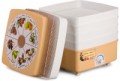 | 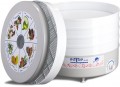 |
|---|---|---|
| ROTOR Diva Lux | ROTOR Rotor | |
| Outdated Product | from $41.20 up to $54.36 | |
| User reviews | ||
| TOP sellers | ||
High pallets. Labels on the lid with drying modes for different products. | ||
| Type | vertical fruit dryer | vertical fruit dryer |
| Drying levels | 5 pcs | 5 pcs |
| Total capacity | 17 L | 20 L |
| Power consumption | 520 W | 520 W |
Specs | ||
| Thermostat |  | |
| Temperature range | 30 – 70 °C | 0 – 70 °C |
| Location of the fan (heater) | bottom | bottom |
| Control | control knob | control knob |
| Overheat protection | |  |
| Tray material | plastic | plastic |
| Dimensions | 390x400x400 mm | 400x390x390 mm |
| Weight | 4.5 kg | 5 kg |
| Added to E-Catalog | may 2014 | october 2013 |


Compare ROTOR Diva Lux and Rotor
You may be interested in
My comparisons
ROTOR Diva Lux often compared


ROTOR Rotor often compared


Glossary
Total capacity
The total volume of all dryer trays. The larger the volume, the more products can be loaded into the device at a time. For modern dryers, a capacity of up to 10 L is considered relatively small, from 11 to 15 L — medium, from 16 to 20 L — high, and the largest models can hold more than 20 L.
Note that if you plan to dry several different types of fruits or vegetables at the same time, it is worth considering not only the total volume of the dryer, but also the number of trays (see above).
Note that if you plan to dry several different types of fruits or vegetables at the same time, it is worth considering not only the total volume of the dryer, but also the number of trays (see above).
Temperature range
The temperature range that the dryer can provide in the working chamber.
The simplest models provide only one operating temperature option, usually from 50 °C to 60 °C. More advanced devices equipped with thermostats (see above) and can have a wide range of adjustment — this is very useful, because different temperature regimes are recommended for different products. To assess the general capabilities of a particular dryer, you can use the following table of temperatures recommended for drying:
— 35...40 °C — plant stems, greens;
— 40...45 °C — bread;
— 38...42 °C (in some cases up to 45 °C) — yoghurt;
— 50...55 °C — vegetables;
— 55...60 °C — fruits;
— 65...75 °C — meat, fish.
We emphasize that these are the most general, conditional data. The specific temperature may differ from the recommended one — depending on the thickness of the slices, the specific type of food, the desired result, etc. Detailed recommendations on this matter can be found in special sources.
The simplest models provide only one operating temperature option, usually from 50 °C to 60 °C. More advanced devices equipped with thermostats (see above) and can have a wide range of adjustment — this is very useful, because different temperature regimes are recommended for different products. To assess the general capabilities of a particular dryer, you can use the following table of temperatures recommended for drying:
— 35...40 °C — plant stems, greens;
— 40...45 °C — bread;
— 38...42 °C (in some cases up to 45 °C) — yoghurt;
— 50...55 °C — vegetables;
— 55...60 °C — fruits;
— 65...75 °C — meat, fish.
We emphasize that these are the most general, conditional data. The specific temperature may differ from the recommended one — depending on the thickness of the slices, the specific type of food, the desired result, etc. Detailed recommendations on this matter can be found in special sources.
Overheat protection
Security system that turns off the power to the dryer when the critical temperature in the working chambers is reached. This does not only save food from overdrying, but also prevents more serious consequences in the first place, such as a breakdown or even an ignition in the dryer, which is fraught with fire.