
Comparison Bark B-280D vs Bark B-270D
Add to comparison | 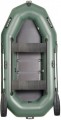 | 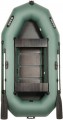 |
|---|---|---|
| Bark B-280D | Bark B-270D | |
from $188.20 | from $195.60 | |
| TOP sellers | ||
| Type | rowing | rowing |
| Number of seats | 3 | 2 |
| Load capacity | 288 kg | 300 kg |
Equipment | ||
| Bottom type | flat | flat |
| Bottom cover | lath slate | lath slate |
| Transom | in absent | in absent |
| Seats | rigid and movable | rigid and movable |
| More features | carrying handles swivel oarlocks eye roller lifeline | carrying handles swivel oarlocks eye roller lifeline |
Specs | ||
| Number of pressurized compartments | 2 | 2 |
| Balloon diameter | 36 cm | 38 cm |
| Dimensions (LxW) | 280x135 cm | 270x139 cm |
| Dimensions (folded) | 100x45x35 cm | 100x45x35 cm |
| Fabric density | 850 g/m² | 850 g/m² |
| Weight | 21 kg | 22 kg |
Items in set | ||
| Paddles |  | |
| Pump | | |
| Repair kit | | |
| Boat bag | | |
| Added to E-Catalog | march 2017 | march 2017 |


Compare Bark B-280D and B-270D
You may be interested in
My comparisons
Glossary
Number of seats
The total number of seats provided in the boat is, in fact, the maximum number of adults for which it is designed. Usually, this number corresponds to the number of seats.
There are three things to keep in mind when choosing this indicator. Firstly, with the maximum number of people in the boat, it can be quite crowded and not very comfortable. Secondly, in addition to people, such boats often have to be loaded with luggage, which can be heavy and voluminous. Thirdly, the capabilities of the boat are limited not only by the number of seats, but also by the carrying capacity (see below). Therefore, if it is planned to carry large people and/or a large amount of luggage on the ship, it is best to choose a model with a margin for the number of seats.
As for the specific number, the smallest modern boats have 1 or 2 seats. Medium-sized models with 3 or 4 seats are also extremely popular. 5-seater options are relatively rare, and the largest models can accommodate 6 or more people.
There are three things to keep in mind when choosing this indicator. Firstly, with the maximum number of people in the boat, it can be quite crowded and not very comfortable. Secondly, in addition to people, such boats often have to be loaded with luggage, which can be heavy and voluminous. Thirdly, the capabilities of the boat are limited not only by the number of seats, but also by the carrying capacity (see below). Therefore, if it is planned to carry large people and/or a large amount of luggage on the ship, it is best to choose a model with a margin for the number of seats.
As for the specific number, the smallest modern boats have 1 or 2 seats. Medium-sized models with 3 or 4 seats are also extremely popular. 5-seater options are relatively rare, and the largest models can accommodate 6 or more people.
Load capacity
The maximum weight of cargo that the boat is normally designed to carry. The cargo in this case includes both passengers and their luggage, as well as the engine and various additional equipment.
The carrying capacity stated in the characteristics clearly cannot be exceeded: although most inflatable boats are able to stay afloat even with severe overload, in such conditions controllability and stability noticeably deteriorate, wear increases and the likelihood of damage to the bottom or cylinder increases. We also note that there is no strict connection between the carrying capacity and the number of seats (see above): models with the same number of seats can differ significantly in permissible load. And it is important to take boats with a large carrying capacity if necessary, because this affects the density of materials, overall weight and price.
The carrying capacity stated in the characteristics clearly cannot be exceeded: although most inflatable boats are able to stay afloat even with severe overload, in such conditions controllability and stability noticeably deteriorate, wear increases and the likelihood of damage to the bottom or cylinder increases. We also note that there is no strict connection between the carrying capacity and the number of seats (see above): models with the same number of seats can differ significantly in permissible load. And it is important to take boats with a large carrying capacity if necessary, because this affects the density of materials, overall weight and price.
Balloon diameter
The diameter of the boat's balloon — the inflatable shell that forms the sides — in a fully inflated state. This parameter primarily affects the dimensions of the cockpit (see below): with the same dimensions of the boat, a thicker cylinder leaves less space in the cockpit. Also, the carrying capacity is somewhat related to the diameter — a large cylinder usually holds more air and gives more buoyancy; however, in fact, the possibilities for transporting goods are also highly dependent on the characteristics of the bottom and the overall strength of the structure.
Dimensions (LxW)
The dimensions of the inflated boat in length and width, along the outer edges (excluding oars, motor, etc.). This parameter allows you to estimate how much space the vessel will occupy in the working position. In addition, the first size value — length — indicates other parameters: the larger it is, the better the boat is suitable for gliding and, usually, its capacity is greater (see "Number of seats").
Weight
The total weight of the boat with oars and decking (if any), but excluding the motor and additional attachments. The lighter the boat, the more convenient it is to carry, however, a small weight can affect either the price or the quality (compared to analogues). Weight also affects speed characteristics — a lighter boat is easier to accelerate to high speed with the same motor power; however, do not forget that these characteristics also depend on the material, the shape of the bottom and many other parameters.