
Comparison Makita HR2470T vs Makita HR2470
Add to comparison | 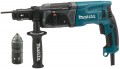 | 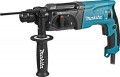 |
|---|---|---|
| Makita HR2470T | Makita HR2470 | |
from $215.96 up to $267.09 | from $192.88 | |
| User reviews | ||
| TOP sellers | ||
Model HR2470 is supplied without accessories, HR2470X includes a set of drills (5 pcs) and lubricant, HR2470X15 includes a set of drills (5 pcs), HR2470X1 includes a keyed chuck, HR2470X2 includes a keyless chuck | ||
| Operating modes | hammer drilling drilling only chiselling (demolition hammer) | hammer drilling drilling only chiselling (demolition hammer) |
Specs | ||
| Power consumption | 780 W | 780 W |
| Impact energy | 2.4 J | 2.4 J |
| Number of thrusts | 4500 bpm | 4500 bpm |
| Rotation speed | 1100 rpm | 1100 rpm |
| Reverse | brush | brush |
| Motor location | horizontal | horizontal |
Chuck | ||
| Chuck type | SDS+ keyless | SDS+ |
| Quick chuck change |  |  |
| Wood drilling max. ⌀ | 32 mm | 32 mm |
| Metal drilling max. ⌀ | 13 mm | 13 mm |
| Concrete drilling max. ⌀ | 24 mm | 24 mm |
| Max. hole saw ⌀ | 65 mm | 65 mm |
Features | ||
| Functions | safety clutch power button lock | safety clutch power button lock |
General | ||
| Power source | mains (230 V) | mains (230 V) |
| In box | additional handle depth gauge case (bag) | additional handle depth gauge case (bag) |
| Power cord length | 4 m | 4 m |
| Dimensions | 39.4x8.4x21.4 cm | 37x8.4x21.4 cm |
| Weight | 3 kg | 2.9 kg |
| Added to E-Catalog | march 2015 | june 2012 |


Compare Makita HR2470T and HR2470
Rotary hammers Makita HR2470T and Makita HR2470 have similar features, such as 780 W power consumption, 2.4 J impact energy, and 4500 bpm stroke rate. However, the HR2470T model provides a quick-release chuck, which can be more convenient for users, whereas the HR2470 does not have this feature. Additionally, the HR2470T is slightly heavier, weighing 3 kg compared to 2.9 kg for the HR2470. Both devices have a safety clutch and power button lock, and come with an additional handle and case.
You may be interested in
My comparisons
Makita HR2470T often compared


Makita HR2470 often compared


Glossary
Chuck type
The type of cartridge used in a rotary hammer to hold a working tool.
— SD+. Abbreviation for it. "Steck-Dreh-Sitzt" — "insert-turn-fixed." Today's most common rotary hammer chuck, used in low and medium power models. It has a 10mm diameter shank with 4 slots and accepts tools from 4 to 26mm in diameter and 110mm to 1000mm in length. The advantages of SDS + are the reliability of fastening and convenience when changing tools — it does not require additional devices such as keys. The main drawback is the significant beating of the tool during rotation, due to which such a cartridge is very poorly suitable for drilling.
— SDS Max. Modification of the SDS + cartridge (see above), intended for use in powerful professional models. It has a shank diameter of 18 mm and allows the use of tools with a diameter of up to 55 mm; otherwise similar to SDS+.
— SDS-Quick. A variation of the SDS cartridge (see above), in the shank under which protrusions are used instead of grooves. It is also possible to install tools with 1/4" hex shanks in such a chuck. The most common tool diameter for SDS-Quick is 4-10 mm. This chuck is used relatively rarely.
— Quick release. Chuck for holding drills and other tools used in drilling holes. The design is similar to those used in electric drills — it has 3 cams, it is designed for a too...l with a cylindrical shank without grooves, and hand force is enough to install / remove the tool. Such a cartridge is devoid of the main drawback of SDS — beats during rotation; this allows you to use the rotary hammer for drilling with good quality. On the other hand, it is much worse for chiselling than SDS. Therefore, keyless chucks are usually supplied as an accessory and are installed instead of the standard SDS chuck.
— Key. The presence of a special key cartridge in the delivery set of the rotary hammer, usually in addition to the standard SDS (see above). In terms of mounting design, this chuck is similar to the keyless chuck (see above) and is also designed for use in drilling. Its main difference lies in the method of installing / removing the tool: you can’t do this with your bare hands, you must use a special key to compress / unclench the cams. Such a system is somewhat more reliable than a quick-clamping system, but much less convenient: changing a tool takes a lot of time, and the key can be lost.
— SD+. Abbreviation for it. "Steck-Dreh-Sitzt" — "insert-turn-fixed." Today's most common rotary hammer chuck, used in low and medium power models. It has a 10mm diameter shank with 4 slots and accepts tools from 4 to 26mm in diameter and 110mm to 1000mm in length. The advantages of SDS + are the reliability of fastening and convenience when changing tools — it does not require additional devices such as keys. The main drawback is the significant beating of the tool during rotation, due to which such a cartridge is very poorly suitable for drilling.
— SDS Max. Modification of the SDS + cartridge (see above), intended for use in powerful professional models. It has a shank diameter of 18 mm and allows the use of tools with a diameter of up to 55 mm; otherwise similar to SDS+.
— SDS-Quick. A variation of the SDS cartridge (see above), in the shank under which protrusions are used instead of grooves. It is also possible to install tools with 1/4" hex shanks in such a chuck. The most common tool diameter for SDS-Quick is 4-10 mm. This chuck is used relatively rarely.
— Quick release. Chuck for holding drills and other tools used in drilling holes. The design is similar to those used in electric drills — it has 3 cams, it is designed for a too...l with a cylindrical shank without grooves, and hand force is enough to install / remove the tool. Such a cartridge is devoid of the main drawback of SDS — beats during rotation; this allows you to use the rotary hammer for drilling with good quality. On the other hand, it is much worse for chiselling than SDS. Therefore, keyless chucks are usually supplied as an accessory and are installed instead of the standard SDS chuck.
— Key. The presence of a special key cartridge in the delivery set of the rotary hammer, usually in addition to the standard SDS (see above). In terms of mounting design, this chuck is similar to the keyless chuck (see above) and is also designed for use in drilling. Its main difference lies in the method of installing / removing the tool: you can’t do this with your bare hands, you must use a special key to compress / unclench the cams. Such a system is somewhat more reliable than a quick-clamping system, but much less convenient: changing a tool takes a lot of time, and the key can be lost.
Quick chuck change
Possibility of quick replacement of the perforator chuck — usually from a regular SDS to a quick-clamping one (for more details, see "Chuck type"). Such replacement is carried out in a few seconds and does not require additional tools.
Weight
The weight of a fully assembled rotary hammer (in the case of battery power, with a standard battery installed). Unlike many other types of equipment, in the case of rotary hammers, light weight is far from always an advantage. So, heavy models are better suited for professional use — they are less prone to vibrations and, usually, are stronger, which is important when working with difficult-to-cut materials for a long time. But for small, simple works of short duration, a lot of weight is not required, and in this case, light models are useful, which do not require significant effort to hold on weight.