
Comparison Edon MIG-308 vs Edon MIG-280
Add to comparison | 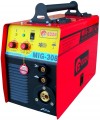 | 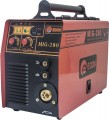 |
|---|---|---|
| Edon MIG-308 | Edon MIG-280 | |
from $251.64 up to $289.44 | from $230.48 up to $261.56 | |
| User reviews | ||
| TOP sellers | ||
Wide range of welding current adjustment. Hot start. Arc force. Europlug for hose connection. | ||
| Type | semi-automatic inverter | semi-automatic inverter |
| Welding type | MMA MIG/MAG | MMA MIG/MAG |
Specs | ||
| Welding current | DC | DC |
| Input voltage | 230 В | 230 В |
| Power consumption | 7.2 kW | 7.2 kW |
| Open circuit voltage | 55 В | 55 В |
| Min. welding current | 40 А | 20 А |
| Max. welding current | 308 А | 280 А |
| Duty cycle | 60 % | 60 % |
| Max. electrode size | 5 mm | 5 mm |
| Minimum wire diameter | 0.6 mm | 0.6 mm |
| Max. wire diameter | 1 mm | 1 mm |
| Wire feed speed | 12 m/min | 13 m/min |
| More features | Hot Start Arc Force Anti-Stick | Hot Start Arc Force Anti-Stick |
| Coil location | internal | internal |
| Detachable welding cable (MIG/MAG) | removable | removable |
General | ||
| Torch cable | 3 m | |
| Dimensions (HxWxD) | 340x205x450 mm | 340x205x450 mm |
| Weight | 14 kg | 12 kg |
| Added to E-Catalog | october 2014 | august 2014 |


Compare Edon MIG-308 and MIG-280
Comparing Edon MIG-308 and Edon MIG-280, it can be noted that both devices are semi-automatic inverters with the capability of manual arc and semi-automatic welding. The main difference lies in the maximum welding current: MIG-308 supports up to 308 A, while MIG-280 supports up to 280 A. It is also worth noting that the minimum welding current of the MIG-280 is 20 A, which can be useful for finer work. The wire feed speed of the MIG-280 is slightly higher — 13 m/min compared to 12 m/min for the MIG-308. Both devices have the same dimensions and weight, but the MIG-280 is lighter by 2 kg. The choice between them will depend on the required power and specifics of the work.
You may be interested in
My comparisons
Edon MIG-308 often compared


Edon MIG-280 often compared


Glossary
Min. welding current
The smallest current that the device is able to supply through the electrodes during operation. For different materials, different thicknesses of the parts to be welded and different types of welding itself, the optimal welding current will be different; there are special tables that allow you to determine this value. The general rule is that a high current is far from always useful: it gives a rougher seam; when working with thin materials, it is possible to melt through the junction instead of connecting the parts, not to mention excessive energy consumption. Therefore, if you have to work with parts of small thickness (2-3 mm), before choosing a welding machine, it makes sense to make sure that it is capable of delivering the desired current without “busting”.
Max. welding current
The highest current that the welding machine is capable of delivering through the electrodes during operation. In general, the higher this indicator, the thicker the electrodes the device can use and the greater the thickness of the parts with which it can work. Of course, it does not always make sense to chase high currents — they are more likely to damage thin parts. However, if you have to deal with large-scale work and a large thickness of the materials to be welded, you simply cannot do without a device with the appropriate characteristics. Optimum welding currents depending on materials, type of work (see "Type of welding"), type of electrodes, etc. can be specified in special tables. As for specific values, in the most “weak” models, the maximum current does not even reach 100 A, in the most powerful ones it can exceed 225 A and even 250 A.
Wire feed speed
Wire feed speed provided by the semi-automatic model (see "Type"). The higher the speed (with the same thickness) — the faster you can lead the electrode over the seam and the less time the process takes. On the other hand, too fast feed makes it difficult to work with seams of small length. Detailed information on the optimal wire feed speed can be found in special sources.
Torch cable
The length of the torch cable supplied with the machine.
The term "torch" is relevant for welding such as TIG (in argon, non-consumable electrode) or MIG / MAG (partially automated welding in an inert (MIG) or active (MAG) gas) - this is what the working nozzle for such welding is called. And the longer the wire with which the burner is connected to the device, the more freedom the welder has in moving, the farther he can go without moving the device itself. On the other hand, excessively long cables create problems in storage and transportation, and often during operation (you need to look for a place where to place the excess wire). Therefore, when choosing, you should proceed from what is more important for you: the ability to move away from the device or the overall compactness. As for specific length options, they usually range from 2 to 5 meters.
The term "torch" is relevant for welding such as TIG (in argon, non-consumable electrode) or MIG / MAG (partially automated welding in an inert (MIG) or active (MAG) gas) - this is what the working nozzle for such welding is called. And the longer the wire with which the burner is connected to the device, the more freedom the welder has in moving, the farther he can go without moving the device itself. On the other hand, excessively long cables create problems in storage and transportation, and often during operation (you need to look for a place where to place the excess wire). Therefore, when choosing, you should proceed from what is more important for you: the ability to move away from the device or the overall compactness. As for specific length options, they usually range from 2 to 5 meters.