
Comparison AL-KO Comfort 40.4 E vs AL-KO Comfort 40 E
Add to comparison |  | 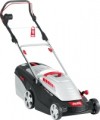 |
|---|---|---|
| AL-KO Comfort 40.4 E | AL-KO Comfort 40 E | |
| Outdated Product | from $22.36 | |
| User reviews | ||
| TOP sellers | ||
| Type | lawn mower | lawn mower |
| Motor type | electric (mains) | electric (mains) |
Mowing | ||
| Cutting width | 40 cm | 40 cm |
| Cutting system | rotary | rotary |
| Min. cutting height | 28 mm | 28 mm |
| Max. cutting height | 68 mm | 68 mm |
| Number of height settings | 6 | 6 |
| Cutting height adjustment | synchronous | synchronous |
| Recommended area | 600 m² | 600 m² |
Cleaning | ||
| Mulching |  |  |
| Grass ejection | rear ejection in a bag | rear ejection in a bag |
| Bag type | hard | hard |
| Bag volume | 43 L | 43 L |
| Full bag indicator | | |
Design | ||
| Features | handle height adjustment | |
In box | ||
| Nozzles | 2-tooth blade | 2-tooth blade |
Motor | ||
| Motor power | 1400 W | 1400 W |
General | ||
| Deck material | plastic | plastic |
| Front wheel diameter | 15.5 cm | 16.5 cm |
| Rear wheel diameter | 19 cm | 20 cm |
| Dimensions | 130x45x105 cm | |
| Weight | 19.2 kg | 19 kg |
| Added to E-Catalog | june 2025 | april 2015 |


Compare AL-KO Comfort 40.4 E and Comfort 40 E
You may be interested in
My comparisons
AL-KO Comfort 40.4 E often compared

AL-KO Comfort 40 E often compared


Glossary
Mulching
Possibility of work of a lawn-mower in the mode of a mulching.
Mulching is the chopping and automatic spreading of mowed grass over the site. This is one of the most convenient and at the same time practical methods of vegetation disposal. So, it does not need to be collected, and the resulting coating (mulch) performs a number of useful functions: it fertilizes the soil, reduces its heating and evaporation of moisture in hot weather, and also keeps the top layer loose.
Note that some lawn mowers allow you to use a nozzle purchased separately for mulching. However, such models are not included in this category: mulching in our catalog is indicated only for models that support this function out of the box.
Mulching is the chopping and automatic spreading of mowed grass over the site. This is one of the most convenient and at the same time practical methods of vegetation disposal. So, it does not need to be collected, and the resulting coating (mulch) performs a number of useful functions: it fertilizes the soil, reduces its heating and evaporation of moisture in hot weather, and also keeps the top layer loose.
Note that some lawn mowers allow you to use a nozzle purchased separately for mulching. However, such models are not included in this category: mulching in our catalog is indicated only for models that support this function out of the box.
Features
- Self-propelled. In self-propelled lawn mowers, the engine rotates not only the cutting tool, but also the wheels of the lawn mower; thus, the user does not need to push it in front of him - it is enough just to set and control the direction of movement. This is convenient, but such models are more expensive than non-self-propelled ones. This is due not only to the complexity of the design, but also to the fact that such devices require more powerful engines - after all, power must be divided between the cutting nozzle and the chassis. For the same reason, a self-propelled unit will be less productive and efficient than a non-self-propelled analogue of the same power. However, some types of lawn mowers are by definition self-propelled - in particular, these are heavy professional models that would be difficult to push with your hands, as well as mini tractor riders(see "Type").
- Height adjustable handle. Possibility of height adjustment of the lawn mower handle, which allows to optimally adjust the device to the height of the user. This feature is especially useful for short or, conversely, tall people - by default, lawn mower handles are made for medium height, and it would be inconvenient to work with the unit without height adjustment.
- Piano wheels. The lawn mower has special, so-called. caster wheels (similar to th...ose used, for example, in supermarket carts). These wheels automatically turn in the direction of movement of the device, which significantly reduces the turning radius of the lawn mower and increases its maneuverability. At the same time, it is worth noting that this design is usually used only for the front wheels, while the rear ones remain rigidly fixed to the axle. So moving such a structure sideways still does not work.
- Flushing fitting. The presence of a fitting in the lawn mower for connecting a garden hose; usually such a fitting is located on the deck and is designed for a standard connector used in hoses. In accordance with the name, this function allows you to rinse the deck and blade of the unit, removing grass residues and other contaminants from them: just connect the hose, turn on the working nozzle and give water. This is much more convenient than removing the deck and washer blade by hand - especially when it comes to a heavy professional mower or rider (see "Type").
- Cup holder. The presence of a cup holder in the design of the lawn mower - a specialized stand for glasses and relatively small bottles. Such a stand usually has a characteristic recess where a container with a drink for the operator is installed. Often, cupholders are made in pairs, they are placed on a separate panel between the tubes of the handle of the unit. There are coasters in traditional lawn mowers and riders (mini tractors).
- Height adjustable handle. Possibility of height adjustment of the lawn mower handle, which allows to optimally adjust the device to the height of the user. This feature is especially useful for short or, conversely, tall people - by default, lawn mower handles are made for medium height, and it would be inconvenient to work with the unit without height adjustment.
- Piano wheels. The lawn mower has special, so-called. caster wheels (similar to th...ose used, for example, in supermarket carts). These wheels automatically turn in the direction of movement of the device, which significantly reduces the turning radius of the lawn mower and increases its maneuverability. At the same time, it is worth noting that this design is usually used only for the front wheels, while the rear ones remain rigidly fixed to the axle. So moving such a structure sideways still does not work.
- Flushing fitting. The presence of a fitting in the lawn mower for connecting a garden hose; usually such a fitting is located on the deck and is designed for a standard connector used in hoses. In accordance with the name, this function allows you to rinse the deck and blade of the unit, removing grass residues and other contaminants from them: just connect the hose, turn on the working nozzle and give water. This is much more convenient than removing the deck and washer blade by hand - especially when it comes to a heavy professional mower or rider (see "Type").
- Cup holder. The presence of a cup holder in the design of the lawn mower - a specialized stand for glasses and relatively small bottles. Such a stand usually has a characteristic recess where a container with a drink for the operator is installed. Often, cupholders are made in pairs, they are placed on a separate panel between the tubes of the handle of the unit. There are coasters in traditional lawn mowers and riders (mini tractors).
Front wheel diameter
The diameter of the front wheels of the unit. For more information about this parameter, see "Rear wheel diameter" — everything written there is true in this case. We only note that the front wheels relatively rarely have their own drive, so the diameter for them is not as important as for the rear ones.
Rear wheel diameter
The diameter of the rear wheels of the unit.
Larger wheels, on the one hand, increase cross-country ability and allow you to effectively overcome pits, bumps and other obstacles on rough terrain. On the other hand, they cost more, are more expensive, and in self-propelled models, they also require more traction from the engine.
This indicator is often determined by the type of lawn mower (see above). So, mowers and riders, by definition, have large wheels, because they are designed for difficult terrain, and in a minitractor, the wheels must also withstand a fairly significant weight. But robotic lawn mowers, on the contrary, are used mainly on flat surfaces with low grass, and they do not need large wheels.
If you have to choose among classic lawn mowers, where this parameter can be different, you should proceed from the planned working conditions. So, if we are talking about a flat lawn — you can not pay much attention to this indicator; but for rough terrain with pits, tubercles, ditches, etc., you should choose larger wheels — from 25 cm or more.
Larger wheels, on the one hand, increase cross-country ability and allow you to effectively overcome pits, bumps and other obstacles on rough terrain. On the other hand, they cost more, are more expensive, and in self-propelled models, they also require more traction from the engine.
This indicator is often determined by the type of lawn mower (see above). So, mowers and riders, by definition, have large wheels, because they are designed for difficult terrain, and in a minitractor, the wheels must also withstand a fairly significant weight. But robotic lawn mowers, on the contrary, are used mainly on flat surfaces with low grass, and they do not need large wheels.
If you have to choose among classic lawn mowers, where this parameter can be different, you should proceed from the planned working conditions. So, if we are talking about a flat lawn — you can not pay much attention to this indicator; but for rough terrain with pits, tubercles, ditches, etc., you should choose larger wheels — from 25 cm or more.