
Comparison be quiet! Dark Rock Elite vs be quiet! Pure Loop 360
Add to comparison | 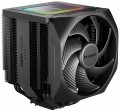 |  |
|---|---|---|
| be quiet! Dark Rock Elite | be quiet! Pure Loop 360 | |
| Compare prices 4 | from $136.26 | |
| TOP sellers | ||
The Dark Rock Elite cooler's front fan mounting system with height adjustment guides provides a maximum clearance of 71mm above the motherboard's second DIMM slot, allowing you to install modules with any heatsinks. The top cover, installed on the cooler's radiator, is equipped with ARGB lighting. Thanks to the nickel-plated base, liquid metal-based thermal interfaces can be used with Dark Rock Elite. | ||
Main specs | ||
| Features | for CPU | for CPU |
| Product type | air cooler | liquid cooling |
| Air flow direction | sideways (dispersion) | |
| Double-tower |  |  |
| Max. TDP | 280 W | |
Fan | ||
| Number of fans | 2 | 3 |
| Fan size | 135 mm | 120 mm |
| Fan thickness | 25 mm | |
| Bearing | Fluid Dynamic Bearing | Rifle Bearing |
| Max. RPM | 2000 rpm | 2000 rpm |
| Speed controller | auto (PWM) | auto (PWM) |
| replaceable | | |
| Min noise level | 11 dB | 19 dB |
| Noise level | 26 dB | 36 dB |
| Power source | 4-pin | 4-pin |
Radiator | ||
| Heat pipes | 7 | |
| Heatpipe contact | indirect | |
| Heatsink material | aluminium / copper | aluminum |
| Plate material | nickel-plated copper | copper |
| RAM space | 32 mm | |
| Socket | AMD AM4 AMD AM5 Intel 1150 Intel 1155/1156 Intel 1151 / 1151 v2 Intel 1200 Intel 1700 / 1851 | AMD AM2/AM3/FM1/FM2 AMD AM4 Intel 1150 Intel 1155/1156 Intel 2011 / 2011 v3 Intel 2066 Intel 1151 / 1151 v2 Intel 1200 |
Liquid cooling | ||
| Heatsink size | 360 mm | |
| Pump rotation speed | 5500 rpm | |
| Pipe length | 400 mm | |
| Pump power source | 3-pin | |
General | ||
| Lighting | | |
| Lighting colour | ARGB | |
| Lighting sync | multi compatibility | |
| Mount type | bilateral (backplate) | bilateral (backplate) |
| Manufacturer's warranty | 3 years | 3 years |
| Dimensions | 120x136x168 mm | 397x120x52 mm |
| Height | 168 mm | |
| Weight | 1340 g | 1360 g |
| Added to E-Catalog | november 2023 | october 2020 |





Compare be quiet! Dark Rock Elite and Pure Loop 360
Price comparison
You may be interested in
My comparisons
be quiet! Dark Rock Elite often compared


Glossary
Product type
- Fan. A classic fan is a motor with blades that provides air flow; This also includes sets of several fans. In any case, such devices should not be confused with coolers (see below) - fans do not have radiators. Almost all solutions of this type are designed for cases (see “Purpose”), only a few models are designed for “airflow” hard drives or chipsets.
— Reversible fan. A type of fan (see above) in which the impeller is turned in the opposite direction. This was done so that when placed behind the “system unit” case or in its upper part, it was possible to give the assembly an aesthetic appearance - the reversible fan will be installed with the front side for air airflow. Such solutions are used mainly for the side walls of “aquarium” type housings.
— Radiator. Design made of heat-conducting material with a special ribbed shape. This shape provides a large area of contact with air, and as a result, good heat transfer. Radiators do not consume energy and operate absolutely silently, but are not very efficient. Therefore, in their pure form they are extremely rare, and such models are intended either for low-power PC components with low heat dissipation (energy-efficient processors, hard drives, etc.), or for assembling an active cooler (see below) from a separately purchased fan and radiator (this option is found among solutions for video cards).
<...br> — Active cooler. A device in the form of a radiator with a fan installed on it; Moreover, in many models, the radiator does not directly contact the cooled component, but is connected to it using heat pipes, while air is blown out to the side (the so-called tower layout, especially popular in systems for CPU; for more details, see “Blowing air flow”) . In any case, such designs, on the one hand, are relatively simple and inexpensive, on the other hand, they are quite effective, making them an extremely popular type of CO. In particular, it is in this format that most solutions for processors are produced (including tower and boxed ones), and in general, coolers can be used for almost any component of the system, with the exception of the case.
- Water cooling. Water cooling systems consist of three main parts: a water block in direct contact with the component to be cooled (usually the processor), an external cooler, and a pump (either separate or built into the cooler). These components are connected by hoses through which water (or another similar coolant) circulates - it provides heat transfer. And the cooling unit is usually a cooler - a system of fans and radiators that dissipates thermal energy into the surrounding air. Water systems are noticeably more efficient than active coolers (see above); they are suitable even for very powerful and “hot” CPUs, which traditional coolers have difficulty coping with. On the other hand, this type of cooling is quite cumbersome and difficult to install, and is not cheap.
— LSS kit. Kit for self-assembly of a liquid (water) cooling system. In this case, it is understood that the entire system is supplied in the form of a set of parts, from which the customer must assemble the finished life-support system himself. Its installation is more complex than traditional water systems. Therefore, there are only a few LSS kits produced, and they are designed mainly for enthusiasts who like to experiment with the design and design of their PCs.
- Backplate. A solid metal plate used as a fastening element for the cooling system. Serves to prevent bending of the motherboard or video card when deploying a heat dissipation system, and also provides passive cooling of the rear side of tech modules with which it is adjacent.
— Water block VRM. A water block that provides effective cooling of the elements of the VRM (Voltage Regulator Module) power subsystem of the central processor.
— CPU water block. A copper or nickel heat exchanger designed to remove heat from the CPU through the coolant. Used in water cooling systems for computers. Most often, processor water blocks are equipped with mounts for specific processor platforms.
- GPU water block. Liquid cooling units for maximum efficient heat removal from the video card. Similar solutions are produced for a specific group of video cards on one graphics processor. GPU water blocks consist of two main parts: the top, where a copper alloy heat sink is located, a plastic cover with liquid channels and a casing to give rigidity to the structure, as well as a metal plate at the bottom of the block on the back side of the printed circuit board.
— A set of fastenings. A set of fasteners for mounting cooling systems on elements of a computer motherboard. Available for specific socket versions.
— Reversible fan. A type of fan (see above) in which the impeller is turned in the opposite direction. This was done so that when placed behind the “system unit” case or in its upper part, it was possible to give the assembly an aesthetic appearance - the reversible fan will be installed with the front side for air airflow. Such solutions are used mainly for the side walls of “aquarium” type housings.
— Radiator. Design made of heat-conducting material with a special ribbed shape. This shape provides a large area of contact with air, and as a result, good heat transfer. Radiators do not consume energy and operate absolutely silently, but are not very efficient. Therefore, in their pure form they are extremely rare, and such models are intended either for low-power PC components with low heat dissipation (energy-efficient processors, hard drives, etc.), or for assembling an active cooler (see below) from a separately purchased fan and radiator (this option is found among solutions for video cards).
<...br> — Active cooler. A device in the form of a radiator with a fan installed on it; Moreover, in many models, the radiator does not directly contact the cooled component, but is connected to it using heat pipes, while air is blown out to the side (the so-called tower layout, especially popular in systems for CPU; for more details, see “Blowing air flow”) . In any case, such designs, on the one hand, are relatively simple and inexpensive, on the other hand, they are quite effective, making them an extremely popular type of CO. In particular, it is in this format that most solutions for processors are produced (including tower and boxed ones), and in general, coolers can be used for almost any component of the system, with the exception of the case.
- Water cooling. Water cooling systems consist of three main parts: a water block in direct contact with the component to be cooled (usually the processor), an external cooler, and a pump (either separate or built into the cooler). These components are connected by hoses through which water (or another similar coolant) circulates - it provides heat transfer. And the cooling unit is usually a cooler - a system of fans and radiators that dissipates thermal energy into the surrounding air. Water systems are noticeably more efficient than active coolers (see above); they are suitable even for very powerful and “hot” CPUs, which traditional coolers have difficulty coping with. On the other hand, this type of cooling is quite cumbersome and difficult to install, and is not cheap.
— LSS kit. Kit for self-assembly of a liquid (water) cooling system. In this case, it is understood that the entire system is supplied in the form of a set of parts, from which the customer must assemble the finished life-support system himself. Its installation is more complex than traditional water systems. Therefore, there are only a few LSS kits produced, and they are designed mainly for enthusiasts who like to experiment with the design and design of their PCs.
- Backplate. A solid metal plate used as a fastening element for the cooling system. Serves to prevent bending of the motherboard or video card when deploying a heat dissipation system, and also provides passive cooling of the rear side of tech modules with which it is adjacent.
— Water block VRM. A water block that provides effective cooling of the elements of the VRM (Voltage Regulator Module) power subsystem of the central processor.
— CPU water block. A copper or nickel heat exchanger designed to remove heat from the CPU through the coolant. Used in water cooling systems for computers. Most often, processor water blocks are equipped with mounts for specific processor platforms.
- GPU water block. Liquid cooling units for maximum efficient heat removal from the video card. Similar solutions are produced for a specific group of video cards on one graphics processor. GPU water blocks consist of two main parts: the top, where a copper alloy heat sink is located, a plastic cover with liquid channels and a casing to give rigidity to the structure, as well as a metal plate at the bottom of the block on the back side of the printed circuit board.
— A set of fastenings. A set of fasteners for mounting cooling systems on elements of a computer motherboard. Available for specific socket versions.
Air flow direction
The direction in which the active cooler (see "Type") airflow exits.
This parameter is relevant primarily for models used with processors, but the options can be as follows:
— Sideways (scattering). Operation format typical for coolers of the so-called tower design. In these models, the fan is mounted perpendicular to the substrate in contact with the processor, due to which the airflow moves parallel to the motherboard. This ensures maximum efficiency: the heated air does not return to the processor and other system components, but is dissipated in the case (and almost immediately goes outside if the computer has at least one case fan). The main disadvantage of this option is the large height of the structure, which can make it difficult to place it in some system units. However, in most cases this point is not fundamental — especially when it comes to a powerful cooling system designed for an advanced system with a performant "hot" processor. So, it is side dissipation that is the most popular option nowadays — especially in coolers with a maximum TDP of 150 W and higher (although more modest models often use this layout).
— Down (to the motherboard). This format of operation allows you to "lay" the fan with a heatsink flat on the motherboard, significantly reducing the height of the entire cooler (compared to models using side blowing). On the other hand, this format of...work is not very efficient — after all, before dissipating through the case, hot air again blows over the board with the processor. So nowadays, this option is relatively rare, and mainly in low-power coolers with an acceptable TDP of up to 150 W. And you should pay attention to such models mainly when there is little space in the case and a small cooler height is more important than high efficiency.
This parameter is relevant primarily for models used with processors, but the options can be as follows:
— Sideways (scattering). Operation format typical for coolers of the so-called tower design. In these models, the fan is mounted perpendicular to the substrate in contact with the processor, due to which the airflow moves parallel to the motherboard. This ensures maximum efficiency: the heated air does not return to the processor and other system components, but is dissipated in the case (and almost immediately goes outside if the computer has at least one case fan). The main disadvantage of this option is the large height of the structure, which can make it difficult to place it in some system units. However, in most cases this point is not fundamental — especially when it comes to a powerful cooling system designed for an advanced system with a performant "hot" processor. So, it is side dissipation that is the most popular option nowadays — especially in coolers with a maximum TDP of 150 W and higher (although more modest models often use this layout).
— Down (to the motherboard). This format of operation allows you to "lay" the fan with a heatsink flat on the motherboard, significantly reducing the height of the entire cooler (compared to models using side blowing). On the other hand, this format of...work is not very efficient — after all, before dissipating through the case, hot air again blows over the board with the processor. So nowadays, this option is relatively rare, and mainly in low-power coolers with an acceptable TDP of up to 150 W. And you should pay attention to such models mainly when there is little space in the case and a small cooler height is more important than high efficiency.
Double-tower
A feature found in some active CPU coolers (see "Intended Use").
For tower arrangements in general, see Airflow Blowing below. And the double-tower design means that the cooler has two working blocks — that is, two fans and two radiators. Accordingly, there are more heat pipes in the design than in single-tower models — at least 4 of them, and more often 5 – 6 or even more. Such an arrangement can significantly increase the cooling efficiency; on the other hand, it also significantly affects the dimensions, weight and price.
For tower arrangements in general, see Airflow Blowing below. And the double-tower design means that the cooler has two working blocks — that is, two fans and two radiators. Accordingly, there are more heat pipes in the design than in single-tower models — at least 4 of them, and more often 5 – 6 or even more. Such an arrangement can significantly increase the cooling efficiency; on the other hand, it also significantly affects the dimensions, weight and price.
Max. TDP
The maximum TDP provided by the cooling system. Note that this parameter is indicated only for solutions equipped with heatsinks (see "Type"); for separately made fans, the efficiency is determined by other parameters, primarily by the air flow values (see above).
TDP can be described as the amount of heat that a cooling system is able to remove from a serviced component. Accordingly, for the normal operation of the entire system, it is necessary that the TDP of the cooling system is not lower than the heat dissipation of this component (heat dissipation data is usually indicated in the detailed characteristics of the components). And it is best to select coolers with a power margin of at least 20 – 25% — this will give an additional guarantee in case of forced operation modes and emergency situations (including clogging of the case and reduced air exchange efficiency).
As for specific numbers, the most modest modern cooling systems provide TDP up to 100 W, the most advanced — up to 250 W and even higher.
TDP can be described as the amount of heat that a cooling system is able to remove from a serviced component. Accordingly, for the normal operation of the entire system, it is necessary that the TDP of the cooling system is not lower than the heat dissipation of this component (heat dissipation data is usually indicated in the detailed characteristics of the components). And it is best to select coolers with a power margin of at least 20 – 25% — this will give an additional guarantee in case of forced operation modes and emergency situations (including clogging of the case and reduced air exchange efficiency).
As for specific numbers, the most modest modern cooling systems provide TDP up to 100 W, the most advanced — up to 250 W and even higher.
Number of fans
The number of fans in the design of the cooling system. More fans provide higher efficiency (all else being equal); on the other hand, the dimensions and the noise generated during operation also increase accordingly. Also, note that other things being equal, a smaller number of large fans is considered more advanced than numerous small ones; see "Fan diameter" for details.
Fan size
The diameter of the fan(s) used in the cooling system.
In general, larger fans are considered more advanced than smaller ones: they allow you to create a powerful air flow at a relatively low speed and low noise level. On the other hand, a large diameter means large dimensions, weight and price. As for specific figures, 40 mm and 60 mm models are considered miniature, 80 mm and 92 mm are medium, 120 mm and 135 / 140 mm are large, and even 200 mm fans are found in the most powerful case systems.
In general, larger fans are considered more advanced than smaller ones: they allow you to create a powerful air flow at a relatively low speed and low noise level. On the other hand, a large diameter means large dimensions, weight and price. As for specific figures, 40 mm and 60 mm models are considered miniature, 80 mm and 92 mm are medium, 120 mm and 135 / 140 mm are large, and even 200 mm fans are found in the most powerful case systems.
Fan thickness
This parameter must be considered in the context of whether the fan will fit into the computer case. Standard case fans are available in the order of 25 mm in thickness. Low-profile coolers with a thickness of about 15 mm are designed for small-sized cases, where saving space is extremely important. Fans of large thickness (30-40 mm) boast high cooling efficiency due to the increased impeller dimensions. However, they are noisier than standard models at the same speed and do not always fit into the case normally, sometimes touching other components.
Bearing
The type of bearing used in the cooling fan(s).
The bearing is the piece between the rotating axle of the fan and the fixed base that supports the axle and reduces friction. The following types of bearings are found in modern fans:
— Sliding. The action of these bearings is based on direct contact between two solid surfaces, carefully polished to reduce friction. Such devices are simple, reliable and durable, but their efficiency is rather low — rolling, and even more so the hydrodynamic and magnetic principle of operation (see below), provide much less friction.
— Rolling. They are also called "ball bearings", since the "intermediaries" between the axis of rotation and the fixed base are balls (less often — cylindrical rollers) fixed in a special ring. When the axis rotates, such balls roll between it and the base, due to which the friction force is very low — noticeably lower than in plain bearings. On the other hand, the design turns out to be more expensive and complex, and in terms of reliability it is somewhat inferior to both the same plain bearings and more advanced hydrodynamic devices (see below). Therefore, although rolling bearings are quite widespread nowadays, however, in general, they are much less common than the mentioned varieties.
— Hydrodynamic. Bearings of this type are filled with a special liquid; when rotate...d, it creates a layer on which the moving part of the bearing slides. In this way, direct contact between hard surfaces is avoided and friction is significantly reduced compared to previous types. Also, these bearings are quiet and very reliable. Of their shortcomings, a relatively high cost can be noted, but in fact this moment often turns out to be invisible against the background of the price of the entire system. Therefore, this option is extremely popular nowadays, it can be found in cooling systems of all levels — from low-cost to advanced.
— Magnetic centering. Bearings based on the principle of magnetic levitation: the rotating axis is "suspended" in a magnetic field. Thus, it is possible (as in hydrodynamic ones) to avoid contact between solid surfaces and further reduce friction. Considered the most advanced type of bearings, they are reliable and quiet, but expensive.
The bearing is the piece between the rotating axle of the fan and the fixed base that supports the axle and reduces friction. The following types of bearings are found in modern fans:
— Sliding. The action of these bearings is based on direct contact between two solid surfaces, carefully polished to reduce friction. Such devices are simple, reliable and durable, but their efficiency is rather low — rolling, and even more so the hydrodynamic and magnetic principle of operation (see below), provide much less friction.
— Rolling. They are also called "ball bearings", since the "intermediaries" between the axis of rotation and the fixed base are balls (less often — cylindrical rollers) fixed in a special ring. When the axis rotates, such balls roll between it and the base, due to which the friction force is very low — noticeably lower than in plain bearings. On the other hand, the design turns out to be more expensive and complex, and in terms of reliability it is somewhat inferior to both the same plain bearings and more advanced hydrodynamic devices (see below). Therefore, although rolling bearings are quite widespread nowadays, however, in general, they are much less common than the mentioned varieties.
— Hydrodynamic. Bearings of this type are filled with a special liquid; when rotate...d, it creates a layer on which the moving part of the bearing slides. In this way, direct contact between hard surfaces is avoided and friction is significantly reduced compared to previous types. Also, these bearings are quiet and very reliable. Of their shortcomings, a relatively high cost can be noted, but in fact this moment often turns out to be invisible against the background of the price of the entire system. Therefore, this option is extremely popular nowadays, it can be found in cooling systems of all levels — from low-cost to advanced.
— Magnetic centering. Bearings based on the principle of magnetic levitation: the rotating axis is "suspended" in a magnetic field. Thus, it is possible (as in hydrodynamic ones) to avoid contact between solid surfaces and further reduce friction. Considered the most advanced type of bearings, they are reliable and quiet, but expensive.
Min noise level
The lowest noise level produced by the cooling system during operation.
This parameter is indicated only for those models that have capacity control and can operate at reduced power. Accordingly, the minimum noise level is the noise level in the most “quiet” mode, the volume of work, which this model cannot be less than.
These data will be useful, first of all, to those who are trying to reduce the noise level as much as possible and, as they say, “fight for every decibel”. However, it is worth noting here that in many models the minimum values are about 15 dB, and in the quietest — only 10 – 11 dB. This volume is comparable to the rustling of leaves and is practically lost against the background of ambient noise even in a residential area at night, not to mention louder conditions, and the difference between 11 and 18 dB in this case is not significant for human perception. A comparison table for sound starting from 20 dB is given in the "Noise level" section below.
This parameter is indicated only for those models that have capacity control and can operate at reduced power. Accordingly, the minimum noise level is the noise level in the most “quiet” mode, the volume of work, which this model cannot be less than.
These data will be useful, first of all, to those who are trying to reduce the noise level as much as possible and, as they say, “fight for every decibel”. However, it is worth noting here that in many models the minimum values are about 15 dB, and in the quietest — only 10 – 11 dB. This volume is comparable to the rustling of leaves and is practically lost against the background of ambient noise even in a residential area at night, not to mention louder conditions, and the difference between 11 and 18 dB in this case is not significant for human perception. A comparison table for sound starting from 20 dB is given in the "Noise level" section below.