
Comparison NB F160 vs NB F80
Add to comparison | 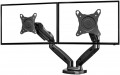 |  |
|---|---|---|
| NB F160 | NB F80 | |
from $26.36 | from $18.73 | |
| TOP sellers | ||
Built-in gas spring has adjustable stiffness | Built-in gas spring has adjustable stiffness | |
| Type | desktop mount | desktop mount |
| Number of mounts | for 2 panels | |
| Installation | clamp | clamp |
Specs | ||
| Minimum size | 17 " | 17 " |
| Max. size | 27 " | 27 " |
| Max. weight | 6.5 kg | 9 kg |
| Adjustments | tilt turn depth adjustment slide rotation height adjustment | tilt turn depth adjustment slide rotation height adjustment |
Angles and dimensions | ||
| Upward tilt angle | 35 ° | 35 ° |
| Downward tilt angle | 50 ° | 50 ° |
| Turn angle | 360 ° | 360 ° |
| Rotation angle | 180 ° | 180 ° |
| VESA | 75x75mm 100x100 mm | 75x75mm 100x100 mm |
General | ||
| Cable management |  | |
| Dimensions (WxHxD) | 390x280x100 mm | |
| Added to E-Catalog | september 2017 | september 2017 |


Compare NB F160 and F80
You may be interested in
NB F160 often compared


NB F80 often compared


Glossary
Number of mounts
The number of mounts for TVs provided in the design of the stand. Most modern stands have one mount — after all, most often TVs are used as a single device, and this is quite enough. However, there are models on which you can install more TVs — up to 6. This allows you to create a "wall" of several screens put together.
In addition, there are options for 2 mounts, where TVs are installed "back to back", with screens in different directions; they are usually of the ceiling type (see above). The area of application for such mounts is primarily public places where public address systems are used: waiting rooms of railway stations and airports, large shopping centers, etc.
The most advanced models offer 3 or 4 mounts, mainly for creating "video walls" of monitors.
Note that in our catalog this parameter is indicated only for models with two or more mounts; if it is not specified, it means that there is only one mount.
In addition, there are options for 2 mounts, where TVs are installed "back to back", with screens in different directions; they are usually of the ceiling type (see above). The area of application for such mounts is primarily public places where public address systems are used: waiting rooms of railway stations and airports, large shopping centers, etc.
The most advanced models offer 3 or 4 mounts, mainly for creating "video walls" of monitors.
Note that in our catalog this parameter is indicated only for models with two or more mounts; if it is not specified, it means that there is only one mount.
Max. weight
The maximum weight of the TV that can be installed on the mount/stand; more specifically, it is the maximum weight that the mount/stand can support for an indefinitely long time without any negative consequences. Unlike the screen size described above, this parameter is accurate and should not be exceeded: perhaps the stand/mount will not break immediately under excess weight, but this can happen at any time, and such a breakdown is not covered by the warranty.
It is worth considering that for classic stands with several shelves (see "Type"), the maximum wheight is usually indicated for the entire structure as a whole and is the sum of the loads for each individual shelf. Thus, the maximum weight of the TV is not limited by the total maximum wheight, but by the maximum wheight for one shelf. This does not apply to stands with mounts; they usually list the maximum wheight on the mount, in which case it corresponds to the maximum weight of the TV.
The screen size is directly related to the maximum wheight (after all, a large TV weighs more). Typically, for screens up to 24", structures with a maximum wheight of about 5-6 kg are usually quite enough, for a 32" device, about 12 kg may be needed, large 55" screens reach a maximum weight of about 25-30 kg, and in the case of plasma panels, these figures increase by 1.5-2 times However, anyway, before choosing, you should clarify the weight of the specific TV model for which the stand/mount is selected.
It is worth considering that for classic stands with several shelves (see "Type"), the maximum wheight is usually indicated for the entire structure as a whole and is the sum of the loads for each individual shelf. Thus, the maximum weight of the TV is not limited by the total maximum wheight, but by the maximum wheight for one shelf. This does not apply to stands with mounts; they usually list the maximum wheight on the mount, in which case it corresponds to the maximum weight of the TV.
The screen size is directly related to the maximum wheight (after all, a large TV weighs more). Typically, for screens up to 24", structures with a maximum wheight of about 5-6 kg are usually quite enough, for a 32" device, about 12 kg may be needed, large 55" screens reach a maximum weight of about 25-30 kg, and in the case of plasma panels, these figures increase by 1.5-2 times However, anyway, before choosing, you should clarify the weight of the specific TV model for which the stand/mount is selected.