
Comparison Volt Polska Sinus PRO 800E 800 VA vs Powercom BNT-800A 800 VA
Add to comparison | 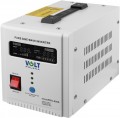 | 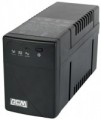 |
|---|---|---|
| Volt Polska Sinus PRO 800E 800 VA | Powercom BNT-800A 800 VA | |
| Outdated Product | from $72.76 up to $79.12 | |
| User reviews | ||
| TOP sellers | ||
| Type | smart | smart |
| Form factor | standard (Tower) | standard (Tower) |
| Full load operating time | 5 min | |
| Half load operating time | 10 min | |
| Switching to battery | 4 ms | 4 ms |
Input | ||
| Input voltage | 1 phase (230V) | 1 phase (230V) |
| Input voltage range | 170 – 270 В | 165-275 В |
| Max. current | 10 А | 6 А |
| Bypass (direct connection) | in absent | in absent |
Output | ||
| Output voltage | 1 phase (230V) | 1 phase (230V) |
| Peak output power | 800 VA | 800 VA |
| Rated output power | 500 W | 480 W |
| Output voltage accuracy | 1 % | |
| Efficiency | 92 % | |
| Output waveform | pure sine wave (PSW) | similar to a sinusoid (approximated) |
| Output frequency | 50-60 Hz | |
| Redundant sockets | 2 | |
| Socket type | type E (FR) | |
| Reserved C13/C14 connectors | 2 | |
Battery | ||
| Battery included | no battery | |
| Battery(ies) connection to UPS | 12 В | |
| Total battery capacity | 9 Ah | |
| Number of batteries | 1 | |
| Full charge time | 360 min | |
| Min. charging current | 5 А | |
| Max. charging current | 10 А | |
| Charging current regulation |  |  |
| External battery connection | | |
Protection | ||
| Protection | short circuit protection overload protection noise filtering sound alarm | short circuit protection overload protection noise filtering sound alarm |
| Fuse | auto | melting |
| Surge protection | 460 J | |
General | ||
| Screen | | |
| Carrying handle | | |
| Operating temperature | 0 °C ~ +40 °C | 0 – 40 °C |
| Noise level | 40 dB | |
| Dimensions (HxWxD) | 155x138x226 mm | 135x97x320 mm |
| Weight | 4.5 kg | 6.5 kg |
| Added to E-Catalog | november 2022 | april 2012 |


Compare Volt Polska Sinus PRO 800E and Powercom BNT-800A
You may be interested in
My comparisons
Volt Polska Sinus PRO 800E often compared


Powercom BNT-800A often compared


Glossary
Full load operating time
UPS continuous operation time from a fully charged battery when connected to a load with a power equal to the UPS output power (maximum or effective, depending on the type of load, see the relevant paragraphs for details). For a UPS designed to work with a home or office PC, a time of about 10-15 minutes is considered sufficient, this is enough to save data and complete work. To power servers, it is worth using devices with an operating time of 20 minutes or more.
Half load operating time
UPS continuous operation time from a fully charged battery when connected to a load with a power equal to half the output power of the UPS (maximum or effective, depending on the type of load, see below for details). The operating time with such a load is much longer than for a full load, and even in the simplest models it can reach 20-30 minutes.
Input voltage range
In this case, the input voltage range is implied, in which the UPS is able to supply a stable voltage to the load only due to its own regulators, without switching to the battery. For redundant UPSs (see "Type") this range is quite small, approximately 190 to 260 V; for interactive and especially inverter ones, it is much wider. Some UPS models allow you to manually set the input voltage range.
Max. current
The maximum current drawn by the UPS. In fact, the current reaches its maximum value only when the UPS is operating from the mains with maximum load power and a completely discharged battery. However, when calculating the load on the power grid, this parameter should be taken into account.
Rated output power
The effective output power of the UPS is, in fact, the maximum active power of the load that can be connected to the device.
Active power is consumed directly for the operation of the device; it is expressed in watts. In addition to it, most AC devices also consume reactive power, which is "wasted" (relatively speaking) is spent by coils and capacitors. Apparent power (denoted in volt-amperes) is precisely the sum of active and reactive power; it is this characteristic that should be used in accurate electrical calculations. See "Maximum output power" for details; here we note that when selecting a UPS for a relatively simple application, it is quite possible to use only effective power. This is at least easier than converting the watts claimed in the characteristics of the connected devices into full power volt-amps.
The most modest modern "uninterruptibles" give out less than 500 watts. 501 – 1000 W can be considered an average value, 1.1 – 2 kW is above average, and in the most powerful models this figure exceeds 2 kW and can reach very impressive values (up to 1000 kW or more in some industrial class UPS).
Active power is consumed directly for the operation of the device; it is expressed in watts. In addition to it, most AC devices also consume reactive power, which is "wasted" (relatively speaking) is spent by coils and capacitors. Apparent power (denoted in volt-amperes) is precisely the sum of active and reactive power; it is this characteristic that should be used in accurate electrical calculations. See "Maximum output power" for details; here we note that when selecting a UPS for a relatively simple application, it is quite possible to use only effective power. This is at least easier than converting the watts claimed in the characteristics of the connected devices into full power volt-amps.
The most modest modern "uninterruptibles" give out less than 500 watts. 501 – 1000 W can be considered an average value, 1.1 – 2 kW is above average, and in the most powerful models this figure exceeds 2 kW and can reach very impressive values (up to 1000 kW or more in some industrial class UPS).
Output voltage accuracy
This parameter characterizes the degree of difference between the AC voltage at the output of the UPS and the perfect voltage, the graph of which has the shape of a regular sinusoid. The perfect voltage is so named because it is the most uniform and creates the least unnecessary load on the connected devices. Thus, the distortion of the output voltage is one of the most important parameters that determine the quality of the power received by the load. A distortion level of 0% means that the UPS produces a perfect sine wave, up to 5% — slight sine wave distortion, up to 18% — strong distortion, from 18% to 40% — a trapezoidal signal, more than 40% — a square wave.
Efficiency
Efficiency (coefficient of performance) in the case of a UPS is the ratio of its output power to the power consumed from the network. This is one of the main parameters that determine the overall efficiency of the device: the higher the efficiency, the less energy the UPS wastes (due to heating parts, electromagnetic radiation, etc.). In modern models, the efficiency value can reach 99%.
Output waveform
The form of a graph describing the changes in voltage at the output of the UPS.
— Pure sinewave. The classic AC voltage graph, this is how it changes in an AC network; The sine wave output means that the UPS has little to no distortion compared to the mains. As a result, such power is suitable for any AC technology, and some devices (for example, audio equipment) generally require an exceptionally pure sine wave. However, this requires rather complex technical solutions, and therefore this waveform can be found in expensive interactive and inverter UPSs.
— Simulated sine wave (approximated). This signal has a shape close to a sinusoid, but the graph line in this case is not smooth, but consists of separate rectangular “steps”. This waveform is provided by most inexpensive UPSs; such devices are inexpensive and quite suitable for powering computer equipment.
— Pure sinewave. The classic AC voltage graph, this is how it changes in an AC network; The sine wave output means that the UPS has little to no distortion compared to the mains. As a result, such power is suitable for any AC technology, and some devices (for example, audio equipment) generally require an exceptionally pure sine wave. However, this requires rather complex technical solutions, and therefore this waveform can be found in expensive interactive and inverter UPSs.
— Simulated sine wave (approximated). This signal has a shape close to a sinusoid, but the graph line in this case is not smooth, but consists of separate rectangular “steps”. This waveform is provided by most inexpensive UPSs; such devices are inexpensive and quite suitable for powering computer equipment.
Output frequency
The frequency (frequency range) of the AC voltage output by the UPS. For computer technology, the frequency range of 47-53 Hz is considered normal, although the smaller the deviation from the 50 Hz standard, the better. On the other hand, in some UPS models, this frequency can be automatically synchronized with the frequency of the mains — so the power supplied to the load will not differ regardless of whether the load is powered by the mains or from the battery. In this case, a wider frequency range, on the contrary, is more desirable.