
Comparison Joolz Aer2 vs Cybex Coya
Add to comparison |  | 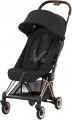 |
|---|---|---|
| Joolz Aer2 | Cybex Coya | |
from $355.58 | Outdated Product | |
| TOP sellers | ||
Convenient folding system, stands upright when folded. Shoulder strap. Large shopping basket. | ||
| Design | pushchairs | pushchairs |
| Type | single | single |
| Folding system | booklike type | booklike type |
Carrycot and walking unit | ||
| Backrest tilt adjustment |  | |
| Adjustable footrest |  | |
| Bumper bar | | |
| Viewing window | | |
| Harness type | 5-point | 5-point |
Frame and chassis | ||
| Depreciation | spring | spring |
| Number of wheels | 4 | 4 |
| Carrycot installation | | |
| Car seat installation | | |
| Handle type | classic | classic |
| Carrying handle / strap | | |
Wheels | ||
| Swivel wheels | | |
| Lockable front wheels | | |
| Rear wheels without axle | | |
| Wheels | eVA foam rubber | |
| Wheels rim | plastic | plastic |
| Front wheels diameter | 15 cm | |
| Rear wheels diameter | 16 cm | |
Delivery set | ||
| In box | seat unit shopping basket | seat unit shopping basket |
General | ||
| Max. weight | 22 kg | 22 kg |
| Dimensions (unfolded) (LxWxH) | 83×45×106 cm | 79x44x105 cm |
| Chassis width | 45 cm | 44 cm |
| Dimensions (folded) (LxWxH) | 55x45x23.5 cm | 52x44x18 cm |
| Weight (complete) | 6.3 kg | 6.6 kg |
| Country of origin | Netherlands | Germany |
| Added to E-Catalog | august 2025 | august 2023 |


Compare Joolz Aer2 and Cybex Coya
You may be interested in
Cybex Coya often compared


Glossary
Adjustable footrest
The ability to adjust the position of the footrest, on which the legs of the baby in the pushchair rest.
A similar ability is found in some pushchairs, transformers and pushchairs of universal pushchairs (see "Design"). The footrest itself is an inclined surface attached to the front edge of the seat. Adjustable footrests are those in which the angle of inclination can be adjusted; in many models, this footrest can even be set horizontally. This makes it possible to choose the most comfortable position for the baby's legs in different situations.
A similar ability is found in some pushchairs, transformers and pushchairs of universal pushchairs (see "Design"). The footrest itself is an inclined surface attached to the front edge of the seat. Adjustable footrests are those in which the angle of inclination can be adjusted; in many models, this footrest can even be set horizontally. This makes it possible to choose the most comfortable position for the baby's legs in different situations.
Bumper bar
A feature used in walking seat units where the child is sitting. The bumper bar is a horizontal handrail installed in front of the baby seat. The child can hold on to such a handrail; in addition, such a device reduces the risk of falling out of the stroller, and for additional security, the bumper bar can be supplemented with a crotch strap (see below). To make the stroller more convenient to store, transport and clean, the bumper bar is often made removable; in some models, it also serves as a carrying handle (see above).
Viewing window
A window made of transparent or translucent material, built into the hood that covers the cradle or seating unit. In the version with a walking block, the viewing window is usually located so that the parent can see the baby directly while moving, without being distracted from controlling the stroller. In cradles, the parent can see the child through a window by approaching the stroller from the side of the hood (that is, on the opposite side of the handle); implementations with a window in the front hemisphere of the hood are less common. In addition, a baby lying in a cradle can usually see the outside world through the window (primarily the sky above the stroller). The viewing window can be made in the form of oilcloth or a mesh mosquito net, through the holes of which air freely penetrates, but insects and small debris raised by the wind are retained.
Carrycot installation
The ability to install a carrycot on the pushchair — a characteristic basket in which the baby can lie comfortably.
Carrycots are used mainly for very young kids (up to 6 – 8 months), who can not yet sit normally in seat units. And the possibility of installing such an accessory by definition is available in all universal pushchairs (see "Design"). Also, the replacement of the seat unit on the carrycot can be provided in pushchair models. In fact, such pushchairs are also universal – but they are not initially equipped with carrycots, and therefore belong to the category of pushchairs.
Carrycots are used mainly for very young kids (up to 6 – 8 months), who can not yet sit normally in seat units. And the possibility of installing such an accessory by definition is available in all universal pushchairs (see "Design"). Also, the replacement of the seat unit on the carrycot can be provided in pushchair models. In fact, such pushchairs are also universal – but they are not initially equipped with carrycots, and therefore belong to the category of pushchairs.
Lockable front wheels
A feature found on models with swivel wheels (see above). Locking allows you to fix such wheels straight, without the possibility of turning to the sides; in some situations — for example, when driving over difficult terrain — locked wheels are more convenient than swivel wheels. And when manoeuvrability is required, the locks can be easily released.
Rear wheels without axle
Pushchairs in which the rear wheels are mounted on completely separate stands, without any additional bridge between them.
The main advantage of rear wheels without an axle is that the legs of the parent following the stroller do not touch the bridge between the wheels. In addition, this feature slightly increases the mobility (allows the stroller to pass between the wheels lying on the road objects, without clinging to them with the axle).
The main advantage of rear wheels without an axle is that the legs of the parent following the stroller do not touch the bridge between the wheels. In addition, this feature slightly increases the mobility (allows the stroller to pass between the wheels lying on the road objects, without clinging to them with the axle).
Wheels
The type of wheels installed on the pushchair.
The most popular in our time are rubber wheels, including air-filled ones. Plastic wheels are used mainly in inexpensive pushchairs to further reduce the cost, while gel ones, on the contrary, are considered a very advanced option. Polyurethane wheels and EVA foam-filled wheels are also widely used. Here is a more detailed description of each of these varieties:
— Rubber. Rubber solid tires, found in many modern pushchairs, are popular due to their affordability, quiet operation, and smooth ride over bumps. While less effective on uneven surfaces compared to air-filled and gel wheels, solid rubber tires are cost-effective, low-maintenance, damage-resistant, and suitable for various wheel diameters, including small ones.
— Air-filled. Air-filled rubber tires, commonly featured on pushchairs, offer a softer ride and facilitate easy maneuvering on uneven surfaces and high curbs. Despite their higher cost, they require periodic maintenance to ensure proper pressure and protection against cuts or punctures. However, users find air-filled wheels manageable, as they are thick and less prone to damage.
— Plastic. Plastic wheels, commonly featuring both tire and rim made from this material (thou...gh some have metal rims), are known for their simplicity and affordability. However, they lack durability, reliability, and effective vibration dampening due to their hardness. Typically found in low-cost pushchairs with small wheels designed for flat surfaces.
— Gel. Wheels similar in design to air-filled tires (see the relevant paragraph), but filled not with air, but with a special gel. The main advantage of this option is its insensitivity to small punctures and cuts: coming out, the gel in the tire in contact with air almost instantly solidifies, effectively sealing the damage. In addition, such wheels are virtually maintenance-free — they do not need to be inflated. The disadvantages of gel tires include high cost and somewhat higher rigidity than air-filled tires (although in terms of softness of running such wheels are still noticeably superior to rubber and even more so to plastic ones).
— Polyurethane. Solid polyurethane tires offer excellent maneuverability, shock absorption, puncture resistance, and durability. They are unaffected by extreme temperature changes and are cost-effective, making them a common choice for various pushchair types.
— EVA. Wheels made of microporous foam rubber, specifically EVA material, offer high elasticity, excellent cushioning, and wear resistance. Lightweight and puncture-resistant, these wheels provide a smooth pushchair ride. However, they may stiffen in cold winter weather.
The most popular in our time are rubber wheels, including air-filled ones. Plastic wheels are used mainly in inexpensive pushchairs to further reduce the cost, while gel ones, on the contrary, are considered a very advanced option. Polyurethane wheels and EVA foam-filled wheels are also widely used. Here is a more detailed description of each of these varieties:
— Rubber. Rubber solid tires, found in many modern pushchairs, are popular due to their affordability, quiet operation, and smooth ride over bumps. While less effective on uneven surfaces compared to air-filled and gel wheels, solid rubber tires are cost-effective, low-maintenance, damage-resistant, and suitable for various wheel diameters, including small ones.
— Air-filled. Air-filled rubber tires, commonly featured on pushchairs, offer a softer ride and facilitate easy maneuvering on uneven surfaces and high curbs. Despite their higher cost, they require periodic maintenance to ensure proper pressure and protection against cuts or punctures. However, users find air-filled wheels manageable, as they are thick and less prone to damage.
— Plastic. Plastic wheels, commonly featuring both tire and rim made from this material (thou...gh some have metal rims), are known for their simplicity and affordability. However, they lack durability, reliability, and effective vibration dampening due to their hardness. Typically found in low-cost pushchairs with small wheels designed for flat surfaces.
— Gel. Wheels similar in design to air-filled tires (see the relevant paragraph), but filled not with air, but with a special gel. The main advantage of this option is its insensitivity to small punctures and cuts: coming out, the gel in the tire in contact with air almost instantly solidifies, effectively sealing the damage. In addition, such wheels are virtually maintenance-free — they do not need to be inflated. The disadvantages of gel tires include high cost and somewhat higher rigidity than air-filled tires (although in terms of softness of running such wheels are still noticeably superior to rubber and even more so to plastic ones).
— Polyurethane. Solid polyurethane tires offer excellent maneuverability, shock absorption, puncture resistance, and durability. They are unaffected by extreme temperature changes and are cost-effective, making them a common choice for various pushchair types.
— EVA. Wheels made of microporous foam rubber, specifically EVA material, offer high elasticity, excellent cushioning, and wear resistance. Lightweight and puncture-resistant, these wheels provide a smooth pushchair ride. However, they may stiffen in cold winter weather.
Front wheels diameter
The diameter of the front wheels installed in the stroller.
At the same time, the front wheels are not as important for mobility as the rear wheels: for example, to overcome obstacles, the stroller is often lifted "on its toes" by tilting it towards itself, with only the rear wheels working. Therefore, the diameter of the front wheels may be noticeably smaller than the rear wheels. It should be noted here that the small size also has its advantages — the wheels are lighter.
Speaking of specific numbers, diameter up to 15 cm is considered very modest, 16 — 20 cm — small, 21 — 25 cm — medium, 26 — 30 cm is larger than average and more than 30 cm is large.
At the same time, the front wheels are not as important for mobility as the rear wheels: for example, to overcome obstacles, the stroller is often lifted "on its toes" by tilting it towards itself, with only the rear wheels working. Therefore, the diameter of the front wheels may be noticeably smaller than the rear wheels. It should be noted here that the small size also has its advantages — the wheels are lighter.
Speaking of specific numbers, diameter up to 15 cm is considered very modest, 16 — 20 cm — small, 21 — 25 cm — medium, 26 — 30 cm is larger than average and more than 30 cm is large.
Rear wheels diameter
The diameter of the rear wheels installed in the stroller.
The larger the wheel — the better it overcomes obstacles and bumps, the more convenient it is to drive the stroller over mud, snow and other difficult surfaces. For the rear wheels these moments are most relevant: for example, when driving the stroller over obstacles, it is usually tilted towards itself, so that the front wheels are in the air, and the rear wheels have to overcome the obstacle. On the other hand, small wheels weigh less and are easier to move, they are better suited for flat surfaces. So choose a stroller on this indicator should take into account the roads on which it has to be driven. If you plan to move on flat floors, good asphalt and stroller ramps — it is worth choosing small wheels, up to 20 cm. For difficult terrain, driving on mud and snow, regular overcoming steps and curbs it makes sense to pay attention to wheels in 30 cm and larger. And the diameter of 20 — 30 cm is an average option — it is suitable if you have to ride mainly on flat surfaces, but occasionally there is a need to overcome obstacles.
The larger the wheel — the better it overcomes obstacles and bumps, the more convenient it is to drive the stroller over mud, snow and other difficult surfaces. For the rear wheels these moments are most relevant: for example, when driving the stroller over obstacles, it is usually tilted towards itself, so that the front wheels are in the air, and the rear wheels have to overcome the obstacle. On the other hand, small wheels weigh less and are easier to move, they are better suited for flat surfaces. So choose a stroller on this indicator should take into account the roads on which it has to be driven. If you plan to move on flat floors, good asphalt and stroller ramps — it is worth choosing small wheels, up to 20 cm. For difficult terrain, driving on mud and snow, regular overcoming steps and curbs it makes sense to pay attention to wheels in 30 cm and larger. And the diameter of 20 — 30 cm is an average option — it is suitable if you have to ride mainly on flat surfaces, but occasionally there is a need to overcome obstacles.