
Comparison be quiet! Pure Power 12 BP004 vs be quiet! System Power 10 BN330
Add to comparison |  | 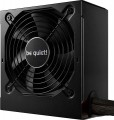 |
|---|---|---|
| be quiet! Pure Power 12 BP004 | be quiet! System Power 10 BN330 | |
| Compare prices 1 | from $463.00 | |
| User reviews | ||
| TOP sellers | ||
80 PLUS Gold Certificate. CWT platform. | ||
| Power | 850 W | 850 W |
| Form factor | ATX | ATX |
Specs | ||
| PFC | active | active |
| Efficiency | 91 % | 89 % |
| Cooling system | active | active |
| Fan size | 120 mm | 120 mm |
| Fan bearing | sliding | sliding |
| Certification | 80+ Gold | 80+ Gold |
| ATX12V version | 3.1 | 2.52 |
| EPS12V version | 2.92 | 2.92 |
Power connectors | ||
| MB/CPU power supply | 24+8+8(4+4) pin | 24+8+8(4+4) pin |
| SATA | 6 | 6 |
| MOLEX | 1 | 1 |
| PCIe 8pin (6+2) | 3 | 4 |
| PCIe 16pin | 1 pcs | |
| Cable system | non-modular | non-modular |
Cable length | ||
| MB | 550 mm | 550 mm |
| CPU | 600 mm | 600 mm |
| SATA | 500 mm | 450 mm |
| MOLEX | 800 mm | 790 mm |
| PCIe | 500 mm | 500 mm |
Max. power | ||
| +3.3V | 20 А | 22 А |
| +5V | 20 А | 22 А |
| +12V1 | 70.9 А | 40 А |
| +12V2 | 36 А | |
| -12V | 0.3 А | 0.3 А |
| +5Vsb | 3 А | 3 А |
| +12V | 850 W | 850 W |
| +3.3V +5V | 120 W | 120 W |
General | ||
| Over voltage protection (OVP) |  | |
| Over power protection (OPP) | | |
| Short circuit protection (SCP) | | |
| Protection | OTP, OCP, UVP, SIP | OTP, OCP, UVP, SIP |
| Noise level | 25 dB | 10 dB |
| Manufacturer's warranty | 10 years | 5 years |
| Dimensions (HxWxD) | 86x150x160 mm | 86x150x140 mm |
| Weight | 2.7 kg | 2.14 kg |
| Added to E-Catalog | december 2024 | december 2022 |



Compare be quiet! Pure Power 12 and System Power 10
Price comparison
You may be interested in
be quiet! Pure Power 12 often compared


be quiet! System Power 10 often compared


Glossary
Efficiency
Efficiency, in this case — the ratio of the power of the power supply (see "Power") to its power consumption. The higher the efficiency, the more efficient the power supply, the less energy it consumes from the network at the same output power, and the cheaper it is to operate. Efficiency may differ depending on the load; the characteristics can indicate both the minimum efficiency and its value at an average load (50%).
It should be noted that compliance with one or another level of 80PLUS efficiency directly depends on this indicator (for more details, see "Certificate").
It should be noted that compliance with one or another level of 80PLUS efficiency directly depends on this indicator (for more details, see "Certificate").
ATX12V version
A standard for power supplies that supplements the ATX specifications regarding power supply along the 12 V line. Introduced into use since the time of the Intel Pentium 4 processor. In the first series of the standard, the +5 V line was mainly used; from version 2.0, the +12 V line was introduced to fully power the components computer. Also in the second generation, a 24-pin power connector appeared, used in most modern motherboards.
PCIe 8pin (6+2)
Number of 8-pin PCIe power connectors (6+2) provided in the PSU design.
Additional PCIe power connectors (of all formats) are used for additional power to types of internal peripherals that require more than the 75W supplied directly through the PCIe slot on the motherboard (a typical example is graphics cards). In PC components, there are two types of such connectors — 6-pin, providing up to 75W of additional power, and 8-pin, giving up to 150W. The 8-pin (6+2) connectors used in power supplies are universal: they can work with both 6-pin and 8-pin connectors on the expansion board. Therefore, this type of connector is the most popular in modern PSUs.
As for the quantity, there are models on sale with 1 PCIe 8-pin (6+2) connector, 2 such connectors, 3 connectors, 4 connectors, and in some cases — 6 or more. Several of these connectors can be useful, for example, when connecting multiple graphics cards — or for a powerful high-performance video adapter equipped with multiple additional PCIe power connectors.
Additional PCIe power connectors (of all formats) are used for additional power to types of internal peripherals that require more than the 75W supplied directly through the PCIe slot on the motherboard (a typical example is graphics cards). In PC components, there are two types of such connectors — 6-pin, providing up to 75W of additional power, and 8-pin, giving up to 150W. The 8-pin (6+2) connectors used in power supplies are universal: they can work with both 6-pin and 8-pin connectors on the expansion board. Therefore, this type of connector is the most popular in modern PSUs.
As for the quantity, there are models on sale with 1 PCIe 8-pin (6+2) connector, 2 such connectors, 3 connectors, 4 connectors, and in some cases — 6 or more. Several of these connectors can be useful, for example, when connecting multiple graphics cards — or for a powerful high-performance video adapter equipped with multiple additional PCIe power connectors.
PCIe 16pin
The 16-pin PCIe power connector is designed to replace the existing 8-pin counterparts. It consists of twelve lines for current supply and four more for data transmission. The connector provides up to 600 watts of additional power, which is a fourfold increase in power compared to the 8-pin versions of the interface. Additional PCIe connectors of all formats are used to power those types of internal peripherals that no longer have enough with the 75 watts delivered directly through the PCIe slot on the motherboard.
+3.3V
The maximum values of current and power that the PSU can provide on individual power lines.
The power line can be simply described as a pair of contacts for connecting a particular load; one of these contacts is “ground” (with zero voltage), and the second has a certain voltage with a plus or minus sign, this voltage corresponds to the voltage of the power line. In this paragraph, it is + 3.3V (such power is present in 20- and 24-pin connectors for motherboards, in SATA power connectors and some other types of connectors).
In general, power and currents are rather specific parameters that the average user rarely needs — mainly when connecting high-power components such as video cards, as well as when starting a PSU without a computer to power other electronics (for example, amateur radio stations). It is also worth mentioning that the sum of the maximum powers on all lines can be higher than the total output power of the PSU — this means that all lines cannot operate at full power at the same time. Accordingly, when the PSU is fully loaded, some of them will produce less power than the maximum possible.
The power line can be simply described as a pair of contacts for connecting a particular load; one of these contacts is “ground” (with zero voltage), and the second has a certain voltage with a plus or minus sign, this voltage corresponds to the voltage of the power line. In this paragraph, it is + 3.3V (such power is present in 20- and 24-pin connectors for motherboards, in SATA power connectors and some other types of connectors).
In general, power and currents are rather specific parameters that the average user rarely needs — mainly when connecting high-power components such as video cards, as well as when starting a PSU without a computer to power other electronics (for example, amateur radio stations). It is also worth mentioning that the sum of the maximum powers on all lines can be higher than the total output power of the PSU — this means that all lines cannot operate at full power at the same time. Accordingly, when the PSU is fully loaded, some of them will produce less power than the maximum possible.
+5V
The maximum current that the PSU is capable of issuing + 5V to the power line. For more information about power lines in general, see "+3.3V". Also note here that + 5V power, in addition to connectors for motherboards (for 20 and 24 pins), is also found in Molex and SATA plugs, as well as some other specific types of connectors.
+12V1
The maximum current the PSU can deliver on the first +12V power line.
For more information on power lines in general, see the "+3.3V" section. Here, it is worth mentioning that 12V is the most popular voltage among computer power connectors. It is used in almost all such connectors (with few exceptions), and some plugs (for example, additional PCI-E power with 6 or 8 connectors) use only 12-volt lines — specifically in the +12V format. The division of +12V power into several separate lines is done for safety reasons — to reduce the current going through each individual wire and thus prevent excessive load and overheating of the wiring. However, some manufacturers do not specify the maximum current for individual +12V lines and provide only the overall value in the specifications; in such cases, this number is indicated in this section.
For more information on power lines in general, see the "+3.3V" section. Here, it is worth mentioning that 12V is the most popular voltage among computer power connectors. It is used in almost all such connectors (with few exceptions), and some plugs (for example, additional PCI-E power with 6 or 8 connectors) use only 12-volt lines — specifically in the +12V format. The division of +12V power into several separate lines is done for safety reasons — to reduce the current going through each individual wire and thus prevent excessive load and overheating of the wiring. However, some manufacturers do not specify the maximum current for individual +12V lines and provide only the overall value in the specifications; in such cases, this number is indicated in this section.
+12V2
The maximum current that the PSU can deliver on the second +12V power rail.
For more information on power rails in general, see the section "+3.3V". Here, it is worth mentioning that 12V is the most popular voltage among computer power connectors. It is used in almost all such connectors (with a few exceptions), and some plugs (such as the additional PCI-E power with 6 or 8 connectors) use only 12-volt rails — specifically in the +12V format. The division of +12V power into several separate rails is used for safety reasons — to reduce the current flowing through each individual wire and thus prevent excessive load and overheating of the wiring. However, some manufacturers do not specify the maximum current for separate +12V rails and only provide the overall value in the specifications; in such cases, this number is indicated in the "+12V1" section.
For more information on power rails in general, see the section "+3.3V". Here, it is worth mentioning that 12V is the most popular voltage among computer power connectors. It is used in almost all such connectors (with a few exceptions), and some plugs (such as the additional PCI-E power with 6 or 8 connectors) use only 12-volt rails — specifically in the +12V format. The division of +12V power into several separate rails is used for safety reasons — to reduce the current flowing through each individual wire and thus prevent excessive load and overheating of the wiring. However, some manufacturers do not specify the maximum current for separate +12V rails and only provide the overall value in the specifications; in such cases, this number is indicated in the "+12V1" section.
Noise level
The noise level produced by the power supply.
Usually, the characteristics indicate the average value of the noise level during normal operation. The lower this value, the quieter the power supply and the more comfortable it is to use. However, it is worth noting that modern computer PSUs produce very little noise. So, in the quietest models, this figure does not exceed 20 dB — this is no louder than the rustling of leaves in a light breeze, such a sound is almost inaudible and is quite acceptable even in a residential area at night. Also acceptable for this application are noise sources of 21 – 25 dB(corresponding to a whisper at a distance of about 1 m) and 26 – 30 dB(wall clock ticking). Noise of more than 30 dB is already considered quite significant for computer PSUs; according to sanitary standards, such equipment in residential premises can only be used during the day.
When choosing a power supply for this indicator, it is worth considering a few points. First, noise reduction comes at a cost: it can affect the cooling performance and/or cost of the device. Secondly, the noise from the power supply is often lost against the background of louder PC components — for example, powerful cooling systems for the CPU or graphics card. Thirdly, the very environment where the PC is installed can be noisy — an example is a...n office or coworking. Thus, specifically looking for a low-noise model makes sense mainly in cases where maximum silence is crucial for you.
Usually, the characteristics indicate the average value of the noise level during normal operation. The lower this value, the quieter the power supply and the more comfortable it is to use. However, it is worth noting that modern computer PSUs produce very little noise. So, in the quietest models, this figure does not exceed 20 dB — this is no louder than the rustling of leaves in a light breeze, such a sound is almost inaudible and is quite acceptable even in a residential area at night. Also acceptable for this application are noise sources of 21 – 25 dB(corresponding to a whisper at a distance of about 1 m) and 26 – 30 dB(wall clock ticking). Noise of more than 30 dB is already considered quite significant for computer PSUs; according to sanitary standards, such equipment in residential premises can only be used during the day.
When choosing a power supply for this indicator, it is worth considering a few points. First, noise reduction comes at a cost: it can affect the cooling performance and/or cost of the device. Secondly, the noise from the power supply is often lost against the background of louder PC components — for example, powerful cooling systems for the CPU or graphics card. Thirdly, the very environment where the PC is installed can be noisy — an example is a...n office or coworking. Thus, specifically looking for a low-noise model makes sense mainly in cases where maximum silence is crucial for you.