
Comparison Nikon Z6 III body vs Nikon Z6 II body
Add to comparison | 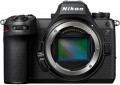 | 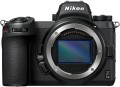 |
|---|---|---|
| Nikon Z6 III body | Nikon Z6 II body | |
from $3,049.99 | Compare prices 7 | |
| TOP sellers | ||
Wi-Fi 802.11ac. Full frame. Smartphone control. 5-axis matrix stabilization. Fast and tenacious autofocus. High rate of fire. OLED viewfinder. Auxiliary screen on the top end. Swivel touch display. | Wi-Fi 802.11ac. Full frame. Smartphone control. 5-axis matrix stabilization. Fast and tenacious autofocus. High rate of fire. OLED viewfinder. Auxiliary screen on the top end. Swivel touch display. | |
| Camera type | "mirrorless" (MILC) | "mirrorless" (MILC) |
| DxOMark rating | 94 | |
Sensor | ||
| Sensor | CMOS BSI | CMOS BSI |
| Sensor size | full frame | full frame |
| Total MP | 27 | 28 |
| Effective MP number | 25 | 25 |
| Maximum image size | 6048x4032 px | 6048x4024 px |
| Light sensitivity (ISO) | 50 - 204800 | 50-204800 |
| RAW format recording |  | |
Lens | ||
| Mount (bayonet) | Nikon Z | Nikon Z |
| Manual focus | | |
| Image stabilization | with matrix shift | with matrix shift |
Photo shooting | ||
| HDR | | |
| 2 control dials | | |
| White balance measuring | | |
| Auto bracketing | | |
| Exposure modes | auto shutter priority aperture priority manual mode | auto shutter priority aperture priority manual mode |
| Metering system | point centre-weighted sensor (estimated) | point centre-weighted sensor (estimated) |
Video recording | ||
| Full HD (1080) | 1920x1080 px 240 fps | 1920x1080 px 120 fps |
| Ultra HD (4K) | 5496x2904 px 60 fps | 3840x2160 px 30 fps |
| File recording formats | H.264, H.265 | MPEG-4, H.264 |
| Manual video focus | | |
| Connection ports | HDMI v 1.4 headphone Jack microphone Jack | HDMI v 1.4 headphone Jack microphone Jack |
Focus | ||
| Autofocus modes | one shot tracking in face | one shot tracking in face |
| Focus points | 273 шт | 273 шт |
| Touch focus | | |
| Contour enhancement | | |
Viewfinder and shutter | ||
| Viewfinder | electronic | electronic |
| Viewfinder crop | 0.8 x | 0.8 x |
| Frame coverage | 100 % | |
| Shutter speed | 900 - 1/16000 с | 900 - 1/8000 с |
| Continuous shooting | 20 fps | 14 fps |
| Shutter type | electronic/mechanical | mechanical |
Screen | ||
| Screen size | 3.1 '' | 3.2 '' |
| Screen resolution | 2100 thousand pixels | 2100 thousand pixels |
| Touch screen | | |
| Rotary display | | |
| Additional screen | | |
Memory and communications | ||
| Memory cards types | XQD, CFexpress Type B, SD | XQD, CFexpress Type B, SD |
| Communications | Wi-Fi Bluetooth smartphone control | Wi-Fi Bluetooth smartphone control |
Flash | ||
| Built-in flash |  | |
| External flash connect | | |
Power source | ||
| Power source | battery | battery |
| Battery model | EN-EL15c | EN-EL15c |
| Shots per charge | 380 шт | 410 шт |
General | ||
| Material | aluminium alloy | aluminium alloy |
| Protection | dustproof, waterproof | dustproof, waterproof |
| Dimensions (WxHxD) | 139x102x74 mm | 134x101x70 mm |
| Weight | 760 g | 705 g |
| Color | ||
| Added to E-Catalog | june 2024 | november 2020 |




Compare Nikon Z6 III and Z6 II
Price comparison
You may be interested in
My comparisons
Nikon Z6 III often compared


Nikon Z6 II often compared


Glossary
DxOMark rating
The result shown by the camera in the DxOMark ranking.
DxOMark is one of the most popular and respected resources for expert camera testing. According to the test results, the camera receives a certain number of points; The more points, the higher the final score.
DxOMark is one of the most popular and respected resources for expert camera testing. According to the test results, the camera receives a certain number of points; The more points, the higher the final score.
Total MP
The total number of individual light sensitive dots (pixels) provided in the camera's sensor. Denoted in megapixels - millions of pixels.
The total number of MPs, as a rule, is greater than the number of megapixels from which the frame is directly built (for more details, see "Effective number of MPs"). This is due to the presence of service areas on the matrix. In general, this parameter is more of a reference than practically significant: a larger total number of MPs with the same size and effective resolution means a slightly smaller size of each pixel, and, accordingly, an increased likelihood of noise (especially at high ISO values).
The total number of MPs, as a rule, is greater than the number of megapixels from which the frame is directly built (for more details, see "Effective number of MPs"). This is due to the presence of service areas on the matrix. In general, this parameter is more of a reference than practically significant: a larger total number of MPs with the same size and effective resolution means a slightly smaller size of each pixel, and, accordingly, an increased likelihood of noise (especially at high ISO values).
Maximum image size
The maximum size of photos taken by the camera in normal (non-panoramic) mode. In fact, this paragraph indicates the highest resolution of photography — in pixels vertically and horizontally, for example, 3000x4000. This indicator directly depends on the resolution of the matrix: the number of dots in the image cannot exceed the effective number of megapixels (see above). For example, for the same 3000x4000, the matrix must have an effective resolution of at least 3000*4000 = 12 million dots, that is, 12 MP.
Theoretically, the larger the size of the photo, the more detailed the image, the more small details can be conveyed on it. At the same time, the overall image quality (including the visibility of fine details) depends not only on resolution, but also on a number of other technical and software factors; see "Effective MP number" for more details.
Theoretically, the larger the size of the photo, the more detailed the image, the more small details can be conveyed on it. At the same time, the overall image quality (including the visibility of fine details) depends not only on resolution, but also on a number of other technical and software factors; see "Effective MP number" for more details.
Light sensitivity (ISO)
The sensitivity range of a digital camera matrix. In digital photography, light sensitivity is expressed in the same ISO units as in film photography; however, unlike film, the light sensitivity of the sensor in a digital camera can be changed, which gives you more options for adjusting shooting parameters. High maximum light sensitivity is important if you have to use a lens with a low aperture (see Aperture), as well as when shooting dimly lit scenes and fast-moving objects; in the latter case, high ISO allows you to use low shutter speeds, which minimizes image blur. However, note that with an increase in the value of the applied ISO, the level of noise in the resulting images also increases.
Full HD (1080)
The maximum resolution and frame rate of video captured by the camera in Full HD (1080p).
The traditional Full HD video resolution in this case is 1920x1080; other options are more specific and practically do not occur in modern cameras. Regarding the frame rate, it is worth noting first of all that a normal (not slow-motion) video is shot at a speed of up to 60 fps, and in this case, the higher the frame rate, the smoother the video will be, the less jerks will be noticeable when moving in the frame. If the frame rate is 100 fps or higher, this usually means that the camera has a slow-motion video mode.
The traditional Full HD video resolution in this case is 1920x1080; other options are more specific and practically do not occur in modern cameras. Regarding the frame rate, it is worth noting first of all that a normal (not slow-motion) video is shot at a speed of up to 60 fps, and in this case, the higher the frame rate, the smoother the video will be, the less jerks will be noticeable when moving in the frame. If the frame rate is 100 fps or higher, this usually means that the camera has a slow-motion video mode.
Ultra HD (4K)
The maximum resolution and frame rate of video captured by the camera in the Ultra HD (4K) standard.
UHD 4K refers to resolutions with a frame size of approximately 4,000 horizontal pixels. Specifically, in cameras for video shooting, resolutions of 3840x2160 and 4096x2160 are most often used. Regarding the frame rate, it is worth noting first of all that a normal (not slow-motion) video is shot at a speed of up to 60 fps, and in this case, the higher the frame rate, the smoother the video will be, the less jerks will be noticeable when moving in the frame. If the frame rate is 100 fps or higher, this usually means that the camera has a slow-motion video mode.
UHD 4K refers to resolutions with a frame size of approximately 4,000 horizontal pixels. Specifically, in cameras for video shooting, resolutions of 3840x2160 and 4096x2160 are most often used. Regarding the frame rate, it is worth noting first of all that a normal (not slow-motion) video is shot at a speed of up to 60 fps, and in this case, the higher the frame rate, the smoother the video will be, the less jerks will be noticeable when moving in the frame. If the frame rate is 100 fps or higher, this usually means that the camera has a slow-motion video mode.
File recording formats
File formats in which the camera can record video. Given that the footage is designed to be viewed on an external screen, you should make sure that the playback device (DVD player, media centre, etc.) is able to work with the appropriate formats. At the same time, many camera models themselves can play the role of a player by connecting to a TV via an audio / video output or HDMI (see the corresponding paragraphs of the glossary). And if the video materials are to be viewed on a computer, you should not pay special attention to this parameter at all: problems with format incompatibility in such cases rarely occur, but are usually solved by installing the appropriate codec.
Frame coverage
The ratio, expressed as a percentage, between the portion of the image that the photographer sees in the viewfinder (see above) and the image that is actually captured by the camera when shooting. Most often, it is specified as a percentage of the width and height of the frame, rather than the area.
Modern digital cameras often have viewfinders with a frame coverage of less than 100% - thus, the frame includes not only the visible scene, but also some space beyond its edges. This creates some inconveniences - in particular, it may be necessary to crop the photo to ensure a pre-conceived composition. Therefore, a viewfinder with 100% coverage is still considered the ideal option. Some time ago, such systems were found mainly in premium cameras, but now, thanks to cheaper prices and technological developments, they can be installed even in relatively inexpensive amateur compacts (see "Product type").
Modern digital cameras often have viewfinders with a frame coverage of less than 100% - thus, the frame includes not only the visible scene, but also some space beyond its edges. This creates some inconveniences - in particular, it may be necessary to crop the photo to ensure a pre-conceived composition. Therefore, a viewfinder with 100% coverage is still considered the ideal option. Some time ago, such systems were found mainly in premium cameras, but now, thanks to cheaper prices and technological developments, they can be installed even in relatively inexpensive amateur compacts (see "Product type").
Shutter speed
The range of shutter speeds that the camera is capable of shooting.
Exposure is the time between opening and closing the shutter (see below), in other words, the period of time captured in the photo. For different purposes, methods and conditions of shooting, different shutter speeds will be optimal. Small values (in modern cameras they can reach thousandths of a second) are important when shooting fast-moving objects and for shooting at long distances — in the first case, they minimize the effect of image blur from the movement of the object, in the second — the effect of camera shake in hands. However, for shooting at low shutter speeds, a good matrix light sensitivity or high-aperture optics are required (see above). Long shutter speeds (measured in seconds) are used for shooting in low light conditions — such as city streets at night or the starry sky — and also allow you to create the effect of movement in the frame. Accordingly, the greater the shutter speed range, the wider the camera's ability to choose the option that is optimal for certain conditions.
Exposure is the time between opening and closing the shutter (see below), in other words, the period of time captured in the photo. For different purposes, methods and conditions of shooting, different shutter speeds will be optimal. Small values (in modern cameras they can reach thousandths of a second) are important when shooting fast-moving objects and for shooting at long distances — in the first case, they minimize the effect of image blur from the movement of the object, in the second — the effect of camera shake in hands. However, for shooting at low shutter speeds, a good matrix light sensitivity or high-aperture optics are required (see above). Long shutter speeds (measured in seconds) are used for shooting in low light conditions — such as city streets at night or the starry sky — and also allow you to create the effect of movement in the frame. Accordingly, the greater the shutter speed range, the wider the camera's ability to choose the option that is optimal for certain conditions.