
Comparison Stag Tournament vs Donic Top Team 500
Add to comparison | 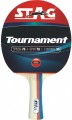 | 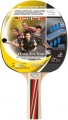 |
|---|---|---|
| Stag Tournament | Donic Top Team 500 | |
from $6.40 | from $21.40 | |
| TOP sellers | ||
| In box | 1 racket case | 1 racket |
| Class | advanced (4*) | advanced (4*) |
Specs | ||
| Playing style | universal | universal |
| Handle shape | flared | flared |
| Speed | 70 | 80 |
| Spin | 70 | 60 |
| Control | 95 | 80 |
| Base material | wood | wood |
| Number of base layers | 5 | |
| Sponge thickness | 1.5 mm | 1.7 mm |
General | ||
| ITTF certificate |  |  |
| Weight | 157 g | |
| Added to E-Catalog | april 2017 | march 2015 |


Compare Stag Tournament and Donic Top Team 500
You may be interested in
My comparisons
Donic Top Team 500 often compared


Glossary
In box
— Racket. The primary playing tool in table tennis, consisting of a solid base and rubber coverings glued on both sides. This option is convenient for amateur play, training, and beginner players, while professional players customize their tools, choosing each part to suit their needs. It should be noted that rackets can be sold individually or come in sets of 2 or 4.
— Blade. A wooden or composite blank of the racket that determines its basic speed, control, flexibility, and overall weight. Rubber coverings are separately installed on the blade to adjust speed, control, spin, and the racket's behavior for attacking, defensive, or all-around styles. Such a delicate approach to choosing playing equipment is primarily relevant for professionals.
— Balls. Having balls is convenient for a starter kit, especially if the purchase is intended for home, cottage, school, or office, where it's important to start playing immediately without separately choosing accessories. At the same time, the quality of the balls may vary: in simple sets, they are usually suitable for amateur play, while for training, it is better to separately check the class and durability of the balls.
— Net. This accessory allows you to quickly prepare a place for play. However, in...most cases, it is usually intended for home and amateur use, not for sports competitions.
— Cover. A protective accessory for storing one or more rackets. It reduces the risk of rubber covering damage, protects the surface from dust, and helps conveniently carry the equipment. It is especially useful for rackets with softer or tackier coverings, which quickly lose playing properties if not stored carefully.
— Blade. A wooden or composite blank of the racket that determines its basic speed, control, flexibility, and overall weight. Rubber coverings are separately installed on the blade to adjust speed, control, spin, and the racket's behavior for attacking, defensive, or all-around styles. Such a delicate approach to choosing playing equipment is primarily relevant for professionals.
— Balls. Having balls is convenient for a starter kit, especially if the purchase is intended for home, cottage, school, or office, where it's important to start playing immediately without separately choosing accessories. At the same time, the quality of the balls may vary: in simple sets, they are usually suitable for amateur play, while for training, it is better to separately check the class and durability of the balls.
— Net. This accessory allows you to quickly prepare a place for play. However, in...most cases, it is usually intended for home and amateur use, not for sports competitions.
— Cover. A protective accessory for storing one or more rackets. It reduces the risk of rubber covering damage, protects the surface from dust, and helps conveniently carry the equipment. It is especially useful for rackets with softer or tackier coverings, which quickly lose playing properties if not stored carefully.
Speed
Table tennis rackets have 3 main practical characteristics: speed, spin and control. The general class of the product, the style of play (see above), the available techniques, the requirements for the player's skills, etc. depend on their values and ratio. One of the most popular designation options is on a hundred-point scale; This scale is also used in our catalogue.
The speed indicator describes how fast the ball will move after contact with the racket. High-speed values are very important for an attacking style of play.
The speed indicator describes how fast the ball will move after contact with the racket. High-speed values are very important for an attacking style of play.
Spin
Table tennis rackets have 3 main characteristics: speed, spin and control. The general class of the product, the style of play (see above), available techniques, requirements for player skills, etc. depend on their values and ratio. One of the most popular designation options is on a hundred-point scale; This scale is also used in our catalogue.
The higher the spin number, the more the ball will spin with the corresponding hit and the better the racket is suitable for various spinning techniques.
The higher the spin number, the more the ball will spin with the corresponding hit and the better the racket is suitable for various spinning techniques.
Control
Table tennis rackets have 3 main practical characteristics: speed, spin and control. The general class of the product, the style of play (see above), available techniques, requirements for player skills, etc. depend on their values and ratio. One of the most popular designation options is on a hundred-point scale; This scale is also used in our catalogue.
Control describes the overall handling of a racket. Roughly speaking, this is a parameter of how easily it can be used to give the tennis ball exactly the speed, direction of flight and rotation that the athlete wants to provide. High values on the control scale will be comfortable regardless of the level of the player and the style of play; however, increasing the speed/rotation hurts control, as a “faster” or “spinning” racket is usually more demanding on the accuracy of movements. Therefore, many models for professionals and experienced amateurs, usually, are distinguished by a low degree of controllability, and “beginner” rackets, on the contrary, have high control parameters and low speed/spin.
Control describes the overall handling of a racket. Roughly speaking, this is a parameter of how easily it can be used to give the tennis ball exactly the speed, direction of flight and rotation that the athlete wants to provide. High values on the control scale will be comfortable regardless of the level of the player and the style of play; however, increasing the speed/rotation hurts control, as a “faster” or “spinning” racket is usually more demanding on the accuracy of movements. Therefore, many models for professionals and experienced amateurs, usually, are distinguished by a low degree of controllability, and “beginner” rackets, on the contrary, have high control parameters and low speed/spin.
Number of base layers
The number of layers that make up the base of the racket. The number of layers affects the degree of rigidity and elasticity of the base and, accordingly, the characteristics of the rebound of the ball. However, this moment is irrelevant for the simple reason that the materials used (see above), the presence of inserts, build quality, sponge thickness (see below), etc. also affect the mentioned characteristics. And given that modern table tennis rackets are very diverse (for example, wooden models can use different types of wood), the number of layers is today a reference parameter, which in itself does not affect the practical characteristics of a particular model.
Sponge thickness
The sponge is the bottom layer of the coating, located under the outer coating (rubber is most often used for such a coating). The thickness of the sponge determines the characteristics of the impulse that the racket transmits to the ball, and, accordingly, the characteristics of the flight of the ball after the impact; in other words, this parameter affects all three practical characteristics of the racket - speed, rotation, control. Accordingly, models for different playing styles (see above) also differ in sponge thickness.
So, a small thickness - up to 1.5 mm - is typical for protective style products, which are distinguished by low speed and good control. All-purpose rackets use sponges of the thickness of 1.5 – 1.8 mm, which provides a balance between speed and control. And thick sponges - from 2 mm - are installed in rackets for an attacking game, and the greater the thickness, the higher the speed and rotation, and the worse the control.
So, a small thickness - up to 1.5 mm - is typical for protective style products, which are distinguished by low speed and good control. All-purpose rackets use sponges of the thickness of 1.5 – 1.8 mm, which provides a balance between speed and control. And thick sponges - from 2 mm - are installed in rackets for an attacking game, and the greater the thickness, the higher the speed and rotation, and the worse the control.
ITTF certificate
This racket model has an ITTF (International Table Tennis Federation) certificate.
The ITTF - International Table Tennis Federation - is the world organization responsible for developing the official rules for international competitions and monitoring their compliance. These rules also include technical requirements for equipment used in international competitions. An official ITTF certificate is required to allow equipment (including rackets) to participate in such competitions; in other words, to participate in an official international tournament you will need a racket with an ITTF certificate. However, having a certificate is more important taking into account another point: the ITTF puts forward quite strict requirements for the quality of equipment. This has a positive effect on the quality of certified products, but it also imposes some restrictions: for example, the base of the racket must consist of at least 85% wood (see “Base Material”), and some types of spikes on the rubbers are prohibited.
It is worth noting that rackets of almost any class can have an ITTF certificate (see above), even very inexpensive models. A certificate can also be issued for sets - as a rule, this means that all complete equipment (net, balls, etc.) meets the ITTF requirements. But the bases (see “Product type”) do not pass certification: a self-assembled racket may turn out to not comply with ITTF...standards, even if the base itself fits perfectly into these standards.
The ITTF - International Table Tennis Federation - is the world organization responsible for developing the official rules for international competitions and monitoring their compliance. These rules also include technical requirements for equipment used in international competitions. An official ITTF certificate is required to allow equipment (including rackets) to participate in such competitions; in other words, to participate in an official international tournament you will need a racket with an ITTF certificate. However, having a certificate is more important taking into account another point: the ITTF puts forward quite strict requirements for the quality of equipment. This has a positive effect on the quality of certified products, but it also imposes some restrictions: for example, the base of the racket must consist of at least 85% wood (see “Base Material”), and some types of spikes on the rubbers are prohibited.
It is worth noting that rackets of almost any class can have an ITTF certificate (see above), even very inexpensive models. A certificate can also be issued for sets - as a rule, this means that all complete equipment (net, balls, etc.) meets the ITTF requirements. But the bases (see “Product type”) do not pass certification: a self-assembled racket may turn out to not comply with ITTF...standards, even if the base itself fits perfectly into these standards.
Weight
The total weight of the racket or base (see "Product type"). Usually, in the first case, the weight values are in the range of 140 – 180 g; occasionally there are lighter models, mainly these are rackets of the "beginner" class 1 * (see above). For most bases, this figure is 50 – 100 g.
In general, lighter rackets are considered better suited for beginner players — in particular, light weight contributes to good control. Trained professionals can use more "weighty" equipment. In addition, it is believed that heavy rackets are better suited for the attacking style of play (see above), while light rackets are more convenient in defence. Anyway, the choice of weight depends on personal preferences: the racket should not seem either too light or too heavy.
In general, lighter rackets are considered better suited for beginner players — in particular, light weight contributes to good control. Trained professionals can use more "weighty" equipment. In addition, it is believed that heavy rackets are better suited for the attacking style of play (see above), while light rackets are more convenient in defence. Anyway, the choice of weight depends on personal preferences: the racket should not seem either too light or too heavy.