
Comparison B.Well WI-933 vs B.Well WI-922
Add to comparison | 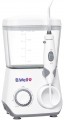 | 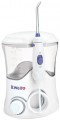 |
|---|---|---|
| B.Well WI-933 | B.Well WI-922 | |
| Outdated Product | Outdated Product | |
| TOP sellers | ||
| Type | irrigator | irrigator |
| Nozzles | 8 no. standard (single jet) orthodontic (for braces) periodontological (pocket cleaning) for implants brush attachment 1 pc for tongue cleaning | 7 no. standard (single jet) orthodontic (for braces) periodontological (pocket cleaning) for implants for tongue cleaning |
Specs | ||
| Intensity modes | 10 | 10 |
| Pulsation rate | 1.7 thousand/min | |
| Irrigator pressure | up to 120 PSI | |
| Water tank capacity | 800 ml | 600 ml |
Features | ||
| 360° nozzle rotation |  |  |
Power supply | ||
| Power source | network | network |
| Max. operating time | 50 min | |
General | ||
| Nozzle compartment | | |
| Case / cover | | |
| Dimensions | 137x115x233 mm | |
| Weight | 770 g | |
| Color | ||
| Added to E-Catalog | february 2020 | february 2019 |


Compare B.Well WI-933 and WI-922
Electric irrigators B.Well WI-933 and WI-922 have similar characteristics, but there are several key differences. WI-933 offers an 800 ml water tank and pressure up to 862 kPa, providing a more powerful cleaning, whereas WI-922 has a 600 ml tank and pressure up to 827 kPa. Both devices have 10 power modes and come with attachments for various needs, but WI-933 includes one additional attachment. Both irrigators operate from the mains and have similar additional accessories, such as an accessory stand and a case.
You may be interested in
B.Well WI-922 often compared


Glossary
Nozzles
No translation necessary.
Pulsation rate
The number of pulsations per minute indicates the rhythm of the water jet's impact on teeth and gums. Frequent impulses sequentially loosen and wash away impurities, and the flow feels more continuous and gentle. However, for example, 1800 pulsations per minute are not necessarily more effective than 1200, as the result also depends on the water jet's strength, the nozzle, and the irrigator's design.
Irrigator pressure
The pressure of an irrigator characterizes the force of the water jet and directly affects the intensity of cleaning. Values around 20 – 40 PSI are suitable for acclimation and gentle care, whereas 70 – 100 PSI provides more thorough rinsing of hard-to-reach areas. The wide range allows you to select a comfortable flow strength for gums, implants, braces, and various attachments.
Water tank capacity
The reservoir capacity directly affects the duration of irrigation without refilling. About 200 ml is usually sufficient for a short daily procedure, 300-400 ml for a more thorough cleaning of the entire oral cavity, and a capacity of 500 ml is convenient for braces, extended care, or use by multiple family members. The actual consumption also depends on the pressure, selected nozzle, and jet speed.
360° nozzle rotation
360° nozzle rotation allows you to turn it around its axis and direct the stream at the desired angle without changing the position of the irrigator handle. This makes it easier to clean the inner sides of teeth, distant molars, the gum line, and areas around braces or implants. The user needs to bend their wrist and reposition the device less, making cleaning more precise and comfortable.
Max. operating time
The maximum operating time indicates how long a portable oral irrigator can function on a single battery charge. For a better understanding of the values, note that one cleaning session takes about 2 minutes, meaning the irrigator works around 4 minutes per day (per person). However, actual autonomy depends on the water pressure, selected mode, and battery condition.
In our catalog, the parameter is specified in minutes, despite manufacturers' bold claims of 30 days of operation. In such cases, it is recalculated into 2 sessions of 2 minutes per day. Thus, 30 days equal 120 minutes.
In our catalog, the parameter is specified in minutes, despite manufacturers' bold claims of 30 days of operation. In such cases, it is recalculated into 2 sessions of 2 minutes per day. Thus, 30 days equal 120 minutes.