
Comparison Tanix TX6 32 Gb vs Tanix TX9
Add to comparison | 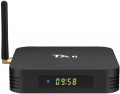 | 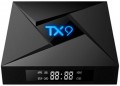 |
|---|---|---|
| Tanix TX6 32 Gb | Tanix TX9 | |
| Outdated Product | Outdated Product | |
| TOP sellers | ||
The media player can run both Android 7.0 and later Android 9.0 firmware. Information about the installed firmware version must be specified directly in the store. | ||
| Type | Media Player | Media Player |
| Operating system | Android (AOSP) | Android (AOSP) |
Connectivity and interfaces | ||
| Bluetooth | v4.1 | v4.1 |
| Wi-Fi | Wi-Fi 5 (802.11ac) | Wi-Fi 5 (802.11ac) |
| Miracast |  |  |
| Card reader | | |
| IPTV support | | |
Connectors | ||
| HDMI | 1 | 1 |
| USB-A 2.0 | 2 pcs | |
| USB-A 5Gbps | 1 pcs | |
| LAN | 100 Mbps | 100 Mbps |
| AV output | | |
| Coaxial output | | |
| Optical output | | |
Hardware | ||
| CPU | Allwinner H6 | Amlogic S912 |
| CPU cores | 4 | |
| CPU frequency | 1.8 GHz | 2 GHz |
| RAM | 4 GB | 3 GB |
| Built-in memory | 32 GB | 32 GB |
| Ultra HD 4K support | | |
General | ||
| Video decoders | H.263, H.264 | |
| Screen | | |
| Remote control | + | + |
| Dimensions (WxHxD) | 105x25x105 mm | 102x22x102 mm |
| Weight | 450 g | 170 g |
| Added to E-Catalog | march 2019 | september 2018 |


Compare Tanix TX6 32 Gb and TX9
You may be interested in
My comparisons
Tanix TX6 32 Gb often compared


Tanix TX9 often compared


Glossary
Miracast
A wireless technology that allows you to directly broadcast video and audio from one device to another directly over a Wi-Fi connection. At the same time, unlike AirPlay, transmission does not require a router and building a local network — it is enough that the receiver and transmitter are compatible with Miracast. One of the most popular ways to use this technology is to output a “picture” from a smartphone / tablet screen to a TV, and vice versa. A media centre or TV receiver with Miracast is useful if the TV itself does not support this function.
USB-A 2.0
A classic USB port for connecting flash drives, receivers, keyboards, and other compatible peripherals, designed for data transfer up to 480 Mbps. This type of port is convenient for basic tasks where high speed isn't necessary, but it significantly falls behind more modern USB versions for very large files and fast external drives. The major advantage here is compatibility: USB-A 2.0 has long remained the most familiar format for mass accessories.
AV output
— AV output. Analogue output for video and audio transferring. Previously, due to the large size of the equipment, it consisted of 3 RCA jacks and was connected to the TV accordingly. Now the devices have become more compact and don't have free space on the case. Therefore, the AV output is a single headphone jack, to which a tee cable is already connected (check availability in the package). Since all components of the video signal are on the same cable, the picture quality and immunity to interference are low.
Coaxial output
In this case, the term coaxial refers to a type of SP/DIF interface that uses an electrical cable with an RCA connector. This interface provides sound transmission, including multichannel, in digital format; at the same time, the electrical cable is more susceptible to interference than the optical one, but is not as fragile.
Optical output
A variation of the SP/DIF audio interface that uses a TOSLINK fibre optic cable. Like the coaxial connector, the optical output uses a digital data transfer format and can work with multi-channel audio. At the same time, optical fibre requires rather delicate handling, but it is absolutely insensitive to electrical interference.
CPU
The model of the CPU installed in the media player.
This information is mainly of reference value: the processor is selected in such a way as to provide certain practical characteristics (maximum resolution, support for certain standards, embedded applications, etc.). So when choosing, you should focus primarily on these specifications. However, if you wish, knowing the processor model, you can find detailed data on it and evaluate the capabilities of the media centre to work with resource-consuming applications. This can be useful, in particular, if you choose an Android model (see above) and plan to use additional software intensively — the set of applications for this OS is very extensive, and some of them are quite demanding on system resources.
Also note that CPU data is often specified for advertising purposes — to emphasize that the device has a fairly advanced chip from a well-known brand. Among the most common brands of such processors are Allwinner, Amlogic, Rockchip, Realtek.
This information is mainly of reference value: the processor is selected in such a way as to provide certain practical characteristics (maximum resolution, support for certain standards, embedded applications, etc.). So when choosing, you should focus primarily on these specifications. However, if you wish, knowing the processor model, you can find detailed data on it and evaluate the capabilities of the media centre to work with resource-consuming applications. This can be useful, in particular, if you choose an Android model (see above) and plan to use additional software intensively — the set of applications for this OS is very extensive, and some of them are quite demanding on system resources.
Also note that CPU data is often specified for advertising purposes — to emphasize that the device has a fairly advanced chip from a well-known brand. Among the most common brands of such processors are Allwinner, Amlogic, Rockchip, Realtek.
CPU cores
The core is the part of the processor that executes a single thread of instructions. Accordingly, the presence of multiple cores allows to work with multiple threads simultaneously, which has a positive effect on performance. Theoretically, more cores (4 cores or even 6 cores or more) can increase the efficiency of the processor. However, in fact, CPU performance depends on so many additional factors that the number of cores is purely a reference parameter. So, a high-end dual-core processor may well be more performant than an inexpensive quad-core one.
CPU frequency
The clock speed of the CPU installed in the media centre.
On the technical side, the higher this indicator, the faster the processor works and the higher, accordingly, the overall system performance. At the same time, the CPU performance depends, in addition to the frequency itself, on a number of factors — architecture, number of cores, special design features, etc.; and the actual speed of the entire system is affected by performance of components other than the processor. In addition, manufacturers usually select processors in such a way that their computing power is guaranteed to be enough for all the features claimed for a media centre. Therefore, in this case, the CPU frequency is more of a reference parameter (and partly an advertising indicator that demonstrates the advanced specifications of the device), rather than practically significant for buyer.
On the technical side, the higher this indicator, the faster the processor works and the higher, accordingly, the overall system performance. At the same time, the CPU performance depends, in addition to the frequency itself, on a number of factors — architecture, number of cores, special design features, etc.; and the actual speed of the entire system is affected by performance of components other than the processor. In addition, manufacturers usually select processors in such a way that their computing power is guaranteed to be enough for all the features claimed for a media centre. Therefore, in this case, the CPU frequency is more of a reference parameter (and partly an advertising indicator that demonstrates the advanced specifications of the device), rather than practically significant for buyer.
RAM
The amount of RAM installed in the media player.
In general, this volume is selected by the manufacturer in such a way that the device can normally cope with the tasks that are claimed for it. On the other hand, all else being equal, more RAM usually means faster performance. This parameter is especially important if the media player runs under the Android OS (see above): such firmware allows the installation of additional applications that may have rather high requirements for RAM.
As for specific values, by modern standards, a device with more than 2 GB of RAM is considered a fast media player.
In general, this volume is selected by the manufacturer in such a way that the device can normally cope with the tasks that are claimed for it. On the other hand, all else being equal, more RAM usually means faster performance. This parameter is especially important if the media player runs under the Android OS (see above): such firmware allows the installation of additional applications that may have rather high requirements for RAM.
As for specific values, by modern standards, a device with more than 2 GB of RAM is considered a fast media player.