
Comparison Redragon Cobra FPS vs Redragon Cobra
Add to comparison | 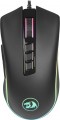 | 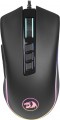 |
|---|---|---|
| Redragon Cobra FPS | Redragon Cobra | |
from $61.41 | Compare prices 9 | |
| User reviews | ||
| TOP sellers | ||
| Product type | mouse | mouse |
| Connection | wired | wired |
| Sensor | optical | optical |
| Type | for game | for game |
Sensor and control | ||
| Sensor resolution | 500 – 24000 DPI | 100 – 10000 DPI |
| Max. acceleration | 50 G | 20 G |
| Max. speed | 150 ips | |
| Number of buttons | 7 | 7 |
| Side buttons |  | |
| DPI-button | | |
| Scroll wheels | 1 | 1 |
Additional features | ||
| DPI level indicator | | |
| Programmable buttons | | |
| Built-in memory | | |
| Lighting | RGB | multicolor |
| Lighting effects | + | + |
Connection and power supply | ||
| Cable | USB-A braided | USB-A braided |
General | ||
| Size (LxWxH) | 127x66x41 mm | 127x66x41 mm |
| Color | ||
| Added to E-Catalog | january 2020 | january 2020 |





Compare Redragon Cobra FPS and Cobra
Mouse Redragon Cobra FPS and Redragon Cobra have similar features but differ in sensor resolution and user reviews. The Cobra FPS offers a broader DPI range from 500 to 24000, making it more versatile, while the Cobra is limited to a range of up to 10000 DPI. Users note that the Cobra FPS has excellent build quality and functionality, but some mention issues with button squeaking after a few months of use. Cobra also receives positive reviews for its price and quality, but some users report mouse heating during prolonged use.
Price comparison
You may be interested in
Glossary
Sensor resolution
Resolution of the sensor responsible for tracking mouse movements on the work surface. Specified in DPI — dots per inch.
The physical meaning of DPI as a whole is as follows. The sensor of a modern mouse works on the same principle as the camera matrix, and consists of pixels. And DPI is the number of pixels that fall on 1 inch of the underlying surface (length or width), "visible" by the sensor.
It is believed that more DPI means a more advanced sensor and mouse in general; nowadays, models for 3500 – 5000 DPI, 12000 DPI, 16000 DPI even more are not uncommon. In a way, it is — high resolution contributes to accuracy. However, the only thing that is directly determined by this indicator is the speed at which the cursor moves across the screen: the higher the resolution of the sensor, the greater the number of pixels that the cursor will move when the mouse itself moves a certain distance. At the same time, it is worth recalling that too high a speed is even more undesirable than too low. So the real need for high DPI ( 1000 and above) arises mainly when working on large screens (4K resolution and more); for more modest displays (HD and Full HD), smaller values are often enough.
The physical meaning of DPI as a whole is as follows. The sensor of a modern mouse works on the same principle as the camera matrix, and consists of pixels. And DPI is the number of pixels that fall on 1 inch of the underlying surface (length or width), "visible" by the sensor.
It is believed that more DPI means a more advanced sensor and mouse in general; nowadays, models for 3500 – 5000 DPI, 12000 DPI, 16000 DPI even more are not uncommon. In a way, it is — high resolution contributes to accuracy. However, the only thing that is directly determined by this indicator is the speed at which the cursor moves across the screen: the higher the resolution of the sensor, the greater the number of pixels that the cursor will move when the mouse itself moves a certain distance. At the same time, it is worth recalling that too high a speed is even more undesirable than too low. So the real need for high DPI ( 1000 and above) arises mainly when working on large screens (4K resolution and more); for more modest displays (HD and Full HD), smaller values are often enough.
Max. acceleration
The greatest acceleration during movement, at which the mouse maintains normal performance; if this indicator is exceeded, the cursor may “break down” (moving to an unexpected place due to incorrect processing of data from the sensor).
The faster the mouse moves, the greater the acceleration acting on it. Accordingly, this parameter determines the sensitivity to sudden movements, the extent to which this model is able to normally perceive and process such movements. High values of maximum acceleration ( 40 G, 50 G) are important first of all in dynamic games, especially for professional e-sportsmen and advanced enthusiasts. If the mouse is bought for relatively simple tasks (working with documents, surfing the web, etc.), you can ignore this indicator.
The faster the mouse moves, the greater the acceleration acting on it. Accordingly, this parameter determines the sensitivity to sudden movements, the extent to which this model is able to normally perceive and process such movements. High values of maximum acceleration ( 40 G, 50 G) are important first of all in dynamic games, especially for professional e-sportsmen and advanced enthusiasts. If the mouse is bought for relatively simple tasks (working with documents, surfing the web, etc.), you can ignore this indicator.
Max. speed
The ips (inches per second) parameter is the linear speed of mouse movement, expressed in inches per second, at which the manipulator's sensor is able to read the surface. In top models, the maximum mouse movement speed often reaches 400-600 ips, but devices with ips in the region of 200 are more common.
Lighting
The presence of illumination in the design of the mouse.
This illumination can be provided by the same LED that illuminates the surface below the sensor, or by separate light sources. It can have a different colour, and the most advanced systems — RGB backlighting — allow you to adjust the shade to your liking. Anyway, the backlight gives the mouse an unusual and stylish appearance, besides, it can also have special effects (see below). However, this function has not only an aesthetic, but also quite a practical meaning: for example, a colour change can be used as a DPI level indicator (see above) or as a low battery signal. On the other hand, the backlight affects the cost of the device, and the real need for it is not so often — moreover, in many cases (for example, in the office) an extra “illumination” is completely useless. Therefore, most modern mice still do not have a backlight.
This illumination can be provided by the same LED that illuminates the surface below the sensor, or by separate light sources. It can have a different colour, and the most advanced systems — RGB backlighting — allow you to adjust the shade to your liking. Anyway, the backlight gives the mouse an unusual and stylish appearance, besides, it can also have special effects (see below). However, this function has not only an aesthetic, but also quite a practical meaning: for example, a colour change can be used as a DPI level indicator (see above) or as a low battery signal. On the other hand, the backlight affects the cost of the device, and the real need for it is not so often — moreover, in many cases (for example, in the office) an extra “illumination” is completely useless. Therefore, most modern mice still do not have a backlight.