
Comparison Tenda AC8 vs Tenda AC7
Add to comparison | 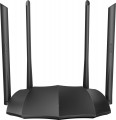 | 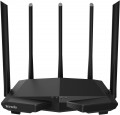 |
|---|---|---|
| Tenda AC8 | Tenda AC7 | |
from $76.13 | Outdated Product | |
| User reviews | ||
| TOP sellers | ||
Beamforming and MU-MIMO support. 4 antennas with a gain of 6 dBi. | The router is equipped with five antennas with a gain of 6 dBi, in total with a transmitter with a power of up to 23 dBm, this allows you to count on a wide coverage area. | |
| Product type | router | router |
| Data input (WAN-port) | Ethernet (RJ45) Wi-Fi | Ethernet (RJ45) Wi-Fi |
Wireless Wi-Fi connection | ||
| Wi-Fi standards | Wi-Fi 3 (802.11g) Wi-Fi 4 (802.11n) Wi-Fi 5 (802.11ac) | Wi-Fi 3 (802.11g) Wi-Fi 4 (802.11n) Wi-Fi 5 (802.11ac) |
| Frequency band | 2.4GHz 5 GHz | 2.4GHz 5 GHz |
| Operating ranges | dual-band (2.4 GHz and 5 GHz) | dual-band (2.4 GHz and 5 GHz) |
| Wireless speed 2.4 GHz | 300 Mbps | 300 Mbps |
| Wireless speed 5 GHz | 867 Mbps | 867 Mbps |
Connection and LAN | ||
| WAN | 1 port 1 Gbps | 1 port 100 Mbps |
| LAN | 3 ports 1 Gbps | 3 ports 100 Mbps |
Antenna and transmitter | ||
| Number of antennas | 4 | 5 |
| Antenna type | external | external |
| MU-MIMO |  | |
| Gain | 6 dBi | 6 dBi |
| 2.4 / 5 GHz antennas | 4 | |
| Transmitter power | 23 dBm | 23 dBm |
| Signal strength 2.4 GHz | 20 dBm | 20 dBm |
| Signal strength 5 GHz | 23 dBm | 23 dBm |
Functions | ||
| Features | NAT bridge mode repeater Beamforming firewall | NAT bridge mode repeater Beamforming firewall |
| More features | DHCP server VPN DDNS DMZ | DHCP server VPN DDNS DMZ |
Security | ||
| Safety standards | WPA WEP WPA2 | WPA WEP WPA2 |
General | ||
| Operating temperature | 0 °C ~ +40 °C | |
| Dimensions | 200x127x34 mm | 220x49x142 mm |
| Weight | 310 g | |
| Color | ||
| Added to E-Catalog | january 2020 | may 2019 |


Compare Tenda AC8 and AC7
What is the difference between Tenda AC8 and AC7?
Tenda AC8 is the better pick if you have a fast internet plan or move large files over the wired network because it has Gigabit WAN and LAN, while AC7 is capped at 100 Mbps on both WAN and LAN which can bottleneck even a strong 5 GHz Wi‑Fi link. AC7 can be the better choice for larger or wall-heavy apartments if you prioritize Wi‑Fi coverage, since it uses 5 external antennas versus 4 on AC8, although both are dual-band AC1200 with MU‑MIMO and beamforming.
Which is better?
Better overall: Tenda AC8 because its WAN and LAN ports are Gigabit, so it makes sense for 300–1000 Mbps internet plans and fast wired devices like a PC, NAS, or IPTV.
Both AC8 and AC7 are AC1200 dual-band routers with the same Wi‑Fi class. You get 300 Mbps on 2.4 GHz and 867 Mbps on 5 GHz, plus MU‑MIMO and Beamforming for steadier performance with multiple clients.
Choose AC8 if you care about wired speed or want more headroom for future upgrades, since AC7 is limited to 100 Mbps on both WAN and LAN. Choose AC7 if your internet is up to 100 Mbps and you want maximum Wi‑Fi reach from more antennas, since it has 5 external 6 dBi antennas versus 4 on AC8.
You may be interested in
Tenda AC8 often compared


Tenda AC7 often compared
Glossary
WAN
The WAN port characterizes the ability of the device to receive a wired signal. There may be models with both one port and two WAN ports, and in rare cases, more connected providers. Such an expanded number of WAN connectors affects the cost and, accordingly, is found in more part among professional-level routers.
In terms of speed, when choosing a device, the priority is the speed of the output LAN port or Wi-Fi. However, faster WAN ports ( 1 Gbps, 2.5 Gbps, 5 Gbps, 10 Gbps) allow you to divide the load on several outputs at once without reducing speed performance, as may be the case with WAN port 100 Mbps.
In terms of speed, when choosing a device, the priority is the speed of the output LAN port or Wi-Fi. However, faster WAN ports ( 1 Gbps, 2.5 Gbps, 5 Gbps, 10 Gbps) allow you to divide the load on several outputs at once without reducing speed performance, as may be the case with WAN port 100 Mbps.
LAN
In this case, LAN means standard network connectors (known as RJ-45) designed for wired connection of LAN devices — PCs, servers, additional access points, etc. The number of ports corresponds to the number of devices that can be directly connected to wired equipment. way.
In terms of speed, 100 Mbps (Fast Ethernet) and 1 Gbps (Gigabit Ethernet) are the most popular options today. At the same time, thanks to the development of technology, more and more gigabit devices are being produced, although in fact this speed is critical only when transferring large amounts of information. At the same time, some models, in addition to the standard speed of the main LAN ports, may have a 2.5 Gbps, 5 Gbps and even 10 Gbps LAN port with increased bandwidth.
In terms of speed, 100 Mbps (Fast Ethernet) and 1 Gbps (Gigabit Ethernet) are the most popular options today. At the same time, thanks to the development of technology, more and more gigabit devices are being produced, although in fact this speed is critical only when transferring large amounts of information. At the same time, some models, in addition to the standard speed of the main LAN ports, may have a 2.5 Gbps, 5 Gbps and even 10 Gbps LAN port with increased bandwidth.
Number of antennas
The total number of antennas (of all types — see below) provided in the design of the device.
In modern Wi-Fi equipment, this indicator can be different: in addition to the simplest devices with 1 antenna, there are models where this number is 2, 3, 4 and even more. The point of using multiple antennas is twofold. Firstly, if there are several external devices per antenna, they have to share the bandwidth among themselves, and the actual communication speed for each subscriber drops accordingly. Secondly, such a design may also be required when communicating with one external device — to work with MU-MIMO technology (see below), which allows you to fully realize the capabilities of modern Wi-Fi standards.
Anyway, more antennas, usually, means a more advanced and functional device. On the other hand, this parameter significantly affects the cost; so specifically looking for equipment with numerous antennas makes sense mainly when the speed and stability of communication are critical.
Note that antennas intended for mobile communications may also be considered in this clause. So when choosing a model with support for mobile networks, it's ok to clarify this point.
In modern Wi-Fi equipment, this indicator can be different: in addition to the simplest devices with 1 antenna, there are models where this number is 2, 3, 4 and even more. The point of using multiple antennas is twofold. Firstly, if there are several external devices per antenna, they have to share the bandwidth among themselves, and the actual communication speed for each subscriber drops accordingly. Secondly, such a design may also be required when communicating with one external device — to work with MU-MIMO technology (see below), which allows you to fully realize the capabilities of modern Wi-Fi standards.
Anyway, more antennas, usually, means a more advanced and functional device. On the other hand, this parameter significantly affects the cost; so specifically looking for equipment with numerous antennas makes sense mainly when the speed and stability of communication are critical.
Note that antennas intended for mobile communications may also be considered in this clause. So when choosing a model with support for mobile networks, it's ok to clarify this point.
2.4 / 5 GHz antennas
The total number of antennas in the router that can operate on both 5 GHz and 2.4 GHz frequencies. For details about the number of antennas, see "Total antennas", about the range — "Frequency range".
Operating temperature
Ambient air temperature at which the device is guaranteed to remain operational.
All modern Wi-Fi equipment can easily endure the conditions typical for use in apartments, offices, etc. So it makes sense to pay attention to this parameter mainly when choosing a model for outdoor installation (see above) or indoors , where the conditions are not very different from those outside. At the same time, the upper temperature limit is usually quite high, and even in the heat there are usually no problems with operation (of course, if the device is not installed in direct sunlight — which is not recommended anyway). But the lower temperature threshold can be different, not all "street" equipment is designed for frost. However, among frost-resistant models there are solutions where the minimum operating temperature is -10 °C and below, and sometimes even -40 °C and below.
All modern Wi-Fi equipment can easily endure the conditions typical for use in apartments, offices, etc. So it makes sense to pay attention to this parameter mainly when choosing a model for outdoor installation (see above) or indoors , where the conditions are not very different from those outside. At the same time, the upper temperature limit is usually quite high, and even in the heat there are usually no problems with operation (of course, if the device is not installed in direct sunlight — which is not recommended anyway). But the lower temperature threshold can be different, not all "street" equipment is designed for frost. However, among frost-resistant models there are solutions where the minimum operating temperature is -10 °C and below, and sometimes even -40 °C and below.