
Comparison Yamaha YDP-103 vs Yamaha YDP-143
Add to comparison | 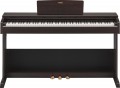 | 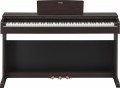 |
|---|---|---|
| Yamaha YDP-103 | Yamaha YDP-143 | |
from $1,099.99 | Compare prices 1 | |
| TOP sellers | ||
| Body | stationary | stationary |
| Cover |  | |
| Built-in pedals | | |
Keys | ||
| Number of keys | 88 шт | 88 шт |
| Size | full size | full size |
| Mechanics | malleus | malleus |
| Sensitivity adjustment | | |
| Rigidity | weighted | weighted |
Specs | ||
| Polyphony | 64 voices | 192 voices |
| Built-in timbres | 10 шт | 10 шт |
| Tempo change | 32 – 280 | 5 – 280 |
| Metronome | | |
| Sequencer (recording) | | |
| Built-in compositions | | |
Effects and control | ||
| Timbres layering | | |
| Keyboard split | | |
| Octave shift | | |
| Reverberation | | |
| Transposition | | |
| Fine tuning | | |
| More features | sound management system | |
Connectors | ||
| Connectable pedals | 1 шт | 1 шт |
| Outputs | USB to host (type B) | USB to host (type B) |
| Headphone outputs | 2 шт | 2 шт |
General | ||
| Built-in acoustics | 12 W | 12 W |
| Number of bands | 1 | 1 |
| Power consumption | 6 W | 8 W |
| Dimensions (WxHxD) | 1357x815x422 mm | 1357x815x422 mm |
| Weight | 38 kg | 38 kg |
| Color | ||
| Added to E-Catalog | july 2017 | june 2017 |



Compare Yamaha YDP-103 and YDP-143
Price comparison
You may be interested in
My comparisons
Yamaha YDP-103 often compared

Yamaha YDP-143 often compared


Glossary
Polyphony
The number of voices supported by the digital piano — more precisely, the maximum number of voices that the instrument can play at the same time.
This parameter should not be confused with the number of notes that can be played simultaneously on the keyboard. The fact is that in many timbres, several voices (tone generators) are used for each note at once — this is the only way to achieve a more or less reliable sound. Thus, the required number of voices can be many times higher than the number of notes — for example, the simplest chord of 3 notes may require 9 or even 12 voices. In addition, tone generators are used to play auto accompaniment parts and built-in songs (see below), and here the number of voices can already be measured in tens.
In light of all this, polyphony of less than 90 voices is typical mainly for relatively simple and inexpensive instruments that are not designed for complex tasks. The smallest number found in modern digital pianos is 32 voices. It is desirable for a more or less solid instrument to have at least 96 voices, and in top models this figure can reach 256.
This parameter should not be confused with the number of notes that can be played simultaneously on the keyboard. The fact is that in many timbres, several voices (tone generators) are used for each note at once — this is the only way to achieve a more or less reliable sound. Thus, the required number of voices can be many times higher than the number of notes — for example, the simplest chord of 3 notes may require 9 or even 12 voices. In addition, tone generators are used to play auto accompaniment parts and built-in songs (see below), and here the number of voices can already be measured in tens.
In light of all this, polyphony of less than 90 voices is typical mainly for relatively simple and inexpensive instruments that are not designed for complex tasks. The smallest number found in modern digital pianos is 32 voices. It is desirable for a more or less solid instrument to have at least 96 voices, and in top models this figure can reach 256.
Tempo change
The range over which the tempo of the sound played by the instrument can change. It can be either a built-in melody or a part recorded on a sequencer, or an auto accompaniment, a tutorial or a metronome. For more information on all of these features, see the corresponding glossary entries. Here we note that a change in tempo is often required in fact — for example, to speed up an initially "sluggish" accompaniment or slow down a training programme that is difficult to master at the original tempo.
Tempo is traditionally indicated in beats per minute. The classical, "academic" range covers options from 40 bpm ("grave", "very slow") to 208 bpm ("prestissimo", "very fast"), however, in modern digital pianos, the working range of tempos is often significantly wider.
Tempo is traditionally indicated in beats per minute. The classical, "academic" range covers options from 40 bpm ("grave", "very slow") to 208 bpm ("prestissimo", "very fast"), however, in modern digital pianos, the working range of tempos is often significantly wider.
More features
Additional features and sound customization options provided by the instrument in addition to those listed above. In this paragraph, usually, various original proprietary technologies and solutions are indicated; the specific meaning of these functions is best specified in the documentation for the tool.
Power consumption
The power consumed by the tool during normal operation.
The cost of electricity, as well as connection requirements, depend on this indicator. At the same time, we note that digital pianos require relatively little energy — even in the most powerful and advanced models, consumption usually does not exceed 60 watts. So in fact, power consumption data is required mainly for specific cases — for example, to calculate the total load when connecting a tool to an autonomous generator along with other devices. In addition, this information may be useful when assessing the power of the built-in speaker, for more information, see "Built-in acoustics".
The cost of electricity, as well as connection requirements, depend on this indicator. At the same time, we note that digital pianos require relatively little energy — even in the most powerful and advanced models, consumption usually does not exceed 60 watts. So in fact, power consumption data is required mainly for specific cases — for example, to calculate the total load when connecting a tool to an autonomous generator along with other devices. In addition, this information may be useful when assessing the power of the built-in speaker, for more information, see "Built-in acoustics".