
Comparison Makita DUC353Z vs Makita UC4030A
Add to comparison | 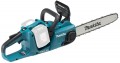 | 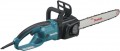 |
|---|---|---|
| Makita DUC353Z | Makita UC4030A | |
from $568.82 | from $205.08 | |
| TOP sellers | ||
DUC303Z comes with 300mm bar and chain only, DUC353Z comes with 350mm bar and chain only, DUC353RF2 comes with 350mm bar and chain, two batteries (3Ah) and charger | Electronic engine protection. Smooth start. Keyless chain tension. Quick access to carbon brushes. There are modifications of the model with a cord length of 0.5 m or 5 m. The UC4030A model is supplied without a case, and the UC4030AK model is supplied with a case. | |
| Product type | chainsaw | chainsaw |
| Type | portable | portable |
| Power source | battery | mains (230 V) |
Motor | ||
| Brushless motor |  |  |
| Engine location | transversely | longitudinally |
| Power | 2000 W | |
Cutting equipment | ||
| Bar/blade size | 350 mm | 400 mm |
| Chain pitch | 3/8 " | 3/8 " |
| Chain speed | 20 m/s | 13 m/s |
Protective functions | ||
| Soft start | | |
| Chain brake | | |
| Electronic motor protection | | |
Features | ||
| Features | keyless chain tension keyless blade replacement | keyless chain tension keyless blade replacement |
| In box | chain without charger | |
Battery | ||
| Battery in set | no | |
| Battery platform | Makita 18V LXT | |
| Battery voltage | 18 В | |
| Compatible batteries | BL1815N, BL1820, BL1830, BL1840, BL1850, BL1860 | |
| Powered by two batteries | | |
General | ||
| Noise level | 100 dB | 102 dB |
| Oil tank volume | 0.2 L | 0.14 L |
| Size | 773x215x235 mm | 492x201x220 mm |
| Weight | 4.7 kg | 5.2 kg |
| Added to E-Catalog | august 2017 | december 2009 |


Compare Makita DUC353Z and UC4030A
You may be interested in
My comparisons
Makita DUC353Z often compared

Makita UC4030A often compared


Glossary
Power source
By type of power source, all modern saw can be divided into electric and gasoline. The common difference between them is that electrical units are more compact and lighter, less noisy, easy to maintain and do not produce exhaust gases, so they can be used indoors without restrictions. Petrol tools, in turn, combine high power and independence from power grids, but they are heavy, bulky, more difficult to operate and repair, more expensive (both in terms of their own cost and fuel price) and are generally designed for use outside premises. Therefore, most modern saw are made electric, which in turn can use different types of power:
- Power supply (230 V). Connection to a standard 230 V household network, in other words, a regular socket. This option can be used both in portable saw and in stationary tools of relatively low power (up to 3.5 kW). There are sockets almost everywhere where there is electricity at all, and the operating time of such units is almost unlimited (as long as there is voltage in the network). The main disadvantage of such a power supply is the presence of a power cord that does not allow you to go far from the outlet (and with a portable tool, you also have to make sure that the cord does not get under the canvas).
- Power supply (110 V). Tools powered in the American and Japanese manners - from power networks with a voltage of 110...V. Power tools with such an operating supply voltage are produced for the market of North and Central America, the Land of the Rising Sun, Saudi Arabia. Also, 110 V power grids are found in the UK. To avoid tool failure when connected to standard 230 V household networks, you will need an additional link in the face of a step-down transformer or a special 110 V converter.
- Power supply (400 V). Powered by a three-phase power supply with a voltage of 400 V. Such power is suitable even for high-power saw, but it is far from being available everywhere - basically a three-phase connection is available in workshops, workshops and other industrial premises. Therefore, this option is found exclusively in stationary tools (see "Type") of high power, for which a conventional socket is no longer enough.
- Accumulator. Powered by own battery. The main advantages of this option are mobility, the ability to work independently of sockets and the absence of a power cord that can interfere with work. On the other hand, such a power supply is not suitable for high-power saw, other things being equal, a cordless tool turns out to be noticeably heavier and more expensive than a mains one, and the operating time is limited by the battery charge. However, in most cases, the battery is made removable, which allows you to keep several batteries ready and change them as needed.
- Battery / power supply (230 V). Tools that allow two power options - from an outlet and from its own battery. See above for more details on each option, and their combination makes the saw as versatile as possible. So, if there are sockets nearby, you can work from the network, saving battery power (or even recharging it in the process), and if there is a problem with the sockets or the network cable interferes with work, you can switch to the battery. On the other hand, such versatility affects the price, and the tool itself still turns out to be more cumbersome and heavy than a purely network one.
- Power supply (230 V). Connection to a standard 230 V household network, in other words, a regular socket. This option can be used both in portable saw and in stationary tools of relatively low power (up to 3.5 kW). There are sockets almost everywhere where there is electricity at all, and the operating time of such units is almost unlimited (as long as there is voltage in the network). The main disadvantage of such a power supply is the presence of a power cord that does not allow you to go far from the outlet (and with a portable tool, you also have to make sure that the cord does not get under the canvas).
- Power supply (110 V). Tools powered in the American and Japanese manners - from power networks with a voltage of 110...V. Power tools with such an operating supply voltage are produced for the market of North and Central America, the Land of the Rising Sun, Saudi Arabia. Also, 110 V power grids are found in the UK. To avoid tool failure when connected to standard 230 V household networks, you will need an additional link in the face of a step-down transformer or a special 110 V converter.
- Power supply (400 V). Powered by a three-phase power supply with a voltage of 400 V. Such power is suitable even for high-power saw, but it is far from being available everywhere - basically a three-phase connection is available in workshops, workshops and other industrial premises. Therefore, this option is found exclusively in stationary tools (see "Type") of high power, for which a conventional socket is no longer enough.
- Accumulator. Powered by own battery. The main advantages of this option are mobility, the ability to work independently of sockets and the absence of a power cord that can interfere with work. On the other hand, such a power supply is not suitable for high-power saw, other things being equal, a cordless tool turns out to be noticeably heavier and more expensive than a mains one, and the operating time is limited by the battery charge. However, in most cases, the battery is made removable, which allows you to keep several batteries ready and change them as needed.
- Battery / power supply (230 V). Tools that allow two power options - from an outlet and from its own battery. See above for more details on each option, and their combination makes the saw as versatile as possible. So, if there are sockets nearby, you can work from the network, saving battery power (or even recharging it in the process), and if there is a problem with the sockets or the network cable interferes with work, you can switch to the battery. On the other hand, such versatility affects the price, and the tool itself still turns out to be more cumbersome and heavy than a purely network one.
Brushless motor
A modern brushless motor type, which makes the tool more powerful, efficient, and convenient for prolonged use. This design reduces friction inside the motor, so the saw typically heats up less, operates more quietly, and lasts longer under regular load.
Compared to brushed models, the brushless motor better utilizes battery charge and maintains stable RPM under load, which is especially noticeable when cutting dense wood, beams, or sheet materials. Another significant advantage is fewer consumables and less maintenance, as brushes do not need to be replaced over time.
In practice, this is particularly useful for frequent construction, installation, roofing work, and other tasks where high power, autonomy, and reliability are expected from the saw.
Compared to brushed models, the brushless motor better utilizes battery charge and maintains stable RPM under load, which is especially noticeable when cutting dense wood, beams, or sheet materials. Another significant advantage is fewer consumables and less maintenance, as brushes do not need to be replaced over time.
In practice, this is particularly useful for frequent construction, installation, roofing work, and other tasks where high power, autonomy, and reliability are expected from the saw.
Engine location
The location of the motor in the electric portable saw (see "Type").
- Longitudinally. The longitudinal arrangement allows you to achieve a good balance, allowing you to work comfortably in different positions; this is especially true for cutting branches from trees and other similar work, where the cutting plane can be located at different angles. In addition, such a tool has a smaller width and a longer length, which can make it easier to work in hard-to-reach places. On the other hand, such saws are more expensive than cross-cut saws.
- Transversely. The transverse arrangement of the engine slightly worsens the balance compared to the longitudinal one and makes it difficult to saw along an inclined plane, at an angle to the vertical. In addition, the length of such saws is noticeably shorter. However, for the simplest work with sawing from top to bottom, they are no worse than longitudinal ones, but they are much cheaper. Yes, and a small length in some cases can also be a virtue.
- Longitudinally. The longitudinal arrangement allows you to achieve a good balance, allowing you to work comfortably in different positions; this is especially true for cutting branches from trees and other similar work, where the cutting plane can be located at different angles. In addition, such a tool has a smaller width and a longer length, which can make it easier to work in hard-to-reach places. On the other hand, such saws are more expensive than cross-cut saws.
- Transversely. The transverse arrangement of the engine slightly worsens the balance compared to the longitudinal one and makes it difficult to saw along an inclined plane, at an angle to the vertical. In addition, the length of such saws is noticeably shorter. However, for the simplest work with sawing from top to bottom, they are no worse than longitudinal ones, but they are much cheaper. Yes, and a small length in some cases can also be a virtue.
Power
Saw motor power in watts. For petrol tools (see "Power Source"), horsepower is additionally indicated, see below for details.
The higher the power, the better the tool is suitable for voluminous work and hard materials, the greater the depth of cut it can provide and the easier it can cope with significant loads. In addition, for different types of saws and different types of materials, the actual power values \u200b\u200bcan also be different. For example, a power of 2.5 – 3 kW is actually the limit for chain saws, but in chain saws this is an average figure, among such tools there are models of 3 – 4 kW and even more. Detailed selection recommendations for various cases can be found in special sources.
The higher the power, the better the tool is suitable for voluminous work and hard materials, the greater the depth of cut it can provide and the easier it can cope with significant loads. In addition, for different types of saws and different types of materials, the actual power values \u200b\u200bcan also be different. For example, a power of 2.5 – 3 kW is actually the limit for chain saws, but in chain saws this is an average figure, among such tools there are models of 3 – 4 kW and even more. Detailed selection recommendations for various cases can be found in special sources.
Bar/blade size
The largest tyre size (in chain saws) or disc (in circular saws and some others, see "Device") that is allowed for this tool. Tyres are sized by working length, rims by diameter.
A larger bar/wheel allows for deeper cuts but requires more powerful motors. Therefore, this parameter cannot be exceeded — this can lead to an overload of the engine with all the corresponding troubles. However, in many models with a disc it is physically impossible to install a nozzle with a diameter larger than the maximum allowable.
Also note that saws with similar bar/blade sizes may differ in maximum depth of cut (mostly due to differences in design or power). As for the specific dimensions, they depend on the type of saw (see "Device"). For example, large discs of 450 – 500 mm are found exclusively in stationary chain saws, the maximum figure for cutting models is 400 – 450 mm, for trimming — 300 – 350 mm, and sizes of 500 – 550 mm or more clearly indicate that speech It's about a chainsaw chainsaw bar. Detailed recommendations regarding the choice of a tool for a given size can be found in special sources.
A larger bar/wheel allows for deeper cuts but requires more powerful motors. Therefore, this parameter cannot be exceeded — this can lead to an overload of the engine with all the corresponding troubles. However, in many models with a disc it is physically impossible to install a nozzle with a diameter larger than the maximum allowable.
Also note that saws with similar bar/blade sizes may differ in maximum depth of cut (mostly due to differences in design or power). As for the specific dimensions, they depend on the type of saw (see "Device"). For example, large discs of 450 – 500 mm are found exclusively in stationary chain saws, the maximum figure for cutting models is 400 – 450 mm, for trimming — 300 – 350 mm, and sizes of 500 – 550 mm or more clearly indicate that speech It's about a chainsaw chainsaw bar. Detailed recommendations regarding the choice of a tool for a given size can be found in special sources.
Chain speed
The maximum speed of the chain relative to the material that a saw of the appropriate design can provide (see "Device"). Higher speed allows to achieve faster and cleaner cuts, but requires more engine power; low speed, in turn, reduces productivity, but allows you to achieve good traction with a relatively low engine power. More detailed recommendations regarding this parameter can be found in special sources.
Soft start
A function that starts the engine smoothly without a sudden jerk and gradually brings the tool up to working speed. It makes the start safer and more comfortable because the saw doesn't jerk in your hands at the moment of activation. In practice, soft start is convenient when you need to make a precise cut in mid-air, work in an awkward position, or simply better control the tool from the first seconds.
Compared to models without such a function, the load on the hands, gearbox, and power network is lower. This is especially useful for powerful circular, reciprocating, and chain saws, where a sudden start is felt most strongly.
In box
- Disc. The presence of a saw blade is included in the delivery set of the circular tool. It can be either one or several, which allows you to use the saw “out of the box” without the need to purchase additional consumables. If you already have a saw blade or intend to select it for specific tasks, it is worth taking a closer look at the configurations without a blade - they are usually cheaper.
- Chain. One or more chains included as standard with the saw. The presence of a chain with teeth for cutting allows you to do without purchasing a separate executive body for chain saw. However, there are configurations without a chain - it is assumed that the customer already has a chain or he will select the required option himself.
— Saw blade. The presence of one or more saw blades in the complete set of a reciprocating or band tool. They ensure that the saw is ready for use literally immediately after unpacking. There are also configurations of reciprocating or band models without a saw blade - they are cheaper, and the customer has the right to choose a suitable blade independently.
— Dust collector. A dust collector is included with the saw. The dust collector is a container for collecting sawdust and other d...ebris generated during operation; As a rule, such a container is made removable. Installing a dust collector slightly increases the dimensions of the entire tool, but this is compensated by cleanliness and convenience: dust and other production waste mostly settle in the container and not on surrounding objects.
- Charger. The presence of a charging block in the package allows you to charge batteries. Accordingly, for models with batteries, this accessory is necessary to power the battery. However, there are models without a charger. And saw with it may differ in the charger model, the name of which will allow you to learn more about its characteristics and, if necessary or if required (breakdown), purchase a similar one.
— Case (bag). Availability of a case or bag included with the instrument. A case is a container-suitcase made of hard material; bags are usually made of soft material. This way the case provides maximum protection and the bag can be folded away compactly when not in use. The specific type of case that comes with the saw should be specified separately. However, in any case, a complete case or bag will be more convenient for storing and transporting the instrument than impromptu packaging.
- Stand. The stand makes the saw tool more stable, reliable and safe. The presence of a stand is typical for stationary type saw. Mostly these are powerful, productive, large and heavy models that are located in a separate place. The stand can be implemented either with classic legs (bed) or with a cabinet with a tool compartment. The stand can be equipped with various types of saw: circular saw, miter saw, band saw, cutting saw and even chain saw (with electric drive).
— Wheels for transportation. Transport wheels make it easy to move sawing equipment around the shop. The presence of wheels will come in handy when the saw needs to be moved a little to install some large workpieces or simply when cleaning the workshop. As a rule, wheels are typical for stationary saw with a table top or work holder.
- Chain. One or more chains included as standard with the saw. The presence of a chain with teeth for cutting allows you to do without purchasing a separate executive body for chain saw. However, there are configurations without a chain - it is assumed that the customer already has a chain or he will select the required option himself.
— Saw blade. The presence of one or more saw blades in the complete set of a reciprocating or band tool. They ensure that the saw is ready for use literally immediately after unpacking. There are also configurations of reciprocating or band models without a saw blade - they are cheaper, and the customer has the right to choose a suitable blade independently.
— Dust collector. A dust collector is included with the saw. The dust collector is a container for collecting sawdust and other d...ebris generated during operation; As a rule, such a container is made removable. Installing a dust collector slightly increases the dimensions of the entire tool, but this is compensated by cleanliness and convenience: dust and other production waste mostly settle in the container and not on surrounding objects.
- Charger. The presence of a charging block in the package allows you to charge batteries. Accordingly, for models with batteries, this accessory is necessary to power the battery. However, there are models without a charger. And saw with it may differ in the charger model, the name of which will allow you to learn more about its characteristics and, if necessary or if required (breakdown), purchase a similar one.
— Case (bag). Availability of a case or bag included with the instrument. A case is a container-suitcase made of hard material; bags are usually made of soft material. This way the case provides maximum protection and the bag can be folded away compactly when not in use. The specific type of case that comes with the saw should be specified separately. However, in any case, a complete case or bag will be more convenient for storing and transporting the instrument than impromptu packaging.
- Stand. The stand makes the saw tool more stable, reliable and safe. The presence of a stand is typical for stationary type saw. Mostly these are powerful, productive, large and heavy models that are located in a separate place. The stand can be implemented either with classic legs (bed) or with a cabinet with a tool compartment. The stand can be equipped with various types of saw: circular saw, miter saw, band saw, cutting saw and even chain saw (with electric drive).
— Wheels for transportation. Transport wheels make it easy to move sawing equipment around the shop. The presence of wheels will come in handy when the saw needs to be moved a little to install some large workpieces or simply when cleaning the workshop. As a rule, wheels are typical for stationary saw with a table top or work holder.
Battery in set
Features of the battery saw package, regarding the presence of a battery in the kit or the design of the tool. For cordless tools in general, see "Power Source", and the options in this case may be as follows:
— Missing. The complete absence of batteries in the delivery set — they need to be looked for separately. This is associated with certain troubles, but it also provides important advantages. Firstly, the model and number of purchased batteries can be chosen at your discretion, depending on your needs and low-cost. Secondly, a suitable battery may already be “in the household” — especially when you consider that some manufacturers produce universal batteries suitable for different types of power tools of the same brand. Thanks to all this, this option is extremely popular — in fact, most cordless saws come without batteries.
— 1 battery. "Classic of the genre": one removable battery included. The main advantages of this configuration are low cost and at the same time the ability to use the saw “out of the box” without selecting power sources for it. At the same time, when the charge is exhausted, you will inevitably have to take breaks for charging — or still buy another battery. Thus, this option is relatively rare — sets with two batteries are more common.
— 2 batteries. The most popular option among saws supplied with batteries included. H...owever, it is worth noting that in this category there are two types of tools. The first, and most common, is saws for one battery. In such models, the second battery plays the role of a spare, its presence allows you to extend battery life and minimize interruptions for charging: while one battery is in use, the second can be charged. The second variety of saws in a similar configuration are models that initially operate on two batteries (see "Powered by two batteries") and are supplied with power supplies in the kit; this case is analogous to having one battery in a simpler tool (see above).
— 3 batteries. A very rare configuration option: in the presence of a charger for 2 batteries, it allows you to practically eliminate interruptions in charging, but it is expensive and rarely needed (and in cases where 3 batteries are really needed, the required number of batteries can be purchased separately).
— 4 batteries. A variant found among individual models powered immediately by 2 batteries. Essentially the same as 2 batteries for a tool powered by 1 battery; see above for details.
— Built-in. A battery built into the body of the saw and not designed to be removed and replaced by the user. This design somewhat reduces the overall dimensions of the tool, but does not allow you to quickly change a dead battery to a fresh one — the only option is charging, which can take quite a lot of time. In addition, if the battery fails, the tool will, at best, have to be carried to a service centre, at worst, replaced with a new one. Therefore, this option is used extremely rarely — in separate low-power tools that are not designed for high loads and long-term operation.
— Missing. The complete absence of batteries in the delivery set — they need to be looked for separately. This is associated with certain troubles, but it also provides important advantages. Firstly, the model and number of purchased batteries can be chosen at your discretion, depending on your needs and low-cost. Secondly, a suitable battery may already be “in the household” — especially when you consider that some manufacturers produce universal batteries suitable for different types of power tools of the same brand. Thanks to all this, this option is extremely popular — in fact, most cordless saws come without batteries.
— 1 battery. "Classic of the genre": one removable battery included. The main advantages of this configuration are low cost and at the same time the ability to use the saw “out of the box” without selecting power sources for it. At the same time, when the charge is exhausted, you will inevitably have to take breaks for charging — or still buy another battery. Thus, this option is relatively rare — sets with two batteries are more common.
— 2 batteries. The most popular option among saws supplied with batteries included. H...owever, it is worth noting that in this category there are two types of tools. The first, and most common, is saws for one battery. In such models, the second battery plays the role of a spare, its presence allows you to extend battery life and minimize interruptions for charging: while one battery is in use, the second can be charged. The second variety of saws in a similar configuration are models that initially operate on two batteries (see "Powered by two batteries") and are supplied with power supplies in the kit; this case is analogous to having one battery in a simpler tool (see above).
— 3 batteries. A very rare configuration option: in the presence of a charger for 2 batteries, it allows you to practically eliminate interruptions in charging, but it is expensive and rarely needed (and in cases where 3 batteries are really needed, the required number of batteries can be purchased separately).
— 4 batteries. A variant found among individual models powered immediately by 2 batteries. Essentially the same as 2 batteries for a tool powered by 1 battery; see above for details.
— Built-in. A battery built into the body of the saw and not designed to be removed and replaced by the user. This design somewhat reduces the overall dimensions of the tool, but does not allow you to quickly change a dead battery to a fresh one — the only option is charging, which can take quite a lot of time. In addition, if the battery fails, the tool will, at best, have to be carried to a service centre, at worst, replaced with a new one. Therefore, this option is used extremely rarely — in separate low-power tools that are not designed for high loads and long-term operation.