
Comparison Trust GXT-288 vs Dvtech WD205
Add to comparison | 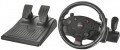 | 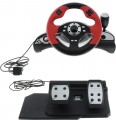 |
|---|---|---|
| Trust GXT-288 | Dvtech WD205 | |
from $89.28 up to $107.56 | Outdated Product | |
| TOP sellers | ||
| Device type (configuration) | steering wheel, pedals, and gearbox | steering wheel and pedals |
| Compatibility | PC (Windows) PlayStation 3 | PC (Windows) PlayStation 3 |
| Connection | wired | wired |
| Cable | USB-A | USB-A |
Technical specifications | ||
| Total number of buttons | 11 | 14 |
| Feedback | vibration | vibration |
| D-pad controller |  | |
| Steering wheel turn | 270° | 240° |
| Paddle shifters | 2 pcs | |
| Pedals | accelerator brake | accelerator brake |
General information | ||
| Mounting | clamps | suction cups |
| Power source | USB port | USB port |
| Color | ||
| Added to E-Catalog | july 2016 | june 2016 |


Compare Trust GXT-288 and Dvtech WD205
You may be interested in
My comparisons
Trust GXT-288 often compared


Glossary
Device type (configuration)
— Steering Wheel. Ready-to-use gaming steering wheels that can be plugged in and played right out of the box. Such a set usually includes the wheel with a base, mount, and cables, but without pedals or a separate gearbox, so acceleration and braking may be assigned to buttons or paddles. This option is suitable for arcade races, simple racing simulators, and cases where a basic kit without extra accessories is needed.
— Steering Wheel with Pedals. A more complete racing kit that, in addition to the steering block, includes a separate pedal platform for the accelerator, brake, and sometimes the clutch. This set is noticeably closer to real car control than just a wheel without pedals, as speed and braking are controlled with your feet. It's a convenient starting option for Forza, Gran Turismo, F1, Assetto Corsa, and other racing games.
— Steering Wheel, Pedals, and Gearbox. Contains the three main elements at once: a steering block, pedals, and a separate gear shifter. Here, the gear shifter refers to a standalone shifter that mimics manual shifting, not paddle shifters on the wheel. This set is better suited for simulators, drifting, truck games, and fans of manual gear shifting, where more realistic seating and control are important.
— Steering Wheel with Gearbox. Kits where the gear lever is provid...ed along with the wheel. Unlike kits with a separate gearbox, here the lever is often located directly on the same base with the wheel, making the set more compact and not requiring separate space for the shifter. This option is convenient for arcade races, simple simulators, and users who want manual shifting without complex modular assembly.
— Steering Wheel. A separate interchangeable part of a gaming steering wheel, designed to be mounted on a compatible steering base. This option is considered a more professional solution because the user assembles the simulator modularly: separately choosing the base, wheel, pedals, gearbox, and other accessories. This allows you to customize the shape, diameter, grip, buttons, and style of the wheel for specific races — for example, formula, rally, drift, or GT races.
— Steering Base. The main power block to which the steering wheel is connected and which is responsible for rotation, resistance, and Force Feedback feedback. The base itself is not a ready-to-play wheel, as it usually requires a separate steering wheel, pedals, and other accessories. This option is more often chosen for modular simulators where power, precision, and the ability to assemble the kit yourself are important.
— Pedals. An independent accessory for a gaming steering wheel that is responsible for the accelerator, brake, and in some kits, the clutch. They are purchased to replace the basic pedal block, upgrade a simulator, or assemble a kit from separate components. For example, more advanced pedals can more accurately transmit braking force and better suit serious racing simulators.
— Gearbox. A gear shifter for gaming steering wheels and racing simulators. It mimics the operation of a manual or sequential gearbox, depending on the model's design. This accessory is especially useful for car simulators, drifting, rally, truck simulators, and games where players want to control gears with a separate lever instead of paddles.
— Handbrake. An accessory for a racing simulator that mimics a lever for a parking or hydraulic brake. It is especially useful in drifting, rally, and some arcade races, where you need to quickly break the rear axle into a slide or take a corner sideways.
— Steering Wheel with Pedals. A more complete racing kit that, in addition to the steering block, includes a separate pedal platform for the accelerator, brake, and sometimes the clutch. This set is noticeably closer to real car control than just a wheel without pedals, as speed and braking are controlled with your feet. It's a convenient starting option for Forza, Gran Turismo, F1, Assetto Corsa, and other racing games.
— Steering Wheel, Pedals, and Gearbox. Contains the three main elements at once: a steering block, pedals, and a separate gear shifter. Here, the gear shifter refers to a standalone shifter that mimics manual shifting, not paddle shifters on the wheel. This set is better suited for simulators, drifting, truck games, and fans of manual gear shifting, where more realistic seating and control are important.
— Steering Wheel with Gearbox. Kits where the gear lever is provid...ed along with the wheel. Unlike kits with a separate gearbox, here the lever is often located directly on the same base with the wheel, making the set more compact and not requiring separate space for the shifter. This option is convenient for arcade races, simple simulators, and users who want manual shifting without complex modular assembly.
— Steering Wheel. A separate interchangeable part of a gaming steering wheel, designed to be mounted on a compatible steering base. This option is considered a more professional solution because the user assembles the simulator modularly: separately choosing the base, wheel, pedals, gearbox, and other accessories. This allows you to customize the shape, diameter, grip, buttons, and style of the wheel for specific races — for example, formula, rally, drift, or GT races.
— Steering Base. The main power block to which the steering wheel is connected and which is responsible for rotation, resistance, and Force Feedback feedback. The base itself is not a ready-to-play wheel, as it usually requires a separate steering wheel, pedals, and other accessories. This option is more often chosen for modular simulators where power, precision, and the ability to assemble the kit yourself are important.
— Pedals. An independent accessory for a gaming steering wheel that is responsible for the accelerator, brake, and in some kits, the clutch. They are purchased to replace the basic pedal block, upgrade a simulator, or assemble a kit from separate components. For example, more advanced pedals can more accurately transmit braking force and better suit serious racing simulators.
— Gearbox. A gear shifter for gaming steering wheels and racing simulators. It mimics the operation of a manual or sequential gearbox, depending on the model's design. This accessory is especially useful for car simulators, drifting, rally, truck simulators, and games where players want to control gears with a separate lever instead of paddles.
— Handbrake. An accessory for a racing simulator that mimics a lever for a parking or hydraulic brake. It is especially useful in drifting, rally, and some arcade races, where you need to quickly break the rear axle into a slide or take a corner sideways.
Total number of buttons
The total number of buttons provided in the manipulator's design.
The more buttons, the more additional functions can be "assigned" to the manipulator, reducing the likelihood of having to use other control devices (e.g., a PC keyboard) during gameplay. However, many gaming consoles (see "Platform Compatibility") require a certain minimum number of buttons for a compatible gamepad — having fewer buttons would simply not allow full use of all the console functions. For instance, the standard controller for the PlayStation 4 has 11 buttons.
Note that the D-Pad manipulator (see below) is not counted in this calculation: it is considered a specific control device, although it is based on buttons.
The more buttons, the more additional functions can be "assigned" to the manipulator, reducing the likelihood of having to use other control devices (e.g., a PC keyboard) during gameplay. However, many gaming consoles (see "Platform Compatibility") require a certain minimum number of buttons for a compatible gamepad — having fewer buttons would simply not allow full use of all the console functions. For instance, the standard controller for the PlayStation 4 has 11 buttons.
Note that the D-Pad manipulator (see below) is not counted in this calculation: it is considered a specific control device, although it is based on buttons.
Steering wheel turn
The steering wheel rotation angle in the control wheel (see "Device Type"). This parameter is measured by the total range — from one extreme point to the other; accordingly, the rotation angle from the mid position will be half of the total. For instance, an indicator of 180° means the wheel can turn both right and left by 90°.
This parameter directly affects both the overall level and the purpose of the wheel. Models with a rotation angle up to 270° are predominantly entry-level and are mainly intended for arcade racing enthusiasts without a significant emphasis on realism, as well as for children and beginner gamers. More advanced wheels have a rotation angle of 900°, or even 1080°. These figures are not arbitrary — they correspond to the steering wheel rotation ranges in most production cars (900°) and some racing supercars (1080°). Thus, such features make using the wheel as realistic as possible — on the other hand, they significantly impact the cost.
The range of steering wheel rotation can be adjusted by the steering angle adjustment function (if this feature is implemented in the game controller). The option is set either directly in the game or through the software that manages the wheel's operation.
This parameter directly affects both the overall level and the purpose of the wheel. Models with a rotation angle up to 270° are predominantly entry-level and are mainly intended for arcade racing enthusiasts without a significant emphasis on realism, as well as for children and beginner gamers. More advanced wheels have a rotation angle of 900°, or even 1080°. These figures are not arbitrary — they correspond to the steering wheel rotation ranges in most production cars (900°) and some racing supercars (1080°). Thus, such features make using the wheel as realistic as possible — on the other hand, they significantly impact the cost.
The range of steering wheel rotation can be adjusted by the steering angle adjustment function (if this feature is implemented in the game controller). The option is set either directly in the game or through the software that manages the wheel's operation.
Paddle shifters
Paddle shifters behind the steering wheel, which can be pressed with fingers without removing hands from the wheel, are most often used for gear shifting. Basic models usually have two paddles: the right one is for shifting up, and the left one is for shifting down. More advanced wheels may have 4 or 6 paddles, with additional pairs used for clutch, manual start, DRS, car adjustments, or other commands in simulators. The more paddle shifters there are, the more convenient it is to control important functions directly from the wheel, especially in F1, GT, and other racing simulators.
Mounting
Mounting demonstrates how a racing wheel is secured on a work surface to prevent movement during turns, vibrations, or force feedback.
— Clamps. Clamps (screw clamp mounting) secure the racing wheel to the table by mechanically pressing it to the tabletop. This option is more reliable than suction cups and better suited for wheels with vibration or force feedback, as the base shifts less during sudden turns. When choosing, it is important to consider the thickness of the table and the shape of the edge so the clamp can properly grab on and securely fix the wheel.
— Suction cups. Suction cups hold the wheel by sticking to a smooth table surface. This option is simpler and quicker to install, but usually less reliable, especially on rough, dusty, or uneven surfaces. Suction cups are more suitable for lightweight wheels without powerful feedback and for temporary setups, when you don't want to screw in clamps each time.
— Bolts. A rigid method for installing pedals, gear shifters, handbrakes, where the device is bolted to a cockpit, stand, or special platform through mounting holes. Such mounting is more reliable than clamps and suction cups because the device does not shift even during active driving.
— Clamps. Clamps (screw clamp mounting) secure the racing wheel to the table by mechanically pressing it to the tabletop. This option is more reliable than suction cups and better suited for wheels with vibration or force feedback, as the base shifts less during sudden turns. When choosing, it is important to consider the thickness of the table and the shape of the edge so the clamp can properly grab on and securely fix the wheel.
— Suction cups. Suction cups hold the wheel by sticking to a smooth table surface. This option is simpler and quicker to install, but usually less reliable, especially on rough, dusty, or uneven surfaces. Suction cups are more suitable for lightweight wheels without powerful feedback and for temporary setups, when you don't want to screw in clamps each time.
— Bolts. A rigid method for installing pedals, gear shifters, handbrakes, where the device is bolted to a cockpit, stand, or special platform through mounting holes. Such mounting is more reliable than clamps and suction cups because the device does not shift even during active driving.