
Comparison DJI RC Pro 2 vs DJI RC Pro
Add to comparison |  | 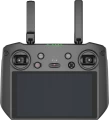 |
|---|---|---|
| DJI RC Pro 2 | DJI RC Pro | |
| Compare prices 2 | Compare prices 2 | |
| TOP sellers | ||
| Suitable for | for FPV drones | for FPV drones |
| Form factor | gamepad | gamepad |
| Display | + | + |
| Screen size | 7 | 5.5 |
| Screen resolution | 1920x1080 | |
| Compatibility | Mavic 4 Pro, Mini 4 Pro, Air 3S, Air 3 | Mini 3 Pro, Air 2S, Mavic 3 Classic, Mavic 3, Mavic 3 Cine |
Transmitter and communication | ||
| Radio frequency | 2.4 GHz, 5.1 GHz, 5.8 GHz | 2.4 GHz, 5.8 GHz |
| Transmitter power | 2000 mW | |
| Range | 30 km | 15 km |
| Video transmission |  | |
| Telemetry support | | |
Control | ||
| Controls | 11 | 11 |
| Gimbals | on potentiometers | on potentiometers |
| Touchscreen | | |
Features | ||
| Built-in speaker | | |
| HDMI output | | |
| Built-in memory | 128 GB | |
| Card reader | microSD | microSD |
General | ||
| Power supply | battery | battery |
| Operating time | 4 h | 3 h |
| Connector for charging | USB-C | USB-C |
| Dimensions | 183x203x60 mm | |
| Weight | 680 g | |
| Added to E-Catalog | may 2025 | february 2024 |




Compare DJI RC Pro 2 and RC Pro
Price comparison
DJI RC Pro often compared


Glossary
Screen size
Display diagonal size in inches. The larger the display, the more accurate and easier to read the information displayed on it, the better the video stream can be seen on the screen in real time. On the other hand, a display that is too large entails an increase in the size and cost of the controller. In remote controls with the ability to display only service parameters, the screen size is usually from 1 to 3 inches, in copies with full color matrices and support for broadcasting a video stream - about 5 - 7 inches diagonally.
Screen resolution
Display size in dots (pixels) horizontally and vertically. The higher the resolution of the screen, the more detailed the image can be displayed on it and the smaller objects will be clearly visible. It makes sense to pay attention to this parameter in controllers that are used to control the RC model with a first-person view in real time. The display resolution of such copies can correspond to the Full HD format (1920x1080 pixels) or even exceed it (for example, Quad HD - 2560x1440 pixels).
Compatibility
Compatibility of the controller with specific RC models. For many popular models, their own specialized remote controls are produced, which are initially tailored to the characteristics of a particular model. However, it is often possible to replace the “native” controller with a third-party one - many models of this type are produced with compatibility for a certain list of RC equipment. Before purchasing, it makes sense to check compatibility to avoid unpleasant surprises.
Radio frequency
The frequency at which communication takes place between the controller and the RU model.
In cars and radio-controlled special equipment, the most widely used analog standards are 27, 35, 40, 49 and 75 MHz. The base frequency is considered to be 27 MHz, and other options are used as an alternative to it, which ensures that signals from different remote controls are not mixed when located in the coverage area of several transmitters.
The 915 MHz frequency (or 868 MHz for certain regions) is often used in controllers to control drones using the ELRS protocol (see “Communication Protocol”). It provides increased range but requires large antennas.
Digital data transmission for controlling RC models and quadcopters can be performed at frequencies of 2.4 GHz, 5.1 GHz, 5.8 GHz. A significant advantage of these options is the channel separation technology, thanks to which the remote controls can operate in close proximity to each other without creating problems. The gigahertz bands differ in their communication range and throughput. Note that theoretically the 2.4 GHz frequency may be more susceptible to interference, because Many modern Wi-Fi modules work on it. However, thanks to the aforementioned channel distribution, such problems rarely arise.
In cars and radio-controlled special equipment, the most widely used analog standards are 27, 35, 40, 49 and 75 MHz. The base frequency is considered to be 27 MHz, and other options are used as an alternative to it, which ensures that signals from different remote controls are not mixed when located in the coverage area of several transmitters.
The 915 MHz frequency (or 868 MHz for certain regions) is often used in controllers to control drones using the ELRS protocol (see “Communication Protocol”). It provides increased range but requires large antennas.
Digital data transmission for controlling RC models and quadcopters can be performed at frequencies of 2.4 GHz, 5.1 GHz, 5.8 GHz. A significant advantage of these options is the channel separation technology, thanks to which the remote controls can operate in close proximity to each other without creating problems. The gigahertz bands differ in their communication range and throughput. Note that theoretically the 2.4 GHz frequency may be more susceptible to interference, because Many modern Wi-Fi modules work on it. However, thanks to the aforementioned channel distribution, such problems rarely arise.
Transmitter power
Rated power of the transmitter installed in the controller. This is an important parameter for ensuring reliable control of the RC model at a distance. The power of the transmitter is measured in milliwatts (mW), and the higher the number, the further the signal reaches and the more reliable control will be over long distances or in conditions of interference. In professional models of remote controls, the transmitter power can exceed 1000 mW (1 W).
Range
The operating range of the transmitter in the control panel, in other words, is the maximum distance that the RC model can move away from the transmitter without losing control. The greater this distance, the more convenient it is to operate the car, but at the same time, powerful “long-range” transmitters have corresponding dimensions, weight and cost. In practice, the range may be less than stated - for example, due to the presence of obstacles in the signal path or due to weak batteries. Therefore, it is best to choose according to this parameter with some reserve.
Built-in memory
The amount of built-in memory on board the controller.
Advanced devices are equipped with a data storage device - it is used to store firmware and record video streams from the RU-model camera. The larger the storage capacity, the more filmed videos can be stored in the controller’s memory. On the other hand, this characteristic directly affects the price. It is also worth considering that some remote controls allow you to supplement the built-in storage with a memory card (for more details, see “Card Reader”).
Advanced devices are equipped with a data storage device - it is used to store firmware and record video streams from the RU-model camera. The larger the storage capacity, the more filmed videos can be stored in the controller’s memory. On the other hand, this characteristic directly affects the price. It is also worth considering that some remote controls allow you to supplement the built-in storage with a memory card (for more details, see “Card Reader”).
Operating time
Time of continuous operation of the controller without recharging the battery or replacing batteries. When choosing based on this indicator, it is worth considering that it is quite approximate. In practice, operating time strongly depends on the intensity of use of the remote control, and in models powered by replaceable batteries, also on the quality of these elements. Actual autonomy can often be less, and sometimes even more, than declared. However, different models of controllers can be compared based on the operating time on one full charge given in the specifications.