
Comparison Pimax Crystal Light vs HTC Vive Pro 2 KIT
Add to comparison |  | 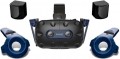 |
|---|---|---|
| Pimax Crystal Light | HTC Vive Pro 2 KIT | |
| Compare prices 1 | Compare prices 1 | |
| TOP sellers | ||
Headphones have a built-in amplifier. Dual front camera. Increased resolution of AMOLED matrices. Comfortable fit. Huge library of PC games. Requires a relatively powerful PC and a lot of free space in the room. | ||
| Device type | VR glasses | VR glasses |
| Purpose (compatibility) | Windows | Windows |
Specs | ||
| Screen resolution | 2880x2880 px | 4896x2448 px |
| Field of view | 130 ° | 120 ° |
| Refresh rate | 120 fps | 120 fps |
| 6DoF motion tracking |  | |
| Accelerometer |  | |
| Gyroscope | | |
| Lens distance adjusting | | |
| Pupillary distance adjustment | | |
Multimedia | ||
| USB-C | + | |
| DisplayPort | v1.2 | |
| Bluetooth | + | |
| Microphone | | |
| Headphones | | |
| Headphone output | | |
General | ||
| Controller | | |
| External sensors | | |
| Track camera | | |
| Material | plastic | plastic |
| Added to E-Catalog | december 2024 | february 2022 |


Compare Pimax Crystal Light and HTC Vive Pro 2 KIT
Price comparison
You may be interested in
Pimax Crystal Light often compared


HTC Vive Pro 2 KIT often compared


Glossary
Screen resolution
Resolution of built-in displays in glasses equipped with such equipment — that is, models for PC / consoles, as well as standalone devices (see "Intended use").
The higher the resolution, the more smooth and detailed the “picture” is given out by glasses, all other things being equal. Thanks to the development of technology nowadays, models with Full HD (1920x1080) screens and even higher resolutions are not uncommon. On the other hand, this parameter significantly affects the cost of points. In addition, it is worth remembering that in order to fully work with high-resolution displays, you need powerful graphics capable of playing relevant content. In the case of glasses for PCs and set-top boxes, this puts forward corresponding requirements for external devices, and in standalone models you have to use advanced integrated video adapters (which affects the cost even more).
The higher the resolution, the more smooth and detailed the “picture” is given out by glasses, all other things being equal. Thanks to the development of technology nowadays, models with Full HD (1920x1080) screens and even higher resolutions are not uncommon. On the other hand, this parameter significantly affects the cost of points. In addition, it is worth remembering that in order to fully work with high-resolution displays, you need powerful graphics capable of playing relevant content. In the case of glasses for PCs and set-top boxes, this puts forward corresponding requirements for external devices, and in standalone models you have to use advanced integrated video adapters (which affects the cost even more).
Field of view
The viewing angle provided by virtual reality glasses is the angular size of the space that falls into the user's field of view. Usually, the characteristics indicate the size of this space horizontally; however, if you need the most accurate information, this point needs to be specified separately.
The wider the viewing angle — the more the game space the user can see without turning his head, the more powerful the immersion effect and the less likely that the image will be subject to the "tunnel vision" effect. On the other hand, making the field of view too wide also does not make sense, given the characteristics of the human eye. In general, a large viewing angle is considered to be an angle of 100° or more. On the other hand, there are models where this indicator is 30° or even less — these are, usually, specific devices (for example, drone piloting glasses and augmented reality glasses), where such characteristics are quite justified given the overall functionality.
The wider the viewing angle — the more the game space the user can see without turning his head, the more powerful the immersion effect and the less likely that the image will be subject to the "tunnel vision" effect. On the other hand, making the field of view too wide also does not make sense, given the characteristics of the human eye. In general, a large viewing angle is considered to be an angle of 100° or more. On the other hand, there are models where this indicator is 30° or even less — these are, usually, specific devices (for example, drone piloting glasses and augmented reality glasses), where such characteristics are quite justified given the overall functionality.
Accelerometer
Presence in points of own built — in accelerometer.
The accelerometer is a sensor that records the accelerations that the device is subjected to. It performs two main functions: determines the position of the glasses relative to the horizon (in the direction of gravity) and monitors jerks and tremors (however, this function is secondary in VR glasses). Such a sensor is necessary for a full-fledged "immersion" in virtual reality, so it must be provided in glasses made in the form of independent devices (see "Intended use"). But models for PC / consoles may not be equipped with an accelerometer — this means that the glasses are not designed for classic VR, but for more specific tasks (for example, controlling a drone with a first-person view).
As for models for smartphones, most of them do not have this function, since all modern smartphones are equipped with accelerometers. However, there are exceptions — high-end models designed for specific devices: in them, the accelerometer can work in conjunction with a smartphone sensor, which ensures the most accurate image positioning.
The accelerometer is a sensor that records the accelerations that the device is subjected to. It performs two main functions: determines the position of the glasses relative to the horizon (in the direction of gravity) and monitors jerks and tremors (however, this function is secondary in VR glasses). Such a sensor is necessary for a full-fledged "immersion" in virtual reality, so it must be provided in glasses made in the form of independent devices (see "Intended use"). But models for PC / consoles may not be equipped with an accelerometer — this means that the glasses are not designed for classic VR, but for more specific tasks (for example, controlling a drone with a first-person view).
As for models for smartphones, most of them do not have this function, since all modern smartphones are equipped with accelerometers. However, there are exceptions — high-end models designed for specific devices: in them, the accelerometer can work in conjunction with a smartphone sensor, which ensures the most accurate image positioning.
Gyroscope
The presence in the glasses of its own built-in gyroscope.
The gyroscope captures the direction, speed, and angle of rotation of the device—usually along all three axes. Without such a sensor, it is impossible to achieve a full-fledged "immersion" in virtual reality, so it is available in all standalone glasses, as well as in most models for PC / consoles (see "Intended use"). In the second case, the only exceptions are individual models with a specific purpose — "personal cinemas", glasses for piloting drones, etc. In turn, glasses for smartphones do not initially require gyroscopes, since smartphones themselves have such sensors. However, there are exceptions here too — advanced models created for specific top-level devices: in them, the built-in gyroscope works in conjunction with the gyroscope of the connected smartphone, ensuring maximum positioning accuracy.
The gyroscope captures the direction, speed, and angle of rotation of the device—usually along all three axes. Without such a sensor, it is impossible to achieve a full-fledged "immersion" in virtual reality, so it is available in all standalone glasses, as well as in most models for PC / consoles (see "Intended use"). In the second case, the only exceptions are individual models with a specific purpose — "personal cinemas", glasses for piloting drones, etc. In turn, glasses for smartphones do not initially require gyroscopes, since smartphones themselves have such sensors. However, there are exceptions here too — advanced models created for specific top-level devices: in them, the built-in gyroscope works in conjunction with the gyroscope of the connected smartphone, ensuring maximum positioning accuracy.
USB-C
Presence of a USB-C port in glasses. This is a relatively new type of USB port, with miniature size (slightly larger than microUSB) and a convenient reversible design, allowing the plug to be connected either way. It can be found in glasses of different purposes and, accordingly, designed for various applications. For example, in models for PCs/consoles, this port is used similarly to traditional USB-A — for main connection, alongside HDMI or DisplayPort interfaces. In standalone devices, in turn, USB-C is mainly intended for battery charging and connection to a computer for direct file exchange, settings management, firmware updates, etc.
It should also be noted that this section might specify the USB version that the USB-C port corresponds to. Currently, two versions are relevant — 5Gbps and 10Gbps; for VR glasses, the difference between them is generally not significant.
It should also be noted that this section might specify the USB version that the USB-C port corresponds to. Currently, two versions are relevant — 5Gbps and 10Gbps; for VR glasses, the difference between them is generally not significant.
DisplayPort
Availability of DisplayPort input in glasses; the version of this interface can also be specified here.
DisplayPort is one of the most popular high-resolution digital video interfaces these days (however, audio transmission is also possible). It is especially common in computer technology, and is actually a standard in Apple PCs and laptops. Only glasses for computers and set-top boxes are equipped with this type of input (see “Purpose”) - it is used to receive a video signal (and audio signal, if necessary) from an external device. As for DisplayPort versions, the options here could be:
- v.1.2. The earliest (2010) version that is relevant today, but at the same time a more than functional version. Fully supports video quality up to 5K (30 fps), and with certain restrictions - up to 8K.
- v.1.3. Update released in 2014. It provided the opportunity to fully work with 8K resolutions at 30 fps, and with 4K and 5K at 120 and 60 fps, respectively.
- v.1.4. Updated in 2016, in which the bandwidth was further increased - up to support for 5K video at 240 fps and 8K at 120 fps. In addition, there is compatibility with HDR 10 technology, which improves color reproduction and overall picture quality.
DisplayPort is one of the most popular high-resolution digital video interfaces these days (however, audio transmission is also possible). It is especially common in computer technology, and is actually a standard in Apple PCs and laptops. Only glasses for computers and set-top boxes are equipped with this type of input (see “Purpose”) - it is used to receive a video signal (and audio signal, if necessary) from an external device. As for DisplayPort versions, the options here could be:
- v.1.2. The earliest (2010) version that is relevant today, but at the same time a more than functional version. Fully supports video quality up to 5K (30 fps), and with certain restrictions - up to 8K.
- v.1.3. Update released in 2014. It provided the opportunity to fully work with 8K resolutions at 30 fps, and with 4K and 5K at 120 and 60 fps, respectively.
- v.1.4. Updated in 2016, in which the bandwidth was further increased - up to support for 5K video at 240 fps and 8K at 120 fps. In addition, there is compatibility with HDR 10 technology, which improves color reproduction and overall picture quality.
Bluetooth
The presence of a Bluetooth module in the glasses; The Bluetooth version to which this module corresponds can also be specified here.
Bluetooth is a technology created for direct wireless connection between various devices. This technology is found in all types of VR glasses (see “Purpose”), although most models with its support are independent devices. In any case, the most popular way to use Bluetooth in virtual reality glasses is to broadcast sound wirelessly. Moreover, the format of such a broadcast may be different, depending on the specifics of the glasses themselves. Thus, standalone devices broadcast the reproduced sound to external headphones. Models for PCs and smartphones may have built-in headphones, and here the sound is transmitted via Bluetooth to the glasses from an external device; Audio from the built-in microphone can be transmitted in the opposite direction.
In addition, there are other possible ways to use Bluetooth, such as directly exchanging files with another device or connecting game controllers. Such capabilities are found exclusively in stand-alone glasses; the specific functionality for each model should be clarified separately.
As for the versions, the oldest one used in VR glasses today is Bluetooth 3.0, the newest is Bluetooth 5.0. However, the differences between different versions for such devices are not fundamental; this information is provided mainly for reference purposes.
Bluetooth is a technology created for direct wireless connection between various devices. This technology is found in all types of VR glasses (see “Purpose”), although most models with its support are independent devices. In any case, the most popular way to use Bluetooth in virtual reality glasses is to broadcast sound wirelessly. Moreover, the format of such a broadcast may be different, depending on the specifics of the glasses themselves. Thus, standalone devices broadcast the reproduced sound to external headphones. Models for PCs and smartphones may have built-in headphones, and here the sound is transmitted via Bluetooth to the glasses from an external device; Audio from the built-in microphone can be transmitted in the opposite direction.
In addition, there are other possible ways to use Bluetooth, such as directly exchanging files with another device or connecting game controllers. Such capabilities are found exclusively in stand-alone glasses; the specific functionality for each model should be clarified separately.
As for the versions, the oldest one used in VR glasses today is Bluetooth 3.0, the newest is Bluetooth 5.0. However, the differences between different versions for such devices are not fundamental; this information is provided mainly for reference purposes.
Headphones
The presence of your own headphones in the design or delivery of virtual reality glasses.
A full-fledged "immersion" in the virtual world requires not only a picture on the screen, but also an appropriate sound accompaniment, for which headphones are the best option. However, glasses take up quite a lot of space on the head, and not all “ears” can be comfortably combined with them (this is especially noticeable on large over-ear headphones). In addition, when connecting headphones with a wire, there may be problems related to the length and/or location of the audio cable. Thus, some models provide this function. These models can have any purpose (see above); most of these are for PC/console glasses, but headphones are also popular in standalone devices. Also note that some glasses use speakers located in the ear area; such speakers are also considered headphones in this case.
An alternative to the bundled "ears" is a headphone output; however, there are models with both functions at once — either folding / removable cups or the simplest speakers mentioned above play the role of headphones in them.
A full-fledged "immersion" in the virtual world requires not only a picture on the screen, but also an appropriate sound accompaniment, for which headphones are the best option. However, glasses take up quite a lot of space on the head, and not all “ears” can be comfortably combined with them (this is especially noticeable on large over-ear headphones). In addition, when connecting headphones with a wire, there may be problems related to the length and/or location of the audio cable. Thus, some models provide this function. These models can have any purpose (see above); most of these are for PC/console glasses, but headphones are also popular in standalone devices. Also note that some glasses use speakers located in the ear area; such speakers are also considered headphones in this case.
An alternative to the bundled "ears" is a headphone output; however, there are models with both functions at once — either folding / removable cups or the simplest speakers mentioned above play the role of headphones in them.
Headphone output
Availability in points of an exit for connection of earphones. Most often, the role of such a connector is played by a standard 3.5 mm mini-jack socket.
A full-fledged "immersion" in the virtual world requires not only a picture on the screen, but also an appropriate sound accompaniment, for which headphones are the best option. Its own headphone output allows you to connect wired "ears" directly to the glasses — it is much more convenient and safer during use than connecting headphones to a computer or set-top box. However, independent devices can also have such a connector (see "Purpose").
Note that there are VR glasses with their own built-in headphones, but this option is more convenient: it allows you to select the “ears” separately, according to the user’s own preferences.
A full-fledged "immersion" in the virtual world requires not only a picture on the screen, but also an appropriate sound accompaniment, for which headphones are the best option. Its own headphone output allows you to connect wired "ears" directly to the glasses — it is much more convenient and safer during use than connecting headphones to a computer or set-top box. However, independent devices can also have such a connector (see "Purpose").
Note that there are VR glasses with their own built-in headphones, but this option is more convenient: it allows you to select the “ears” separately, according to the user’s own preferences.