
Comparison Braun BNT 400 vs Beurer FT 100
Add to comparison | 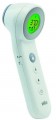 |  |
|---|---|---|
| Braun BNT 400 | Beurer FT 100 | |
| Compare prices 2 | Compare prices 1 | |
| TOP sellers | ||
Display in °C and °F. Measuring distance: 4 – 6 cm. High temperature warning LED (green/yellow/red): up to 37.5 °C = green, from 37.5 °C to 37.9 °C = yellow, from 38.0 °C = red. | ||
| Type | infrared | contact |
| Application area | frontal | frontal |
Measurements | ||
| Air temperatures |  | |
| Liquid temperatures | | |
| Measurement duration | 2 с | |
| Measurement accuracy | 0.2 °C | |
General | ||
| Reading memory | 60 pcs | |
| Sound signal | | |
| Display backlight | | |
| Power source | 2xAAA | |
| Color | ||
| Added to E-Catalog | february 2020 | june 2019 |


Compare Braun BNT 400 and Beurer FT 100
Price comparison
You may be interested in
My comparisons
Braun BNT 400 often compared


Glossary
Type
The type defines the general use and principle of operation of the thermometer.
— Contact. These are devices that need direct skin contact for operation. Known as traditional and widely used medical thermometers, contact models are affordable and generally reliable. While some may require a longer contact time, advanced models can provide a temperature measurement in just a few seconds.
— Infrared. Non-contact thermometers measure temperature by detecting infrared radiation from a surface, where a warmer surface emits more infrared "glow." These devices, more hygienic than contact models, allow swift temperature readings for multiple individuals. They are versatile, capable of measuring the temperature of various surfaces, such as baby food bottles. For ear applications, this method is often considered the most suitable. However, non-contact models tend to be pricier than their contact counterparts.
— Pacifier. A specialized oral thermometer for infants, designed in the shape of a typical baby pacifier. It includes a temperature sensor and a display, making it easy for young children to hold in their mouths. This design addresses potential issues that may arise with a more conventional "adult" thermometer. While limited by age, there are sets available that combine a contact thermometer with the pacifier design, providing comfort for differ...ent age ranges or versatile use, such as measuring ambient temperature.
— Contact. These are devices that need direct skin contact for operation. Known as traditional and widely used medical thermometers, contact models are affordable and generally reliable. While some may require a longer contact time, advanced models can provide a temperature measurement in just a few seconds.
— Infrared. Non-contact thermometers measure temperature by detecting infrared radiation from a surface, where a warmer surface emits more infrared "glow." These devices, more hygienic than contact models, allow swift temperature readings for multiple individuals. They are versatile, capable of measuring the temperature of various surfaces, such as baby food bottles. For ear applications, this method is often considered the most suitable. However, non-contact models tend to be pricier than their contact counterparts.
— Pacifier. A specialized oral thermometer for infants, designed in the shape of a typical baby pacifier. It includes a temperature sensor and a display, making it easy for young children to hold in their mouths. This design addresses potential issues that may arise with a more conventional "adult" thermometer. While limited by age, there are sets available that combine a contact thermometer with the pacifier design, providing comfort for differ...ent age ranges or versatile use, such as measuring ambient temperature.
Measurement duration
The time it takes for a thermometer to provide a temperature reading, from contact or activating the IR sensor to obtaining the result, is crucial for efficiency. Quick measurements save time during temperature checks. However, it's important to mention that for axillary use (see "Application area"), it's advised to keep the thermometer in place for a minimum of 5 minutes, irrespective of the manufacturer's specified measurement time, due to the nature of the procedure.
Measurement accuracy
The extent to which a device deviates from the actual temperature during measurements determines its accuracy. Even the least accurate electronic medical thermometers today have a maximum deviation of 0.3 °C, sufficient for everyday and basic medical use. Common models offer even higher accuracy, with deviations as low as 0.1 °C or 0.2 °C, making the pursuit of maximum accuracy necessary only in specific scenarios.
Reading memory
The number of results the thermometer can store in memory. The ability to "remember" the results of previous measurements can be very convenient in some cases — in particular, it allows you to accurately track changes in temperature over time. The most advanced models are capable of storing several dozen readings in memory.
Power source
Type of batteries used in thermometers.
— AA. The ubiquitous battery, commonly found everywhere batteries are sold, operates at 1.5 volts, making it widely accessible.
— AAA. The batteries, which are a compact alternative to AA batteries with the same 1.5V voltage, are widely used and suitable for small devices.
— CR2032. One of the most popular types of batteries, with a diameter of 20 mm and a thickness of 3.2 mm. Actual for use in compact devices.
— AA. The ubiquitous battery, commonly found everywhere batteries are sold, operates at 1.5 volts, making it widely accessible.
— AAA. The batteries, which are a compact alternative to AA batteries with the same 1.5V voltage, are widely used and suitable for small devices.
— CR2032. One of the most popular types of batteries, with a diameter of 20 mm and a thickness of 3.2 mm. Actual for use in compact devices.