
Comparison Beurer FT 85 vs Braun BNT 400
Add to comparison | 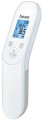 | 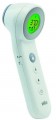 |
|---|---|---|
| Beurer FT 85 | Braun BNT 400 | |
from $32.03 | Compare prices 2 | |
| TOP sellers | ||
| Type | infrared | infrared |
| Application area | frontal | frontal |
Measurements | ||
| Air temperatures |  | |
| Liquid temperatures | | |
| Measurement duration | 2 с | |
| Measurement range | 0 – 80 °C | |
| Measurement accuracy | 0.2 °C | 0.2 °C |
General | ||
| Reading memory | 60 pcs | |
| Sound signal | | |
| Display backlight | | |
| Power source | 2xAAA | 2xAAA |
| Dimensions | 16.1x4.28x3.6 mm | |
| Weight | 67 g | |
| Color | ||
| Added to E-Catalog | february 2021 | february 2020 |




Compare Beurer FT 85 and Braun BNT 400
Thermometers Beurer FT 85 and Braun BNT 400 are both infrared and designed for measuring forehead temperature. Both devices have a measurement accuracy of ±0.2 °C and can measure air temperature and liquids. However, Braun BNT 400 stands out for its measurement speed — only 2 seconds, whereas Beurer FT 85 does not have a specified measurement time. Both thermometers have memory for readings for 60 entries, a sound signal and a display backlight, but do not have a waterproof body or flexible tip. Both work on 2xAAA batteries.
Price comparison
You may be interested in
My comparisons
Beurer FT 85 often compared

Braun BNT 400 often compared


Glossary
Measurement duration
The time it takes for a thermometer to provide a temperature reading, from contact or activating the IR sensor to obtaining the result, is crucial for efficiency. Quick measurements save time during temperature checks. However, it's important to mention that for axillary use (see "Application area"), it's advised to keep the thermometer in place for a minimum of 5 minutes, irrespective of the manufacturer's specified measurement time, due to the nature of the procedure.
Measurement range
The range of temperatures that a thermometer can measure.
For measuring body temperature, a range of 35 – 43 °C is considered ample, covering values encountered in individuals with high fever or hypothermia. Although modern medical thermometers may have broader ranges, especially those designed for water and air temperature measurement (e.g., -20 – 100 °C), when used for body temperature, they typically operate within a narrower range. The overall and "solid" measurement ranges are often specified separately in these thermometers.
For measuring body temperature, a range of 35 – 43 °C is considered ample, covering values encountered in individuals with high fever or hypothermia. Although modern medical thermometers may have broader ranges, especially those designed for water and air temperature measurement (e.g., -20 – 100 °C), when used for body temperature, they typically operate within a narrower range. The overall and "solid" measurement ranges are often specified separately in these thermometers.
Reading memory
The number of results the thermometer can store in memory. The ability to "remember" the results of previous measurements can be very convenient in some cases — in particular, it allows you to accurately track changes in temperature over time. The most advanced models are capable of storing several dozen readings in memory.