
Comparison HECHT 6700 vs HECHT 6500
Add to comparison | 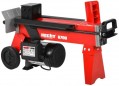 | 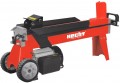 |
|---|---|---|
| HECHT 6700 | HECHT 6500 | |
| Outdated Product | Outdated Product | |
| TOP sellers | ||
| Type | hydraulic | hydraulic |
| Operating position | horizontal | horizontal |
| Splitting force | 4 t | 5 t |
| Max. log length | 37 cm | 52 cm |
| Max. log diameter | 25 cm | 25 cm |
Motor | ||
| Motor type | electric | electric |
| Voltage | 230 В | 230 В |
| Max. power | 1.5 kW | 2.2 kW |
General | ||
| Wheels |  | |
| Country of origin | Czech Republic | Czech Republic |
| Weight | 38 kg | 45 kg |
| Added to E-Catalog | september 2018 | september 2018 |


Compare HECHT 6700 and 6500
You may be interested in
My comparisons
HECHT 6700 often compared

HECHT 6500 often compared


Glossary
Splitting force
The greatest force that the wood splitter is able to apply to the workpiece in the process of splitting.
This parameter is relevant for hydraulic and rack units (see "Type"). Even in the simplest such devices, the splitting force reaches several tons. In general, high force allows you to cope with hard and thick workpieces, however, it requires high power and strength, which significantly affects the price and weight of the entire unit. Therefore, it is worth choosing a model according to this characteristic, taking into account the specifics of the work.
So, for use in the private sector, a wood splitter with a splitting force of up to 5 tons is considered quite sufficient, for boiler rooms and other relatively large consumers — 5-8 tons (up to 10 tons), and more powerful devices are intended mainly for industrial use.
This parameter is relevant for hydraulic and rack units (see "Type"). Even in the simplest such devices, the splitting force reaches several tons. In general, high force allows you to cope with hard and thick workpieces, however, it requires high power and strength, which significantly affects the price and weight of the entire unit. Therefore, it is worth choosing a model according to this characteristic, taking into account the specifics of the work.
So, for use in the private sector, a wood splitter with a splitting force of up to 5 tons is considered quite sufficient, for boiler rooms and other relatively large consumers — 5-8 tons (up to 10 tons), and more powerful devices are intended mainly for industrial use.
Max. log length
The longest log that a log splitter can handle. In fact, this is the largest distance that the stop and working nozzle can be spread; if the workpiece is longer than this distance, it will have to be sawn.
Note that this indicator significantly affects the dimensions (especially in a horizontal working position), and the force required to split a long log is quite high. Therefore, for small volumes of work (for example, when harvesting firewood for a private house), a wood splitter with a relatively small maximum length is often the best choice — up to 60 cm ; longer workpieces can be sawn. But models of more than 60 cm are intended mainly for work on a large scale.
Note that this indicator significantly affects the dimensions (especially in a horizontal working position), and the force required to split a long log is quite high. Therefore, for small volumes of work (for example, when harvesting firewood for a private house), a wood splitter with a relatively small maximum length is often the best choice — up to 60 cm ; longer workpieces can be sawn. But models of more than 60 cm are intended mainly for work on a large scale.
Max. power
Wood splitter motor power in watts. The designation in watts is used for all types of engines, which allows you to compare units with different types of motors.
A powerful motor is needed above all in order to provide a high splitting force (see above). However, when choosing, it is worth focus not so much on power, but on the force stated in the characteristics and the length / thickness of the logs. In addition, in the case of electric motors (see "Motor type"), the power directly determines the energy consumption, which is important in some situations (when running from a generator, with weak wiring, etc.)
A powerful motor is needed above all in order to provide a high splitting force (see above). However, when choosing, it is worth focus not so much on power, but on the force stated in the characteristics and the length / thickness of the logs. In addition, in the case of electric motors (see "Motor type"), the power directly determines the energy consumption, which is important in some situations (when running from a generator, with weak wiring, etc.)