
Comparison M-AUDIO Oxygen Pro Mini vs M-AUDIO Oxygen Pro 25
Add to comparison | 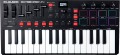 | 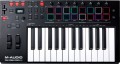 |
|---|---|---|
| M-AUDIO Oxygen Pro Mini | M-AUDIO Oxygen Pro 25 | |
| Compare prices 1 | from $199.00 | |
| TOP sellers | ||
| Keys | 32 шт | 25 шт |
| Key size | small-sized | full size |
| Mechanics | active (dynamic) | active (dynamic) |
| Rigidity | semi-weighted | semi-weighted |
Control | ||
| Pitch controller |  | |
| Modulation controller | | |
| Transposition | | |
| Octave shift | | |
| Arpeggiator | | |
| Transport control | | |
| Pads | 8 | 16 |
| Faders | 4 | 1 |
| Regulators (encoders) | 4 | 8 |
Connections | ||
| MIDI out | | |
| USB to host (type B) | | |
| Connectable pedals | 1 шт | 1 шт |
General | ||
| Programming function | | |
| Display | monochrome | monochrome |
| Dimensions (WxHxD) | 401x60x190 mm | 490x83x264 mm |
| Weight | 1.2 kg | 2.5 kg |
| Color | ||
| Added to E-Catalog | march 2021 | march 2021 |



Compare M-AUDIO Oxygen Pro Mini and Oxygen Pro 25
Price comparison
You may be interested in
My comparisons
M-AUDIO Oxygen Pro Mini often compared


M-AUDIO Oxygen Pro 25 often compared

Glossary
Keys
The total number of keys on the keyboard.
The more keys provided in the design, the wider the instrument's own range, the more notes it can play without resorting to octave shift or transposition. On the other hand, this characteristic directly affects the dimensions and cost, and an extensive range is not required so often. Therefore, 88 -key instruments corresponding to a full-size classical piano keyboard are quite rare. But compact models with only 25 keys(2 octaves), on the contrary, are popular: for the purposes for which MIDI keyboards are used, this is often quite enough. Other common options are the 49 -key (4 octave) and 61 -key (5 octave) models; somewhat less common are 32 and 37 keys.
The more keys provided in the design, the wider the instrument's own range, the more notes it can play without resorting to octave shift or transposition. On the other hand, this characteristic directly affects the dimensions and cost, and an extensive range is not required so often. Therefore, 88 -key instruments corresponding to a full-size classical piano keyboard are quite rare. But compact models with only 25 keys(2 octaves), on the contrary, are popular: for the purposes for which MIDI keyboards are used, this is often quite enough. Other common options are the 49 -key (4 octave) and 61 -key (5 octave) models; somewhat less common are 32 and 37 keys.
Key size
In this case, the size means the size of the keys in width — the length practically does not affect the game process.
— Full size. Standard-width keys, as on a traditional piano keyboard. Switching to such a keyboard from another instrument with standard keys does not cause any problems; Also note that this particular option is recommended for complex games. On the other hand, a full-size keyboard can take up quite a lot of space.
— Small size. Reduced width keys. It is worth paying attention to this option, first of all, if there is not much space for installing the keyboard and compactness is crucial: small keys allow you to reduce the size of the device. In addition, such keys can be useful for people with small hands. But for complex parties, they are worse than full-sized ones.
— Full size. Standard-width keys, as on a traditional piano keyboard. Switching to such a keyboard from another instrument with standard keys does not cause any problems; Also note that this particular option is recommended for complex games. On the other hand, a full-size keyboard can take up quite a lot of space.
— Small size. Reduced width keys. It is worth paying attention to this option, first of all, if there is not much space for installing the keyboard and compactness is crucial: small keys allow you to reduce the size of the device. In addition, such keys can be useful for people with small hands. But for complex parties, they are worse than full-sized ones.
Pads
The number of pads provided in the design of the keyboard.
Pads are auxiliary controls in the form of characteristic pads, usually square. The pads respond to touch, each of them can be tied to a specific sound or even a sequence of sounds. One of the most popular ways to use pads is to play drums or other rhythmic instruments.
Pads are auxiliary controls in the form of characteristic pads, usually square. The pads respond to touch, each of them can be tied to a specific sound or even a sequence of sounds. One of the most popular ways to use pads is to play drums or other rhythmic instruments.
Faders
The number of faders provided in the design of the keyboard.
A fader is a slider control. The simplest kind of such controls is the volume setting; if there is one fader in the design, most likely it is responsible for the volume. If there are more controls, other functions can be tied to them, respectively — in particular, changing the settings in the recording programme on the computer to which the keyboard is connected.
A fader is a slider control. The simplest kind of such controls is the volume setting; if there is one fader in the design, most likely it is responsible for the volume. If there are more controls, other functions can be tied to them, respectively — in particular, changing the settings in the recording programme on the computer to which the keyboard is connected.
Regulators (encoders)
The number of encoder controlsprovided in the design of the keyboard.
Such a knob looks like a rotary knob, with which you can control various functions of the device to which the keyboard is connected — for example, turn the virtual knobs in the programme for recording and sound processing. At the same time, we note that a full-fledged encoder is capable of rotating 360 ° and turning to any angle in any direction, however, keyboards can also contain knobs with a limited rotation sector — they can also be called encoders. None of these options has a clear advantage: in some cases, an unlimited turning sector is more convenient, in others, a limited one.
Such a knob looks like a rotary knob, with which you can control various functions of the device to which the keyboard is connected — for example, turn the virtual knobs in the programme for recording and sound processing. At the same time, we note that a full-fledged encoder is capable of rotating 360 ° and turning to any angle in any direction, however, keyboards can also contain knobs with a limited rotation sector — they can also be called encoders. None of these options has a clear advantage: in some cases, an unlimited turning sector is more convenient, in others, a limited one.