
Comparison Roland FP-E50 vs Yamaha P-225
Add to comparison | 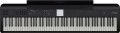 | 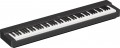 |
|---|---|---|
| Roland FP-E50 | Yamaha P-225 | |
from $999.99 | Compare prices 7 | |
| TOP sellers | ||
| Body | portable | portable |
Keys | ||
| Number of keys | 88 шт | 88 шт |
| Size | full size | full size |
| Mechanics | malleus | malleus |
| Sensitivity adjustment |  | |
| Rigidity | weighted | weighted |
Specs | ||
| Polyphony | 256 voices | 192 voices |
| Built-in timbres | 1075 шт | 24 шт |
| Auto accompaniment | | |
| Accompaniment styles | 107 шт | 20 шт |
| Learning mode |  | |
| Tempo change | 10 – 500 | 5 – 280 |
| Metronome | | |
| Sequencer (recording) | | |
| Built-in compositions | | |
Effects and control | ||
| Timbres layering | | |
| Keyboard split | | |
| Reverberation | | |
| Transposition | | |
| Fine tuning | | |
Connectors | ||
| Inputs | Mini-jack (linear) MIDI in USB to device (type A) | Mini-jack (linear) MIDI in USB to device (type A) |
| Connectable pedals | 3 шт | 2 шт |
| Outputs | MIDI out | USB to host (type B) MIDI out |
| Headphone outputs | 1 шт | 2 шт |
| Linear outputs | 2 шт | 2 шт |
General | ||
| Built-in acoustics | 22 W | 14 W |
| Number of bands | 1 | 2 |
| Display | monochrome | |
| Power consumption | 9 W | 15 W |
| Dimensions (WxHxD) | 1300x174x322 mm | 1326x129x272 mm |
| Weight | 17.1 kg | 11.5 kg |
| In box | music stand pedal PSU | PSU |
| Color | ||
| Added to E-Catalog | october 2023 | october 2023 |




Compare Roland FP-E50 and Yamaha P-225
Price comparison
You may be interested in
My comparisons
Roland FP-E50 often compared


Yamaha P-225 often compared


Glossary
Polyphony
The number of voices supported by the digital piano — more precisely, the maximum number of voices that the instrument can play at the same time.
This parameter should not be confused with the number of notes that can be played simultaneously on the keyboard. The fact is that in many timbres, several voices (tone generators) are used for each note at once — this is the only way to achieve a more or less reliable sound. Thus, the required number of voices can be many times higher than the number of notes — for example, the simplest chord of 3 notes may require 9 or even 12 voices. In addition, tone generators are used to play auto accompaniment parts and built-in songs (see below), and here the number of voices can already be measured in tens.
In light of all this, polyphony of less than 90 voices is typical mainly for relatively simple and inexpensive instruments that are not designed for complex tasks. The smallest number found in modern digital pianos is 32 voices. It is desirable for a more or less solid instrument to have at least 96 voices, and in top models this figure can reach 256.
This parameter should not be confused with the number of notes that can be played simultaneously on the keyboard. The fact is that in many timbres, several voices (tone generators) are used for each note at once — this is the only way to achieve a more or less reliable sound. Thus, the required number of voices can be many times higher than the number of notes — for example, the simplest chord of 3 notes may require 9 or even 12 voices. In addition, tone generators are used to play auto accompaniment parts and built-in songs (see below), and here the number of voices can already be measured in tens.
In light of all this, polyphony of less than 90 voices is typical mainly for relatively simple and inexpensive instruments that are not designed for complex tasks. The smallest number found in modern digital pianos is 32 voices. It is desirable for a more or less solid instrument to have at least 96 voices, and in top models this figure can reach 256.
Built-in timbres
The number of built-in sounds provided by the Digital Piano.
Despite the name, digital pianos are extremely rarely designed to imitate the sound of only a piano — the electronic hardware allows them to provide other timbres of sound. In addition, even the piano has its own varieties — for example, among the grand pianos there are 6 main classes, from large concert to miniature. So the built-in sounds can cover different kinds of pianos, as well as other instruments and sound effects.
The abundance and variety of timbres in digital pianos as a whole is not as great as in synthesizers, however, in this category there are very “charged” models, with a hundred timbres or more (in the most multifunctional, this number can exceed 900). However, it is worth specifically looking for a “multi-instrumental” model if you do not intend to be limited to the sound of the piano and would like to have more freedom of choice. It is worth remembering that a specific set of timbres can be different.
If the instrument is bought exclusively as a piano, then here, on the contrary, it is worth paying attention primarily to solutions with a small number of timbres. Such models are not only cheaper than "universals" — they can also sound better (due to the fact that there are few timbres and the manufacturer can carefully approach the sound quality of each built-in "instrument").
Despite the name, digital pianos are extremely rarely designed to imitate the sound of only a piano — the electronic hardware allows them to provide other timbres of sound. In addition, even the piano has its own varieties — for example, among the grand pianos there are 6 main classes, from large concert to miniature. So the built-in sounds can cover different kinds of pianos, as well as other instruments and sound effects.
The abundance and variety of timbres in digital pianos as a whole is not as great as in synthesizers, however, in this category there are very “charged” models, with a hundred timbres or more (in the most multifunctional, this number can exceed 900). However, it is worth specifically looking for a “multi-instrumental” model if you do not intend to be limited to the sound of the piano and would like to have more freedom of choice. It is worth remembering that a specific set of timbres can be different.
If the instrument is bought exclusively as a piano, then here, on the contrary, it is worth paying attention primarily to solutions with a small number of timbres. Such models are not only cheaper than "universals" — they can also sound better (due to the fact that there are few timbres and the manufacturer can carefully approach the sound quality of each built-in "instrument").
Accompaniment styles
The number of Auto Accompaniment Styles (see above) originally stored in Digital Piano memory.
Different auto accompaniment styles differ from each other in the same way that different melodies differ from each other — in tempo, time signature, rhythmic pattern, set of instruments used, etc. Accordingly, the more styles initially available in the instrument, the wider the choice of the musician and the higher the probability of finding the option that best suits a particular situation. However even numerous styles does not guarantee that among them there will be a suitable one; in addition, we note that with the same number of styles, their specific set in different instruments can also be different. However, custom styles can be provided for this case (see below).
Summarizing, we can say this: if you plan to work intensively with auto accompaniment, in addition to the number of styles, it will not hurt to clarify their specific range.
Different auto accompaniment styles differ from each other in the same way that different melodies differ from each other — in tempo, time signature, rhythmic pattern, set of instruments used, etc. Accordingly, the more styles initially available in the instrument, the wider the choice of the musician and the higher the probability of finding the option that best suits a particular situation. However even numerous styles does not guarantee that among them there will be a suitable one; in addition, we note that with the same number of styles, their specific set in different instruments can also be different. However, custom styles can be provided for this case (see below).
Summarizing, we can say this: if you plan to work intensively with auto accompaniment, in addition to the number of styles, it will not hurt to clarify their specific range.
Learning mode
The presence of a training mode in the digital piano.
As the name suggests, this mode is designed to teach the game. At the same time, usually, it provides different levels of difficulty — from the most basic, for those who are just starting to master the "keys", to the advanced one, which allows you to train your technique and improve your existing performance skills. However, anyway, the principle of learning is the same: the tool independently tells the student which keys to press at one time or another. Such hints can be in the form of a backlight (see above) or as a graphic on the display. Such a method is doubtful from the point of view of classical academic learning, however, it is undoubtedly more convenient and faster than reading musical notation. Moreover, the instrument can also play the role of an examiner — launch prompts at the original tempo of the melody and check how accurately the student hits the notes.
Also note that the learning mode requires the obligatory presence of a metronome (see below).
As the name suggests, this mode is designed to teach the game. At the same time, usually, it provides different levels of difficulty — from the most basic, for those who are just starting to master the "keys", to the advanced one, which allows you to train your technique and improve your existing performance skills. However, anyway, the principle of learning is the same: the tool independently tells the student which keys to press at one time or another. Such hints can be in the form of a backlight (see above) or as a graphic on the display. Such a method is doubtful from the point of view of classical academic learning, however, it is undoubtedly more convenient and faster than reading musical notation. Moreover, the instrument can also play the role of an examiner — launch prompts at the original tempo of the melody and check how accurately the student hits the notes.
Also note that the learning mode requires the obligatory presence of a metronome (see below).
Tempo change
The range over which the tempo of the sound played by the instrument can change. It can be either a built-in melody or a part recorded on a sequencer, or an auto accompaniment, a tutorial or a metronome. For more information on all of these features, see the corresponding glossary entries. Here we note that a change in tempo is often required in fact — for example, to speed up an initially "sluggish" accompaniment or slow down a training programme that is difficult to master at the original tempo.
Tempo is traditionally indicated in beats per minute. The classical, "academic" range covers options from 40 bpm ("grave", "very slow") to 208 bpm ("prestissimo", "very fast"), however, in modern digital pianos, the working range of tempos is often significantly wider.
Tempo is traditionally indicated in beats per minute. The classical, "academic" range covers options from 40 bpm ("grave", "very slow") to 208 bpm ("prestissimo", "very fast"), however, in modern digital pianos, the working range of tempos is often significantly wider.
Connectable pedals
The largest number of pedals that can be connected to the Digital Piano at the same time.
Pedals are an indispensable element of equipping a traditional piano, respectively, they are also necessary for electronic analogues of this instrument. However, in stationary devices (see "Body") the pedals are made built-in (see above), so this option is found only in portable models. Also note that if a stationary digital piano has 3 pedals as standard — like in a real piano — then portable digital pianos often have fewer. This is due to the fact that a full set of three pedals is rarely required in fact, and in many cases just one is enough (especially since many instruments allow you to reconfigure its functions).
In general, it makes sense to specifically buy an instrument with three connected pedals mainly for demanding professional musicians who value the full functionality of the pedals (or the ability to tie an extended set of functions to the foot control). In other cases, this parameter is not particularly important.
Pedals are an indispensable element of equipping a traditional piano, respectively, they are also necessary for electronic analogues of this instrument. However, in stationary devices (see "Body") the pedals are made built-in (see above), so this option is found only in portable models. Also note that if a stationary digital piano has 3 pedals as standard — like in a real piano — then portable digital pianos often have fewer. This is due to the fact that a full set of three pedals is rarely required in fact, and in many cases just one is enough (especially since many instruments allow you to reconfigure its functions).
In general, it makes sense to specifically buy an instrument with three connected pedals mainly for demanding professional musicians who value the full functionality of the pedals (or the ability to tie an extended set of functions to the foot control). In other cases, this parameter is not particularly important.
Outputs
— USB to host (type B). Connector for connecting a digital piano to a computer using the USB standard; in this case, the instrument plays the role of a peripheral device. The possibilities of such a connection can be different: recording live music, updating firmware, voices and auto accompaniment styles, using the digital piano as an external MIDI keyboard, fine-tuning the instrument and troubleshooting, etc.; specific functionality varies from model to model.
— MIDI out. An output that allows you to broadcast MIDI signals (MIDI events) from the Digital Piano to external devices. A MIDI signal is, in fact, a "preparation" of sound: a signal generated when a key is pressed and containing information about the note number, duration, and force of pressing. Based on this signal, the electronics of the instrument (or other device) generates the sound of a certain timbre. The MIDI output can be useful for connecting a digital piano to, for example, an external sequencer for recording, or to a synthesizer for playback in a tone that is not in the piano itself.
— MIDI thru. Output used for switching MIDI signals. The description of such signals is given above, but here we note that the MIDI thru output duplicates the signals received at the MIDI input of the digital piano. This function can be useful in some specific cases — for example, connecting several electr...onic instruments together.
— MIDI out. An output that allows you to broadcast MIDI signals (MIDI events) from the Digital Piano to external devices. A MIDI signal is, in fact, a "preparation" of sound: a signal generated when a key is pressed and containing information about the note number, duration, and force of pressing. Based on this signal, the electronics of the instrument (or other device) generates the sound of a certain timbre. The MIDI output can be useful for connecting a digital piano to, for example, an external sequencer for recording, or to a synthesizer for playback in a tone that is not in the piano itself.
— MIDI thru. Output used for switching MIDI signals. The description of such signals is given above, but here we note that the MIDI thru output duplicates the signals received at the MIDI input of the digital piano. This function can be useful in some specific cases — for example, connecting several electr...onic instruments together.
Headphone outputs
The number of headphone outputs provided in the design of the digital piano.
Headphones can come in handy in situations where it is inconvenient or undesirable for one reason or another to use the digital piano's built-in speakers — for example, if you need to keep quiet and not disturb others with music, or vice versa, the environment is too noisy and it is difficult to hear the sound of the instrument. At the same time, many digital pianos have two headphone outputs, which allows two people to use the “ears” at the same time. This feature can be useful, for example, when playing 4 hands on one keyboard, or when teaching (the second pair of headphones in such cases is used by the teacher).
The outputs of this type themselves most often use a 3.5 mm mini-Jack or 6.35 mm Jack connector. The first option is the most popular in modern headphones; the Jack connector, in turn, is somewhat more reliable, and the “ears” with a mini-Jack plug can be connected to such a jack using a simple adapter.
Headphones can come in handy in situations where it is inconvenient or undesirable for one reason or another to use the digital piano's built-in speakers — for example, if you need to keep quiet and not disturb others with music, or vice versa, the environment is too noisy and it is difficult to hear the sound of the instrument. At the same time, many digital pianos have two headphone outputs, which allows two people to use the “ears” at the same time. This feature can be useful, for example, when playing 4 hands on one keyboard, or when teaching (the second pair of headphones in such cases is used by the teacher).
The outputs of this type themselves most often use a 3.5 mm mini-Jack or 6.35 mm Jack connector. The first option is the most popular in modern headphones; the Jack connector, in turn, is somewhat more reliable, and the “ears” with a mini-Jack plug can be connected to such a jack using a simple adapter.
Built-in acoustics
The power of the native acoustics installed in the Digital Piano.
This indicator directly affects the maximum volume that the instrument is able to produce "on its own", without connecting external speakers. At the same time, it is worth noting that many manufacturers go to the trick and indicate in the characteristics not the rated power (rms power when operating at full volume), but the peak power, which is the highest power that the acoustics can deliver at short “ups” of volume. Peak power values can be quite impressive — in the tens and hundreds of watts — but these figures have a very indirect relation to the actual capabilities of the speakers. Therefore, before choosing, it is worth clarifying what kind of power is mentioned in the characteristics. To do this, it is not necessary to look for detailed data on the instrument, it is enough to compare the power of the speakers with the power consumption (see below): if the claimed power of the acoustics is greater than the power consumption of the entire instrument, then the manufacturer indicated exactly the peak value.
This indicator directly affects the maximum volume that the instrument is able to produce "on its own", without connecting external speakers. At the same time, it is worth noting that many manufacturers go to the trick and indicate in the characteristics not the rated power (rms power when operating at full volume), but the peak power, which is the highest power that the acoustics can deliver at short “ups” of volume. Peak power values can be quite impressive — in the tens and hundreds of watts — but these figures have a very indirect relation to the actual capabilities of the speakers. Therefore, before choosing, it is worth clarifying what kind of power is mentioned in the characteristics. To do this, it is not necessary to look for detailed data on the instrument, it is enough to compare the power of the speakers with the power consumption (see below): if the claimed power of the acoustics is greater than the power consumption of the entire instrument, then the manufacturer indicated exactly the peak value.