
Comparison Yamaha PAC112V vs Yamaha PAC012
Add to comparison | 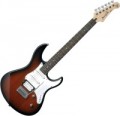 | 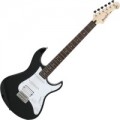 |
|---|---|---|
| Yamaha PAC112V | Yamaha PAC012 | |
| Compare prices 1 | Compare prices 1 | |
| User reviews | ||
| TOP sellers | ||
Solid alder body. 5 deck colour options. Schematic of SSH pickups. Coil cut. | ||
| Type | electric guitar | electric guitar |
| Number of strings | 6 | 6 |
| Pickups | passive | passive |
| Pickup diagram | H-S-S | H-S-S |
| Coil cutoff |  |  |
Tone block | ||
| Type | passive | passive |
| Volume controls | 1 | 1 |
| Tone controls | 1 | 1 |
| Pickup switch | 5 position | 5 position |
Body | ||
| Type | monolith | monolith |
| Size | 4/4 | 4/4 |
| Shape | Stratocaster | Stratocaster |
| Cutaway | double | double |
| Pickguard | | |
| Material | alder | agathis |
| Bridge | Vintage Tremolo | Vintage Tremolo |
| Through string attachment | | |
Neck | ||
| Mount type | bolted | bolted |
| Number of frets | 22 | 22 |
| Neck profile | C | C |
| Fretboard radius | 13.8 " | 13.8 " |
| Anchor | single | single |
| Scale | 25.5 " | 25.5 " |
| Pegs | closed | closed |
| Neck material | maple | maple |
| Fretboard | rosewood | sonokelin |
| Color | ||
| Added to E-Catalog | september 2016 | september 2016 |

Compare Yamaha PAC112V and PAC012
Price comparison
You may be interested in
My comparisons
Yamaha PAC112V often compared


Yamaha PAC012 often compared


Glossary
Coil cutoff
The ability to disable one of the coils in a humbucking pickup.
Pickups with this feature are, in fact, universal modules that can operate in both humbucking and single-coil modes. See "Pickup Diagram" for details on both. And the ability to switch between these modes allows the musician to change the colour of the sound without resorting to external gadgets or changing instruments. For example, for a dynamic composition with rich overdrive, it is more convenient to use a classic humbucker, and for a slow, lyrical melody, just move the switch and you can enjoy all the advantages of a single-coil.
Pickups with this feature are, in fact, universal modules that can operate in both humbucking and single-coil modes. See "Pickup Diagram" for details on both. And the ability to switch between these modes allows the musician to change the colour of the sound without resorting to external gadgets or changing instruments. For example, for a dynamic composition with rich overdrive, it is more convenient to use a classic humbucker, and for a slow, lyrical melody, just move the switch and you can enjoy all the advantages of a single-coil.
Material
The material from which the body of an electric guitar is made. For models with cutouts (semi-acoustic, see "Type"), in this case, only the material of the back deck and sides can be taken into account, and data on the top deck is given separately (for more details, see "Deck Cover Material").
Now on the market there are cases of such trees: red, maple, agatis, ash, alder.
It makes no sense to dwell on each of the materials found in modern electric guitars. Their variety is very large, however, unlike acoustic guitars, the body in this case does not play such a significant role in shaping the sound, and its material has a relatively small effect on the acoustic properties of the instrument (although the exact degree of such influence is a moot point). If you wish, you can find detailed data on a particular material in special sources, but in fact it makes sense to look primarily at the appearance of the instrument and its price category.
Now on the market there are cases of such trees: red, maple, agatis, ash, alder.
It makes no sense to dwell on each of the materials found in modern electric guitars. Their variety is very large, however, unlike acoustic guitars, the body in this case does not play such a significant role in shaping the sound, and its material has a relatively small effect on the acoustic properties of the instrument (although the exact degree of such influence is a moot point). If you wish, you can find detailed data on a particular material in special sources, but in fact it makes sense to look primarily at the appearance of the instrument and its price category.
Fretboard
The material from which the fretboard of an electric guitar is made.
The fretboard is placed under the strings, where the strings are pressed when played. The need to use overlays is due to the fact that the types of wood from which the fingerboard itself is made are often not hard enough, and dents could occur on their surface from constant contact with the strings. Accordingly, the overlays are made of a harder material that retains the shape of the surface even after repeated pressing of the strings. As such a material, both special types of wood ( ebony, rosewood) and high-quality phenolic polymers can be used.
In general, the quality of the fingerboard is usually quite consistent with the price category of the instrument, but it hardly makes sense to dwell on the detailed characteristics of each material (they are not so critical for the normal use of an electric guitar). We only note that the material of the overlay directly affects the appearance of the instrument.
The fretboard is placed under the strings, where the strings are pressed when played. The need to use overlays is due to the fact that the types of wood from which the fingerboard itself is made are often not hard enough, and dents could occur on their surface from constant contact with the strings. Accordingly, the overlays are made of a harder material that retains the shape of the surface even after repeated pressing of the strings. As such a material, both special types of wood ( ebony, rosewood) and high-quality phenolic polymers can be used.
In general, the quality of the fingerboard is usually quite consistent with the price category of the instrument, but it hardly makes sense to dwell on the detailed characteristics of each material (they are not so critical for the normal use of an electric guitar). We only note that the material of the overlay directly affects the appearance of the instrument.