
Comparison Ajax MotionCam (PhOD) vs Ajax MotionProtect Plus
Add to comparison | 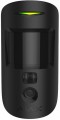 |  |
|---|---|---|
| Ajax MotionCam (PhOD) | Ajax MotionProtect Plus | |
| Outdated Product | Outdated Product | |
| TOP sellers | ||
Photo recording when motion is detected. Photo delivery time at default settings (320 × 240 pixels): up to 9 s (from 7 to 20 s, depending on resolution). Max. photo size 640x480 pixels. Pictures in a series: 1-5 pieces. The main difference from the regular version Ajax MotionCam is the ability to receive data from the camera on request. Protection against forgery. Jamming alert. Tamper for opening and attempting to detach from the fastening. | Protection against false alarms from air conditioners, fireplaces and other glare. | |
| Sensor | movements infrared (PIR) | movements combined (PIR + microwave) |
| Mount | indoor | indoor |
| Installation | wall-mounted | wall-mounted |
| Connecting sensors (protocol) | Jeweller | Jeweller |
| Features | sensitivity adjustment animal immunity tamper-evident / tear-off protection jamming alert | sensitivity adjustment animal immunity tamper-evident / tear-off protection jamming alert |
General | ||
| Horizontal angle of coverage | 88.5 ° | 88.5 ° |
| Vertical angle of coverage | 80 ° | 80 ° |
| Range | 12 m | 12 m |
| Response time | 0.15 с | 0.15 с |
| Communication range | 1700 m | 1200 m |
| Power source | batteries | batteries |
| Working hours | 36 months | 60 months |
| Protection class | IP50 | |
| Operating temperature | -10 °C ~ +40 °C | -10 °C ~ +40 °C |
| Maximum humidity | 75 % | 75 % |
| Dimensions | 135x70x60 mm | 110x65x50 mm |
| Weight | 167 g | 96 g |
| Added to E-Catalog | june 2023 | november 2017 |


Compare Ajax MotionCam (PhOD) and MotionProtect Plus
You may be interested in
My comparisons
Ajax MotionCam (PhOD) often compared


Glossary
Sensor
Modern security sensors are conditionally divided into three main groups:
Note that there are many combined models that combine several types of sensors at once. And here is a detailed description of each individual variety:
- Intersection sensor (barrier). Sensors reacting to the crossing of the guarded perimeter. Such a sensor generates a beam (or several beams) in the infrared range, and when such a beam is crossed by a foreign object, the device gives a signal. Most often, the IR barrier consists of a separately made receiver and transmitter, however, there are also one-sided devices in which the emitter itself “monitors” the reflection of the beam from a certain object. Recall that IR rays are invisible to the naked eye; this makes it possible to effectively disguise such a system. And the range of modern IR barriers can reach several hundred meters.
- Motion Sensor. Sensors that respond to moving objects in the field of view. They can use different principles of operation: infrared, microwave, etc. Motion sensors in the original sense of the term are used mainly as security; in such models, the functions of a break, vibration and / or temperature sensor may be additionally provided. However, there is another variety - household models designed for use as lighting sensors (see below). They are designed to switch the 230 V voltage intended for lighting fixtures (rather than the 12/24 V used in alarm systems), and most often use the same voltage for their own power supply; and other types of detection (except for movement) are not provided in such models. As for the types of work, infrared ones are based on the change in the thermal radiation of objects and can give false alarms due to unforeseen heat flows, and also depend on weather conditions. Combined, which, in addition to the infrared sensor, are equipped with a microwave (microwave), reacts not only to thermal changes. Accordingly, they are less prone to false positives, but much more expensive.
- Infrared (PIR) motion sensor.... The principle of the PIR infrared sensor (from the English passive infrared sensor) is based on fixing changes in thermal radiation from surrounding objects. Such sensors accurately register movement, but are not immune from false alarms due to unforeseen heat flows and depend on weather conditions. There are models that combine several PIR sensors, so they can analyze more changes and more accurately register movement.
— Microwave (SHF) motion sensor. These sensors operate in the microwave radio range similar to a radar: the device periodically emits a pulse and, by analyzing the reflected signal, determines the presence of foreign objects in the controlled space. Such devices are somewhat more complicated and more expensive than infrared ones, but their capabilities are noticeably wider. For example, an IR sensor usually has a limited field of view, while a microwave device is able to "see" the entire 360° around. The "radar" coverage area is not limited to line of sight, it can detect foreign objects behind small obstacles - like window glass or partitions between workstations in an office. In addition, the microwave sensor is equally effective over the entire temperature range. Among the disadvantages, in addition to cost, it can be noted that it is undesirable to use them when people are constantly in the area of microwave action. However, most alarms still turn on only when there are no people in the room.
- Combined (PIR + microwave) motion sensor. Such models consist of two types of sensors, infrared (PIR) and microwave (microwave). Combined solutions combine two dissimilar technologies, which minimizes the number of false positives. In addition to thermal analysis, these devices emit electromagnetic waves at a high frequency, typically 5.8 GHz (may differ depending on the manufacturer). These waves are bounced off the surrounding objects, so that the sensor can register even slight changes.
- Break sensor. Security sensors that react to glass breaking. Nowadays, such sensors are most often made contactless and do not require placement on the glass itself, although there are exceptions. And the most popular principle of their work is acoustic: with the help of a microphone, the sensor “listens” to the environment and reacts to the sound of breaking glass (this sound is quite unique, it is easy to separate it from extraneous noise). There are other principles of operation, for example, infrared (reaction to a sharp change in the visible "picture") or vibration (tracking shocks and vibrations using a contact sensor). Some models also have the functionality of a motion sensor, and sometimes a full-fledged vibration sensor.
- Opening sensor. Security sensors that respond to the opening of windows, doors, hatches, etc. As a rule, the sensor itself is placed in a door or window opening, and a special mark is placed on the door / window. When closed, this label is in close proximity to the main device, and when opened, it moves away and the sensor is triggered. Such sensors may also have vibration and/or temperature detection.
- Vibration sensor. Security sensors that respond to various shocks and vibrations. They can be used for different purposes. For example, such a sensor can warn of an attempt to open a door or window, climb over a fence, crack a safe or an entire wall of a building; It can be mounted on a cabinet door or desk drawer as an opening alarm. And some of these devices are so sensitive that they can even be placed near individual valuable items - so that the sensor reacts to any attempt to move such an object from its place. On sale there are both specialized vibration sensors and models with combined functionality that also respond to movement, breaking, opening and / or temperature.
- Smoke detector. Fire-fighting sensors that react to the appearance of smoke in the air. This is one of the simplest and most reliable methods for detecting a fire: smoke during fires is almost guaranteed, and even with a low intensity of the flame, smoke is often quite significant. For additional reliability, such detectors can be combined with gas and/or temperature sensors.
- Gas sensor. Fire detectors that react to the presence of a certain gas in the air. The specific format of operation of such devices may be different. So, some models react to carbon monoxide (CO) - not only is it a product of combustion and a sign of fire, but it is also dangerous in itself, so such a sensor also provides protection against carbon monoxide poisoning. A number of devices are triggered when a significant amount of domestic gas appears in the air (for example, from an open burner or a damaged pipeline), methane, propane-butane, etc. - in such cases, timely notification avoids an explosion. Finally, sensors that are able to detect sleeping gases are marked in a separate line. Note that gas sensors may also have smoke and/or temperature response functions.
— Leak sensor (flooding). Household sensors that react to the appearance of moisture on the floor or other surfaces. Such a sensor is installed right in the place of possible flooding, and a pair (or several pairs) of special contacts are used for detection: even a small amount of water between the terminals closes them and leads to operation. Contacts can be placed both on the sensor body itself and on a remote unit connected to it with a wire. Some of these devices also have a temperature sensor function.
- Temperature sensor. By itself, temperature detection is very versatile, it is used in all major formats of sensors - security, fire, domestic. At the same time, there are very few temperature sensors in their pure form - these are separate fire models that respond to a significant increase in temperature. In the security format, this type of detection is most often combined with motion or opening detection; Specifically, a thermal sensor in security systems can provide, for example, tracking heat from living objects or responding to a change in temperature in a room when a door / window is opened. As for domestic use, here we are talking about monitoring and controlling the microclimate in the room; To this end, sensors of this type are often supplemented with humidity sensors.
- Humidity sensor. Household sensors that monitor indoor air humidity. Humidity is one of the key characteristics of the microclimate, maintaining a certain level is necessary both for the normal well-being of people and for more specific tasks - ensuring optimal conditions in a warehouse, workshop, laboratory, etc. Note that pure humidity sensors are found rare, usually this function is combined with temperature detection.
— Lighting. Sensors designed to automatically turn on and off lighting. Almost all such models are a special kind of motion sensors described above. And the main difference from traditional (security) motion sensors is that this type of sensors is used to switch the voltage of 230 V (and not 12/24 V); the same voltage is often used for its own power supply, although there are also models with batteries / accumulators. In addition, most of these devices have brightness control (see "Functions and Capabilities"). The light sensor can also be used for security purposes - to illuminate a moving object that has entered the protected area. However, most often such sensors provide convenience in purely everyday situations - for example, to turn on the light in a dark entrance when a person enters it.
- Security : motion sensors ( infrared PIR and combined PIR + microwave), breaking, opening, vibration, IR barriers.
- Fire protection : smoke and gas detectors .
- Household : light, humidity and leakage sensors.
Note that there are many combined models that combine several types of sensors at once. And here is a detailed description of each individual variety:
- Intersection sensor (barrier). Sensors reacting to the crossing of the guarded perimeter. Such a sensor generates a beam (or several beams) in the infrared range, and when such a beam is crossed by a foreign object, the device gives a signal. Most often, the IR barrier consists of a separately made receiver and transmitter, however, there are also one-sided devices in which the emitter itself “monitors” the reflection of the beam from a certain object. Recall that IR rays are invisible to the naked eye; this makes it possible to effectively disguise such a system. And the range of modern IR barriers can reach several hundred meters.
- Motion Sensor. Sensors that respond to moving objects in the field of view. They can use different principles of operation: infrared, microwave, etc. Motion sensors in the original sense of the term are used mainly as security; in such models, the functions of a break, vibration and / or temperature sensor may be additionally provided. However, there is another variety - household models designed for use as lighting sensors (see below). They are designed to switch the 230 V voltage intended for lighting fixtures (rather than the 12/24 V used in alarm systems), and most often use the same voltage for their own power supply; and other types of detection (except for movement) are not provided in such models. As for the types of work, infrared ones are based on the change in the thermal radiation of objects and can give false alarms due to unforeseen heat flows, and also depend on weather conditions. Combined, which, in addition to the infrared sensor, are equipped with a microwave (microwave), reacts not only to thermal changes. Accordingly, they are less prone to false positives, but much more expensive.
- Infrared (PIR) motion sensor.... The principle of the PIR infrared sensor (from the English passive infrared sensor) is based on fixing changes in thermal radiation from surrounding objects. Such sensors accurately register movement, but are not immune from false alarms due to unforeseen heat flows and depend on weather conditions. There are models that combine several PIR sensors, so they can analyze more changes and more accurately register movement.
— Microwave (SHF) motion sensor. These sensors operate in the microwave radio range similar to a radar: the device periodically emits a pulse and, by analyzing the reflected signal, determines the presence of foreign objects in the controlled space. Such devices are somewhat more complicated and more expensive than infrared ones, but their capabilities are noticeably wider. For example, an IR sensor usually has a limited field of view, while a microwave device is able to "see" the entire 360° around. The "radar" coverage area is not limited to line of sight, it can detect foreign objects behind small obstacles - like window glass or partitions between workstations in an office. In addition, the microwave sensor is equally effective over the entire temperature range. Among the disadvantages, in addition to cost, it can be noted that it is undesirable to use them when people are constantly in the area of microwave action. However, most alarms still turn on only when there are no people in the room.
- Combined (PIR + microwave) motion sensor. Such models consist of two types of sensors, infrared (PIR) and microwave (microwave). Combined solutions combine two dissimilar technologies, which minimizes the number of false positives. In addition to thermal analysis, these devices emit electromagnetic waves at a high frequency, typically 5.8 GHz (may differ depending on the manufacturer). These waves are bounced off the surrounding objects, so that the sensor can register even slight changes.
- Break sensor. Security sensors that react to glass breaking. Nowadays, such sensors are most often made contactless and do not require placement on the glass itself, although there are exceptions. And the most popular principle of their work is acoustic: with the help of a microphone, the sensor “listens” to the environment and reacts to the sound of breaking glass (this sound is quite unique, it is easy to separate it from extraneous noise). There are other principles of operation, for example, infrared (reaction to a sharp change in the visible "picture") or vibration (tracking shocks and vibrations using a contact sensor). Some models also have the functionality of a motion sensor, and sometimes a full-fledged vibration sensor.
- Opening sensor. Security sensors that respond to the opening of windows, doors, hatches, etc. As a rule, the sensor itself is placed in a door or window opening, and a special mark is placed on the door / window. When closed, this label is in close proximity to the main device, and when opened, it moves away and the sensor is triggered. Such sensors may also have vibration and/or temperature detection.
- Vibration sensor. Security sensors that respond to various shocks and vibrations. They can be used for different purposes. For example, such a sensor can warn of an attempt to open a door or window, climb over a fence, crack a safe or an entire wall of a building; It can be mounted on a cabinet door or desk drawer as an opening alarm. And some of these devices are so sensitive that they can even be placed near individual valuable items - so that the sensor reacts to any attempt to move such an object from its place. On sale there are both specialized vibration sensors and models with combined functionality that also respond to movement, breaking, opening and / or temperature.
- Smoke detector. Fire-fighting sensors that react to the appearance of smoke in the air. This is one of the simplest and most reliable methods for detecting a fire: smoke during fires is almost guaranteed, and even with a low intensity of the flame, smoke is often quite significant. For additional reliability, such detectors can be combined with gas and/or temperature sensors.
- Gas sensor. Fire detectors that react to the presence of a certain gas in the air. The specific format of operation of such devices may be different. So, some models react to carbon monoxide (CO) - not only is it a product of combustion and a sign of fire, but it is also dangerous in itself, so such a sensor also provides protection against carbon monoxide poisoning. A number of devices are triggered when a significant amount of domestic gas appears in the air (for example, from an open burner or a damaged pipeline), methane, propane-butane, etc. - in such cases, timely notification avoids an explosion. Finally, sensors that are able to detect sleeping gases are marked in a separate line. Note that gas sensors may also have smoke and/or temperature response functions.
— Leak sensor (flooding). Household sensors that react to the appearance of moisture on the floor or other surfaces. Such a sensor is installed right in the place of possible flooding, and a pair (or several pairs) of special contacts are used for detection: even a small amount of water between the terminals closes them and leads to operation. Contacts can be placed both on the sensor body itself and on a remote unit connected to it with a wire. Some of these devices also have a temperature sensor function.
- Temperature sensor. By itself, temperature detection is very versatile, it is used in all major formats of sensors - security, fire, domestic. At the same time, there are very few temperature sensors in their pure form - these are separate fire models that respond to a significant increase in temperature. In the security format, this type of detection is most often combined with motion or opening detection; Specifically, a thermal sensor in security systems can provide, for example, tracking heat from living objects or responding to a change in temperature in a room when a door / window is opened. As for domestic use, here we are talking about monitoring and controlling the microclimate in the room; To this end, sensors of this type are often supplemented with humidity sensors.
- Humidity sensor. Household sensors that monitor indoor air humidity. Humidity is one of the key characteristics of the microclimate, maintaining a certain level is necessary both for the normal well-being of people and for more specific tasks - ensuring optimal conditions in a warehouse, workshop, laboratory, etc. Note that pure humidity sensors are found rare, usually this function is combined with temperature detection.
— Lighting. Sensors designed to automatically turn on and off lighting. Almost all such models are a special kind of motion sensors described above. And the main difference from traditional (security) motion sensors is that this type of sensors is used to switch the voltage of 230 V (and not 12/24 V); the same voltage is often used for its own power supply, although there are also models with batteries / accumulators. In addition, most of these devices have brightness control (see "Functions and Capabilities"). The light sensor can also be used for security purposes - to illuminate a moving object that has entered the protected area. However, most often such sensors provide convenience in purely everyday situations - for example, to turn on the light in a dark entrance when a person enters it.
Communication range
The communication range provided by the wireless sensor (see “Connection”) is the maximum distance to a neighboring device at which the sensor is able to maintain uninterrupted communication.
Note that some communication technologies allow operation through repeaters (for more details, see "Communication Protocol"); in such cases, the actual connection range may be noticeably greater than the sensor's own communication range. However, anyway, note that this parameter is usually given for perfect conditions — within the line of sight, without obstacles in the signal path and interference in the used range. In fact, the range of the sensor may be noticeably lower — especially when working through walls; therefore, it is worth choosing according to this indicator with a certain margin. At the same time, the rule “the more the better” is quite valid here: a long range contributes to the overall reliability and stability of the connection.
Note that some communication technologies allow operation through repeaters (for more details, see "Communication Protocol"); in such cases, the actual connection range may be noticeably greater than the sensor's own communication range. However, anyway, note that this parameter is usually given for perfect conditions — within the line of sight, without obstacles in the signal path and interference in the used range. In fact, the range of the sensor may be noticeably lower — especially when working through walls; therefore, it is worth choosing according to this indicator with a certain margin. At the same time, the rule “the more the better” is quite valid here: a long range contributes to the overall reliability and stability of the connection.
Working hours
Operating time of the self-powered sensor on one set of batteries or battery charge (see "Power"). Note that this indicator is quite approximate — it is usually indicated either for an perfect or for a certain “average” mode of operation. The real battery life also depends on a number of practical nuances: the frequency of operations, the communication range, the level of interference, etc., up to the air temperature. So in fact, the operating time may differ from the claimed one, and in the other direction. Nevertheless, according to this characteristic, it is quite possible to both evaluate the overall battery life of the sensor and compare different models with each other: the difference in the indicated operating time usually fully corresponds to the difference in real battery life.
Note that modern sensors have very low power consumption, so their operating time is calculated in months.
Note that modern sensors have very low power consumption, so their operating time is calculated in months.
Protection class
The class of protection against adverse environmental conditions, which corresponds to the sensor body.
This parameter is traditionally designated according to the IP standard - marking "IP" with two digits, each of which corresponds to its own indicator. So, the first digit describes the protection against the ingress of dust and foreign objects; among the sensors for this indicator, there are such options:
— 2. Protection against objects with a thickness of 12.5 mm or more; prevents penetration of fingers.
- 3. Protection against objects with a thickness of 2.5 mm, in particular many tools.
— 4. Protection against objects with a thickness of 1 mm, such as most wires.
— 5. Complete protection against contact of the “filling” with foreign objects, resistance to dust (dust can penetrate inside the case, but in small quantities that do not affect the operation of the device).
— 6. Completely closed case, excluding the ingress of dust.
Note that this parameter describes only the mechanical protection provided by the case (roughly speaking, the size of the holes in it and objects that can penetrate through them). In this case, there is no question of protection against opening and interference with the operation of the sensor - this is a completely separate nuance implemented in other ways (for example, by installing a case opening sensor).
The second digit characterizing the protection against moisture can b...e as follows:
- 0. The complete absence of any protection, water ingress to the body is not allowed. As a rule, means that the sensor is intended exclusively for internal use.
— 1. Protection against vertical drops of water.
— 2. Protection against vertical drops when the body is tilted up to 15° from the standard position.
— 3. Protection against splashes falling on the body at an angle of up to 60 ° to the horizontal. The minimum indicator that allows you to talk about resistance to rain.
— 4. Protection against splashes from any direction. Allows you to safely endure rain with strong winds.
— 5. Protection against water jets from any direction, resistance to storms.
— 6. Protection against strong water jets or strong sea waves (when the device can completely hide under the wave for a short time).
Higher levels of moisture resistance, allowing immersion in water, are not found in modern sensors - this is simply not required, for the most severe conditions, a level of 6 or even 5 is usually sufficient.
The degree of protection according to IP is especially important to consider when choosing outdoor sensors (see "Use") - they are the most susceptible to adverse effects. It is worth noting here that if the degree of protection is not specified, this does not mean that the device is not protected. It's just that it has not passed official IP certification, but the actual degree of protection can be quite high (in such cases it should be clarified according to the manufacturer's documentation). At the same time, we emphasize that a certain degree of IP protection in itself does not guarantee the possibility of outdoor use - after all, the sensor must withstand not only moisture and dust, but also temperature extremes, sunlight and other adverse factors.
This parameter is traditionally designated according to the IP standard - marking "IP" with two digits, each of which corresponds to its own indicator. So, the first digit describes the protection against the ingress of dust and foreign objects; among the sensors for this indicator, there are such options:
— 2. Protection against objects with a thickness of 12.5 mm or more; prevents penetration of fingers.
- 3. Protection against objects with a thickness of 2.5 mm, in particular many tools.
— 4. Protection against objects with a thickness of 1 mm, such as most wires.
— 5. Complete protection against contact of the “filling” with foreign objects, resistance to dust (dust can penetrate inside the case, but in small quantities that do not affect the operation of the device).
— 6. Completely closed case, excluding the ingress of dust.
Note that this parameter describes only the mechanical protection provided by the case (roughly speaking, the size of the holes in it and objects that can penetrate through them). In this case, there is no question of protection against opening and interference with the operation of the sensor - this is a completely separate nuance implemented in other ways (for example, by installing a case opening sensor).
The second digit characterizing the protection against moisture can b...e as follows:
- 0. The complete absence of any protection, water ingress to the body is not allowed. As a rule, means that the sensor is intended exclusively for internal use.
— 1. Protection against vertical drops of water.
— 2. Protection against vertical drops when the body is tilted up to 15° from the standard position.
— 3. Protection against splashes falling on the body at an angle of up to 60 ° to the horizontal. The minimum indicator that allows you to talk about resistance to rain.
— 4. Protection against splashes from any direction. Allows you to safely endure rain with strong winds.
— 5. Protection against water jets from any direction, resistance to storms.
— 6. Protection against strong water jets or strong sea waves (when the device can completely hide under the wave for a short time).
Higher levels of moisture resistance, allowing immersion in water, are not found in modern sensors - this is simply not required, for the most severe conditions, a level of 6 or even 5 is usually sufficient.
The degree of protection according to IP is especially important to consider when choosing outdoor sensors (see "Use") - they are the most susceptible to adverse effects. It is worth noting here that if the degree of protection is not specified, this does not mean that the device is not protected. It's just that it has not passed official IP certification, but the actual degree of protection can be quite high (in such cases it should be clarified according to the manufacturer's documentation). At the same time, we emphasize that a certain degree of IP protection in itself does not guarantee the possibility of outdoor use - after all, the sensor must withstand not only moisture and dust, but also temperature extremes, sunlight and other adverse factors.