
Comparison Fiskars Solid 1066721 vs Fiskars Solid 1066716
Add to comparison |  | 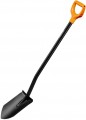 |
|---|---|---|
| Fiskars Solid 1066721 | Fiskars Solid 1066716 | |
| Outdated Product | Outdated Product | |
| User reviews | ||
| TOP sellers | ||
| Type | garden / construction | garden / construction |
| Shape | trench | trench |
| Blade material | steel | steel |
| Corrosion resistant |  | |
| Blade length | 280 mm | |
| Blade width | 180 mm | 180 mm |
| Shaft material | wood | steel |
| Handle | D-handle | D-handle |
| Ergonomic curve |  | |
| Shovel length | 1085 mm | 1170 mm |
| Weight | 1700 g | 1700 g |
| Added to E-Catalog | october 2023 | march 2023 |


Compare Fiskars Solid 1066721 and Solid 1066716
You may be interested in
Fiskars Solid 1066716 often compared


Glossary
Blade length
The total length of the shovel blade. In the case of "digging" shovels (for example, bayonet, see "Form"), this size actually determines the depth to which you can dig at once; in the case of "loading" models (for example, scoops), the total area and, accordingly, the capacity of the canvas depends on the length.
It is worth noting that for each type of shovels there are certain standards for the size of the canvas. However, different models of the same type and shape can vary markedly in length. At the same time, if the length is too short, more movements will have to be done, and if the canvas is too large, it will be heavy and bulky and will require increased effort when working. Therefore, when choosing, it is worth considering the features of the intended application: for example, a relatively short blade will be enough for a small country flower bed, and a larger shovel will come in handy for working in a large garden. Recommendations for more specific tasks can be found in special sources.
It is worth noting that for each type of shovels there are certain standards for the size of the canvas. However, different models of the same type and shape can vary markedly in length. At the same time, if the length is too short, more movements will have to be done, and if the canvas is too large, it will be heavy and bulky and will require increased effort when working. Therefore, when choosing, it is worth considering the features of the intended application: for example, a relatively short blade will be enough for a small country flower bed, and a larger shovel will come in handy for working in a large garden. Recommendations for more specific tasks can be found in special sources.
Shaft material
— Wood. Even inexpensive types of wood are for the most part quite strong and reliable, especially since the stalk can be made quite thick. At the same time, this material is also durable — the service life of a wooden handle is often comparable to the service life of the canvas itself. However compared with steel (see below), such handles are considered less reliable, not least because they are always made removable. On the other hand, a broken or too long / short handle can be easily replaced with a new one. Also, we note that wood has a relatively low thermal conductivity and does not cool hands as much as metal, and in general it is pleasant to the touch.
— Steel. Steel handle, usually, is used in shovels with a blade of the same material (there are exceptions, but extremely rare); moreover, in most cases, such a handle is welded or riveted to the canvas and can only be detached by breaking it off from the tool. The main advantage of steel is its high strength, garden / construction shovels of this type are better suited for work with high loads than tools with wooden handles. In addition, this material is suitable for foldable touring/automobile models (see "Type"). At the same time, steel cuttings are noticeably heavier than wooden ones, and long work with such a shovel requires more strength and endurance. In addition, steel is noticeably more expensive, it is extremely difficult to change su...ch handles (and most often it is simply unjustified), and if the handle breaks, the entire shovel becomes unusable. So it makes sense to specifically look for a full-size shovel with a steel handle, first of all, for complex work, for which the tree may not be reliable enough.
— Aluminium. Another kind of metal cuttings, permanently fixed on the canvas — similar to the steel ones described above. As for the properties, aluminium, on the one hand, is noticeably lighter than steel, on the other hand, it is not so strong and may not be suitable for heavy work.
— Plastic. The main advantages of plastic are lightness and low cost. In addition, it, like wood, does not get too cold hands at low air temperatures, making it excellent for snow removal tools (see "Type"). But full-sized construction / garden shovels with plastic handles are rare and are intended mainly for use where no special loads are planned — the strength of plastic, especially in inexpensive models, is rather low.
— Without a cutting. Shovels that are not equipped with cuttings at all and are sold in the form of a canvas with a shell. The main advantage of this configuration is that the handle can be chosen at your discretion; this is especially useful in cases where standard handles are not suitable for one reason or another (for example, if the user is tall and the stock handles are almost all too short). Most of these models require use with a wooden handle and do not allow other materials; however, this point cannot be called particularly critical.
— Steel. Steel handle, usually, is used in shovels with a blade of the same material (there are exceptions, but extremely rare); moreover, in most cases, such a handle is welded or riveted to the canvas and can only be detached by breaking it off from the tool. The main advantage of steel is its high strength, garden / construction shovels of this type are better suited for work with high loads than tools with wooden handles. In addition, this material is suitable for foldable touring/automobile models (see "Type"). At the same time, steel cuttings are noticeably heavier than wooden ones, and long work with such a shovel requires more strength and endurance. In addition, steel is noticeably more expensive, it is extremely difficult to change su...ch handles (and most often it is simply unjustified), and if the handle breaks, the entire shovel becomes unusable. So it makes sense to specifically look for a full-size shovel with a steel handle, first of all, for complex work, for which the tree may not be reliable enough.
— Aluminium. Another kind of metal cuttings, permanently fixed on the canvas — similar to the steel ones described above. As for the properties, aluminium, on the one hand, is noticeably lighter than steel, on the other hand, it is not so strong and may not be suitable for heavy work.
— Plastic. The main advantages of plastic are lightness and low cost. In addition, it, like wood, does not get too cold hands at low air temperatures, making it excellent for snow removal tools (see "Type"). But full-sized construction / garden shovels with plastic handles are rare and are intended mainly for use where no special loads are planned — the strength of plastic, especially in inexpensive models, is rather low.
— Without a cutting. Shovels that are not equipped with cuttings at all and are sold in the form of a canvas with a shell. The main advantage of this configuration is that the handle can be chosen at your discretion; this is especially useful in cases where standard handles are not suitable for one reason or another (for example, if the user is tall and the stock handles are almost all too short). Most of these models require use with a wooden handle and do not allow other materials; however, this point cannot be called particularly critical.
Ergonomic curve
The presence of a specific bend in the handle of a shovel (or in the shell where the handle is inserted). Due to this bend, the canvas is not at the level of the handle, but below (if you hold the shovel horizontally in the working position). It is believed that this ergonomic shape of the shovel somewhat facilitates the performance of certain work — in particular, when digging the soil, you do not have to bend as low as with a shovel without a bend.
Shovel length
The total length of the shovel; for models with variable length (folding or telescopic, see above), the maximum size is taken into account, when unfolded to the maximum position.
In the case of full size shovels (garden shovels, construction shovels, snow shovels — see "Type"), the optimal length depends primarily on the height of the user. It is believed that a shovel, placed vertically, should be 10 cm below the shoulder joint; however, some prefer a shorter tool — up to the elbow. If you do not have the opportunity to “try on” the shovel “live”, you can measure the height to the desired point (10 cm below the shoulder or elbow) and, when choosing, compare this height with the length of the tool. Note that a shovel without a handle (see above) may well be somewhat longer than necessary — the “surplus” of the handle usually does not create any particular inconvenience. But in the presence of a handle, length matching is extremely important.
If we are talking about small shovels for tourist / automotive purposes, then here we should proceed from a compromise between efficiency and compactness. A shorter shovel will be more convenient to store and transport, but may be inconvenient and ineffective for heavy work (both because of the inconvenience in the hands and because of the short lever length, which requires considerable effort).
In the case of full size shovels (garden shovels, construction shovels, snow shovels — see "Type"), the optimal length depends primarily on the height of the user. It is believed that a shovel, placed vertically, should be 10 cm below the shoulder joint; however, some prefer a shorter tool — up to the elbow. If you do not have the opportunity to “try on” the shovel “live”, you can measure the height to the desired point (10 cm below the shoulder or elbow) and, when choosing, compare this height with the length of the tool. Note that a shovel without a handle (see above) may well be somewhat longer than necessary — the “surplus” of the handle usually does not create any particular inconvenience. But in the presence of a handle, length matching is extremely important.
If we are talking about small shovels for tourist / automotive purposes, then here we should proceed from a compromise between efficiency and compactness. A shorter shovel will be more convenient to store and transport, but may be inconvenient and ineffective for heavy work (both because of the inconvenience in the hands and because of the short lever length, which requires considerable effort).