
Comparison Chieftec Value APB-500B8 vs Chieftec A135 APS-450S
Add to comparison | 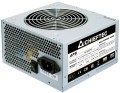 |  |
|---|---|---|
| Chieftec Value APB-500B8 | Chieftec A135 APS-450S | |
| Compare prices 1 | from $56.00 | |
| User reviews | ||
| TOP sellers | ||
| Power | 500 W | 450 W |
| Form factor | ATX | ATX |
Specs | ||
| PFC | active | active |
| Efficiency | 80 % | 80 % |
| Cooling system | active | active |
| Fan size | 120 mm | 140 mm |
| Certification | without 80+ | 80+ |
| ATX12V version | 2.3 | 2.3 |
Power connectors | ||
| MB/CPU power supply | 24+4 pin | 24+4 pin |
| SATA | 3 | 3 |
| MOLEX | 2 | 4 |
| PCIe 6pin | 1 | |
| PCIe 8pin (6+2) | 1 | |
| Floppy |  | |
| Cable system | non-modular | non-modular |
Cable length | ||
| MB | 550 mm | |
| CPU | 550 mm | |
| SATA | 500 mm | |
| MOLEX | 500 mm | |
| PCIe | 550 mm | |
General | ||
| Over voltage protection (OVP) | | |
| Over power protection (OPP) | | |
| Short circuit protection (SCP) | | |
| Manufacturer's warranty | 2 years | 2 years |
| Dimensions (HxWxD) | 87x150x140 mm | 86x150x160 mm |
| Added to E-Catalog | june 2017 | january 2012 |



Compare Chieftec Value and A135
Price comparison
You may be interested in
My comparisons
Chieftec Value often compared

Glossary
Power
The output power of the power supply, in other words, is the maximum power that it is capable of delivering to the system. For the computer to operate efficiently, the power supply must be greater than the total power consumption of the system at maximum load. The latter can be calculated by summing the power of individual components, however, in general, for office configurations , about 400 W — 450 W is considered sufficient, for medium gaming — about 600 W( 500 W, 550 W, 650 W, 700 W, 750 W), and for the top ones — power of 800 W and above ( 850 W, 1000 W and even more than 1 kW).
Fan size
The diameter of the fan(s) in the power supply cooling system.
The large diameter allows to achieve good efficiency at relatively low RPMs, which in turn reduces noise and power consumption. On the other hand, large fans are more expensive than small ones and take up a lot of space, which affects the dimensions of the entire PSU. We also emphasize that a small fan is not yet a sign of a cheap power supply — quite advanced models can also have such equipment, in order to reduce dimensions.
As for specific diameters, the smallest value that can be found in modern consumer-grade PSUs is 80 mm. The most popular option is 120 mm, this size gives good efficiency and a relatively low noise level at a reasonable price and dimensions. Larger diameters are somewhat less common — 135 mm and 140 mm.
The large diameter allows to achieve good efficiency at relatively low RPMs, which in turn reduces noise and power consumption. On the other hand, large fans are more expensive than small ones and take up a lot of space, which affects the dimensions of the entire PSU. We also emphasize that a small fan is not yet a sign of a cheap power supply — quite advanced models can also have such equipment, in order to reduce dimensions.
As for specific diameters, the smallest value that can be found in modern consumer-grade PSUs is 80 mm. The most popular option is 120 mm, this size gives good efficiency and a relatively low noise level at a reasonable price and dimensions. Larger diameters are somewhat less common — 135 mm and 140 mm.
Certification
The presence or absence of an 80+ certificate for the power supply. This certificate indicates high energy efficiency: to obtain it, the efficiency (see above) must be at least 80%, and in different modes (20%, 50% and 100% of the maximum load). There are several degrees of 80+:
— 80+. The original version of the certificate, assuming an efficiency of at least 82% (at least 85% for 50% load).
— 80+ White. The second name of the original 80+ certificate (see above).
— 80+ Bronze — efficiency not less than 85% (for half load — 88%).
— 80+ Silver — respectively 87% (90% for half load).
— 80+ Gold — 89% (92% for half load)
— 80+ Platinum — 90% (94% for half load).
— 80+ Titanium — 94% (96% for half load).
The power factor (see "PFC Type") must be at least 0.9 for the lower levels and at least 0.95 for the Platinum level. Also note that for redundant power used in server systems, the efficiency requirements are somewhat lower.
— 80+. The original version of the certificate, assuming an efficiency of at least 82% (at least 85% for 50% load).
— 80+ White. The second name of the original 80+ certificate (see above).
— 80+ Bronze — efficiency not less than 85% (for half load — 88%).
— 80+ Silver — respectively 87% (90% for half load).
— 80+ Gold — 89% (92% for half load)
— 80+ Platinum — 90% (94% for half load).
— 80+ Titanium — 94% (96% for half load).
The power factor (see "PFC Type") must be at least 0.9 for the lower levels and at least 0.95 for the Platinum level. Also note that for redundant power used in server systems, the efficiency requirements are somewhat lower.
MOLEX
The number of Molex (IDE) connectors provided in the design of the power supply.
Initially, such a connector was intended to power peripherals for the IDE interface, primarily hard drives. And although the IDE itself is completely obsolete today and is not used in new components, however, the Molex power connector continues to be installed in power supplies, and almost without fail. Almost any modern PSU has at least 1 – 2 of these connectors, and in high-end models this number can be 7 or more. This situation is due to the fact that Molex IDE is a fairly universal standard, and with the help of the simplest adapters, components with a different power interface can be powered from it. For example, there are Molex - SATA adapters for drives, Molex - 6 pin for video cards, etc.
Initially, such a connector was intended to power peripherals for the IDE interface, primarily hard drives. And although the IDE itself is completely obsolete today and is not used in new components, however, the Molex power connector continues to be installed in power supplies, and almost without fail. Almost any modern PSU has at least 1 – 2 of these connectors, and in high-end models this number can be 7 or more. This situation is due to the fact that Molex IDE is a fairly universal standard, and with the help of the simplest adapters, components with a different power interface can be powered from it. For example, there are Molex - SATA adapters for drives, Molex - 6 pin for video cards, etc.
PCIe 6pin
Number of 6-pin PCIe power connectors provided in the power supply unit.
These connectors are used for additional power to types of internal peripherals for which the 75W supplied directly through the PCIe slot on the motherboard is insufficient (a typical example being graphics cards). A 6-pin connector on the power supply unit provides an additional 75W, allowing the connection of boards with power consumption up to 150W.
Note that some graphics cards have multiple connectors for additional power. In light of this, a PSU may have either one PCIe 6-pin plug or two such connectors. However, this type of plug is generally used quite rarely due to the proliferation of the more convenient and versatile 8-pin "6+2" format connector, which can be used as either a six- or eight-pin (see more about it below).
These connectors are used for additional power to types of internal peripherals for which the 75W supplied directly through the PCIe slot on the motherboard is insufficient (a typical example being graphics cards). A 6-pin connector on the power supply unit provides an additional 75W, allowing the connection of boards with power consumption up to 150W.
Note that some graphics cards have multiple connectors for additional power. In light of this, a PSU may have either one PCIe 6-pin plug or two such connectors. However, this type of plug is generally used quite rarely due to the proliferation of the more convenient and versatile 8-pin "6+2" format connector, which can be used as either a six- or eight-pin (see more about it below).
PCIe 8pin (6+2)
Number of 8-pin PCIe power connectors (6+2) provided in the PSU design.
Additional PCIe power connectors (of all formats) are used for additional power to types of internal peripherals that require more than the 75W supplied directly through the PCIe slot on the motherboard (a typical example is graphics cards). In PC components, there are two types of such connectors — 6-pin, providing up to 75W of additional power, and 8-pin, giving up to 150W. The 8-pin (6+2) connectors used in power supplies are universal: they can work with both 6-pin and 8-pin connectors on the expansion board. Therefore, this type of connector is the most popular in modern PSUs.
As for the quantity, there are models on sale with 1 PCIe 8-pin (6+2) connector, 2 such connectors, 3 connectors, 4 connectors, and in some cases — 6 or more. Several of these connectors can be useful, for example, when connecting multiple graphics cards — or for a powerful high-performance video adapter equipped with multiple additional PCIe power connectors.
Additional PCIe power connectors (of all formats) are used for additional power to types of internal peripherals that require more than the 75W supplied directly through the PCIe slot on the motherboard (a typical example is graphics cards). In PC components, there are two types of such connectors — 6-pin, providing up to 75W of additional power, and 8-pin, giving up to 150W. The 8-pin (6+2) connectors used in power supplies are universal: they can work with both 6-pin and 8-pin connectors on the expansion board. Therefore, this type of connector is the most popular in modern PSUs.
As for the quantity, there are models on sale with 1 PCIe 8-pin (6+2) connector, 2 such connectors, 3 connectors, 4 connectors, and in some cases — 6 or more. Several of these connectors can be useful, for example, when connecting multiple graphics cards — or for a powerful high-performance video adapter equipped with multiple additional PCIe power connectors.
Dimensions (HxWxD)
PC PSU dimensions are defined by the form factor (most often ATX 150×86 mm), and the key factor in compatibility is depth — the PSU case length. “Universal” ATX units are usually 140, 150 mm, while quiet, high-power models with large heatsinks and a 135/140‑mm fan range from 160 to 200+ mm; compact builds use SFX/SFX-L (depth ~100 and ~125 mm with an adapter bracket). The greater the depth, the higher the risk of hitting drive cages, the PSU shroud, cable management, or a front LCS radiator, and modular connectors plus cable bend radius require another 20 – 40 mm of real clearance.