
Comparison Vitals BK 522t vs Procraft T5600
Add to comparison | 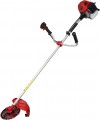 | 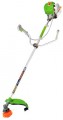 |
|---|---|---|
| Vitals BK 522t | Procraft T5600 | |
| Outdated Product | Outdated Product | |
| User reviews | ||
| TOP sellers | ||
| Type | grass trimmer | grass trimmer |
| Motor type | petrol | petrol |
Mowing | ||
| Cutting width | 43 cm | 41.5 cm |
| Trimmer blade width | 25.5 cm | 25.4 cm |
| Cutting system | rotary | rotary |
Trimmer design | ||
| Motor location | top | top |
| Shaft type | straight | straight |
| Handle type | bike handle | bike handle |
| Line diameter | 2.4 mm | |
| More features | backpack strap | backpack strap |
In box | ||
| Nozzles | 2-tooth blade spool of line saw blade | 2-tooth blade spool of line saw blade |
| More features | fishing line, bag, keys | |
Motor | ||
| ICE type | 2-stroke | 4-stroke |
| Engine size | 52 cm³ | 62 cm³ |
| Motor power | 2 hp | 7.6 hp |
| Motor power | 1500 W | 5600 W |
| Fuel tank volume | 1.2 L | 1 L |
General | ||
| Deck material | plastic | plastic |
| Waterproof | IR21 | |
| Noise level | 110 dB | |
| Weight | 7.5 kg | 5.5 kg |
| Added to E-Catalog | may 2024 | february 2018 |


Compare Vitals BK 522t and Procraft T5600
You may be interested in
My comparisons
Vitals BK 522t often compared


Procraft T5600 often compared


Glossary
Cutting width
The capture width provided by the unit, in other words, the width of the strip of land cultivated in one pass. In fact, this size corresponds to the width of the working nozzle.
The large working width is useful when processing large open spaces, as it allows you to finish the job in a small number of passes. On the other hand, for hard-to-reach places, relatively narrow tools are better suited, able to go where a wider unit will not fit. In addition, the width of the tool directly affects the weight and price.
In general, it makes sense to compare in terms of working width only units of the same type (see above). However, it is worth noting here that trimmers do not differ so much from each other — most models capture from 25 to 45 cm (and a wide processing band is provided by moving the nozzle from side to side). As for the other types, in the most modest models the capture width does not exceed 40 cm, in the heaviest and most powerful it can be 56 – 60 cm or even more(in mini tractors — up to 1.5 m).
The large working width is useful when processing large open spaces, as it allows you to finish the job in a small number of passes. On the other hand, for hard-to-reach places, relatively narrow tools are better suited, able to go where a wider unit will not fit. In addition, the width of the tool directly affects the weight and price.
In general, it makes sense to compare in terms of working width only units of the same type (see above). However, it is worth noting here that trimmers do not differ so much from each other — most models capture from 25 to 45 cm (and a wide processing band is provided by moving the nozzle from side to side). As for the other types, in the most modest models the capture width does not exceed 40 cm, in the heaviest and most powerful it can be 56 – 60 cm or even more(in mini tractors — up to 1.5 m).
Trimmer blade width
The width (diameter) of the trimmer knife characterizes the size of the paddle knife (or saw blade). Such a nozzle has a smaller capture width than a fishing line, however, it allows you to mow more dense thickets, including shrubs.
Line diameter
The diameter of the fishing line supplied with the trimmer (more precisely, with a reel attachment, see "Tips").
In modern models, this parameter can be from 1 to 4 mm. At the same time, a thicker fishing line handles better with dense thickets, but it works rougher, the treated lawn is not particularly even, and for the effective operation of such a nozzle, a fairly powerful engine is needed. On the other hand, a fine line provides a clean and neat cut, but is not suitable for heavy vegetation and large stems. Thus, thick fishing line is usually equipped with powerful units designed for "launched" lawns with an abundance of thick stems. Thin, on the other hand, is found mainly in low-power electric trimmers with a lower engine location, designed for neat lawns with regularly cut grass.
We also recall that many trimmers have the ability to replace the standard reel with another one that differs in line thickness.
In modern models, this parameter can be from 1 to 4 mm. At the same time, a thicker fishing line handles better with dense thickets, but it works rougher, the treated lawn is not particularly even, and for the effective operation of such a nozzle, a fairly powerful engine is needed. On the other hand, a fine line provides a clean and neat cut, but is not suitable for heavy vegetation and large stems. Thus, thick fishing line is usually equipped with powerful units designed for "launched" lawns with an abundance of thick stems. Thin, on the other hand, is found mainly in low-power electric trimmers with a lower engine location, designed for neat lawns with regularly cut grass.
We also recall that many trimmers have the ability to replace the standard reel with another one that differs in line thickness.
More features
Additional accessories included with the lawn mower. This point is mainly relevant for robotic mowers (see “Type”), they are most often equipped with the mentioned accessories, such as:
— Boundary wire. A wire designed to limit the working area of the robotic mower. Such a wire is laid along the perimeter of the work area (taking into account all permanent obstacles such as trees, flower beds, etc.) and is connected to the charging station in a special way. If everything is done correctly, when approaching the border of the site, the mower will change the direction of movement in such a way as not to go beyond the established perimeter - this is more convenient and safer than relying on collision, tilt sensors, etc. Note also that the absence of a wire in included in the kit may mean either the need to purchase it separately, or the fact that the mower, in principle, is not designed to use this function.
- Remote control. A remote control that allows you to control the robotic mower from a distance. Remote control is especially convenient during operation: the user does not need to chase a moving device, just press the desired button while at a fairly close distance. The operating principle of the remote controls may be different (infrared, radio), but they all have a range of at least several meters.
— Charger (charger). Device for charging batteries used in lawn mowers wi...th appropriate power supply. For models supplied with such a device, the charger model may be further specified in the specifications. This information can be useful not only for finding a spare or replacement charger, but also in case the household has other cordless tools and/or batteries for them. The fact is that many manufacturers nowadays use universal batteries that are compatible with a whole set of tools from the same brand; so, for example, the included charger for a mower may be quite suitable for a cordless saw from the same manufacturer.
On the other hand, the package may not contain a charger at all. This option will be optimal primarily if a compatible memory device is already available, and there is simply no need to overpay for a second device. In addition, the absence of a charger will be appreciated by those who want to choose this accessory separately, without relying on the manufacturer’s decision.
- Charging station. Cordless robotic lawnmowers (see Type) may be supplied with a charging station. Such units independently return to the base after completion of work or when a low battery level is detected. Automating the charging processor allows robotic lawn mowers to operate autonomously and makes them more convenient to use. Typically, a charging station contains a “parking” platform (base plate) and special docking contacts for replenishing energy reserves in the battery cells. The base can serve as a place to store the lawn mower during periods of inactivity, and in advanced implementations, the charging station is integrated with smart control systems, making it possible to control the operation of the lawn mower through mobile applications (see “Control from a smartphone”).
Please note that the above list is not complete - other additional items may be included in the kit.
— Boundary wire. A wire designed to limit the working area of the robotic mower. Such a wire is laid along the perimeter of the work area (taking into account all permanent obstacles such as trees, flower beds, etc.) and is connected to the charging station in a special way. If everything is done correctly, when approaching the border of the site, the mower will change the direction of movement in such a way as not to go beyond the established perimeter - this is more convenient and safer than relying on collision, tilt sensors, etc. Note also that the absence of a wire in included in the kit may mean either the need to purchase it separately, or the fact that the mower, in principle, is not designed to use this function.
- Remote control. A remote control that allows you to control the robotic mower from a distance. Remote control is especially convenient during operation: the user does not need to chase a moving device, just press the desired button while at a fairly close distance. The operating principle of the remote controls may be different (infrared, radio), but they all have a range of at least several meters.
— Charger (charger). Device for charging batteries used in lawn mowers wi...th appropriate power supply. For models supplied with such a device, the charger model may be further specified in the specifications. This information can be useful not only for finding a spare or replacement charger, but also in case the household has other cordless tools and/or batteries for them. The fact is that many manufacturers nowadays use universal batteries that are compatible with a whole set of tools from the same brand; so, for example, the included charger for a mower may be quite suitable for a cordless saw from the same manufacturer.
On the other hand, the package may not contain a charger at all. This option will be optimal primarily if a compatible memory device is already available, and there is simply no need to overpay for a second device. In addition, the absence of a charger will be appreciated by those who want to choose this accessory separately, without relying on the manufacturer’s decision.
- Charging station. Cordless robotic lawnmowers (see Type) may be supplied with a charging station. Such units independently return to the base after completion of work or when a low battery level is detected. Automating the charging processor allows robotic lawn mowers to operate autonomously and makes them more convenient to use. Typically, a charging station contains a “parking” platform (base plate) and special docking contacts for replenishing energy reserves in the battery cells. The base can serve as a place to store the lawn mower during periods of inactivity, and in advanced implementations, the charging station is integrated with smart control systems, making it possible to control the operation of the lawn mower through mobile applications (see “Control from a smartphone”).
Please note that the above list is not complete - other additional items may be included in the kit.
ICE type
Scheme of operation of an internal combustion engine installed on a lawn mower. Note that this division is relevant only for gasoline engines (see "Engine type") — diesel engines are extremely rare and are made only four-stroke.
— 2-stroke. The main advantages of two-stroke engines over four-stroke ones are the simplicity of the device and higher power with the same working volume, due to which such units are lighter, more compact and cheaper. On the other hand, they consume more fuel and are distinguished by a high level of noise, and such an engine needs to be filled with a mixture of gasoline and oil in the correct proportion, which complicates maintenance somewhat (there are separate refueling systems, but they are complex and expensive, which is why they are almost never used ). As a result, this option is found mainly among trimmers (see "Type"): it is there that small dimensions and weight are decisive, and the required power and fuel consumption are relatively low.
— 4-stroke. Engines of this type are somewhat more complicated and more expensive than two-stroke ones; in addition, to achieve the same power, they need more volume, which affects the size and weight. On the other hand, if the engine does not need to be "carried in the hands" (as is the case with trimmers), these points do not really matter; and the difference in price, thanks to the development of technology, is becoming less and less noticeable. With a...ll this, four-stroke engines are quieter and consume less fuel. As a result, almost all units where a relatively large and heavy internal combustion engine can be installed are equipped with this particular type of engine. And relatively recently, light and compact engines have appeared, suitable even for trimmers.
— 2-stroke. The main advantages of two-stroke engines over four-stroke ones are the simplicity of the device and higher power with the same working volume, due to which such units are lighter, more compact and cheaper. On the other hand, they consume more fuel and are distinguished by a high level of noise, and such an engine needs to be filled with a mixture of gasoline and oil in the correct proportion, which complicates maintenance somewhat (there are separate refueling systems, but they are complex and expensive, which is why they are almost never used ). As a result, this option is found mainly among trimmers (see "Type"): it is there that small dimensions and weight are decisive, and the required power and fuel consumption are relatively low.
— 4-stroke. Engines of this type are somewhat more complicated and more expensive than two-stroke ones; in addition, to achieve the same power, they need more volume, which affects the size and weight. On the other hand, if the engine does not need to be "carried in the hands" (as is the case with trimmers), these points do not really matter; and the difference in price, thanks to the development of technology, is becoming less and less noticeable. With a...ll this, four-stroke engines are quieter and consume less fuel. As a result, almost all units where a relatively large and heavy internal combustion engine can be installed are equipped with this particular type of engine. And relatively recently, light and compact engines have appeared, suitable even for trimmers.
Engine size
The size of the engine installed in the petrol or diesel model (see "Engine type"). Power directly depends on this indicator, however, only engines of the same type can be compared by volume (see "Type of internal combustion engine"). And even in the same type of units of the same power, the volume can be different. In such cases, note that a larger volume means more fuel consumption, but the engine itself may cost less than a smaller one.
Motor power
Lawnmower engine power expressed in horsepower. The common unit of power these days is the watt, but gasoline and diesel engines (see "Engine Type") are traditionally referred to as hp. Some units are easy to convert to others: 1 hp. approximately equal to 735 watts.
In general, the more powerful the engine, the more performant the mower is and the better it handles with heavy work such as cutting thick grass, bushes, etc. On the other hand, high power has a corresponding effect on fuel consumption, as well as the weight and price of the engine. In addition, it should be taken into account that different types of mowers (see "Type") differ in terms of power requirements. For example, among trimmers there are many models with a capacity of 0.7 – 1.3 hp., for gasoline lawn mowers, the minimum power is already in the range of 1.3 – 2 hp., and for mowers, at least 2.5 hp is required. . So you can only compare units of the same type in terms of power. Detailed recommendations for choosing a mower depending on its type and features of the planned work can be found in special sources.
In general, the more powerful the engine, the more performant the mower is and the better it handles with heavy work such as cutting thick grass, bushes, etc. On the other hand, high power has a corresponding effect on fuel consumption, as well as the weight and price of the engine. In addition, it should be taken into account that different types of mowers (see "Type") differ in terms of power requirements. For example, among trimmers there are many models with a capacity of 0.7 – 1.3 hp., for gasoline lawn mowers, the minimum power is already in the range of 1.3 – 2 hp., and for mowers, at least 2.5 hp is required. . So you can only compare units of the same type in terms of power. Detailed recommendations for choosing a mower depending on its type and features of the planned work can be found in special sources.
Motor power
Lawnmower engine power expressed in watts. This designation is used absolutely for all electric models (see "Engine type"), and it is also often found in gasoline and diesel units along with horsepower (these units are clearly related, 1 hp is about 735 watts).
In general, the more powerful the engine, the more performant the mower and the better it will cope with heavy work such as cutting thick grass, bushes, etc. On the other hand, high power has a corresponding effect on fuel / electricity consumption, as well as the weight and price of the engine. In addition, note that the power requirements depend on the type of mower itself and its engine (see above for both). For example, for most robots, the power does not exceed 500 W — more, taking into account specialization, is not required, besides, otherwise the devices would turn out to be too bulky and heavy. Trimmers and lawn mowers of similar power are only electric, and the power limit for power tools is 2500 – 3000 W when powered from the mains and 1500 – 2000 W for battery models. But in gasoline tools, the minimum power is about 500 – 1000 W for trimmers and 1000 – 1500 W for mowers; the maximum value can exceed 4 kW.
Detailed recommendations for choosing a lawn mower d...epending on its type and features of the planned work can be found in special sources.
In general, the more powerful the engine, the more performant the mower and the better it will cope with heavy work such as cutting thick grass, bushes, etc. On the other hand, high power has a corresponding effect on fuel / electricity consumption, as well as the weight and price of the engine. In addition, note that the power requirements depend on the type of mower itself and its engine (see above for both). For example, for most robots, the power does not exceed 500 W — more, taking into account specialization, is not required, besides, otherwise the devices would turn out to be too bulky and heavy. Trimmers and lawn mowers of similar power are only electric, and the power limit for power tools is 2500 – 3000 W when powered from the mains and 1500 – 2000 W for battery models. But in gasoline tools, the minimum power is about 500 – 1000 W for trimmers and 1000 – 1500 W for mowers; the maximum value can exceed 4 kW.
Detailed recommendations for choosing a lawn mower d...epending on its type and features of the planned work can be found in special sources.
Fuel tank volume
The volume of the fuel tank in a gasoline or diesel mower (see "Engine type").
A large tank allows you to work longer without refueling, but an excessive increase in capacity affects the dimensions and weight of the entire unit. So manufacturers usually select this indicator taking into account the power and fuel consumption of a particular engine, and in general, the volume of the tank is not critical when choosing. However, knowing the tank capacity and fuel consumption (see above), you can estimate how much one refueling will approximately last.
A large tank allows you to work longer without refueling, but an excessive increase in capacity affects the dimensions and weight of the entire unit. So manufacturers usually select this indicator taking into account the power and fuel consumption of a particular engine, and in general, the volume of the tank is not critical when choosing. However, knowing the tank capacity and fuel consumption (see above), you can estimate how much one refueling will approximately last.