
Comparison Makita HR2670 vs DeWALT D25133K
Add to comparison | 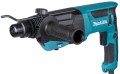 | 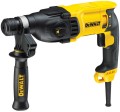 |
|---|---|---|
| Makita HR2670 | DeWALT D25133K | |
| Outdated Product | from $410.00 | |
| User reviews | ||
| TOP sellers | ||
Model D25133N comes without a case/bag, model D25133K comes with a case, and model D25133B comes with a bag | ||
| Operating modes | hammer drilling drilling only chiselling (demolition hammer) | hammer drilling drilling only chiselling (demolition hammer) |
Specs | ||
| Real power | 550 W | 640 W |
| Power consumption | 800 W | 800 W |
| Impact energy | 3 J | 2.6 J |
| Number of thrusts | 4500 bpm | 5500 bpm |
| Rotation speed | 1500 rpm | 1500 rpm |
| Reverse | brush | brush |
| Motor location | horizontal | horizontal |
Chuck | ||
| Chuck type | SDS+ | SDS+ |
| Wood drilling max. ⌀ | 32 mm | 30 mm |
| Metal drilling max. ⌀ | 13 mm | 13 mm |
| Concrete drilling max. ⌀ | 26 mm | 26 mm |
| Max. hole saw ⌀ | 80 mm | 50 mm |
Features | ||
| Functions | safety clutch | safety clutch |
General | ||
| Power source | mains (230 V) | mains (230 V) |
| In box | additional handle depth gauge | additional handle depth gauge case (bag) |
| Power cord length | 4 m | |
| Dimensions | 20.7x7.7x36.2 cm | 33.5x21x7.5 cm |
| Weight | 2.8 kg | 2.6 kg |
| Added to E-Catalog | february 2025 | august 2015 |


Compare Makita HR2670 and DeWALT D25133K
You may be interested in
My comparisons
Makita HR2670 often compared


DeWALT D25133K often compared


Glossary
Real power
The power given out by the perforator directly to the drill or other working equipment. This figure is inevitably lower than the power consumption (see below) due to energy losses in the tool mechanisms.
In general, higher net power means more efficiency and productivity; the reverse side of these advantages is an increase in price, energy consumption, dimensions and weight (however, the latter is not always a drawback for rotary hammers). In addition, note that tools with similar useful power values may differ in the ratio of chiseling speed and impact power: remember, a higher frequency means less energy for each individual impact, and vice versa. So the big numbers in this paragraph can mean both high efficiency when working with hard, stubborn materials, and good performance on relatively simple tasks; these features need to be specified separately.
Also, by the ratio of useful and consumed power, one can evaluate the efficiency of the tool in terms of energy consumption: the lower the power consumption (with the same useful power), the more efficient this model is. The downside of energy efficiency is often increased cost, but it can be recouped fairly quickly in energy savings, especially if you work long hours and often.
In general, higher net power means more efficiency and productivity; the reverse side of these advantages is an increase in price, energy consumption, dimensions and weight (however, the latter is not always a drawback for rotary hammers). In addition, note that tools with similar useful power values may differ in the ratio of chiseling speed and impact power: remember, a higher frequency means less energy for each individual impact, and vice versa. So the big numbers in this paragraph can mean both high efficiency when working with hard, stubborn materials, and good performance on relatively simple tasks; these features need to be specified separately.
Also, by the ratio of useful and consumed power, one can evaluate the efficiency of the tool in terms of energy consumption: the lower the power consumption (with the same useful power), the more efficient this model is. The downside of energy efficiency is often increased cost, but it can be recouped fairly quickly in energy savings, especially if you work long hours and often.
Impact energy
The energy transmitted by the perforator to the material being processed upon impact; the higher this indicator, the stronger and more powerful each individual blow.
First of all, we recall that the energy of impacts is directly related to their frequency: an increase in frequency leads to a decrease in energy. Therefore, for models where the number of strokes can be adjusted, this paragraph usually gives the maximum energy achieved at the minimum speed of operation.
In general, higher impact energy improves efficiency when working with hard, stubborn materials, but requires more motor power (especially if it has to be combined with a high frequency). Therefore, it is worth choosing according to this parameter, taking into account specific tasks. So, for occasional use in everyday life, an energy of 2 J or less is enough, for home repair work of medium intensity, at least 3 J is desirable; a power of 4 J or more is already considered high; and in some industrial-grade perforators, this figure can reach 30 J.
First of all, we recall that the energy of impacts is directly related to their frequency: an increase in frequency leads to a decrease in energy. Therefore, for models where the number of strokes can be adjusted, this paragraph usually gives the maximum energy achieved at the minimum speed of operation.
In general, higher impact energy improves efficiency when working with hard, stubborn materials, but requires more motor power (especially if it has to be combined with a high frequency). Therefore, it is worth choosing according to this parameter, taking into account specific tasks. So, for occasional use in everyday life, an energy of 2 J or less is enough, for home repair work of medium intensity, at least 3 J is desirable; a power of 4 J or more is already considered high; and in some industrial-grade perforators, this figure can reach 30 J.
Number of thrusts
The number of beats per minute provided by the punch. For models in which the beat frequency can be adjusted, this item indicates the entire adjustment range, for example "1600 — 3000".
High impact frequency, on the one hand, increases the productivity of the tool and can significantly reduce the time required for work. On the other hand, with the same engine power, an increase in the number of strokes per minute leads to a decrease in the energy of each stroke. Therefore, among heavy performant devices, a low frequency is often found — up to 2500 beats / min and even lower. And the ability to adjust the frequency of impacts allows you to adjust the hammer to the specific situation, depending on what is more important — productivity or the ability to cope with hard, stubborn material. For example, for old crumbling brickwork, you can set the speed higher, and for working with stone or dense concrete, it is better to reduce the frequency of impacts by directing engine power to increase the energy of each impact.
Summing up, we can say this: when choosing a perforator, you should focus on both the number of strokes and the impact energy. Detailed recommendations on this subject for specific situations can be found in special sources.
High impact frequency, on the one hand, increases the productivity of the tool and can significantly reduce the time required for work. On the other hand, with the same engine power, an increase in the number of strokes per minute leads to a decrease in the energy of each stroke. Therefore, among heavy performant devices, a low frequency is often found — up to 2500 beats / min and even lower. And the ability to adjust the frequency of impacts allows you to adjust the hammer to the specific situation, depending on what is more important — productivity or the ability to cope with hard, stubborn material. For example, for old crumbling brickwork, you can set the speed higher, and for working with stone or dense concrete, it is better to reduce the frequency of impacts by directing engine power to increase the energy of each impact.
Summing up, we can say this: when choosing a perforator, you should focus on both the number of strokes and the impact energy. Detailed recommendations on this subject for specific situations can be found in special sources.
Wood drilling max. ⌀
The maximum diameter of a tool that can be used with a rotary hammer when drilling in wood (and, accordingly, the maximum diameter of the resulting hole). With a large drilling diameter, the loads on the device increase, and some models may simply not be designed for them (despite the technical possibility of installing tools of the appropriate diameter), as a result, it is not worth exceeding the maximum specified diameter, because. this may damage the instrument.
Max. hole saw ⌀
The maximum tool diameter that can be used with a rotary hammer when drilling with a hollow core. Crowns are used to create holes of large diameter (from 40 mm) in hard materials such as reinforced concrete and stone. See "Maximum drilling diameter in wood" for details on the maximum diameter.
In box
— Additional handle. The presence of an additional front handle on the hammer drill, usually located at the base of the chuck. This handle can be non-removable or removable, rigidly fixed or movable. Holding two handles with two hands is much more convenient than holding one and the body, as it allows for optimal distribution of the load on the hands; this is especially important during long-term work and processing of “heavy” materials.
— Depth gauge. A device that allows you to make holes of a strictly defined depth in one go, without constant measurements and without the risk of drilling deeper than necessary. Usually looks like a rod fixed to the body of the hammer drill parallel to the working tool. When used, this rod extends to such a length that when the desired depth is reached, it rests against the surface of the material being processed, preventing the drill from moving further.
— Chisel. Complete attachment for impact work with a hammer drill in the manner of chasing, leveling hard surfaces, chipping tiles, bricks, concrete, etc. Different types of chisels are produced for different tasks — flat, blade, groove, crushing peaks with a sharp tip.
— Boring bit. The presence of Boring bit in the delivery set of tool designed for processing various hard materials by drilling with impact. Buying such a s...et eliminates the need to look for a drill separately, but the characteristics of the complete attachment must be clarified before purchasing, since they may not meet the buyer's requirements.
— Charger. The presence of a charging unit in the kit allows you to charge batteries. Accordingly, for models with batteries, this accessory is necessary to power the battery. However, there are models without a charger. And hammer drills with it can differ in the model of the charger, the name of which will allow you to learn more about its characteristics and, if necessary or as needed (breakdown), buy a similar one.
— Case included. The delivery set includes a special case that facilitates storage and transportation: it provides protection from impacts and adverse conditions (moisture, frost), is equipped with a special handle for carrying, in addition, in the case, along with the hammer drill itself, a set of working tools, replacement cartridges, etc. can be placed.
— Dust collector. The hammer drill comes with a special dust collector. As the name suggests, it is designed to collect dust generated during operation, which could otherwise cause significant inconvenience. It usually looks like a bag or container attached to the body; it can be either replaceable (thrown away with the collected garbage) or permanent. The dust collector slightly increases the weight and dimensions of the hammer drill, but it can be removed if necessary.
— Depth gauge. A device that allows you to make holes of a strictly defined depth in one go, without constant measurements and without the risk of drilling deeper than necessary. Usually looks like a rod fixed to the body of the hammer drill parallel to the working tool. When used, this rod extends to such a length that when the desired depth is reached, it rests against the surface of the material being processed, preventing the drill from moving further.
— Chisel. Complete attachment for impact work with a hammer drill in the manner of chasing, leveling hard surfaces, chipping tiles, bricks, concrete, etc. Different types of chisels are produced for different tasks — flat, blade, groove, crushing peaks with a sharp tip.
— Boring bit. The presence of Boring bit in the delivery set of tool designed for processing various hard materials by drilling with impact. Buying such a s...et eliminates the need to look for a drill separately, but the characteristics of the complete attachment must be clarified before purchasing, since they may not meet the buyer's requirements.
— Charger. The presence of a charging unit in the kit allows you to charge batteries. Accordingly, for models with batteries, this accessory is necessary to power the battery. However, there are models without a charger. And hammer drills with it can differ in the model of the charger, the name of which will allow you to learn more about its characteristics and, if necessary or as needed (breakdown), buy a similar one.
— Case included. The delivery set includes a special case that facilitates storage and transportation: it provides protection from impacts and adverse conditions (moisture, frost), is equipped with a special handle for carrying, in addition, in the case, along with the hammer drill itself, a set of working tools, replacement cartridges, etc. can be placed.
— Dust collector. The hammer drill comes with a special dust collector. As the name suggests, it is designed to collect dust generated during operation, which could otherwise cause significant inconvenience. It usually looks like a bag or container attached to the body; it can be either replaceable (thrown away with the collected garbage) or permanent. The dust collector slightly increases the weight and dimensions of the hammer drill, but it can be removed if necessary.
Power cord length
Power cord length for mains powered drills (see above). The longer the cord, the farther from the outlet you can use the unit and the less it depends on the location of the outlets.
Weight
The weight of a fully assembled rotary hammer (in the case of battery power, with a standard battery installed). Unlike many other types of equipment, in the case of rotary hammers, light weight is far from always an advantage. So, heavy models are better suited for professional use — they are less prone to vibrations and, usually, are stronger, which is important when working with difficult-to-cut materials for a long time. But for small, simple works of short duration, a lot of weight is not required, and in this case, light models are useful, which do not require significant effort to hold on weight.