
Comparison Esperanza EV106R vs Strong SRT 420
Add to comparison |  | 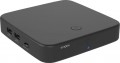 |
|---|---|---|
| Esperanza EV106R | Strong SRT 420 | |
| Outdated Product | from $192.79 | |
| TOP sellers | ||
| Type | TV tuner | Media Player |
| Digital tuner | DVB-T2 (terrestrial) | DVB-T2 (terrestrial) |
| Operating system | Android TV 11 | |
Connectivity and interfaces | ||
| Bluetooth | v5.0 | |
| Wi-Fi | Wi-Fi 5 (802.11ac) | |
| Google Cast (Chromecast) |  |  |
| Miracast | | |
| Card reader | | |
Connectors | ||
| HDMI | 1 | 1 |
| USB-A 2.0 | 2 pcs | 1 pcs |
| LAN | 100 Mbps | |
| Coaxial output | | |
| Optical output | | |
| Antenna input | | |
| More features | SCART | |
Hardware | ||
| CPU | ARM Cortex-A35 | |
| CPU cores | 4 | |
| CPU frequency | 2 GHz | |
| RAM | 2 GB | |
| Built-in memory | 8 GB | |
| Ultra HD 4K support | | |
| HDR support | HDR10+ | |
General | ||
| Video decoders | H.264, H.265 | H.264 |
| Audio decoders | Dolby Digital Plus | |
| Screen | | |
| Remote control | + | with voice control |
| Dimensions (WxHxD) | 122x122x23 mm | |
| Weight | 170 g | |
| Added to E-Catalog | december 2023 | december 2023 |


Compare Esperanza EV106R and Strong SRT 420
You may be interested in
Strong SRT 420 often compared


Glossary
Type
— Media player. Smart set-top boxes with a pre-installed operating system for the "smart" component of the connected display, whether it's an old CRT TV or a computer monitor with a suitable set of interfaces. The media player transforms any ordinary TV into the category of "smart" and expands the range of possibilities of many modern smart TV models. The vast majority of set-top boxes for TV work under the control of the Android operating system and its modifications. As a result, a huge list of compatible applications has been released for devices of this kind, which provide access to network storage of films and series, are responsible for viewing streaming broadcasts, browser operation, social network clients, etc. Media players with powerful electronics support any type of content and pull quite resource-intensive games. Smart set-top boxes are available in form factors from small to large: some of them are indistinguishable from a standard USB flash drive, while others can be made in a rather large case with Wi-Fi antenna “horns”.
— TV tuner. A separate device for receiving TV broadcasts of the digital broadcasting network and transmitting them to the TV screen or any other suitable display via video and audio outputs. An external receiver will be useful for older TVs that do not have a built-in tuner, and if the TV does not support the desired TV broadcast format. Broadcasting programs in digital format is the main, but by...no means the only task of most TV receivers. A considerable proportion of them can record broadcasts to a USB flash drive, play audio and video files from it, and read common file formats from memory cards. Advanced TV tuners can connect to the Internet and be used to consume media content online.
— Tuner for PC. Devices for watching TV on a computer. Among them, two main varieties can be distinguished: external tuners for a PC connected via USB, and internal tuners installed in a PCIe slot as an expansion card. The first option, usually, is characterized by a minimum of equipment, however, such devices can be used with almost any computer, from a powerful desktop workstation to an ultra-compact laptop. Internal tuners can have several inputs and outputs, while they are only suitable for desktop PCs, the case of which allows disassembly and installation of additional boards. Note that in both cases, the set of native functions of the tuner for PC, usually, is very limited. But this cannot be called a disadvantage: many additional features (for example, IPTV or video recording) are easier to implement directly through a computer.
— Video capture device. A type of specialized equipment for capturing audio and video streams through the appropriate connection interfaces and transferring it to a computer for recording or organizing streams. A video capture device will come in handy for creating live broadcasts on Twitch or recording let's plays on YouTube. Such equipment is rarely equipped with its own drives and slots for them — usually it is designed for video recording using computer resources.
— TV tuner. A separate device for receiving TV broadcasts of the digital broadcasting network and transmitting them to the TV screen or any other suitable display via video and audio outputs. An external receiver will be useful for older TVs that do not have a built-in tuner, and if the TV does not support the desired TV broadcast format. Broadcasting programs in digital format is the main, but by...no means the only task of most TV receivers. A considerable proportion of them can record broadcasts to a USB flash drive, play audio and video files from it, and read common file formats from memory cards. Advanced TV tuners can connect to the Internet and be used to consume media content online.
— Tuner for PC. Devices for watching TV on a computer. Among them, two main varieties can be distinguished: external tuners for a PC connected via USB, and internal tuners installed in a PCIe slot as an expansion card. The first option, usually, is characterized by a minimum of equipment, however, such devices can be used with almost any computer, from a powerful desktop workstation to an ultra-compact laptop. Internal tuners can have several inputs and outputs, while they are only suitable for desktop PCs, the case of which allows disassembly and installation of additional boards. Note that in both cases, the set of native functions of the tuner for PC, usually, is very limited. But this cannot be called a disadvantage: many additional features (for example, IPTV or video recording) are easier to implement directly through a computer.
— Video capture device. A type of specialized equipment for capturing audio and video streams through the appropriate connection interfaces and transferring it to a computer for recording or organizing streams. A video capture device will come in handy for creating live broadcasts on Twitch or recording let's plays on YouTube. Such equipment is rarely equipped with its own drives and slots for them — usually it is designed for video recording using computer resources.
Operating system
— Proprietary system. The operating system of the device is represented by the proprietary software shell of the manufacturer. Usually, such operating systems have an attractive and convenient menu. A proprietary operating system is developed directly by the manufacturer for the hardware resources of a particular model or a whole line, but has limited capabilities.
— Android (AOSP). This type of operating system is a modification of the popular Android OS, mainly notable for being open source. It is a versatile operating system that gives the user much more freedom to create changes and customizations within the system itself. At the same time, the installation and stability of certain applications on this platform are not guaranteed, and the overall system management was not specially “tailored” for large screens, which may cause some inconvenience. First of all, such solutions will interest users who understand the features of the Android OS, like to customize and control everything for themselves, and have time for this.
— Android TV. Devices of this type have full-fledged Android TV software, specially adapted to work on large screens. In accordance with the name, it is a type of Android OS, specially designed for such equipment. In addition to the common features of all Androids (such as the ability to install additional applications, including...even games), it has a number of special features: an optimized interface, integration with smartphones (including the ability to use them as a remote control), voice search, etc. Thanks to this, TVs with this feature are significantly superior in functionality to models with a “regular” Smart TV. Of course, a dedicated processor, graphics subsystem and memory are provided for the operation of a multifunctional OS, and the presence of such hardware resources is reflected in the overall cost.
— Google TV. Rebranding of the Android TV platform for TVs and smart consoles, or rather, a new shell on top of the operating system under the sign of the “green droid”, introduced since 2021. Among the innovations, it has a redesigned user interface, an improved knowledge base that more efficiently distributes content by genre and collects search information from the entire list of installed applications and subscriptions. The voice assistant now understands the needs of the audience better and provides a detailed list of what was found. A separate tab in the interface contains live broadcasts of current events, whether it be sports events or a rocket launch to Mars. Among other things, the aspects that involve the use of TV as a command post for managing a single ecosystem of a “smart” home have been improved in the system.
Bluetooth
Bluetooth is a technology used to connect various devices wirelessly directly. In media centers and TV receivers, it can be used to broadcast sound to wireless headphones and acoustics, to work with wireless mice and keyboards, to use a smartphone / tablet as a remote control, etc.; specific functionality should be specified separately. Also note that the supported version of Bluetooth can be specified here. The newest and most advanced is Bluetooth 5.0, but here is a more detailed description of the different versions:
- Bluetooth v4.0. The version in which the "Bluetooth Low Energy" (LE) format was first introduced — in addition to regular Bluetooth (version 2.1 functionality) and the high-speed HE standard for transferring large amounts of information (introduced in version 3.0). Bluetooth LE allows you to significantly reduce power consumption when transmitting small data packets, such as request-responses about connection activity in idle mode. For the media centers and TV receivers themselves, this is not particularly important, but for portable equipment (especially miniature ones, where battery capacity is very limited), such functionality will be useful.
- Bluetooth v 4.1. Development and improvement of Bluetooth 4.0. One of the key improvements was the optimization of collaboration with 4G LTE communication modules so that Bluetooth and LTE do not interfere with each other. In addition, this...version has the ability to simultaneously use a Bluetooth device in several roles — for example, to remotely control an external device while simultaneously streaming music to headphones.
- Bluetooth v4.2. Further, after 4.1, the development of the Bluetooth standard. It did not introduce fundamental updates, but received a number of improvements regarding reliability and noise immunity, as well as improved compatibility with the Internet of Things.
- Bluetooth v5.0. Version introduced in 2016. One of the most notable updates was the introduction of two new modes of operation for Bluetooth LE — with an increase in speed by reducing the range and with an increase in range by reducing the speed. In addition, a number of improvements have been introduced regarding simultaneous work with numerous connected devices, as well as work with the components of the Internet of Things.
Wi-Fi
Wi-Fi is a technology used for wireless connection to computer networks and for direct connection between devices. In media players, tuners and video capture devices, it can be used both to access the Internet or "local area" through a wireless router, and to communicate with a smartphone, tablet, etc. The AirPlay, Chromecast and Miracast functions are also based on this technology. The specific set of Wi-Fi features should be clarified separately; here we note that in this paragraph the specific supported version of such a connection can also be specified. Here are the main current options:
- Wi-Fi 5(802.11ac). One of the newest (for 2020) standards. Uses the 5 GHz band (less crowded than used in earlier 2.4 GHz versions) for improved reliability and lower latency; and speeds can reach 6.77 Gbps with multiple antennas and 1.69 Gbps with a single antenna.
- Wi-Fi 4 (802.11n). The predecessor of the above Wi-Fi 5, the first standard in which the 5 GHz band was introduced — here it is used along with the traditional 2.4 GHz and is not supported by some devices with Wi-Fi 4. Data transfer rate — up to 600 Mbps.
Google Cast (Chromecast)
The built-in feature allows you to send videos, music, photos, and browser tabs to the TV through a media player via Wi-Fi, without cables and flash drives. An important aspect is that in many applications, the phone acts as a remote control: you select a video or movie, "cast" it to the media player, and then the playback continues on the TV while you pause, rewind, and switch content from the smartphone. Compared to simple screen mirroring, Google Cast (Chromecast) is usually more stable and convenient for streaming since the phone can be used for other purposes in the meantime. Unlike Miracast, it often works better with Google services and the Chrome browser, but it requires a proper Wi-Fi connection and one network for the devices. Typical use cases: quickly play YouTube for kids on the TV, "transfer" a movie from an online cinema to the big screen, show guests an album from Google Photos, display a Chrome tab with a website or instruction, as well as launch a presentation from Google Drive/Slides at a meeting without a laptop and HDMI.
Miracast
A wireless technology that allows you to directly broadcast video and audio from one device to another directly over a Wi-Fi connection. At the same time, unlike AirPlay, transmission does not require a router and building a local network — it is enough that the receiver and transmitter are compatible with Miracast. One of the most popular ways to use this technology is to output a “picture” from a smartphone / tablet screen to a TV, and vice versa. A media centre or TV receiver with Miracast is useful if the TV itself does not support this function.
Card reader
A device for reading memory cards, most often in SD format. This feature is especially useful for exchanging information with some types of modern electronics: almost all cameras and laptops are equipped with card readers, and microSD cards used in smartphones and other pocket gadgets can be used in SD slots using simple adapters. Thanks to the card reader, you can, for example, easily view materials captured on a camera or smartphone camera, copy music and movies from a laptop to a media centre, and even perform some special tasks, such as updating the player's firmware. In video capture devices, the built-in card reader allows user to add the drive to the list of computer disks.
USB-A 2.0
A classic USB port for connecting flash drives, receivers, keyboards, and other compatible peripherals, designed for data transfer up to 480 Mbps. This type of port is convenient for basic tasks where high speed isn't necessary, but it significantly falls behind more modern USB versions for very large files and fast external drives. The major advantage here is compatibility: USB-A 2.0 has long remained the most familiar format for mass accessories.
LAN
LAN — connector for wired connection to the Internet and/or local area network using an Ethernet cable. A wired connection is not as convenient as Wi-Fi (see "Multimedia"), but it is considered more reliable and provides faster data transfer speeds. And the speed indicators depend on the device and can be 100 Mbps and 1 Gbps.