
Comparison MSI PRO MP251 24.5 " black vs MSI PRO MP243 23.8 " black
Add to comparison |  | 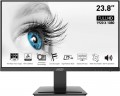 |
|---|---|---|
| MSI PRO MP251 24.5 " black | MSI PRO MP243 23.8 " black | |
| Compare prices 3 | from $139.99 | |
| User reviews | ||
| TOP sellers | ||
| Product type | monitor | monitor |
| Size | 24.5 " | 23.8 " |
Screen | ||
| Panel type | IPS | IPS |
| Surface treatment | matte | anti-glare |
| Resolution | 1920x1080 (16:9) | 1920x1080 (16:9) |
| FPS | 100 Hz | 75 Hz |
| Pixel size | 0.27 mm | |
| Response time (GtG) | 4 ms | 5 ms |
| Response time (MPRT) | 1 ms | |
| Vertical viewing angle | 178 ° | 178 ° |
| Horizontal viewing angle | 178 ° | 178 ° |
| Brightness | 300 cd/m² | 250 cd/m² |
| Static contrast | 1 300:1 | 1 000:1 |
| Colour depth | 6-bit + FRC (16.7M Colors) | 8-bit (16.7M Colors) |
| Colour space (sRGB) | 101 % | 99 % |
| TÜV Rheinland certificate |  | |
Connection | ||
| Video transmission | VGA HDMI v1.4 | DisplayPort v1.2 HDMI v1.4 |
| Connectors (optional) | mini-Jack input (3.5 mm) mini-Jack output (3.5 mm) | mini-Jack output (3.5 mm) |
Features | ||
| Features | Flicker-Free AMD FreeSync | Flicker-Free AMD FreeSync |
| Speakers | | |
| Sound power | 2x2 W | 2x2 W |
General | ||
| Wall mount | VESA 100x100mm | VESA 75x75mm |
| Power consumption | 18 W | |
| External power supply | | |
| Dimensions (WxHxD) | 558x422x207 mm | 542x422x182 mm |
| Weight | 2.9 kg | 2.95 kg |
| Color | ||
| Added to E-Catalog | january 2024 | october 2022 |




Compare MSI PRO MP251 and PRO MP243
Price comparison
You may be interested in
MSI PRO MP251 often compared


MSI PRO MP243 often compared


Glossary
Size
Diagonal size of the monitor matrix, in inches.
This parameter is one of the most important for any screen — it determines the total size of its working area. In general, it is believed that larger monitors are more comfortable: a large screen allows you to see a large fragment of text, images, etc. without having to scroll the "picture". On the other hand, the diagonal directly affects the dimensions, weight and cost of the monitor. In addition, it is worth remembering that screens with the same diagonal can have different aspect ratios and different specializations: for example, widescreen models are convenient for playing games and watching movies, while classic 4:3 or 5:4 solutions are preferable for working with documents. Now there are monitors of different diagonals on the market, among them the most popular are: 19–20", 22", 23 – 24", 25 – 26", 27 – 28", 29 – 30", 32", 34" and more.
This parameter is one of the most important for any screen — it determines the total size of its working area. In general, it is believed that larger monitors are more comfortable: a large screen allows you to see a large fragment of text, images, etc. without having to scroll the "picture". On the other hand, the diagonal directly affects the dimensions, weight and cost of the monitor. In addition, it is worth remembering that screens with the same diagonal can have different aspect ratios and different specializations: for example, widescreen models are convenient for playing games and watching movies, while classic 4:3 or 5:4 solutions are preferable for working with documents. Now there are monitors of different diagonals on the market, among them the most popular are: 19–20", 22", 23 – 24", 25 – 26", 27 – 28", 29 – 30", 32", 34" and more.
Surface treatment
Modern monitors can use displays with both glossy and matte screen surfaces. A matte surface is in some cases more preferable due to the fact that on a glossy screen, when exposed to bright light, noticeable glare appears, sometimes interfering with viewing. On the other hand, glossy screens offer better picture quality, higher brightness, and richer colours.
Due to the development of technology, monitors with a special anti-glare coating have appeared on the market, which, while maintaining all the advantages of a glossy screen, creates significantly less visible glare in bright ambient light.
Due to the development of technology, monitors with a special anti-glare coating have appeared on the market, which, while maintaining all the advantages of a glossy screen, creates significantly less visible glare in bright ambient light.
FPS
The maximum frame rate supported by the monitor at the recommended (maximum) resolution.
The higher the frame rate, the smoother the movement on the screen will look, the less noticeable jerks and blurring will be on it. Of course, the actual image quality also depends on the video signal, but for normal viewing of video at a high frame rate, the monitor must also support it.
When choosing this option, keep in mind that at lower resolutions than the maximum, the supported frame rate may be higher. For example, a model with a 1920x1080 matrix and a claimed frame rate of 60 Hz at a reduced resolution can give 75 Hz; but the 75Hz frame rate is only listed in the specs if it is supported at the monitor's native (maximum) resolution.
Also note that a high frame rate is especially important for gaming models (see "Type"). In most of them, this figure is 120 Hz and higher; monitors with a frequency of 144 Hz are considered the best option in terms of price and quality, however, there are also higher values — 165 Hz, 180 Hz and 240 Hz. And monitors at 100 Hz can be both inexpensive gaming models and advanced home ones.
You can evaluate all the frame rates at which this...monitor is capable of operating by the vertical frequency claimed in the specifications (see below).
The higher the frame rate, the smoother the movement on the screen will look, the less noticeable jerks and blurring will be on it. Of course, the actual image quality also depends on the video signal, but for normal viewing of video at a high frame rate, the monitor must also support it.
When choosing this option, keep in mind that at lower resolutions than the maximum, the supported frame rate may be higher. For example, a model with a 1920x1080 matrix and a claimed frame rate of 60 Hz at a reduced resolution can give 75 Hz; but the 75Hz frame rate is only listed in the specs if it is supported at the monitor's native (maximum) resolution.
Also note that a high frame rate is especially important for gaming models (see "Type"). In most of them, this figure is 120 Hz and higher; monitors with a frequency of 144 Hz are considered the best option in terms of price and quality, however, there are also higher values — 165 Hz, 180 Hz and 240 Hz. And monitors at 100 Hz can be both inexpensive gaming models and advanced home ones.
You can evaluate all the frame rates at which this...monitor is capable of operating by the vertical frequency claimed in the specifications (see below).
Pixel size
The size of one dot (pixel) on a monitor screen. This parameter is related to the maximum resolution of the monitor and its diagonal size — the higher the resolution, the smaller the pixel size (with the same diagonal) and vice versa, the larger the diagonal, the larger the size of one pixel (with the same resolution). The smaller the size of one pixel, the clearer the image will be displayed by the monitor, the less grainy it will be noticeable, which is especially important on large monitors. On the other hand, a small pixel size creates discomfort when working with fine details and text — this mainly applies to monitors with a small diagonal.
Response time (GtG)
The time each individual pixel on the monitor takes to switch from one state to another. The lower the response time, the faster the matrix responds to the control signal, resulting in less delay and better image quality in dynamic scenes.
Note that in this case, the gray-to-gray method is used (the time it takes to switch from 10% gray to 90% gray). Pay attention to this parameter if the monitor is specifically purchased for fast-paced games, movie watching, or other applications involving quick screen movements. However, there’s no need to chase the fastest models. It’s not often possible to discern the difference between 1 ms and 5 ms. For most scenarios, monitors with a 4 ms response time will suffice. In any case, it’s best to rely on live impressions for a true comparison.
Note that in this case, the gray-to-gray method is used (the time it takes to switch from 10% gray to 90% gray). Pay attention to this parameter if the monitor is specifically purchased for fast-paced games, movie watching, or other applications involving quick screen movements. However, there’s no need to chase the fastest models. It’s not often possible to discern the difference between 1 ms and 5 ms. For most scenarios, monitors with a 4 ms response time will suffice. In any case, it’s best to rely on live impressions for a true comparison.
Response time (MPRT)
The parameter expresses how long an object moving in the frame is displayed on the screen until it completely disappears. The lower this indicator, the more realistic dynamic scenes look on the monitor. The reaction of the matrix to movements clearly shows the time of existence of the trail from the changing picture. The MPRT parameter is more dependent on the refresh rate of the monitor screen than on the pixel response time. To reduce its value, the Motion Blur Reduction (MBR) function is often used, which briefly turns off the backlight at the end of the time of dynamic frames in order to increase the clarity of dynamic scenes.
Brightness
The maximum brightness provided by the monitor screen.
Choosing a monitor with high brightness is especially important if the device is going to be used in bright ambient light — for example, if the workplace is exposed to sunlight. A dim image can be "dampened" by such lighting, making work uncomfortable. In other conditions, the high brightness of the screen is very tiring for the eyes.
Most modern monitors give out about 200 – 400 cd / m2 — this is usually quite enough even in the sun. However, there are also higher values: for example, in LCD panels (see "Type") the brightness can reach several thousand cd/m2. This is necessary taking into account the specifics of such devices — the image must be clearly visible from a long distance.
Choosing a monitor with high brightness is especially important if the device is going to be used in bright ambient light — for example, if the workplace is exposed to sunlight. A dim image can be "dampened" by such lighting, making work uncomfortable. In other conditions, the high brightness of the screen is very tiring for the eyes.
Most modern monitors give out about 200 – 400 cd / m2 — this is usually quite enough even in the sun. However, there are also higher values: for example, in LCD panels (see "Type") the brightness can reach several thousand cd/m2. This is necessary taking into account the specifics of such devices — the image must be clearly visible from a long distance.
Static contrast
Static contrast provided by the monitor screen.
This value describes the difference between the brightest whites and darkest blacks that the screen is capable of producing. In this case, unlike dynamic contrast (see below), the difference is indicated on the condition that the brightness of the screen backlight remains unchanged. In other words, this is the contrast that is guaranteed to be achievable within one frame. Static contrast is inevitably lower than dynamic. However, it is she who describes the basic capabilities of the screen.
The minimum static contrast ratio for tolerable image quality is considered to be 250:1, but even the most modest modern monitors give out about 400:1 (and a value of 1000:1 is not the highest class), and in high-end models this figure can reach 2000:1 and even more. .
This value describes the difference between the brightest whites and darkest blacks that the screen is capable of producing. In this case, unlike dynamic contrast (see below), the difference is indicated on the condition that the brightness of the screen backlight remains unchanged. In other words, this is the contrast that is guaranteed to be achievable within one frame. Static contrast is inevitably lower than dynamic. However, it is she who describes the basic capabilities of the screen.
The minimum static contrast ratio for tolerable image quality is considered to be 250:1, but even the most modest modern monitors give out about 400:1 (and a value of 1000:1 is not the highest class), and in high-end models this figure can reach 2000:1 and even more. .
Colour depth
The colour depth supported by the monitor.
This parameter characterizes the number of shades that the screen can display. And here it is worth recalling that the image in modern monitors is based on 3 basic colours — red, green, blue (RGB scheme). And the number of bits is indicated not for the entire screen, but for each base colour. For example, 6 bits (the minimum colour depth for modern monitors) means that the screen is capable of producing 2 ^ 6, that is, 64 shades of red, green and blue; the total number of shades will be 64 * 64 * 64 = 262,144 (0.26 million). An 8-bit colour depth (256 shades for each base colour) already gives a total of 16.7 million colours; and the most advanced modern monitors support 10-bit colour, allowing you to work with more than a billion shades.
Screens with support for FRC technology are worth a special mention; nowadays, you can find models marked " 6 bit + FRC " and " 8 bit + FRC ". This technology was developed to improve picture quality in situations where the incoming video signal has a greater colour depth than the screen, such as when 10-bit video is fed to an 8-bit matrix. If such a screen supports FRC, the picture on it will be noticeably better than on a regular 8-bit monitor (although somewhat worse than on a full-fledged 10-bit monitor, but “8 bit + FRC” screens are much...cheaper).
High colour depth is important primarily for professional graphics and other tasks that require high colour fidelity. On the other hand, such features significantly affect the cost of the monitor. In addition, it is worth remembering that the quality of colour reproduction depends not only on the colour depth, but also on other parameters — in particular, colour gamut (see below).
This parameter characterizes the number of shades that the screen can display. And here it is worth recalling that the image in modern monitors is based on 3 basic colours — red, green, blue (RGB scheme). And the number of bits is indicated not for the entire screen, but for each base colour. For example, 6 bits (the minimum colour depth for modern monitors) means that the screen is capable of producing 2 ^ 6, that is, 64 shades of red, green and blue; the total number of shades will be 64 * 64 * 64 = 262,144 (0.26 million). An 8-bit colour depth (256 shades for each base colour) already gives a total of 16.7 million colours; and the most advanced modern monitors support 10-bit colour, allowing you to work with more than a billion shades.
Screens with support for FRC technology are worth a special mention; nowadays, you can find models marked " 6 bit + FRC " and " 8 bit + FRC ". This technology was developed to improve picture quality in situations where the incoming video signal has a greater colour depth than the screen, such as when 10-bit video is fed to an 8-bit matrix. If such a screen supports FRC, the picture on it will be noticeably better than on a regular 8-bit monitor (although somewhat worse than on a full-fledged 10-bit monitor, but “8 bit + FRC” screens are much...cheaper).
High colour depth is important primarily for professional graphics and other tasks that require high colour fidelity. On the other hand, such features significantly affect the cost of the monitor. In addition, it is worth remembering that the quality of colour reproduction depends not only on the colour depth, but also on other parameters — in particular, colour gamut (see below).