
Comparison Fosi Audio V3 vs Fosi Audio BT20A Pro
Add to comparison |  | 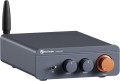 |
|---|---|---|
| Fosi Audio V3 | Fosi Audio BT20A Pro | |
| Compare prices 9 | Compare prices 20 | |
| TOP sellers | ||
Power depends on the power supply, which is not supplied with all configurations. | Built-in Bluetooth 5.0 with AAC codec support. | |
| Device type | amplifier | amplifier |
| Element base | transistor | transistor |
Amplifier parameters | ||
| Number of channels | 2 | 2 |
| Frequency range | 20 – 20000 Hz | 20 – 20000 Hz |
| Power per channel (4Ω) | 300 W | 300 W |
| Signal to noise ratio | 110 dB | 108 dB |
| Harmonic distortion | 0.003 % | 0.005 % |
Connectors | ||
| To amplifier (Main) | RCA | RCA |
| RCA | 1 pairs | 1 pairs |
| Outputs | Pre-Amp | Pre-Amp |
| For acoustics | 4 шт | 2 шт |
Features | ||
| Adjustments | level adjustment | bass control treble adjustment level adjustment |
| More features | Bluetooth | |
General | ||
| Chassis material | aluminum | aluminum |
| PSU | external | external |
| Dimensions (WxDxH) | 105x166x35 mm | |
| Weight | 0.8 kg | |
| Color | ||
| Added to E-Catalog | january 2025 | september 2024 |



Compare Fosi Audio V3 and BT20A Pro
Price comparison
You may be interested in
My comparisons
Fosi Audio V3 often compared

Fosi Audio BT20A Pro often compared


Glossary
Signal to noise ratio
In itself, the signal-to-noise ratio is the ratio of the level of pure sound produced by the amplifier to the level of extraneous noise that occurs during its operation. This parameter is the main indicator of the overall sound quality — and very clear, because. its measurement takes into account almost all the noise that affects the sound in normal operating conditions. A level of 70 – 80 dB in modern amplifiers can be considered acceptable, 80 – 90 dB is not bad, and for advanced audiophile-class devices, a signal-to-noise ratio of at least 100 dB is considered mandatory.
If the specifications do not specify for which output the signal-to-noise ratio is indicated, it usually means its value for the linear input (see "RCA (par)"). This is quite enough to evaluate the quality of the device for this parameter. However, some manufacturers indicate it for other inputs — Main, Phono; see below for more on this.
If the specifications do not specify for which output the signal-to-noise ratio is indicated, it usually means its value for the linear input (see "RCA (par)"). This is quite enough to evaluate the quality of the device for this parameter. However, some manufacturers indicate it for other inputs — Main, Phono; see below for more on this.
Harmonic distortion
This indicator describes the amount of non-linear distortion introduced by the amplifier into the processed signal. Such distortions are not necessarily perceived as extraneous noise, but they degrade the quality of the sound anyway — for example, they can make it more deaf. It is almost impossible to avoid them, but it can be reduced to levels inaudible to the human ear.
As a result, the harmonic distortion factor (harmonics) is one of the main parameters describing the overall sound quality in Hi-Fi and Hi-End amplifiers. The lower it is, the clearer the sound. Hundredths of a percent are considered a good indicator for modern amplifiers, thousandths and below are excellent. The exceptions are tube and hybrid models, for which rather high harmonic coefficients are allowed; see "Element base" for more details.
As a result, the harmonic distortion factor (harmonics) is one of the main parameters describing the overall sound quality in Hi-Fi and Hi-End amplifiers. The lower it is, the clearer the sound. Hundredths of a percent are considered a good indicator for modern amplifiers, thousandths and below are excellent. The exceptions are tube and hybrid models, for which rather high harmonic coefficients are allowed; see "Element base" for more details.
For acoustics
The number of outputs in the design of the amplifier, designed for direct connection of speakers. One such output is usually a pair of screw terminals designed to connect one speaker. Accordingly, the standard set for sound in stereo mode is two outputs (two pairs). However, in multi-channel devices (see “Number of channels”), as well as in models with the ability to connect additional speakers and/or Bi-Wiring (see “Additionally”), more speaker outputs are installed — in accordance with the capabilities of the amplifier.
Adjustments
— Bass adjustment. The presence in the amplifier of a separate low-frequency level control, in other words, bass volume. The ratio of low and high frequencies largely determines the overall picture of the sound; the optimal options for this ratio for different cases will be different, and they depend on a number of factors — from the type of audio being played to the personal tastes of the listener. Anyway, the bass control provides an additional opportunity to fine-tune the sound of the entire system. It is often combined with a treble control (see below); in fact, this combination is the simplest version of the equalizer.
— Treble adjustment. The presence in the amplifier of a separate volume control for high frequencies. The meaning of this function is completely similar to the bass control described above, only it works with a different frequency band.
— Balance adjustment. The presence in the amplifier of adjusting the balance between the channels. This setting is used in stereo sound: by changing the position of the knob, you can increase the volume for one channel and decrease it for another. Due to this, the conditional centre of the perceived sound shifts towards the speaker that sounds louder. This feature can be very useful for correcting the sound stage — for example, if the speakers have different sensitivity, badly placed, or the signal itse...lf is not properly balanced. At the same time, the balance controller introduces additional elements into the design, which increases the likelihood of interference. And therefore, in top-class amplifiers, it may not be provided at all.
— Adjustment of input sensitivity. Ability to change the input sensitivity of the amplifier; For details on this parameter, see "Input Sensitivity (Line Input)". Also note here that the adjustment itself can be useful when working with several sound sources: it allows you to easily reconfigure the amplifier for each of these sources in order to provide the desired output power level and at the same time avoid distortion.
— Level adjustment. The presence in the amplifier of its own level control, in other words, a system that allows you to change the volume of the sound (by changing the actual output power). In modern home amplifiers (see above), this adjustment is common to all channels, and it is responsible for the actual volume; sometimes using the control on the amplifier is more convenient than on another component of the audio system. But in concert models, each channel, usually, is equipped with its own regulator, thanks to which there are many opportunities for fine-tuning the sound to a specific situation.
— Loudness. This function allows you to adjust the tone of the sound at a low volume. Its necessity is connected with the fact that the human ear perceives a quiet sound differently than a loud one; because of this, even high-quality sound at low volume will seem “blurry”, not clear enough. Loudness corrects this by boosting certain frequencies. Usually this mode is enabled by the user at will.
— Treble adjustment. The presence in the amplifier of a separate volume control for high frequencies. The meaning of this function is completely similar to the bass control described above, only it works with a different frequency band.
— Balance adjustment. The presence in the amplifier of adjusting the balance between the channels. This setting is used in stereo sound: by changing the position of the knob, you can increase the volume for one channel and decrease it for another. Due to this, the conditional centre of the perceived sound shifts towards the speaker that sounds louder. This feature can be very useful for correcting the sound stage — for example, if the speakers have different sensitivity, badly placed, or the signal itse...lf is not properly balanced. At the same time, the balance controller introduces additional elements into the design, which increases the likelihood of interference. And therefore, in top-class amplifiers, it may not be provided at all.
— Adjustment of input sensitivity. Ability to change the input sensitivity of the amplifier; For details on this parameter, see "Input Sensitivity (Line Input)". Also note here that the adjustment itself can be useful when working with several sound sources: it allows you to easily reconfigure the amplifier for each of these sources in order to provide the desired output power level and at the same time avoid distortion.
— Level adjustment. The presence in the amplifier of its own level control, in other words, a system that allows you to change the volume of the sound (by changing the actual output power). In modern home amplifiers (see above), this adjustment is common to all channels, and it is responsible for the actual volume; sometimes using the control on the amplifier is more convenient than on another component of the audio system. But in concert models, each channel, usually, is equipped with its own regulator, thanks to which there are many opportunities for fine-tuning the sound to a specific situation.
— Loudness. This function allows you to adjust the tone of the sound at a low volume. Its necessity is connected with the fact that the human ear perceives a quiet sound differently than a loud one; because of this, even high-quality sound at low volume will seem “blurry”, not clear enough. Loudness corrects this by boosting certain frequencies. Usually this mode is enabled by the user at will.
More features
— Direct connection ( By-pass/Direct). The ability to turn on the amplifier in By-pass / Direct mode. Its name is due to the fact that the signal is sent directly to the amplification stages, bypassing all additional controls (timbre, balance, etc.). Power amplifiers (see "Type"), by definition, use just such a scheme of operation. In integrated models, direct connection not only minimizes distortion in the processed signal, but also provides the sound closest to the original, which allows demanding listeners to appreciate the skill of sound engineers.
— Automatic power off. This function ensures that the amplifier automatically turns off if no signal is received from its input for a certain period of time. In this way, downtime is avoided — for example, if the owner left on business, forgetting to turn off the audio system. And considering that many modern amplifiers require a lot of energy even “at idle”, the savings can be quite significant. It is worth clarifying that in this case we are usually not talking about a complete shutdown, but about switching to standby mode; but the power consumption (see below) in this mode is usually so small that in fact the difference is practically not noticeable.
— MM phono stage. The presence of a phono stage in the amplifier for working with turntables equipped with MM type pickups (with a moving magnet). The phono stage itself is a mandatory attr...ibute of models with a Phono input (see "Inputs"); its necessity is due to the fact that the signal from the pickups for vinyl has specific characteristics and needs additional processing. At the same time, two types of pickups can be used in modern record players — the already mentioned MM plus MC (with a moving coil), each with its own signal characteristics. Therefore, for the normal operation of the turntable, you will anyway need a phono stage of the appropriate type. Such equipment is also available as separate devices, but it is usually easier and cheaper to buy an amplifier with a built-in phono stage.
— MS phono stage. The presence of a phono stage in the amplifier to work with turntables equipped with MC type pickups (moving coil). For more information about this function, see the subsection “MM Phono Stage” above.
— Limiter. The presence of a limiter in the amplifier — a device that limits the dynamic range of the processed signal. This device is also called an "audio signal compressor" (due to the fact that it "compresses" the dynamic range). In simpler terms, a limiter essentially reduces the difference between the quietest and loudest sound output from an amplifier. This feature can be useful in any situation where you have to deal with uneven sound volume. For example, a limiter can make it more comfortable to listen to a symphony that has large volume differences — so that the listener can access the slightest nuances of sound and at the same time, loud fragments, as they say, do not beat on the ears. And for professional concert activity, the presence of a compressor is almost mandatory — in particular, to compensate for changes in volume that occur when the distance from the microphone to the acoustic instrument or the vocalist's mouth changes. Of course, the limiter can also be made as a separate device; however, its presence in the amplifier itself is sometimes more convenient. At the same time, this function is complex and expensive, and therefore is found mainly in professional equipment and top-class consumer models.
— Connecting an additional speaker. The ability to connect an additional set of speakers (one or more) to the amplifier. Note that we are not talking about individual speakers, but about sets designed to work with full-length sound. In other words, if such an amplifier produces sound in stereo format at the main outputs (see "Number of channels"), then an additional set of acoustics will be able to work in this format. Models with this function are designed primarily for situations where you need to output sound to several rooms, and the signal can go either to all sets at once, or only to one at the user's choice. Also, an additional set of connectors can be used for Bi-Wiring (see below).
— Biwiring. Amplifiers with this feature use two separate channels of amplification for bass and treble, and are able to output each frequency band through a separate set of connectors. Due to this, it is possible to apply low-frequency and high-frequency signals via separate wires, and directly to the corresponding specialized speakers of the speaker system — instead of outputting a common signal to it and dividing it into frequencies using the built-in speaker crossover. In fact, this means that the Bi-Wiring connection reduces the likelihood of interference and improves the sound quality. However, keep in mind that this will require not only an amplifier, but also speakers that support this function. Note that Bi-Wiring is usually combined with the ability to connect an additional speaker described above.
— Management of external devices. The ability to use the amplifier as a control device for other components of the audio system — for example, preamplifier, turntable, etc. Control is usually carried out from the universal remote control supplied with the amplifier, and the control signal is transmitted through special connectors — this is much more convenient than adjusting each component separately. On the other hand, the construction of such systems is possible only from devices of the same manufacturer — different companies use different control standards, in most cases they are not compatible with each other.
— Bluetooth. A wireless communication technology with a range of about 10 m (more "long-range" versions are not used in amplifiers), originally created for direct connection between various devices. The functionality of such a connection may be different, but in this case, most often it is possible to broadcast to the sound amplifier from an external device — for example, a smartphone or laptop. However, other functions may be provided, for example, remote control from a mobile gadget through a special application.
— Emergency notification. The ability of the amplifier to work in an emergency warning system, more precisely, the availability of special functions and tools for working in such systems. Such tools may include, for example, connecting to fire detectors and automatically triggering warnings or evacuation messages to areas where the detectors have been triggered; selection of message type depending on the triggered sensor; connecting the notification microphone to the “priority input” and muting all other channels when sound is received from the microphone, etc. A specific set of features should be specified separately. Specialized security units may also be responsible for these functions, but sometimes it is more convenient to use an amplifier with built-in support for emergency notification.
— Automatic power off. This function ensures that the amplifier automatically turns off if no signal is received from its input for a certain period of time. In this way, downtime is avoided — for example, if the owner left on business, forgetting to turn off the audio system. And considering that many modern amplifiers require a lot of energy even “at idle”, the savings can be quite significant. It is worth clarifying that in this case we are usually not talking about a complete shutdown, but about switching to standby mode; but the power consumption (see below) in this mode is usually so small that in fact the difference is practically not noticeable.
— MM phono stage. The presence of a phono stage in the amplifier for working with turntables equipped with MM type pickups (with a moving magnet). The phono stage itself is a mandatory attr...ibute of models with a Phono input (see "Inputs"); its necessity is due to the fact that the signal from the pickups for vinyl has specific characteristics and needs additional processing. At the same time, two types of pickups can be used in modern record players — the already mentioned MM plus MC (with a moving coil), each with its own signal characteristics. Therefore, for the normal operation of the turntable, you will anyway need a phono stage of the appropriate type. Such equipment is also available as separate devices, but it is usually easier and cheaper to buy an amplifier with a built-in phono stage.
— MS phono stage. The presence of a phono stage in the amplifier to work with turntables equipped with MC type pickups (moving coil). For more information about this function, see the subsection “MM Phono Stage” above.
— Limiter. The presence of a limiter in the amplifier — a device that limits the dynamic range of the processed signal. This device is also called an "audio signal compressor" (due to the fact that it "compresses" the dynamic range). In simpler terms, a limiter essentially reduces the difference between the quietest and loudest sound output from an amplifier. This feature can be useful in any situation where you have to deal with uneven sound volume. For example, a limiter can make it more comfortable to listen to a symphony that has large volume differences — so that the listener can access the slightest nuances of sound and at the same time, loud fragments, as they say, do not beat on the ears. And for professional concert activity, the presence of a compressor is almost mandatory — in particular, to compensate for changes in volume that occur when the distance from the microphone to the acoustic instrument or the vocalist's mouth changes. Of course, the limiter can also be made as a separate device; however, its presence in the amplifier itself is sometimes more convenient. At the same time, this function is complex and expensive, and therefore is found mainly in professional equipment and top-class consumer models.
— Connecting an additional speaker. The ability to connect an additional set of speakers (one or more) to the amplifier. Note that we are not talking about individual speakers, but about sets designed to work with full-length sound. In other words, if such an amplifier produces sound in stereo format at the main outputs (see "Number of channels"), then an additional set of acoustics will be able to work in this format. Models with this function are designed primarily for situations where you need to output sound to several rooms, and the signal can go either to all sets at once, or only to one at the user's choice. Also, an additional set of connectors can be used for Bi-Wiring (see below).
— Biwiring. Amplifiers with this feature use two separate channels of amplification for bass and treble, and are able to output each frequency band through a separate set of connectors. Due to this, it is possible to apply low-frequency and high-frequency signals via separate wires, and directly to the corresponding specialized speakers of the speaker system — instead of outputting a common signal to it and dividing it into frequencies using the built-in speaker crossover. In fact, this means that the Bi-Wiring connection reduces the likelihood of interference and improves the sound quality. However, keep in mind that this will require not only an amplifier, but also speakers that support this function. Note that Bi-Wiring is usually combined with the ability to connect an additional speaker described above.
— Management of external devices. The ability to use the amplifier as a control device for other components of the audio system — for example, preamplifier, turntable, etc. Control is usually carried out from the universal remote control supplied with the amplifier, and the control signal is transmitted through special connectors — this is much more convenient than adjusting each component separately. On the other hand, the construction of such systems is possible only from devices of the same manufacturer — different companies use different control standards, in most cases they are not compatible with each other.
— Bluetooth. A wireless communication technology with a range of about 10 m (more "long-range" versions are not used in amplifiers), originally created for direct connection between various devices. The functionality of such a connection may be different, but in this case, most often it is possible to broadcast to the sound amplifier from an external device — for example, a smartphone or laptop. However, other functions may be provided, for example, remote control from a mobile gadget through a special application.
— Emergency notification. The ability of the amplifier to work in an emergency warning system, more precisely, the availability of special functions and tools for working in such systems. Such tools may include, for example, connecting to fire detectors and automatically triggering warnings or evacuation messages to areas where the detectors have been triggered; selection of message type depending on the triggered sensor; connecting the notification microphone to the “priority input” and muting all other channels when sound is received from the microphone, etc. A specific set of features should be specified separately. Specialized security units may also be responsible for these functions, but sometimes it is more convenient to use an amplifier with built-in support for emergency notification.