
Comparison Edifier MR5 vs Edifier R1855DB
Add to comparison |  | 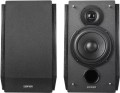 |
|---|---|---|
| Edifier MR5 | Edifier R1855DB | |
| Compare prices 3 | from $360.00 | |
| User reviews | ||
| TOP sellers | ||
The set consists of one passive speaker and one active speaker. Hi-Res Wireless, LDAC codec support. Bluetooth 6.0. | Both 1.0 and 2.0 versions can be on sale. | |
| Features | monitor | homemade |
| Near field monitoring |  |  |
| Mount | shelf | shelf |
Specs | ||
| Type | active | active |
| Number of channels | 2.0 system | 2.0 system |
| Number of speakers | 3 | 2 |
| Number of bands | 3 | 2 |
| Sensitivity | 85 dB | |
| Crossover frequency | 0.155 / 2.6 kHz | |
Power / frequency | ||
| Front | 55 W/channel | 35 W/channel |
| Total rated power | 110 W | 70 W |
| Overall frequency range | 46 – 40000 Hz | 60 – 20000 Hz |
Design | ||
| Design features | phase inverter side treble adjustment bass control | phase inverter front treble adjustment bass control |
Connectors | ||
| Inputs | RCA mini-Jack (3.5 mm) Jack (6.35 mm) and XLR | RCA optical coaxial |
| Outputs | on headphones | |
General | ||
| Bluetooth | v 6.0 | + |
| Remote control | | |
| Tweeter size | 25 mm | 19 mm |
| Midrange speaker size | 95 mm | |
| Woofer size (LF/MF) | 127 mm | 116 mm |
| Finishing material | MDF | MDF |
| Front speaker dimensions (HxWxD) | 26.4x15.9x28 cm | 25x15x22 cm |
| Weight | 10.38 kg | 6.6 kg |
| Color | ||
| Added to E-Catalog | july 2025 | april 2021 |





Compare Edifier MR5 and R1855DB
Price comparison
You may be interested in
My comparisons
Edifier MR5 often compared


Edifier R1855DB often compared


Glossary
Features
General specialization of the speaker system.
These days, by this criterion, we distinguish home, concert, monitor, public address, outdoor, and cinema systems, as well as solutions for expanding existing AS. At the same time, the intended use isn’t a hard rule—many models also allow nonstandard use cases. However, it’s still simpler and more convenient to choose a speaker according to the application it was originally designed for. The specific features of speakers for different purposes are as follows:
— Home. A type of AS intended, as the name suggests, for individual use at home. Note that the specs of such models can vary widely—from the simplest bookshelf speakers to powerful multi-way speakers designed for home theaters and high-quality audio systems.
— Concert. A distinguishing exterior feature of AS intended for concerts is their large size and high nominal power (in some models it exceeds 1 kW). The latter is indispensable for vast spaces—halls, stadiums, etc.—where the sound also has to overpower the audience’s reaction (sometimes quite loud). Buying such speakers for home use makes no sense—not only due to the high price, but also because instead of high-level inputs (as in home AS) these systems have a connector for specialized equi...pment, musical instruments, etc. Most often concert speakers are sold in a 1.0 configuration (see “Number of channels”) so that sound engineers can assemble the required speaker setup from a specific number of components.
— Monitor. The primary purpose of monitor speakers is sound quality control; accordingly, all such models offer extremely high accuracy in reproducing every detail, a flat FR, and virtually no distortion. This makes them indispensable for professional use (for example, in recording studios): a monitor speaker will let you pinpoint all flaws in the input signal, including amplifier noise, editing inaccuracies, etc. Like concert models (see above), these systems are usually equipped with specialized inputs; however, using monitors for home listening makes little sense for another reason as well: all sound imperfections that go unnoticed on regular speakers will show up—and can noticeably spoil the impression. And the price of such models is quite high.
—
— Outdoor. Speaker systems designed for installation outside. They can be used, for example, to provide sound for parties at a country house or outdoors, to play music on café summer terraces, etc. All models of this type necessarily have a moisture-resistant, corrosion-resistant enclosure (see “Water resistance”) for adverse weather; in addition, they are usually protected against UV exposure. Outdoor speakers can be mounted in different ways (see above), but suspended options are the most common.
— Cinema. Models intended, as the name suggests, for use in movie theaters—primarily not in “home-size” rooms for 6–10 viewers, but in large entertainment complexes with dozens or hundreds of seats. Cinema speakers have the following common traits. First, they are all passive, intended to be connected to specialized amplifiers; accordingly, high-voltage inputs in the form of binding posts or Euroblock sockets are used. Second, the power of such devices is quite high—100 W and above. Third, cinema speakers are usually produced in a 1.0 format (see “Number of channels”)—in other words, such models are not complete speaker systems, but individual components used to assemble a specific multichannel AS. This format makes it possible to select speakers as precisely as possible for a specific auditorium. By installation type, cinema speakers are usually floorstanding, in-wall, or wall-mounted. The latter are most often designed for installation on side walls, while the first two go behind the screen. Floorstanding versions can in fact consist of two parts—a classic low-frequency cabinet and a horn for MF and HF.
— Speaker system expansion. A specific type of speaker not intended for standalone use and used as an add-on to traditionally designed speakers. Such models are mainly used in multichannel surround systems—to extend the soundstage vertically; they have a distinctive look: relatively compact size, a slanted top panel, and a driver built into that panel. This way, the drivers aim the sound upward—so that, after reflecting off the ceiling, it reaches the listener and creates the impression that the sound source is above. Using “expansion” speakers lets you avoid specialized ceiling speakers. This is especially convenient given that ceiling speakers are usually in-wall/in-ceiling and fairly complex to install, whereas expansion modules often allow installation directly on top of the main AS components. Also note that this type of speaker may be originally designed for specific main speaker models; it’s worth confirming this before purchase.
These days, by this criterion, we distinguish home, concert, monitor, public address, outdoor, and cinema systems, as well as solutions for expanding existing AS. At the same time, the intended use isn’t a hard rule—many models also allow nonstandard use cases. However, it’s still simpler and more convenient to choose a speaker according to the application it was originally designed for. The specific features of speakers for different purposes are as follows:
— Home. A type of AS intended, as the name suggests, for individual use at home. Note that the specs of such models can vary widely—from the simplest bookshelf speakers to powerful multi-way speakers designed for home theaters and high-quality audio systems.
— Concert. A distinguishing exterior feature of AS intended for concerts is their large size and high nominal power (in some models it exceeds 1 kW). The latter is indispensable for vast spaces—halls, stadiums, etc.—where the sound also has to overpower the audience’s reaction (sometimes quite loud). Buying such speakers for home use makes no sense—not only due to the high price, but also because instead of high-level inputs (as in home AS) these systems have a connector for specialized equi...pment, musical instruments, etc. Most often concert speakers are sold in a 1.0 configuration (see “Number of channels”) so that sound engineers can assemble the required speaker setup from a specific number of components.
— Monitor. The primary purpose of monitor speakers is sound quality control; accordingly, all such models offer extremely high accuracy in reproducing every detail, a flat FR, and virtually no distortion. This makes them indispensable for professional use (for example, in recording studios): a monitor speaker will let you pinpoint all flaws in the input signal, including amplifier noise, editing inaccuracies, etc. Like concert models (see above), these systems are usually equipped with specialized inputs; however, using monitors for home listening makes little sense for another reason as well: all sound imperfections that go unnoticed on regular speakers will show up—and can noticeably spoil the impression. And the price of such models is quite high.
—
— Outdoor. Speaker systems designed for installation outside. They can be used, for example, to provide sound for parties at a country house or outdoors, to play music on café summer terraces, etc. All models of this type necessarily have a moisture-resistant, corrosion-resistant enclosure (see “Water resistance”) for adverse weather; in addition, they are usually protected against UV exposure. Outdoor speakers can be mounted in different ways (see above), but suspended options are the most common.
— Cinema. Models intended, as the name suggests, for use in movie theaters—primarily not in “home-size” rooms for 6–10 viewers, but in large entertainment complexes with dozens or hundreds of seats. Cinema speakers have the following common traits. First, they are all passive, intended to be connected to specialized amplifiers; accordingly, high-voltage inputs in the form of binding posts or Euroblock sockets are used. Second, the power of such devices is quite high—100 W and above. Third, cinema speakers are usually produced in a 1.0 format (see “Number of channels”)—in other words, such models are not complete speaker systems, but individual components used to assemble a specific multichannel AS. This format makes it possible to select speakers as precisely as possible for a specific auditorium. By installation type, cinema speakers are usually floorstanding, in-wall, or wall-mounted. The latter are most often designed for installation on side walls, while the first two go behind the screen. Floorstanding versions can in fact consist of two parts—a classic low-frequency cabinet and a horn for MF and HF.
— Speaker system expansion. A specific type of speaker not intended for standalone use and used as an add-on to traditionally designed speakers. Such models are mainly used in multichannel surround systems—to extend the soundstage vertically; they have a distinctive look: relatively compact size, a slanted top panel, and a driver built into that panel. This way, the drivers aim the sound upward—so that, after reflecting off the ceiling, it reaches the listener and creates the impression that the sound source is above. Using “expansion” speakers lets you avoid specialized ceiling speakers. This is especially convenient given that ceiling speakers are usually in-wall/in-ceiling and fairly complex to install, whereas expansion modules often allow installation directly on top of the main AS components. Also note that this type of speaker may be originally designed for specific main speaker models; it’s worth confirming this before purchase.
Near field monitoring
Possibility of using an acoustic system for monitoring the near field. Monitoring is called sound quality control - for example, during recording in a studio; for this, columns of the corresponding purpose are used (see above). The term "near field" means that acoustics are designed for use at a short distance - up to 1.5 m from the listener; such speakers have a relatively low power and are best suited for small rooms (as well as other conditions where there is no extensive space or it is not required) - in particular, amateur and even home studios.
Number of speakers
The number of individual speakers provided in each speaker. Do not confuse this parameter with the number of bands described below — several speakers can be responsible for one band; it is believed that this can improve some of the sound parameters, in addition, it allows you to achieve high power with relatively small speaker dimensions. Otherwise, the number of speakers is more of a reference than a practically significant indicator.
If there are speakers with a different number of speakers in the set, the maximum value of this parameter is usually indicated (most often — by the front speaker). In this case, passive radiators(if any, see "Design Features") are not taken into account in the calculation.
If there are speakers with a different number of speakers in the set, the maximum value of this parameter is usually indicated (most often — by the front speaker). In this case, passive radiators(if any, see "Design Features") are not taken into account in the calculation.
Number of bands
The number of distinct frequency bands into which the sound is divided when played back through the speakers. For each such band, a separate speaker is provided, and sometimes several (for more details, see "Number of speakers").
Among multi-band consumer-level models, the most common options are 2 or 3 bands — LF / HF and LF / MF / HF, respectively. A larger number, usually, indicates a high class of acoustics, because. it is more accurately capable of reproducing the signal and, accordingly, is more complicated. But there are also small satellites with one speaker ( single-way) for the case of an undemanding listener.
Note that, in addition to integers, models are also produced with a fractional number of bands — for example, 2.5 or 3.5. This marking indicates the presence in the design of a speaker that is responsible for two bands at once: for example, model 2.5 has separate speakers for bass and treble plus a combined bass + midrange (similar in design to bass, but also loaded with mid frequencies).
Among multi-band consumer-level models, the most common options are 2 or 3 bands — LF / HF and LF / MF / HF, respectively. A larger number, usually, indicates a high class of acoustics, because. it is more accurately capable of reproducing the signal and, accordingly, is more complicated. But there are also small satellites with one speaker ( single-way) for the case of an undemanding listener.
Note that, in addition to integers, models are also produced with a fractional number of bands — for example, 2.5 or 3.5. This marking indicates the presence in the design of a speaker that is responsible for two bands at once: for example, model 2.5 has separate speakers for bass and treble plus a combined bass + midrange (similar in design to bass, but also loaded with mid frequencies).
Sensitivity
Speaker sensitivity.
This characteristic is indicated on the basis of how loud the acoustics are capable of producing when a signal of a certain standard power is applied to it. Simply put, the higher the sensitivity of the speaker, the louder it will sound at the same output power of the amplifier. Thus, sensitive acoustics can be effectively used even in combination with relatively low-power "amplifiers". On the other hand, low sensitivity also has its advantages: it allows you to achieve a more uniform frequency response and reduces the likelihood of overloading the amplifier. In the least sensitive modern speakers, this indicator does not exceed 84 dB, in the most sensitive it is 95 – 96 dB or more.
Note that in fact, you have to pay attention to this parameter when acoustics are planned to be used with a separately selected power amplifier. Therefore, for active systems (see "Type"), sensitivity is purely a reference value, and, usually, it can be ignored when choosing.
This characteristic is indicated on the basis of how loud the acoustics are capable of producing when a signal of a certain standard power is applied to it. Simply put, the higher the sensitivity of the speaker, the louder it will sound at the same output power of the amplifier. Thus, sensitive acoustics can be effectively used even in combination with relatively low-power "amplifiers". On the other hand, low sensitivity also has its advantages: it allows you to achieve a more uniform frequency response and reduces the likelihood of overloading the amplifier. In the least sensitive modern speakers, this indicator does not exceed 84 dB, in the most sensitive it is 95 – 96 dB or more.
Note that in fact, you have to pay attention to this parameter when acoustics are planned to be used with a separately selected power amplifier. Therefore, for active systems (see "Type"), sensitivity is purely a reference value, and, usually, it can be ignored when choosing.
Crossover frequency
The crossover frequency provided in the speaker design.
A crossover is installed exclusively in a multi-band model (see "Number of Bands"). This is an electronic filter that ensures the division of the incoming audio signal into separate frequency ranges and directs each range to "its" set of speakers. And the crossover frequency shows where the boundary between these ranges lies. If there are more than two bands, there will be several such boundaries: for example, for a four-band system it may be specified "0.15 / 0.8 / 2.8 kHz" or "0.12 / 1 / 3.8".
In most cases, this parameter has mainly a reference value: the frequencies of the built-in crossover are selected to match the operating characteristics of the speakers installed in the speaker system.
A crossover is installed exclusively in a multi-band model (see "Number of Bands"). This is an electronic filter that ensures the division of the incoming audio signal into separate frequency ranges and directs each range to "its" set of speakers. And the crossover frequency shows where the boundary between these ranges lies. If there are more than two bands, there will be several such boundaries: for example, for a four-band system it may be specified "0.15 / 0.8 / 2.8 kHz" or "0.12 / 1 / 3.8".
In most cases, this parameter has mainly a reference value: the frequencies of the built-in crossover are selected to match the operating characteristics of the speakers installed in the speaker system.
Front
Rated power of one front speaker. See "Total Power Rating" below for details on power rating. Here we note that the higher the power, the louder the system component can sound — of course, with a properly selected amplifier. In addition, this parameter is very important for matching with the amplifier: it is desirable that the output power on the corresponding amplifier channel be less than the power of the speaker. If the incoming signal is more powerful, distortions in the sound and even damage to the speakers are possible, and if it is weaker, then the sound volume will decrease (in other words, it will not be possible to use the full potential of the acoustics), but this moment will be critical only for listening at maximum volume.
Total rated power
The total rated power of all speaker components, in other words, the sum of the powers of all speakers. As a nominal one, they usually indicate the highest average (rms) power at which acoustics can operate for a long time without overloads and damage. In this case, individual power surges can significantly exceed this value, however, it is the rated power that is the main characteristic of any speaker.
First of all, the sound volume depends on this characteristic: the more powerful the speakers, the louder the sound they can produce if there is a suitable amplifier. In addition, in passive and passive-active models, compatibility with an external amplifier also depends on the power: the output power of the “amplifier” should not exceed the power of the acoustics connected to it, otherwise overloads and even breakdowns are possible.
Detailed recommendations regarding the choice of speakers for power for a particular situation can be found in special sources. However, in general, an indicator of up to 100 W by the standards of modern acoustics is considered quite modest, 100 – 200 W — average, 200 – 300 W — above average, and the most powerful sets give out up to 500 W or even more.
In conclusion, we note two more nuances. Firstly, when comparing different systems according to this ch...aracteristic, one must also take into account the sound format in which they work. In particular, if there is a subwoofer, it can account for a significant part of the total power — up to half or more. As a result, for example, a 2.1 set of 50 W with a 20-watt subwoofer at the main frequencies will not be able to pull out the same volume as a 40-watt 2.0 system: in the first case, each main channel will have only 15 watts, in the second — 20 watts. Secondly, in multichannel systems, the total power can be distributed among the channels in different proportions; so, say, two 5.1 systems with the same total power can differ markedly in front and rear balance at maximum volume.
First of all, the sound volume depends on this characteristic: the more powerful the speakers, the louder the sound they can produce if there is a suitable amplifier. In addition, in passive and passive-active models, compatibility with an external amplifier also depends on the power: the output power of the “amplifier” should not exceed the power of the acoustics connected to it, otherwise overloads and even breakdowns are possible.
Detailed recommendations regarding the choice of speakers for power for a particular situation can be found in special sources. However, in general, an indicator of up to 100 W by the standards of modern acoustics is considered quite modest, 100 – 200 W — average, 200 – 300 W — above average, and the most powerful sets give out up to 500 W or even more.
In conclusion, we note two more nuances. Firstly, when comparing different systems according to this ch...aracteristic, one must also take into account the sound format in which they work. In particular, if there is a subwoofer, it can account for a significant part of the total power — up to half or more. As a result, for example, a 2.1 set of 50 W with a 20-watt subwoofer at the main frequencies will not be able to pull out the same volume as a 40-watt 2.0 system: in the first case, each main channel will have only 15 watts, in the second — 20 watts. Secondly, in multichannel systems, the total power can be distributed among the channels in different proportions; so, say, two 5.1 systems with the same total power can differ markedly in front and rear balance at maximum volume.
Overall frequency range
The total frequency range that the speaker is capable of reproducing. Specified from the bottom of the range in the lowest frequency component to the top of the range in the highest frequency: for example, in a 2.1 system with main speakers at 100 – 22000 Hz and a subwoofer at 20 – 150 Hz, the total value will be 20 – 22000 Hz.
The wider the frequency range — the fuller the reproduced sound, the lower the likelihood that some part of the low or high frequencies will be "cut off". It is worth noting here that the human ear perceives frequencies on average from 16 Hz to 22 kHz, and from a practical point of view, it makes no sense to provide a wider frequency range in speakers. However, quite a few models go beyond this range, sometimes quite significantly (for example, there are speakers with a range of about 10 – 50,000 Hz). Such characteristics are a kind of "side effect" of high-end acoustics, and they are usually given for advertising purposes.
Thus, the lower limit of the range in modern speakers can be within frequencies up to 20 Hz, however, higher values \u200b\u200bare more common — 30 – 40 Hz, 40 – 50 Hz, or even more than 70 Hz. In turn, the upper limit in most modern speakers lies in the range 19 – 22 kHz, although there are deviations both upwards (see above) and downwards....
The wider the frequency range — the fuller the reproduced sound, the lower the likelihood that some part of the low or high frequencies will be "cut off". It is worth noting here that the human ear perceives frequencies on average from 16 Hz to 22 kHz, and from a practical point of view, it makes no sense to provide a wider frequency range in speakers. However, quite a few models go beyond this range, sometimes quite significantly (for example, there are speakers with a range of about 10 – 50,000 Hz). Such characteristics are a kind of "side effect" of high-end acoustics, and they are usually given for advertising purposes.
Thus, the lower limit of the range in modern speakers can be within frequencies up to 20 Hz, however, higher values \u200b\u200bare more common — 30 – 40 Hz, 40 – 50 Hz, or even more than 70 Hz. In turn, the upper limit in most modern speakers lies in the range 19 – 22 kHz, although there are deviations both upwards (see above) and downwards....