
Comparison Ice Coorel K15 vs GamePro CP940
Add to comparison | 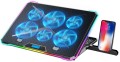 | 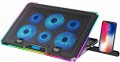 |
|---|---|---|
| Ice Coorel K15 | GamePro CP940 | |
| Outdated Product | Outdated Product | |
| TOP sellers | ||
| Product type | stand | stand |
| Max. screen size | 17.3 " | 17 " |
Features | ||
| Active cooling |  | |
| Fans | 3x100 mm, 3x70 mm | 3x100 mm, 3x70 mm |
| Max. RPM | 2400 rpm | 2400 rpm |
| Noise level | 23 dB | |
| Functions & Features | tilt adjustment fan speed control laptop stopper smartphone holder screen | tilt adjustment fan speed control laptop stopper smartphone holder screen |
| Backlight | RGB | RGB |
Connection | ||
| Connecting to a laptop | USB-A 5Gbps | USB-A 2.0 |
| Peripheral сonnection | 1xUSB-A 5Gbps | 1xUSB-A 2.0 |
General | ||
| Power source | uSB powered | uSB powered |
| Stand material | metal / plastic | metal / plastic |
| Table top/platform size | 420x300x28 mm | 420x300x28 mm |
| Weight | 1.2 kg | 1.1 kg |
| Color | ||
| Added to E-Catalog | september 2024 | march 2024 |


Compare Ice Coorel K15 and GamePro CP940
You may be interested in
My comparisons
Ice Coorel K15 often compared

GamePro CP940 often compared


Glossary
Max. screen size
The largest laptop screen size that the stand is guaranteed to be compatible with. For comparison: the smallest netbooks have a diagonal of 10 – 12 ", ultrabooks are somewhat larger — up to 14" ; among classic laptops, 13" corresponds to the most compact models, 15 — 16" — medium format, 17" — large, and 18.4" is actually the "ceiling" for modern laptops.
Usually, the maximum diagonal indicated in the characteristics corresponds to the size for which the stand was originally designed. However the vast majority of models are able to work with smaller laptops, but this point should be clarified separately. In addition, you should not buy a device that differs markedly in maximum diagonal from your laptop — for example, an 18" stand is unlikely to be convenient for a 12" netbook.
Usually, the maximum diagonal indicated in the characteristics corresponds to the size for which the stand was originally designed. However the vast majority of models are able to work with smaller laptops, but this point should be clarified separately. In addition, you should not buy a device that differs markedly in maximum diagonal from your laptop — for example, an 18" stand is unlikely to be convenient for a 12" netbook.
Noise level
The maximum noise level produced by the stand during operation. This parameter is relevant only for models equipped with active cooling (see above) — in fact, this function is the only source of noise.
The lower this indicator, the more comfortable the use of the stand will be and the better it will be suitable for situations in which silence is important (for example, for working late at night when others are sleeping). At the same time, even in the loudest models, it usually does not exceed 40 dB — this is comparable to the noise of leaves on a tree in a light breeze; and cooling systems in many laptops can make more noise. Therefore, paying close attention to quiet laptop stands is only worth it if you are using an extremely quiet laptop and do not want to lose this advantage.
The lower this indicator, the more comfortable the use of the stand will be and the better it will be suitable for situations in which silence is important (for example, for working late at night when others are sleeping). At the same time, even in the loudest models, it usually does not exceed 40 dB — this is comparable to the noise of leaves on a tree in a light breeze; and cooling systems in many laptops can make more noise. Therefore, paying close attention to quiet laptop stands is only worth it if you are using an extremely quiet laptop and do not want to lose this advantage.
Connecting to a laptop
Connecting to a laptop primarily implies the presence of a USB hub stand — a set of additional USB ports. This feature can be particularly relevant given that USB is the most popular modern standard for connecting peripheral devices, and even one port dedicated to powering the stand can significantly limit a laptop's capability. A hub (splitter) helps rectify the situation. Accordingly, stands may come with a varying number of USB ports and different form factors of connectors.
— USB-A. The classic, widely accepted USB port, which has recently been losing ground to the more advanced USB-C port.
— USB-C. This connector differs from the classic, full-sized USB by its much smaller size and a reversible design that allows the plug to be inserted in either direction.
— USB-A. The classic, widely accepted USB port, which has recently been losing ground to the more advanced USB-C port.
— USB-C. This connector differs from the classic, full-sized USB by its much smaller size and a reversible design that allows the plug to be inserted in either direction.
Peripheral сonnection
Peripheral connection shows which additional devices can be connected to the laptop stand if it functions as a USB hub or docking station. Usually, this includes a mouse, keyboard, flash drive, external SSD, card reader, webcam, headphones, or other accessories through USB-A and USB-C ports. It is important to consider not only the number of connectors but also their standard: USB 2.0 is suitable for simple peripherals, while ports with speeds of 5Gbps, 10Gbps are better for external drives.
Weight
The total weight of the stand. You should pay attention to this parameter first of all if you plan to constantly carry the stand with you, along with a laptop — here light weight can be a noticeable advantage. But if you are looking for an option purely for home use, there is most often no need to pursue low weight: other things being equal, it can be a sign of a small thickness of materials and, as a result, relatively low reliability. In addition, a more massive stand is more stable, it is more difficult to budge or knock over by accidental touch.