
Comparison HECHT 1802 S vs HECHT 1803 S
Add to comparison | 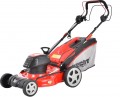 | 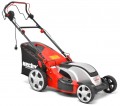 |
|---|---|---|
| HECHT 1802 S | HECHT 1803 S | |
| Outdated Product | from $269.00 | |
| TOP sellers | ||
| Type | lawn mower | lawn mower |
| Motor type | electric (mains) | electric (mains) |
Mowing | ||
| Cutting width | 46 cm | 46 cm |
| Cutting system | rotary | rotary |
| Min. cutting height | 25 mm | 30 mm |
| Max. cutting height | 75 mm | 75 mm |
| Number of height settings | 7 | 7 |
| Cutting height adjustment | synchronous | synchronous |
| Recommended area | 1000 m² | 1200 m² |
Cleaning | ||
| Mulching |  | |
| Grass ejection | side ejection rear ejection in a bag | side ejection rear ejection in a bag |
| Bag type | combined | combined |
| Bag volume | 50 L | 60 L |
| Full bag indicator | | |
Design | ||
| Features | self-propelled | self-propelled |
| Wheel drive | rear | rear |
In box | ||
| Nozzles | 2-tooth blade | 2-tooth blade |
Motor | ||
| Motor power | 1800 W | 1800 W |
| Brushless motor | |  |
General | ||
| Deck material | steel | steel |
| Front wheel diameter | 17.8 cm | 20.3 cm |
| Rear wheel diameter | 25.4 cm | 28 cm |
| Weight | 27 kg | 26.4 kg |
| Added to E-Catalog | april 2024 | june 2016 |


Compare HECHT 1802 S and 1803 S
Lawnmowers HECHT 1802 S and HECHT 1803 S have similar features, but there are important differences. Both devices are equipped with a 1800 W electric motor and a rotary mowing system with a cutting width of 46 cm. However, HECHT 1802 S offers a minimum cutting height of 25 mm, whereas HECHT 1803 S has a setting of 30 mm. Additionally, HECHT 1803 S has a larger grass bag capacity — 60 L compared to 50 L for HECHT 1802 S. Regarding wheels, the front wheels of 1803 S are larger (20.3 cm versus 17.8 cm), which may improve maneuverability. Both devices are self-propelled and have 7 height adjustment settings. Users note that HECHT 1803 S is better suited for larger areas due to the larger area it can cover (1200 m² compared to 1000 m² for 1802 S).
You may be interested in
My comparisons
HECHT 1803 S often compared


Glossary
Min. cutting height
The minimum cutting height provided by the lawnmower — that is, the smallest height of grass that can remain after the passage of the machine. It makes sense to pay attention to this indicator mainly in cases where the lawn is planned to be cut as short as possible. In addition, the lower the minimum height (with the same maximum), the wider the height adjustment range of this model.
Recommended area
The area of the site for which the lawn mower is designed. It cannot be argued that this parameter is critical when choosing a device, these are only manufacturer's recommendations and are very conditional. However, they are more than justified and generally show the available front of work based on the heating of the motor, the capacity of the tank or battery, and other factors that affect the duration of work.
Bag volume
The volume of the grass clipping bag supplied with the lawn mower. Manufacturers select this volume depending on the power, performance and overall level of the unit, however, similar models may differ in this indicator. In such cases, it is worth considering that a larger bag takes longer to fill and needs to be unloaded less often, but it weighs more and takes up more space (even when empty). Mostly the difference in the volume of the bag is 5 liters and there are lawn mowers for 35, 40, 45, 50, 55, 60, 65, 70 and more liters.
Brushless motor
The presence of a brushless (brushless) motor in the device. Such electric motors have a number of advantages over traditional collector motors: in particular, they are more economical in terms of energy consumption, less noisy, and also do not spark. The disadvantages of brushless motors are complexity and high cost.
Front wheel diameter
The diameter of the front wheels of the unit. For more information about this parameter, see "Rear wheel diameter" — everything written there is true in this case. We only note that the front wheels relatively rarely have their own drive, so the diameter for them is not as important as for the rear ones.
Rear wheel diameter
The diameter of the rear wheels of the unit.
Larger wheels, on the one hand, increase cross-country ability and allow you to effectively overcome pits, bumps and other obstacles on rough terrain. On the other hand, they cost more, are more expensive, and in self-propelled models, they also require more traction from the engine.
This indicator is often determined by the type of lawn mower (see above). So, mowers and riders, by definition, have large wheels, because they are designed for difficult terrain, and in a minitractor, the wheels must also withstand a fairly significant weight. But robotic lawn mowers, on the contrary, are used mainly on flat surfaces with low grass, and they do not need large wheels.
If you have to choose among classic lawn mowers, where this parameter can be different, you should proceed from the planned working conditions. So, if we are talking about a flat lawn — you can not pay much attention to this indicator; but for rough terrain with pits, tubercles, ditches, etc., you should choose larger wheels — from 25 cm or more.
Larger wheels, on the one hand, increase cross-country ability and allow you to effectively overcome pits, bumps and other obstacles on rough terrain. On the other hand, they cost more, are more expensive, and in self-propelled models, they also require more traction from the engine.
This indicator is often determined by the type of lawn mower (see above). So, mowers and riders, by definition, have large wheels, because they are designed for difficult terrain, and in a minitractor, the wheels must also withstand a fairly significant weight. But robotic lawn mowers, on the contrary, are used mainly on flat surfaces with low grass, and they do not need large wheels.
If you have to choose among classic lawn mowers, where this parameter can be different, you should proceed from the planned working conditions. So, if we are talking about a flat lawn — you can not pay much attention to this indicator; but for rough terrain with pits, tubercles, ditches, etc., you should choose larger wheels — from 25 cm or more.