
Comparison Husqvarna LC347V vs Husqvarna LC247S
Add to comparison | 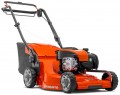 |  |
|---|---|---|
| Husqvarna LC347V | Husqvarna LC247S | |
| Outdated Product | from $418.96 up to $479.96 | |
| TOP sellers | ||
| Type | lawn mower | lawn mower |
| Motor type | petrol | petrol |
Mowing | ||
| Cutting width | 47 cm | 47 cm |
| Cutting system | rotary | rotary |
| Min. cutting height | 20 mm | 20 mm |
| Max. cutting height | 75 mm | 75 mm |
| Number of height settings | 6 | 6 |
| Cutting height adjustment | synchronous | synchronous |
Cleaning | ||
| Grass ejection | rear ejection in a bag | rear ejection in a bag |
| Bag type | soft | soft |
| Bag volume | 55 L | 55 L |
Design | ||
| Features | self-propelled handle height adjustment | self-propelled handle height adjustment |
| Wheel drive | rear | rear |
| Speed adjustment |  |  |
In box | ||
| Nozzles | 2-tooth blade | 2-tooth blade |
Motor | ||
| ICE type | 4-stroke | 4-stroke |
| Motor model | Briggs & Stratton 650EXI | Briggs & Stratton 450 series |
| Engine size | 163 cm³ | 125 cm³ |
| Motor power | 3.3 hp | 2.4 hp |
| Motor power | 2400 W | 1800 W |
| Fuel tank volume | 1 L | 0.8 L |
General | ||
| Deck material | steel | steel |
| Front wheel diameter | 17 cm | 17 cm |
| Rear wheel diameter | 18 cm | 21 cm |
| Noise level | 84 dB | 85 dB |
| Weight | 30 kg | 29 kg |
| Added to E-Catalog | march 2018 | march 2017 |


Compare Husqvarna LC347V and LC247S
Lawn mowers Husqvarna LC347V and LC247S have similar features, such as a cutting width (47 cm), a rotary cutting system, and the ability to adjust cutting height in 6 positions. However, the LC347V stands out with a more powerful Briggs & Stratton 650EXI engine (2400 W) and a larger fuel tank capacity (1 L), providing longer operation without refueling. Meanwhile, the LC247S is equipped with a Briggs & Stratton 450 series engine (1800 W) and a smaller tank (0.8 L). It is also worth noting that the LC347V has speed adjustment, whereas the LC247S does not offer this feature. Both devices have a similar grass bag capacity (55 L).
You may be interested in
My comparisons
Glossary
Speed adjustment
The ability to change the speed of the self-propelled unit (see "Features"). In the absence of this function, you need to pay special attention to the maximum speed, since "non-adjustable" lawnmowers have, in fact, two modes — parking and full speed. But if there is an adjustment, you can adjust the speed of movement to the specifics of the situation. For example, slow motion will be the best mode for dense, long-term uncut grass (or if the operator for some reason cannot follow the mower quickly); and high speed will allow you to quickly cope with a large volume of relatively simple work.
Motor model
Model of the engine installed in the lawn mower. The main performance data of the engine is usually indicated in the general data for the unit. However, knowing the exact name of the motor, you can find more detailed information on it — from specific data to reviews and reviews. Also, data on the engine model can be useful when searching for spare parts or consumables.
Engine size
The size of the engine installed in the petrol or diesel model (see "Engine type"). Power directly depends on this indicator, however, only engines of the same type can be compared by volume (see "Type of internal combustion engine"). And even in the same type of units of the same power, the volume can be different. In such cases, note that a larger volume means more fuel consumption, but the engine itself may cost less than a smaller one.
Motor power
Lawnmower engine power expressed in horsepower. The common unit of power these days is the watt, but gasoline and diesel engines (see "Engine Type") are traditionally referred to as hp. Some units are easy to convert to others: 1 hp. approximately equal to 735 watts.
In general, the more powerful the engine, the more performant the mower is and the better it handles with heavy work such as cutting thick grass, bushes, etc. On the other hand, high power has a corresponding effect on fuel consumption, as well as the weight and price of the engine. In addition, it should be taken into account that different types of mowers (see "Type") differ in terms of power requirements. For example, among trimmers there are many models with a capacity of 0.7 – 1.3 hp., for gasoline lawn mowers, the minimum power is already in the range of 1.3 – 2 hp., and for mowers, at least 2.5 hp is required. . So you can only compare units of the same type in terms of power. Detailed recommendations for choosing a mower depending on its type and features of the planned work can be found in special sources.
In general, the more powerful the engine, the more performant the mower is and the better it handles with heavy work such as cutting thick grass, bushes, etc. On the other hand, high power has a corresponding effect on fuel consumption, as well as the weight and price of the engine. In addition, it should be taken into account that different types of mowers (see "Type") differ in terms of power requirements. For example, among trimmers there are many models with a capacity of 0.7 – 1.3 hp., for gasoline lawn mowers, the minimum power is already in the range of 1.3 – 2 hp., and for mowers, at least 2.5 hp is required. . So you can only compare units of the same type in terms of power. Detailed recommendations for choosing a mower depending on its type and features of the planned work can be found in special sources.
Motor power
Lawnmower engine power expressed in watts. This designation is used absolutely for all electric models (see "Engine type"), and it is also often found in gasoline and diesel units along with horsepower (these units are clearly related, 1 hp is about 735 watts).
In general, the more powerful the engine, the more performant the mower and the better it will cope with heavy work such as cutting thick grass, bushes, etc. On the other hand, high power has a corresponding effect on fuel / electricity consumption, as well as the weight and price of the engine. In addition, note that the power requirements depend on the type of mower itself and its engine (see above for both). For example, for most robots, the power does not exceed 500 W — more, taking into account specialization, is not required, besides, otherwise the devices would turn out to be too bulky and heavy. Trimmers and lawn mowers of similar power are only electric, and the power limit for power tools is 2500 – 3000 W when powered from the mains and 1500 – 2000 W for battery models. But in gasoline tools, the minimum power is about 500 – 1000 W for trimmers and 1000 – 1500 W for mowers; the maximum value can exceed 4 kW.
Detailed recommendations for choosing a lawn mower d...epending on its type and features of the planned work can be found in special sources.
In general, the more powerful the engine, the more performant the mower and the better it will cope with heavy work such as cutting thick grass, bushes, etc. On the other hand, high power has a corresponding effect on fuel / electricity consumption, as well as the weight and price of the engine. In addition, note that the power requirements depend on the type of mower itself and its engine (see above for both). For example, for most robots, the power does not exceed 500 W — more, taking into account specialization, is not required, besides, otherwise the devices would turn out to be too bulky and heavy. Trimmers and lawn mowers of similar power are only electric, and the power limit for power tools is 2500 – 3000 W when powered from the mains and 1500 – 2000 W for battery models. But in gasoline tools, the minimum power is about 500 – 1000 W for trimmers and 1000 – 1500 W for mowers; the maximum value can exceed 4 kW.
Detailed recommendations for choosing a lawn mower d...epending on its type and features of the planned work can be found in special sources.
Fuel tank volume
The volume of the fuel tank in a gasoline or diesel mower (see "Engine type").
A large tank allows you to work longer without refueling, but an excessive increase in capacity affects the dimensions and weight of the entire unit. So manufacturers usually select this indicator taking into account the power and fuel consumption of a particular engine, and in general, the volume of the tank is not critical when choosing. However, knowing the tank capacity and fuel consumption (see above), you can estimate how much one refueling will approximately last.
A large tank allows you to work longer without refueling, but an excessive increase in capacity affects the dimensions and weight of the entire unit. So manufacturers usually select this indicator taking into account the power and fuel consumption of a particular engine, and in general, the volume of the tank is not critical when choosing. However, knowing the tank capacity and fuel consumption (see above), you can estimate how much one refueling will approximately last.
Rear wheel diameter
The diameter of the rear wheels of the unit.
Larger wheels, on the one hand, increase cross-country ability and allow you to effectively overcome pits, bumps and other obstacles on rough terrain. On the other hand, they cost more, are more expensive, and in self-propelled models, they also require more traction from the engine.
This indicator is often determined by the type of lawn mower (see above). So, mowers and riders, by definition, have large wheels, because they are designed for difficult terrain, and in a minitractor, the wheels must also withstand a fairly significant weight. But robotic lawn mowers, on the contrary, are used mainly on flat surfaces with low grass, and they do not need large wheels.
If you have to choose among classic lawn mowers, where this parameter can be different, you should proceed from the planned working conditions. So, if we are talking about a flat lawn — you can not pay much attention to this indicator; but for rough terrain with pits, tubercles, ditches, etc., you should choose larger wheels — from 25 cm or more.
Larger wheels, on the one hand, increase cross-country ability and allow you to effectively overcome pits, bumps and other obstacles on rough terrain. On the other hand, they cost more, are more expensive, and in self-propelled models, they also require more traction from the engine.
This indicator is often determined by the type of lawn mower (see above). So, mowers and riders, by definition, have large wheels, because they are designed for difficult terrain, and in a minitractor, the wheels must also withstand a fairly significant weight. But robotic lawn mowers, on the contrary, are used mainly on flat surfaces with low grass, and they do not need large wheels.
If you have to choose among classic lawn mowers, where this parameter can be different, you should proceed from the planned working conditions. So, if we are talking about a flat lawn — you can not pay much attention to this indicator; but for rough terrain with pits, tubercles, ditches, etc., you should choose larger wheels — from 25 cm or more.
Noise level
The level of noise produced by the device during operation. Usually, a certain average indicator is indicated in the characteristics — in the standard mode of operation; however, the actual values usually do not differ much from the claimed ones.
The lower the noise level, the more convenient the unit to use and the less tired the operator. In the case of lawn mowers, this is especially true, since such equipment is quite noisy — even the quietest models (some robots) give out about 47 – 48 dB, which is comparable to talking at an average volume. Note that the decibel is a non-linear quantity, and it is easiest to evaluate the actual loudness using comparative tables. Here is the simplest table for the values found in modern lawn mowers:
— 60 – 65 dB — talking in raised tones at a distance of about 1 m;
70 dB — loud conversation of several people at the same distance;
75 dB — loud laughter at a distance of 1 m;
80 dB — motorcycle engine, medium power vacuum cleaner.
90 dB — loud screams, freight car at a distance of 7 – 10 m;
100 dB — a subway train or a loud car signal at a distance of 5 – 7 m, an industrial workshop;
110 dB — tractor engine at a distance of about 1 m.
In addition to subjective sensations, there are specific sanitary standards that limit the impact of strong noise. So, according to European standards, noise of 85 dB is allowed to be heard without protective equipment for 8 hours, 91 dB — 2 hours, 97...dB — half an hour, and 103 dB — only 7 minutes. So when choosing a unit, you should take into account the duration of work with it — with high noise, you may need protective headphones.
The lower the noise level, the more convenient the unit to use and the less tired the operator. In the case of lawn mowers, this is especially true, since such equipment is quite noisy — even the quietest models (some robots) give out about 47 – 48 dB, which is comparable to talking at an average volume. Note that the decibel is a non-linear quantity, and it is easiest to evaluate the actual loudness using comparative tables. Here is the simplest table for the values found in modern lawn mowers:
— 60 – 65 dB — talking in raised tones at a distance of about 1 m;
70 dB — loud conversation of several people at the same distance;
75 dB — loud laughter at a distance of 1 m;
80 dB — motorcycle engine, medium power vacuum cleaner.
90 dB — loud screams, freight car at a distance of 7 – 10 m;
100 dB — a subway train or a loud car signal at a distance of 5 – 7 m, an industrial workshop;
110 dB — tractor engine at a distance of about 1 m.
In addition to subjective sensations, there are specific sanitary standards that limit the impact of strong noise. So, according to European standards, noise of 85 dB is allowed to be heard without protective equipment for 8 hours, 91 dB — 2 hours, 97...dB — half an hour, and 103 dB — only 7 minutes. So when choosing a unit, you should take into account the duration of work with it — with high noise, you may need protective headphones.